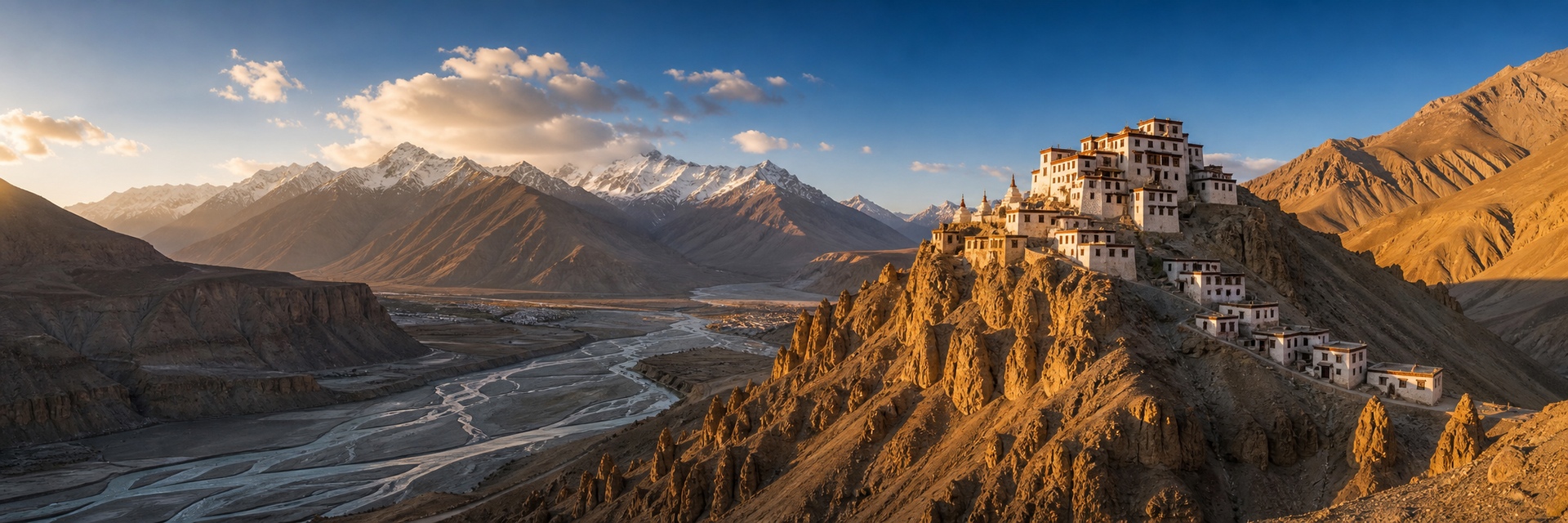
Destination - Himachal - High-desert Himalaya
Setting Up a Luxury Resort in Spiti Valley
Spiti has almost no luxury supply, but Section 118 land limits, border permits and a four-to-five-month road season make it a true frontier business.
Kaza, Key Monastery, Chandratal, Komic, Hikkim and Tabo give Spiti a raw high-desert identity that appeals to expedition travellers, monastery seekers, astro-tourists and adventure guests. But the valley is still largely a homestay economy, reached through Manali-Atal Tunnel-Kunzum La or the Shimla-Kinnaur route, with winter road closures and extreme altitude. We help owners decide whether a legal, off-grid, locally staffed luxury product can exist before frontier romance becomes capital risk.
Section 118
Himachal land restrictions control entry
Jun-Oct
A short road window carries the business
Off-grid
Power, water, heat and waste need self-sufficiency
Dark-sky
Astro-tourism and silence are the premium edge
At a glance
Best-fit micro-markets
Kaza access, Key Monastery views, Tabo side, Komic/Hikkim circuits and carefully selected lower-risk high-desert sites with legal land structure.
Operating season
Road access is usually concentrated around June-October; winter cuts movement and makes full operations difficult.
Positioning
Expedition luxury, monastery and high-desert travel, astro-tourism, passive-solar design, local food and ultra-low-impact stays.
Critical approval
Himachal Section 118 compliance, local land structure, Inner Line Permit protocols near border zones, forest/eco checks and local sanction.
Access
Manali via Atal Tunnel and Kunzum La, or Shimla-Kinnaur-Tabo-Kaza; both routes are seasonal and weather-sensitive.
Build watch-out
Altitude, seismic risk, cold-desert fragility, water, waste, short build season, off-grid systems and seasonal local hiring.
A luxury frontier on homestay ground
Spiti is still raw in the way luxury travellers increasingly seek: high desert, monasteries, big skies, thin air, small villages and long roads. The valley's current hospitality base is largely homestays and simple guesthouses, which creates a genuine whitespace for carefully designed premium stays.
That does not make it easy. The same remoteness that creates the opportunity also limits construction, staffing, medical support, utilities and revenue season. A Spiti resort should be sized like a frontier lodge, not imagined as a normal mountain hotel transplanted to Kaza.
In Spiti, luxury is not abundance. It is warmth, safety, silence, oxygen-aware service and the confidence that the off-grid systems work.
Dark skies, monasteries and expedition demand
The guest comes for Key Monastery, Tabo, Chandratal, Komic, Hikkim, fossil landscapes, high villages, biking, overlanding and skies dark enough for serious astro-tourism. This is expedition and monastic demand, not casual hill-station leisure.
The product should therefore be itinerary-led. Guests need acclimatisation, packed meals, oxygen awareness, road-status communication, guides, warm rooms, astronomy, local food and recovery after long drives. A premium Spiti stay is a basecamp with standards.
- Astro-tourism and dark skies as a genuine premium hook
- Key, Tabo, Komic, Hikkim and Chandratal as itinerary anchors
- Adventure, overlanding and monastery travel as the demand base
- High-altitude safety and road planning as service fundamentals
Section 118 and a four-month road window
Himachal's Section 118 land restrictions mean non-agriculturists and outside entities cannot freely buy land. Any resort structure must be legally tested through local ownership, permissions, lease or approved entity routes before capital is committed. In Spiti, a weak land structure is amplified by remoteness and seasonality.
Road access is the other hard gate. The Manali route through Atal Tunnel and Kunzum La and the Shimla-Kinnaur route each carry weather, landslide, altitude and border sensitivities. The business effectively trades in a short summer-autumn window, so construction and operations must be planned around the same calendar.
| Gate | What it controls |
|---|---|
| Section 118 land route | Whether the owner can legally secure and develop the site |
| Road season | Revenue window, construction timing and emergency access |
| Permit sensitivity | Guest movement near Kinnaur/Spiti border areas |
| Off-grid utilities | Heat, water, power, sewage and winter shutdown safety |
Spiti feasibility gates before design.
Permits, cold-desert ecology and Himachal approvals
The approvals path can include Section 118 permissions or compliant land structure, local building sanction, forest and tree permissions where relevant, Inner Line Permit protocols for border-sensitive routes, environmental and cold-desert ecology checks, fire and safety, tourism registration, pollution-control consent, water and waste permissions.
Because Spiti is fragile, low-impact is not a style preference. Sewage, waste, water extraction, vehicle movement, dark-sky lighting, village impact and winter shutdown must all be designed so the resort does not burden the valley that makes it valuable.
Spitian architecture for silence and cold
The design should learn from Spiti: mud-brick and stone, thick walls, compact forms, passive solar, south-facing warmth, small openings, flat roofs where appropriate, monastery-influenced restraint and wind protection. Imported glass-heavy luxury will be cold, thirsty and wrong.
Experience design should be equally spare: tea, fire, astronomy, monastery routes, local food, high-village visits, geology, guided silence and recovery from altitude. The property should feel like it belongs to Kaza's high desert, not like it landed from a city.
Off-grid build and seasonal local teams
Construction is constrained by a short window, altitude, road closures, material lead time, cold nights and limited local contractor depth. Power, solar, batteries, heating, water storage, sewage treatment, kitchens, medical backup and staff housing must be commissioned before opening because there is no easy fallback.
Hiring should prioritise local Spitian staff and seasonal specialists who can handle altitude and isolation. Leadership may come from Himachal or wider resort markets, but the service culture must be trained around expedition logistics, road disruption, dark-sky discipline and winter shutdown.
Gladwin's edge in Spiti Valley
We test Spiti through the hard gates first: Section 118, land structure, road season, permits, altitude, water, off-grid utilities, village relationship and whether the P&L works in a short window. Only then do we shape the lodge.
From there we manage approvals, passive-solar design, procurement, off-grid systems, local hiring, altitude protocols and launch as one accountable partner. The result is a business built for Spiti's constraints, not a resort fantasy placed on a fragile valley.
Planning a resort in Spiti Valley?
We take single accountability from raw land to a stabilised opening — siting and approvals, market and pricing, design, procurement, and the full team — from General Manager to line level — recruited through our executive search practice and trained for opening.
Speak with a partnerSetting up a resort in Spiti Valley — FAQs
Not freely. Himachal's Section 118 restricts land acquisition by non-agriculturists and outside entities, so any resort requires a compliant land route, local structure or permissions before investment.
The practical road-access season is usually around June to October, depending on Kunzum La, Manali and Kinnaur routes. Winter cuts access and makes full operations difficult.
They can, especially around Kinnaur/Spiti and border-sensitive routes. Permit handling should be built into guest itineraries and operations rather than handled casually.
Expedition luxury, monastery travel, dark-sky astro-tourism and high-desert silence are the strongest. A conventional hill resort would feel misplaced and operationally heavy.
Off-grid reliability in a short season: heat, water, power, sewage, staff housing, medical support and material logistics must all work because there is little backup.
Local Spitian staff are important for legitimacy and altitude readiness, supported by seasonal specialists and leadership from Himachal or wider resort markets. Training must cover road disruption, safety and winter shutdown.
Explore the cluster
Luxury resorts across India’s destinations
North - Trans-Himalayan Ladakh
Ladakh
Ladakh sells vastness, but water scarcity and a five-month operating window make restraint the core luxury discipline.
North · Himalayan hill stations
Shimla, Manali & Himachal
The Himalayas' most reachable luxury market — and the one hardest to buy into. In Himachal the project is won or lost on land permission long before it is a question of slate roofs and mountain views.
North - Char Dham high-Himalaya
Kedarnath & the Char Dham
The Char Dham has record yatra demand, but the temples close for winter; the entire business has to earn inside a short, fragile high-Himalaya window.
Also explore our executive search practice for the General Manager and leadership team, and the wider end-to-end hospitality practice — hotels, residences, clubs and heritage properties.