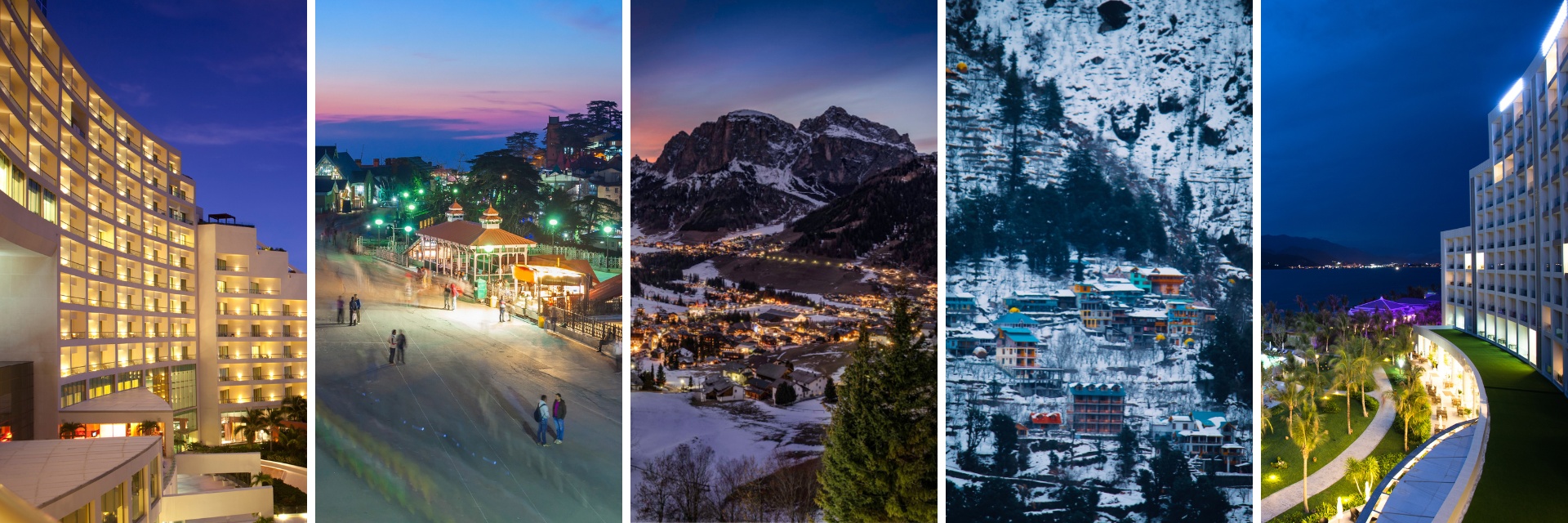
Destination · North India · Himalayan hill stations
Setting Up a Luxury Resort in Himachal
The Himalayas' most reachable luxury market — and the one hardest to buy into. In Himachal the project is won or lost on land permission long before it is a question of slate roofs and mountain views.
Himachal is where north India goes to cool down, honeymoon and see snow, and it sits a comfortable drive from the country's densest pool of high spenders. It is also a state that, by law, does not let most outside investors simply buy the land they want. We run a Himachal resort as one accountable programme — clearing the Section 118 permission and the planning caps before capital moves, then taking you from a slope with a view to a fully staffed property that trades hard across both the summer and the snow.
Section 118
The permission gate cleared before you commit
Two seasons
Summer escape and winter snow, priced apart
Zone IV/V
Seismic engineering built in, not bolted on
Turnkey
Slope to a stabilised first year
At a glance
Best-fit micro-markets
Shimla belt: Mashobra, Naldehra, Chail, Kasauli, Narkanda. Kullu valley: Manali, Naggar, Katrain, Solang. Also Kufri and the Tirthan/Sainj side.
Peak seasons
April–June summer escape and wedding season; December–February snow tourism. Monsoon July–September is the landslide-and-low-occupancy trough.
Core demand
The Delhi–NCR, Chandigarh, Haryana and Punjab drive market — families, honeymooners, corporate offsites and destination weddings.
Defining land constraint
Section 118 of the HP Tenancy & Land Reforms Act — non-agriculturists cannot buy agricultural land without state government permission.
Critical clearances
Section 118 permission, HP Town & Country Planning approval with height/FAR caps, forest and tree-felling NOC, plus seismic and slope-stability sign-off.
Access
By road from Chandigarh (approx. 3.5 hrs to Shimla, 8 hrs to Manali); Shimla and Bhuntar (Kullu) airports are small and weather-dependent; Chandigarh is the reliable gateway.
The opportunity
Himachal is the hill-station market with the shortest tether to real money. Wildflower Hall at Mashobra carried the Oberoi flag for two decades on the strength of the old Cecil and Viceregal legacy; the Kullu–Manali valley absorbs enormous volume every summer and every snowfall; Chail, Kasauli, Naldehra and Narkanda each hold a loyal, repeat-heavy audience. What almost none of it is, at scale, is genuinely luxury. The demand is proven and the drive-market is huge — the supply that meets it at the top end is thin and ageing.
That is the gap. Not another mid-market Mall Road property or a volume block in Manali, but a small, view-led, design-literate resort — 30 to 70 keys — that turns Himachal's colossal footfall into premium ADR rather than season-dependent volume. The barrier that keeps this gap open is not demand or design. It is that the land is genuinely hard for an outside investor to acquire, and the sites that are both buildable and beautiful are scarce. Clearing that barrier cleanly is the whole game.
In Himachal the trophy site is worthless until Section 118 permission and the planning caps are resolved. We treat land permission as the first deliverable of the project, not a formality discovered after the deal.
The guest & the two seasons
Himachal runs on a drive market, and that shapes everything. The dependable core is the road audience out of Delhi–NCR, Chandigarh, Haryana and Punjab — a self-drive family, a honeymooning couple, a corporate offsite bussed up from Gurugram, a wedding party taking over a property for four days. They arrive by car through Chandigarh, they book on short lead times, and they are exquisitely weather-sensitive: a forecast of snow fills Manali overnight, a landslide on the ghat road empties it just as fast.
The business is really two businesses stacked on one asset. April to June is the summer escape — families fleeing the plains' heat, honeymooners, the wedding-and-offsite season, rates at their peak. December to February is snow tourism — a different, younger, shorter-stay guest chasing the first fall at Solang, Kufri and Narkanda. Between them sits the July–September monsoon: landslides, road closures and the occupancy trough the model must be built to survive. A Himachal resort that prices for one season and ignores the other, or that has no answer to the monsoon shoulder, is only half a business.
- Summer (Apr–Jun): families, honeymooners, weddings and offsites; peak rate
- Winter (Dec–Feb): snow tourism, younger and shorter-stay, strong festive spike
- Monsoon (Jul–Sep): the trough to plan around — landslides, closures, low occupancy
- Weddings and corporate offsites as a distinct, buy-out-led revenue line
- A drive market on short lead times and acutely sensitive to weather and road conditions
Land, Section 118 & the site reality
Himachal protects its land more fiercely than almost any state in India, and this is the fact that decides whether a project happens at all. Under Section 118 of the Himachal Pradesh Tenancy and Land Reforms Act, a non-agriculturist — which is what most outside individuals and companies are — cannot buy agricultural land in the state without the express permission of the state government. Permission is granted case by case, typically tied to a bona-fide project such as a hotel or tourism unit, and it comes with conditions and timelines. This is where the majority of outside resort plans in Himachal stall, and it is the first thing we resolve.
On top of the ownership question sits the physical one. Buildable hill land is a narrow resource: much of the attractive terrain is apple orchard or forest, felling of deodar and other trees is tightly restricted, and slopes are steep, geologically young and seismically live — most of the state sits in seismic Zone IV or V. The HP Town & Country Planning regime layers building-height limits and FAR caps across planning and special areas, and the National Green Tribunal takes an active interest in hill construction. A plot that photographs like a dream can be legally un-buyable, structurally punishing, or both. We resolve title, permission, slope and clearance together, before capital is committed.
| Question | What it decides |
|---|---|
| Section 118 permission | Whether an outside buyer can legally acquire the agricultural land at all |
| TCP planning area, height & FAR caps | How much and how tall you can build, and the storeys the slope will carry |
| Forest status & tree-felling NOC | Whether the deodar and orchard cover can be touched, and where the building can sit |
| Slope stability & seismic Zone IV/V | The foundation and retaining strategy, and the real cost of building safely on the gradient |
| Road access & landslide exposure | Whether the site is reachable in monsoon and winter, and how construction material even arrives |
The Himachal land test — a plot has to clear all of these before it is real. Specifics always depend on the individual site, its classification and current state notifications.
Approvals & licences — the Himachal stack
A Himachal resort carries a distinctive approvals stack, and its long pole is at the very front: nothing else matters until the land is legally acquirable. We build and govern the licensing roadmap end to end; the licensed filings themselves are lodged by your appointed architects, structural engineers and lawyers, and we sequence and drive them so the gating items are not discovered late.
- Section 118 permission from the state government for land purchase by a non-agriculturist
- HP Town & Country Planning approval — layout, height and FAR within the planning/special area
- Change of land use and NOCs where the plot is orchard, forest-adjacent or agricultural
- Forest clearance and tree-felling permission for any regulated species (deodar and others)
- Environmental clearance (SEIAA) where built-up area or the hill location crosses the threshold, plus HP State Pollution Control Board consents
- HP Tourism registration and hotel classification, fire NOC, FSSAI, excise (bar) licence, and PWD/IPH water and sewerage sanctions
What a Himachal resort must be
The mountain forgives nothing generic. What earns a premium here is a property that feels rooted in the hill it stands on — the colonial hill-station grammar the British left behind, married to Himachali vernacular: pitched slate roofs, deodar timber, local dressed stone, deep eaves for the snow load, and rooms oriented ruthlessly to the view because the view is the product. Interiors have to be warm — log fires, wood, wool, cosy winter volumes — not the airy pale palette that works on a beach. A Himachal resort is a cold-weather building first, and it should feel like one to walk into on a January evening.
The experience has to answer both seasons and the guest who drives up expecting more than a room. That means a serious spa and thermal offer for the honeymoon and wellness audience, food and beverage that does not surrender to the town's dhabas, a fireside bar, and guided access to what the mountains actually offer — Naldehra's golf, the orchards, the treks and the snow at Solang and Narkanda. The wedding and offsite buy-out has to be designed in, with an event realm that works when the weather turns and the party moves indoors. Get the sense of place and the two-season programme right and the property holds rate; get it generic and it competes on price with everything on the Mall Road.
Slate, deodar and stone are not decoration in Himachal — they are what the snow load, the seismic code and the guest's expectation of the mountains all demand at once.
Procurement & build realities
Building in the Himachal hills is governed by the calendar and the gradient. The workable construction window is short — the fair-weather months between the melting of winter snow and the arrival of the monsoon — with landslide season and heavy snow bracketing it. Material reaches most sites up narrow, switchbacking ghat roads that close without warning, so the schedule has to be built around a genuinely constrained delivery window rather than a plains-style continuous programme. Labour is seasonal and largely migrant, and it has to be housed at altitude through the build and the operation.
The engineering is unforgiving. Seismic Zone IV/V and young, slide-prone slopes make the foundation, retaining and structural design the real cost and risk of the project — not an afterthought. We run the full procurement programme — FF&E, OS&E, kitchens, spa and thermal plant, snow-and-cold-rated building systems, heating, technology and operating supplies — with vendor intelligence and a schedule mapped to the summer build window, the ghat-road logistics and commissioning. In Himachal specifically that means cold-climate specifications, honest lead times for material that has to be hauled uphill, staff-housing planned into the programme, and a build sequence that protects the target opening across a season when the site can be cut off.
Gladwin's edge in Himachal
We treat Himachal as the land-permission and engineering problem it actually is, and we front-load it. Before a rupee is committed we test the Section 118 route, the TCP height and FAR caps, the forest and felling position and the slope and seismic reality — and we choose the micro-market against the guest and the two-season model rather than the view a broker is selling. Only once the land is genuinely acquirable and buildable do we run the rest as one accountable programme: design in the slate-and-deodar idiom, the full procurement and build across a short mountain season, the leadership and operating team hired and trained, and a supported launch, as your single Owner's Representative from slope to opening.
The team we build for a Himachal property is made for the mountain and its calendar. A General Manager who can run a two-season, wedding-and-offsite-heavy operation and staff up and down with occupancy; a hiring plan that draws leadership from the Chandigarh and Delhi talent pools while housing seasonal crews at altitude; and pre-opening training that lands the standard before the first summer peak and holds it through the snow. We build the property to win both seasons and to survive the monsoon in between — because in Himachal that is what a resort has to do.
Planning a resort in Shimla, Manali & Himachal?
We take single accountability from raw land to a stabilised opening — siting and approvals, market and pricing, design, procurement, and the full team — from General Manager to line level — recruited through our executive search practice and trained for opening.
Speak with a partnerSetting up a resort in Shimla, Manali & Himachal — FAQs
Not freely. Under Section 118 of the HP Tenancy and Land Reforms Act, a non-agriculturist — which most outside individuals and companies are — cannot buy agricultural land in the state without the express permission of the state government, granted case by case and usually tied to a bona-fide project such as a hotel. This is the single biggest reason outside resort plans in Himachal stall. We test and pursue the permission route before any capital is committed, so the project is built on land you can genuinely acquire.
They serve different guests. The Shimla belt — Mashobra, Naldehra, Chail, Kasauli, Narkanda — is the quieter, colonial-legacy, repeat-and-wedding audience closer to Chandigarh. The Kullu–Manali valley is higher-volume, honeymoon- and snow-driven, younger and more seasonal, further up the road. We pick the micro-market that matches your investment thesis and the two-season model, then design and price to it.
The gradient and the calendar. Most of the state is in seismic Zone IV or V on young, slide-prone slopes, so the foundation, retaining and structural work is the real cost and risk — not a finish item. The construction window is a short fair-weather band between snow and monsoon, material arrives up narrow ghat roads that close without warning, and crews must be housed at altitude. We build the schedule and the specification around all of that from the outset.
By designing a two-season business, not a one-season one. We build the model to win the April–June summer escape and the December–February snow peak, price them apart, and plan a deliberate answer to the July–September monsoon trough — weddings, offsites, wellness and shoulder-season programming — rather than pretending the low months away. A resort here needs both seasons and a monsoon plan to be a real business.
It has to feel of the mountain. That means the colonial hill-station grammar married to Himachali vernacular — pitched slate roofs, deodar timber, local stone, deep eaves for snow, warm fireside interiors — with rooms oriented to the view, a serious spa and thermal offer, food and beverage that beats the town, and an event realm built for weddings when the weather turns indoors. Generic loses to the Mall Road on price; a genuine sense of place holds rate.
Yes — it is core to the engagement. Once the land is cleared we run design, procurement and the full build across the mountain season, then recruit and train the General Manager and complete operating team — drawing leadership from the Chandigarh and Delhi pools and housing seasonal crews at altitude — and support the launch so the standard is live before the first summer peak, not learned on paying guests.
Explore the cluster
Luxury resorts across India’s destinations
North · Himalayan foothills & Ganga
Rishikesh & Uttarakhand
The world knows Rishikesh for the Ganga and for yoga — but the town itself is dry, vegetarian and tightly built. The premium product lives in the hills above it, and getting there is a siting and licensing decision before it is a design one.
South · Western Ghats plantations
Coorg
The plantation-luxury market India actually created — inside one of the country's most protected landscapes. Coorg is an Eco-Sensitive Zone, land-conversion and slope problem long before it is a design one.
North-West · Rajasthan heritage city
Jaipur
The city that invented the Indian palace-hotel — and set the bar so high that anything ordinary reads as a discount. In Jaipur the hard question is craft, not concrete: can the property earn the word 'palace' honestly?
Also explore our executive search practice for the General Manager and leadership team, and the wider end-to-end hospitality practice — hotels, residences, clubs and heritage properties.