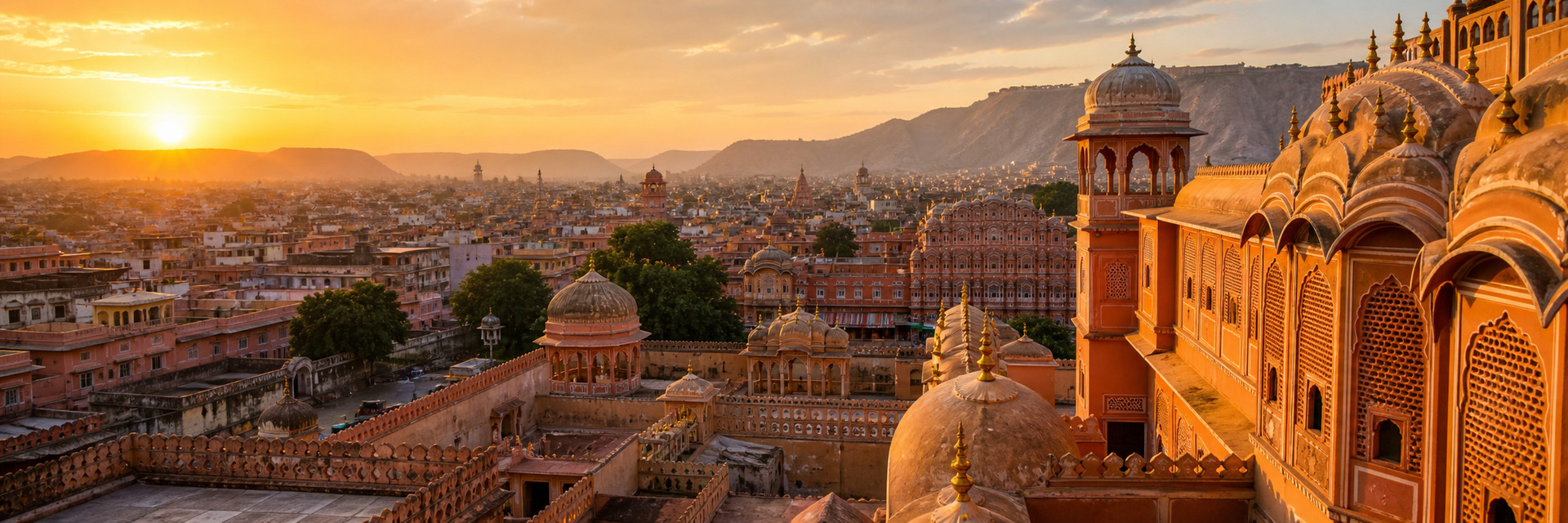
Destination · Rajasthan · Heritage city
Setting Up a Luxury Resort in Jaipur
The city that invented the Indian palace-hotel — and set the bar so high that anything ordinary reads as a discount. In Jaipur the hard question is craft, not concrete: can the property earn the word 'palace' honestly?
Jaipur is where luxury hospitality in India learned its grammar — Rambagh, Rajvilas, Rajmahal — and a guest arriving in the Pink City carries that expectation to the door. The walled city itself is a UNESCO World Heritage precinct where you cannot simply build; the resort-format land sits on the Kukas, Delhi-road and Amer belt beyond it. We run the whole journey as one accountable programme: reading a demand mix of Golden Triangle touring, a short Delhi drive, and the country's most valuable wedding calendar, then taking you from raw land through JDA approvals and a genuine craft build to a stabilised opening.
Palace-set bar
The market Rambagh and Rajvilas defined
Kukas / Amer
Where resort-format land actually sits
Oct–Mar
The peak the model is built to win
Turnkey
Raw land to a stabilised opening
At a glance
Best-fit micro-markets
Delhi-road / Kukas corridor, the Amer–Kunda foothills, Achrol and the Jamdoli–Agra-road approach — resort land beyond the walled city.
Peak season
October–March, with the November–February wedding and touring peak; April–June is hot and low, monsoon shoulder July–September.
Demand mix
Golden Triangle (Delhi–Agra–Jaipur) touring, a 4.5–5 hr Delhi drive market via NH48, destination weddings and MICE (JECC).
Critical approval
Jaipur Development Authority (JDA) land conversion and building-plan sanction; heritage bylaws bind any walled-city or Amer-precinct site.
Incentives
Rajasthan tourism unit / RIPS benefits — stamp-duty, SGST and conversion reliefs for qualifying hotel projects.
Access
Jaipur International Airport (JAI) plus the Delhi self-drive market on NH48; the city is the anchor of India's most-travelled tourist circuit.
The opportunity
Jaipur is the most decorated luxury city in Indian hospitality. Rambagh Palace set the template for the living-palace hotel; the Oberoi Rajvilas re-imagined it as a purpose-built low-rise estate of courtyards and tented villas; Sujan Rajmahal, ITC Rajputana, Fairmont and the Jai Mahal Palace each staked out a different reading of the same idiom. A guest who chooses Jaipur has usually chosen the promise of a palace — which means the destination carries a rate ceiling most Indian cities can only envy, and a standard that punishes anything half-committed.
The whitespace is not another banquet-led business hotel near the airport. It is the estate-format resort that Rajvilas proved and the market has never had enough of: 40 to 90 keys on the Kukas or Amer belt, low-rise and courtyard-planned, with the craft and the calm that let it command palace-tier ADR from touring couples, Delhi weekenders and the wedding client. That is a land, positioning and craft problem long before it is a construction one.
In Jaipur the trophy is rarely the walled-city address — that land is heritage-bound. The winning move is the right 60-key estate on the Amer or Kukas belt, built with real craft, priced to the palace expectation the city already carries.
The guest & the demand — three engines, one calendar
Jaipur runs on three demand engines that peak in the same window. The first is Golden Triangle touring: as the Rajasthan anchor of the Delhi–Agra–Jaipur circuit, the city takes a high volume of international and domestic leisure guests on two-to-three-night stops, and the premium property competes to convert that footfall into rate rather than volume. The second is the Delhi drive market — roughly four-and-a-half to five hours on NH48 — which turns weekends into a dependable, high-yield short-break base that most beach or hill destinations cannot match for reliability.
The third, and the one that reshapes the whole asset, is weddings and MICE. Jaipur is one of India's two or three most sought-after destination-wedding cities, and the Jaipur Exhibition & Convention Centre (JECC) underpins a serious conference and exhibition base. A wedding-capable resort here is not a hotel that occasionally hosts an event; it is designed around the event — arrival sequence, multiple ceremony lawns, a baraat route, back-of-house that can plate for a thousand — while still reading as a serene retreat between bookings. We model the domestic-metro leisure base and the Delhi drive as the dependable core, and treat the peak wedding and MICE calendar as the margin the asset is built to capture.
- Golden Triangle touring: two-to-three-night stops, convert footfall to ADR not volume
- Delhi drive market on NH48: dependable, high-yield weekend short breaks
- Destination weddings: the highest-yield line — design the asset around the event
- MICE via JECC: mid-week and shoulder-season base that flattens the calendar
Land, siting & the walled-city constraint
The first thing to understand about Jaipur land is where you cannot build. The walled Pink City is a UNESCO World Heritage precinct governed by heritage bylaws — façade, height, material and use are tightly controlled, and a resort-format development is effectively off the table inside it. Amer, in the shadow of the fort, carries its own heritage sensitivities. That is why the resort product sits beyond the wall: the Delhi-road and Kukas corridor to the north, the Amer–Kunda foothills, Achrol, and the Jamdoli approach on the Agra road, where estate-scale plots, JDA zoning and a genuine sense of arrival can all coexist.
Beyond siting away from the heritage core, the Jaipur land exercise is a title, zoning and conversion discipline. Agricultural land must be converted to commercial/institutional use, the plot must fall within a JDA zone that permits a hotel, and building-plan sanction follows. Peri-urban parcels can carry fragmented title, ancestral shares and unclear access; a plot that photographs as an Aravalli-view estate can lose its FAR to a green belt, a ridge restriction or a set-back before a single wall is drawn. We resolve the zoning, title and conversion path before capital is committed, not after.
| Consideration | What it decides |
|---|---|
| Distance from the UNESCO walled city / Amer precinct | Whether heritage bylaws bind height, façade, material and use at all |
| JDA zone & master-plan land use | Whether the plot can legally carry a hotel and at what FAR / ground coverage |
| Agricultural-to-commercial conversion | Whether the land is legally usable and the timeline to sanction |
| Aravalli ridge / green-belt / eco-sensitive overlay | Buildable envelope, height limits and the low-rise estate footprint |
| Arrival, road frontage & view corridor | Wedding baraat route, sense of place, and fort/hill sightlines |
Indicative siting logic for a Jaipur resort — always subject to the JDA zone, master-plan use and heritage classification for the specific plot.
Approvals, licences & the Rajasthan incentive layer
A Jaipur resort carries a sequenced approvals stack in which the JDA land conversion and building-plan sanction are the long poles, and the incentive layer is genuine upside that has to be captured deliberately rather than discovered late. We build the licensing roadmap and govern it to a commissioned, legally-clean asset; the licensed filings themselves are made by your appointed architects, structural consultants and lawyers, whom we coordinate. Where any part of the site touches the walled city or Amer, heritage-committee clearance is added to the path from the outset.
The Rajasthan incentive layer is worth engineering the structure around. The state's tourism-unit policy and the Rajasthan Investment Promotion Scheme (RIPS) offer stamp-duty relief, SGST reimbursement, land-conversion and electricity-duty benefits for qualifying hotel and tourism projects — real money that materially changes the return, but only if the project is structured and filed to qualify. We map eligibility at the modelling stage so the incentive is designed in, not bolted on.
- JDA land-use conversion (agricultural to commercial/institutional) and building-plan sanction
- Rajasthan tourism-unit registration and RIPS / tourism-policy incentive filings
- Heritage-committee clearance where any site element touches the walled city or Amer
- Environmental clearance (SEIAA) where built-up area crosses the threshold
- Ministry of Tourism hotel classification (HRACC) and Rajasthan Tourism registration
- Excise (liquor) licence, Fire NOC, FSSAI, RSPCB pollution consents, water and sewage connections
- RERA registration if any villa or residential/branded-residence component is sold
The single most common Jaipur mistake is treating RIPS and the tourism-unit benefits as an afterthought. Structured in at the modelling stage they can move the project's economics; discovered after conversion, they are often lost.
What a Jaipur resort must be
Jaipur is a city of craft, and craft is exactly what it will not forgive you for faking. The idiom is Rajput–Mughal handled with restraint: pink sandstone and dholpur stone, jaali screens that filter the desert light, courtyards and stepwell geometry, chhatris and jharokhas used because they work rather than as decoration. The living reference points — Rambagh and Rajvilas among them — succeed because the detail is real; a property that reaches for the same vocabulary with cast concrete and printed 'motifs' reads instantly as costume, and the Jaipur guest is unusually literate in the difference.
The place is also its own material library. Block-print (Sanganer and Bagru), blue pottery, hand-cut sandstone jaali, marble inlay, lac and brass work — these are living crafts a short drive away, and a resort that commissions them properly turns its own suites, screens, textiles and public realm into a sense of place that cannot be procured from a catalogue. Layer over that a serious food-and-beverage proposition — Rajasthani thali and Marwari kitchens done at destination standard, not a token dal-baati-churma station — and a wedding-capable public realm of lawns, arrival courts and a baraat sequence, and the property earns its rate honestly.
- Rajput–Mughal idiom in real stone and craft, not applied motifs
- Courtyards, jaali, jharokhas and stepwell geometry for the desert light and heat
- Commissioned local craft — block-print, blue pottery, sandstone jaali, marble inlay
- Wedding-first public realm: multiple lawns, arrival courts, baraat route, plating capacity
Procurement & build realities
Building in Jaipur is governed by heat and by craft supply. The workable construction and finishing calendar is shaped by the April-to-June summer, when temperatures make certain trades and pours difficult and the season effectively narrows the window for external stone and finishing work; the programme has to be planned around that heat rather than colliding with it. Water and dust management on a semi-arid Aravalli site are part of the critical path, not a detail.
Jaipur's advantage is its craft supply chain. Hand-cut sandstone and marble, stone carving, jaali fabrication, block-print textiles and blue pottery are all sourced within the region — but craft runs on artisan lead times, not factory ones, and the schedule has to respect that a jaali screen or an inlay floor is made, not ordered. We run the full procurement programme — FF&E, OS&E, kitchens, spa, pool plant, technology and operating supplies — with vendor intelligence that separates the genuine craft ateliers from the volume workshops, lead times mapped to the summer window and to commissioning, and a build sequence that protects the target opening ahead of the October–March peak.
| Factor | Programme implication |
|---|---|
| April–June heat | Sequence external stone, pours and finishing outside the hottest window |
| Craft / artisan lead times | Commission jaali, inlay and block-print early; treat as made-to-order, not stock |
| Semi-arid Aravalli site | Water, dust and drainage management on the critical path |
| Oct–Mar opening target | Commissioning and pre-opening backed off the wedding-season launch date |
How Jaipur's conditions shape the build programme.
Gladwin's edge in Jaipur
We treat Jaipur as the craft and positioning problem it actually is, held inside a real regulatory frame. Before a rupee is committed we resolve where the heritage bylaws do and do not bind, confirm the JDA zoning and conversion path, and engineer the RIPS and tourism-unit incentives into the structure rather than hoping to recover them later. Then we choose the micro-market — the Kukas corridor, the Amer foothills, the Agra-road approach — against the guest and the wedding calendar you actually want, and run the whole programme as one accountable partner and your Owner's Representative: design, the commissioned craft, procurement, the full leadership and operating team hired and trained, and a supported launch across the first peak.
The team we build for a Jaipur property is deliberately of the place. Rajasthan holds one of India's deepest hospitality talent pools — a palace-hotel tradition and a cluster of hotel schools that produce staff fluent in the service register the city expects — and we assemble a General Manager and head-of-department team who can run a wedding-and-MICE-heavy operation without losing the retreat's calm between events. Pre-opening training lands the standard before the first October–March season, so the palace expectation is met on day one rather than learned on paying guests.
Planning a resort in Jaipur?
We take single accountability from raw land to a stabilised opening — siting and approvals, market and pricing, design, procurement, and the full team — from General Manager to line level — recruited through our executive search practice and trained for opening.
Speak with a partnerSetting up a resort in Jaipur — FAQs
Effectively no. The walled city of Jaipur is a UNESCO World Heritage precinct governed by heritage bylaws that control height, façade, material and use, and Amer carries its own heritage sensitivities. Resort-format development sits beyond the wall — the Delhi-road and Kukas corridor, the Amer–Kunda foothills, Achrol and the Agra-road approach — where estate-scale land and JDA zoning can support a hotel. We confirm exactly where the heritage rules bind before you commit to a site.
On the outskirts. The best-fit micro-markets are the Delhi-road / Kukas corridor to the north, the Amer–Kunda foothills, Achrol, and the Jamdoli–Agra-road approach — the belt where the Rajvilas-style estate format already works. These offer the plot size, arrival and Aravalli views a palace-tier resort needs without the walled-city constraints, subject in each case to the JDA zone and any ridge or green-belt overlay.
The long poles are the Jaipur Development Authority (JDA) land-use conversion — agricultural to commercial/institutional — and building-plan sanction, plus heritage-committee clearance if any part of the site touches the walled city or Amer. Around those sit environmental clearance where built-up area crosses the threshold, tourism-unit and RIPS incentive filings, Ministry of Tourism classification, excise, fire, FSSAI, pollution-control consents and water/sewage connections. RERA applies if you sell a villa or residential component. We build and govern the full roadmap in parallel with design.
Yes, and they matter. Rajasthan's tourism-unit policy and the Rajasthan Investment Promotion Scheme (RIPS) offer stamp-duty relief, SGST reimbursement, land-conversion and electricity-duty benefits for qualifying tourism and hotel projects. The benefit is real but conditional — the project has to be structured and filed to qualify — so we map eligibility at the modelling stage and design the incentive in rather than trying to recover it after conversion.
Often decisive. Jaipur is one of India's most sought-after destination-wedding cities, and with JECC anchoring a MICE base as well, the event calendar can be the difference between a good asset and a great one. A wedding-capable resort is designed around the event from the start — arrival sequence, multiple ceremony lawns, a baraat route, back-of-house that can plate at scale — while still reading as a serene retreat between bookings. We model weddings and MICE as the margin the asset is built to capture, on top of a dependable touring and Delhi-drive base.
By commissioning real craft rather than applying motifs. Jaipur's guests are unusually literate in the Rajput–Mughal idiom because the living references — Rambagh, Rajvilas, Rajmahal — set the bar. We build in real pink and dholpur sandstone, hand-cut jaali, courtyards and stepwell geometry, and commission the region's living crafts: block-print from Sanganer and Bagru, blue pottery, marble inlay, lac and brass. Cast-concrete 'heritage' reads as costume here; commissioned craft reads as a palace, and we sequence its artisan lead times into the build programme from the outset.
Explore the cluster
Luxury resorts across India’s destinations
West · Rajasthan lakes & palaces
Udaipur
The address that made Indian luxury famous — on a shoreline you can barely build on. Udaipur is a land-scarcity and events-yield problem long before it is a design one.
North-West · Wildlife & safari
Ranthambore
India's most famous tiger destination — and a reserve where the park itself, not the market, sets your calendar. Ranthambore rewards restraint, permits and naturalists before it rewards architecture.
North · Himalayan hill stations
Shimla, Manali & Himachal
The Himalayas' most reachable luxury market — and the one hardest to buy into. In Himachal the project is won or lost on land permission long before it is a question of slate roofs and mountain views.
Also explore our executive search practice for the General Manager and leadership team, and the wider end-to-end hospitality practice — hotels, residences, clubs and heritage properties.