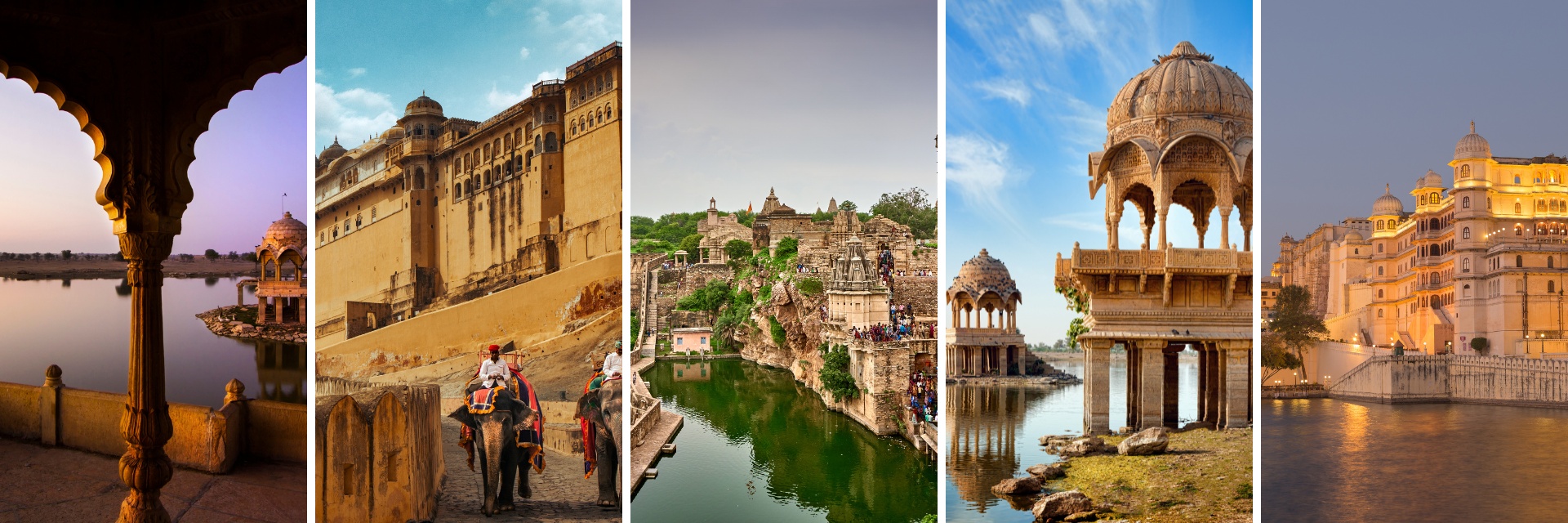
Destination · Rajasthan · Lakes & palaces
Setting Up a Luxury Resort in Udaipur
The address that made Indian luxury famous — on a shoreline you can barely build on. Udaipur is a land-scarcity and events-yield problem long before it is a design one.
Udaipur is where the palace-hotel defined what luxury in India could be, and where the world now comes to marry. But the water that makes the product — Pichola, Fateh Sagar, Swaroop Sagar — is also the most protected and litigated land in the state, and a dry-lake year can hollow out a season. We run the whole journey of an Udaipur resort as one accountable programme: siting against what the lake-conservation regime and the Aravalli slopes actually permit, engineering the property around weddings and events rather than bolting them on, and taking you from raw land or a tired haveli to a stabilised opening.
Weddings-led
The revenue line the whole asset is built around
Lake or hill
Two siting logics, priced and permitted apart
Oct–Mar
The season the model has to win
Turnkey
Raw land or haveli to a stabilised opening
At a glance
Best-fit siting
Lakefront (Pichola, Fateh Sagar, Swaroop Sagar, Badi) where genuinely buildable; Aravalli hill-slopes above the city; old-city havelis and outlying forts for conversion.
Peak season
October–March (wedding season plus cool weather); brutal Apr–Jun summer; July–Sept monsoon that replenishes the lakes.
Revenue mix
Destination weddings, social events, MICE and film are the highest-yield lines; transient rooms are the base, not the story.
Critical constraint
Lakefront land is scarce, fragmented and controlled — lake-conservation norms, UIT sanction and NGT scrutiny gate what is buildable.
Access
Maharana Pratap Airport (Dabok), ~22 km east; strong domestic connectivity plus seasonal wedding charters; ~4 hrs by road to Jodhpur, longer to Jaipur.
Water watch-out
The product depends on full lakes. A poor-monsoon year that drops Pichola and Fateh Sagar directly damages the guest experience — and the rate.
Why Udaipur
No Indian destination sells luxury more effortlessly than Udaipur. The Taj Lake Palace floating on Pichola, The Oberoi Udaivilas on the western shore, The Leela Palace on Fateh Sagar, RAAS in the old city under the City Palace, and Taj Aravali out in the hills have between them written the reference standard for what a Rajasthan resort can command. That legacy is the opportunity and the burden: the guest arrives with an image already formed, and anything that reads as generic five-star loses instantly against a skyline of palaces.
The whitespace is not another lake-view box. It is the property that turns Udaipur's real engine — the wedding, the multi-day social celebration, the film shoot, the closed-buyout — into premium yield through spaces, service and logistics built for it, rather than a rooms hotel that tolerates events. Get the events architecture and the sense of place right and the room rate follows; get them wrong and you are discounting keys in a market that never had to.
In Udaipur the winning asset is rarely the one with the most keys. It is the one engineered around the celebration — the ceremony lawn, the arrival sequence, the buyout — with rooms priced as the by-product, not the pitch.
The guest & the demand — a celebration economy
Udaipur is India's destination-wedding capital, and that single fact should shape the entire brief. The most valuable guest is not the couple on a two-night lake-view stay; it is the family that books the property out for four days, brings three hundred guests, and spends on décor, catering, alcohol, entertainment and rooms at a multiple of a normal night's rate. Around that sit the corporate offsite and MICE calendar, the film and fashion shoots the city is built for, and the leisure traveller who comes for the palaces and the sunset boat on Pichola.
That mix has two consequences the concept has to answer. First, the yield is concentrated in October to March — the cool, dry, marriage-auspicious window — so the model must be built to win that season decisively and to hold a defensible floor through the punishing April–June heat and the monsoon shoulder. Second, the source markets are domestic HNI first: Delhi, Mumbai, Ahmedabad, Kolkata and the NRI diaspora returning to marry at home, with international luxury and inbound weddings as genuine but secondary upside. We model the wedding-and-events base as the core P&L and treat pure transient leisure as the layer that fills the rest of the calendar.
- Destination weddings and multi-day social events as the primary, highest-yield revenue engine
- MICE, corporate buyouts, and film/fashion production as complementary high-value demand
- Domestic HNI and NRI diaspora as the dependable core; international luxury as upside
- Peak Oct–Mar carries the year; design a defensible floor for summer and monsoon
Land, the lakes & the build reality
The paradox of Udaipur is that the thing that makes the product is the thing you can least easily build on. Genuine lakefront on Pichola, Swaroop Sagar and Fateh Sagar is scarce, tightly held, often fragmented across old family titles, and hemmed in by lake-conservation and shoreline norms. The National Green Tribunal has repeatedly scrutinised construction on and around the lakes, and encroachment on the water's edge and its feeder channels is a live legal risk. A plot marketed as 'lakefront' can prove largely unbuildable — or buildable only well back from the water — once the shoreline setback and conservation zone are drawn. We establish this before capital is committed, not after a stop-work order.
The practical alternatives shape most credible projects. The Aravalli hill-slopes ringing the city — the belt that carries properties like Taj Aravali and the newer hill resorts — offer scale, views back over the lakes and city, and fewer waterfront constraints, but bring their own hill-slope, gradient, access-road and drainage engineering. And the heritage route is real: Mewari havelis in the walled old city and forts in the surrounding countryside can be converted under Rajasthan's heritage-hotel framework, trading buildable freedom for character that a new build cannot buy — subject to old-city heritage bylaws and conservation constraints.
| Route | What it gives you | What it costs you |
|---|---|---|
| Lakefront (Pichola / Fateh Sagar / Swaroop Sagar / Badi) | The iconic view and the strongest rate ceiling | Scarce, fragmented title, lake-conservation setbacks, NGT exposure |
| Aravalli hill-slope | Scale, privacy, panoramic outlook, fewer water constraints | Slope engineering, access roads, drainage, longer arrival |
| Heritage conversion (haveli / fort) | Instant character and story under the heritage-hotel route | Structural retrofit, heritage bylaws, constrained key count |
Three siting routes into Udaipur — indicative; always subject to the specific title, shoreline survey and sanction for the plot.
Approvals, licences & the regulatory stack
An Udaipur resort carries a Rajasthan- and lake-specific approvals stack that has to be sequenced from day one, because the land-use and conservation clearances are the long poles and several items gate one another. We build and govern the licensing roadmap to a commissioned, legally-clean asset; the licensed filings themselves are made by your appointed architects, structural consultants and lawyers, and we coordinate and drive them.
The defining item is the lake and shoreline question. Any project touching or near the lakes has to satisfy lake-conservation and shoreline norms and can attract National Green Tribunal scrutiny, and land-use conversion and building sanction run through the Urban Improvement Trust (UIT) / Udaipur's planning authority. On the incentive side, Rajasthan actively courts tourism investment: the state's tourism unit policy and its investment-promotion scheme (RIPS) can offer fiscal and procedural benefits, and the heritage-hotel policy provides a defined conversion path for havelis and forts — both worth engineering into the structure early.
- Lake-conservation and shoreline compliance; NGT scrutiny for anything on or near the lakes
- Land-use conversion and building-plan sanction via the Urban Improvement Trust (UIT) / planning authority
- Environmental clearance (SEIAA) where built-up area crosses the threshold; groundwater/CGWA consent for water sourcing
- Old-city heritage bylaws and conservation approvals for walled-city havelis; heritage-hotel classification where converting
- Rajasthan tourism registration, hotel classification (Ministry of Tourism / HRACC), and RIPS / tourism-unit incentive filings
- Excise (liquor) licence — decisive for wedding and F&B economics — plus fire NOC, FSSAI, and Rajasthan Pollution Control Board consents
What an Udaipur resort has to be
Udaipur does not reward imported luxury; it rewards Mewar handled with confidence. That means an architecture literate in the local vocabulary — jharokhas, chhatris, courtyard-and-baradari planning, the play of marble against local Rajasthan stone — oriented relentlessly to the water or the hills, so that arrival, the ceremony spaces and the best suites all read the lake or the Aravalli line. The craft heritage is a differentiator, not decoration: miniature painting, stonework, silver and textile traditions can be woven through the interiors and the guest experience in a way a generic palette never earns.
Because the celebration is the product, the events architecture is the plan, not an annexe. That means a hierarchy of ceremony lawns and pillared halls sized for a sequence of functions, a private and theatrical arrival, back-of-house catering and logistics built for outside caterers and hundreds of covers at once, discreet vendor and production access, and a buyout that actually works. Around it, the sunset water experience — the boat, the ghat, the lake-facing bar — the spa and pool as the summer and leisure engine, and food and beverage that can stand on its own between weddings. Sequence all of this to the Oct–Mar peak the whole asset is built to win.
Procurement, water & the build calendar
Building in Udaipur is governed by heat, water and craft. The genuine construction window narrows sharply through the April–June furnace, when daytime temperatures make sustained site work and concrete curing difficult, and again around the monsoon — so the critical path has to be planned to the Rajasthan calendar, not a generic one. Water is a first-order design and delivery issue in a semi-arid region: sourcing, storage, harvesting and recycling have to be engineered from the outset, both for construction and for a wedding operation that consumes at scale, and groundwater draw is regulated.
The craft that defines the product is also a procurement reality. Udaipur and its hinterland hold deep benches of stone-carving, marble and traditional-building artisans — a genuine advantage for authentic detailing, but one that runs to artisan lead times and hand-work schedules rather than industrial cadence, and it has to be planned and sequenced deliberately. We run the full procurement programme — FF&E, OS&E, the wedding and banqueting inventory, kitchens, spa, pool plant and technology — with vendor intelligence and a schedule mapped to the heat, the water plan, the artisan calendar and commissioning, so the target opening survives a Rajasthan year.
A dry-lake year is a product risk, not just a weather note. We stress-test the concept, the water strategy and the calendar so the property still performs when the monsoon underdelivers and Pichola sits low.
Gladwin's edge in Udaipur
We treat Udaipur as the land-scarcity, water and events-yield problem it actually is — not as a view to be photographed. Before a rupee is committed we resolve the shoreline and title question, read the lake-conservation and NGT exposure, weigh the lakefront, hill-slope and heritage-conversion routes against the guest and the economics you want, and structure the RIPS and heritage-hotel incentives into the plan. Then we run the whole programme — Mewar-literate design, the events architecture, the water strategy, procurement, and a supported launch across the first peak season — as one accountable partner and your Owner's Representative, from raw land or a tired haveli to a stabilised opening.
The team we build reflects how this market actually earns. Udaipur sits on a deep palace-hotel service tradition, and we recruit into it deliberately: a General Manager who can run a celebration-led P&L, a banqueting, weddings and events leadership that can deliver three hundred-cover functions to a palace standard, and a hiring plan that blends local Rajasthani hospitality talent with trained leadership. Pre-opening training lands the standard before the first Oct–Mar wedding season — the season the entire model is built to win, not learned on paying guests.
Planning a resort in Udaipur?
We take single accountability from raw land to a stabilised opening — siting and approvals, market and pricing, design, procurement, and the full team — from General Manager to line level — recruited through our executive search practice and trained for opening.
Speak with a partnerSetting up a resort in Udaipur — FAQs
Far less freely than owners hope. Genuine frontage on Pichola, Fateh Sagar and Swaroop Sagar is scarce and often fragmented, and it is governed by lake-conservation and shoreline norms with real National Green Tribunal scrutiny of construction on or near the water. A plot sold as 'lakefront' can prove buildable only well back from the shore once the setback is drawn. We survey the shoreline, title and conservation status for the specific plot before you commit, so the concept is designed to what is genuinely permissible.
They are three different businesses. Lakefront gives the iconic view and the highest rate ceiling but is the scarcest and most regulated; the Aravalli hill-slopes give scale, privacy and panorama with slope, access and drainage to engineer; a haveli or fort conversion under Rajasthan's heritage-hotel route buys instant character and story at the cost of retrofit, heritage bylaws and a constrained key count. We match the route to your investment thesis, your target guest and the economics, rather than to whichever plot a broker is selling.
Because that is where the money is. Udaipur is India's destination-wedding capital, and a four-day multi-function buyout — with its décor, catering, alcohol, entertainment and room spend — yields a multiple of ordinary transient nights. A property engineered for that (ceremony lawns, a theatrical arrival, catering-scale back-of-house, a real buyout) commands premium yield; a rooms hotel that merely tolerates events leaves most of the value on the table.
A great deal. The product depends on full lakes — a sunset on a brimming Pichola is the experience people pay for. A poor-monsoon year that drops the lakes visibly damages the guest experience and pressures rate, and it strains water supply for a wedding operation that consumes at scale. We stress-test the concept, the water sourcing, harvesting and recycling strategy, and the seasonal calendar so the asset still performs in a low-water year.
It varies by site and built-up area, but the lake-conservation/shoreline clearance and land-use conversion are the long poles and must be sequenced first. The stack typically runs through UIT/planning-authority sanction, environmental and groundwater consents where applicable, old-city heritage bylaws or heritage-hotel classification for conversions, Rajasthan tourism registration and classification, excise, fire, FSSAI and pollution-control consents. We build the full roadmap and govern it in parallel with design so nothing surfaces late — and we structure RIPS and tourism-policy incentives in from the start.
Yes — it is core to the engagement. We recruit the General Manager and full head-of-department team, with particular weight on a banqueting, weddings and events leadership capable of palace-standard, large-format functions, blending local Rajasthani hospitality talent with trained leadership drawn from Udaipur's deep palace-hotel tradition. Pre-opening training lands the standard before the first Oct–Mar wedding season, not on your first paying celebration.
Explore the cluster
Luxury resorts across India’s destinations
North-West · Rajasthan heritage city
Jaipur
The city that invented the Indian palace-hotel — and set the bar so high that anything ordinary reads as a discount. In Jaipur the hard question is craft, not concrete: can the property earn the word 'palace' honestly?
North-West · Wildlife & safari
Ranthambore
India's most famous tiger destination — and a reserve where the park itself, not the market, sets your calendar. Ranthambore rewards restraint, permits and naturalists before it rewards architecture.
North · Himalayan foothills & Ganga
Rishikesh & Uttarakhand
The world knows Rishikesh for the Ganga and for yoga — but the town itself is dry, vegetarian and tightly built. The premium product lives in the hills above it, and getting there is a siting and licensing decision before it is a design one.
Also explore our executive search practice for the General Manager and leadership team, and the wider end-to-end hospitality practice — hotels, residences, clubs and heritage properties.