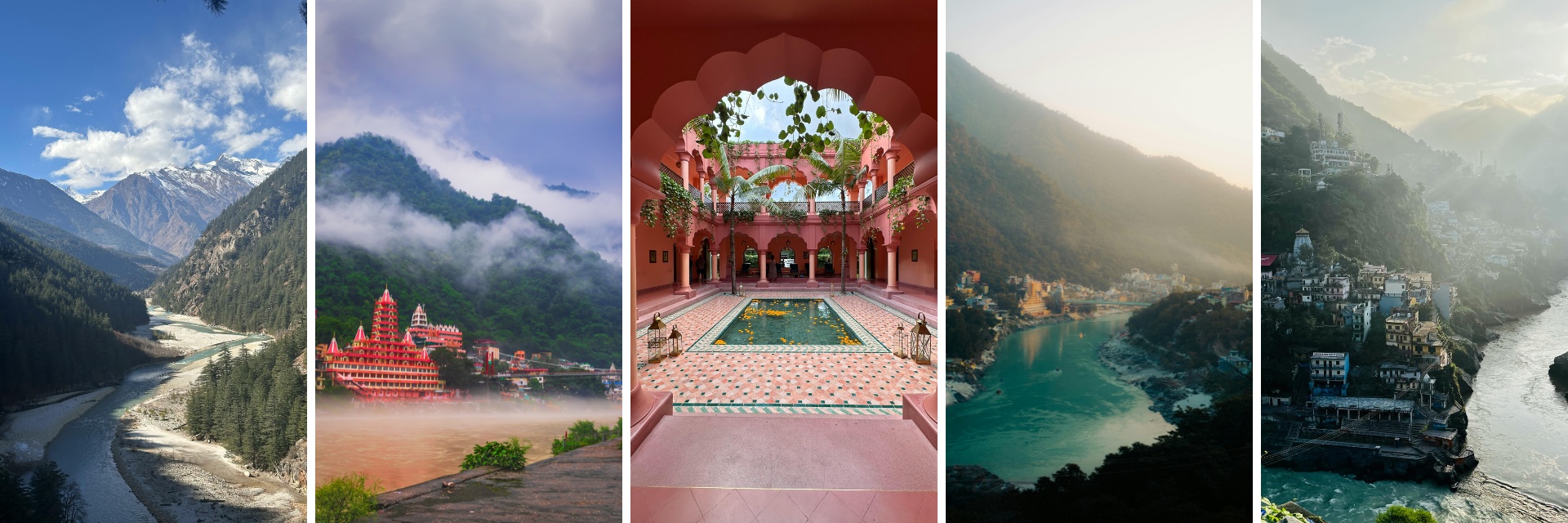
Destination · North India · Himalayan foothills & Ganga
Setting Up a Luxury Resort in Rishikesh & Uttarakhand
The world knows Rishikesh for the Ganga and for yoga — but the town itself is dry, vegetarian and tightly built. The premium product lives in the hills above it, and getting there is a siting and licensing decision before it is a design one.
Rishikesh is the destination everyone can name and few can build in. The pilgrimage core on the river is protected, prohibition-bound and short of developable land, while the top of the market — Ananda in the Himalayas, Taj Rishikesh, the wellness properties around Dehradun — has quietly settled into the ridges and forests above the town. We run the whole journey of an Uttarakhand resort as one accountable programme: reading where the spiritual, wellness and soft-adventure demand actually converges, siting on hillside that clears forest, riverfront and eco-sensitive-zone scrutiny, and taking you from a Himalayan plot to a fully staffed, fully booked opening.
Yoga capital
Global anchor demand the model builds on
Hills, not core
Where the licensed premium product sits
Zone IV
Seismic reality that governs the structure
Turnkey
Himalayan land to a stabilised first year
At a glance
Best-fit micro-markets
Narendra Nagar and the Tehri ridge, the Shivpuri–Byasi river stretch, Pauri and the Dehradun–Mussoorie corridor for view-led and wellness product.
Demand triple
Spiritual pilgrimage, structured wellness (yoga, Ayurveda, panchakarma) and soft adventure (rafting, trekking, Char Dham gateway).
Season & access
Year-round core with March–June and September–November peaks; via Dehradun (Jolly Grant) airport and a strong Delhi self-drive market.
F&B constraint
Rishikesh and Haridwar municipal cores are dry and vegetarian — licensed, non-veg service pushes premium properties to the surrounding hills.
Critical scrutiny
Ganga setbacks and National Green Tribunal attention on riverbank construction, forest clearance and eco-sensitive zones upstream.
Build watch-outs
Seismic Zone IV, 2013-flood-driven landslide caution, and a monsoon window (July–September) that governs the critical path.
The opportunity
Rishikesh is one of the very few Indian destinations with genuine global brand equity: it is the 'yoga capital of the world', a place international guests arrive already knowing, and a rare market where a wellness proposition can command Western retreat pricing on Indian ground. The top end has already proved the thesis — Ananda in the Himalayas at Narendra Nagar built a decades-long reputation as a destination spa, Taj Rishikesh planted a river-view luxury flag, and the wellness-led properties clustered around Dehradun and Mussoorie showed that structured, clinical wellness sells here at the highest tariffs in the country.
The whitespace is not another rafting-camp cluster on the Shivpuri road or another ashram-adjacent guesthouse. It is a disciplined, small-key wellness resort — a genuine programme rather than a spa menu — sited high enough to serve alcohol and a full kitchen, close enough to the Ganga and the town to trade on Rishikesh's name, and built to a standard the existing mid-market simply cannot reach. That is a siting and licensing problem first, a wellness-programming problem second, and a construction problem third.
In Uttarakhand the winning site is almost never the riverbank plot the brochure sells. It is the ridge above it — where the view, the licence and the buildable land finally line up.
The guest & the demand triple
Rishikesh runs on three overlapping guests, and a serious resort has to decide which one it is built for. The first is the spiritual traveller — drawn by the Ganga aarti at Triveni Ghat and Parmarth Niketan, by Laxman Jhula and Ram Jhula, and by the town's ashram lineage — who values proximity, restraint and authenticity over indulgence. The second, and the premium engine, is the structured-wellness guest: the yoga student, the panchakarma patient, the burnt-out professional booking a week-long reset, often international, often solo, staying long and paying deep. The third is the soft-adventure market — rafting, cliff-jumping, trekking, and the Char Dham and Valley of Flowers pilgrimage-tourism that treats Rishikesh and Haridwar as the gateway.
These guests want different things from the same address, and the mistake is trying to serve all three at full luxury. Our starting position is that the dependable premium base is wellness — long stays, high yield, strong repeat and a global source market that flows through Delhi and Dehradun — with the spiritual and adventure demand treated as feeder and shoulder-season fill rather than the core. Delhi's weekend self-drive market underwrites occupancy between the international wellness peaks; the Char Dham season (roughly April to November) lifts the whole valley but skews devotional and price-sensitive.
- Structured wellness (yoga, Ayurveda, panchakarma) as the premium, long-stay core
- Spiritual and pilgrimage travel as authentic feeder and brand context, not the rate base
- Soft adventure — rafting, trekking, Char Dham gateway — as shoulder and day-guest revenue
- Delhi self-drive as the dependable weekend base; international wellness guests as the yield peak
Land, site & the hill-versus-river reality
The single most consequential decision in Uttarakhand is where the property sits relative to the river and the town, because it decides both the licence and the land you can actually build on. The Ganga corridor through Rishikesh and up towards Devprayag carries construction setbacks from the riverbank and sits under sustained National Green Tribunal scrutiny of building near the river — the legacy of unregulated riverfront development and of the 2013 Kedarnath floods that reshaped how Uttarakhand thinks about the water's edge. A plot that photographs as a Ganga-front trophy can be largely undevelopable once the setback, the flood line and the slope are drawn honestly.
The practical answer, which the top of the market has already found, is to site on the hills — Narendra Nagar, the Tehri ridge, Pauri, the Dehradun–Mussoorie shoulder — where the view is wider, the land is buildable, and the property escapes the municipal prohibition on alcohol and non-vegetarian food. Hill land in Uttarakhand brings its own diligence: state restrictions on land purchase and use, terraced and fragmented agricultural holdings, forest-department boundaries, and slope stability in a landslide-prone terrain. We resolve title, setback, slope and clearance path before capital is committed, not after a stop-work notice.
| Consideration | What it decides |
|---|---|
| Distance from the Ganga / riverbank setback | Whether construction is permissible and how NGT scrutiny applies |
| Municipal core vs surrounding hills | Whether alcohol and non-vegetarian F&B can be licensed at all |
| Forest boundary & eco-sensitive zone | Whether the plot needs forest clearance and what the ESZ permits |
| Slope, landslide history & flood line | Villa-vs-terrace layout, structural design and disaster resilience |
Indicative siting logic for Uttarakhand — always subject to the specific plot's survey, forest status and NGT/setback position.
Approvals, clearances & the Uttarakhand stack
An Uttarakhand hill resort carries a distinctive clearance stack that is environmental as much as municipal, and the green clearances are the long poles. Several items gate one another, so the roadmap has to be sequenced from day one. We build and govern the licensing programme to a commissioned, legally-clean asset; the filings themselves are made by your appointed architects, structural consultants and lawyers, whom we coordinate.
The riverfront, forest and eco-sensitive-zone dimensions are what make this stack different from a plains or coastal project. Land near the Ganga is watched by the NGT; land near forest triggers forest clearance; and the Bhagirathi Eco-Sensitive Zone upstream, along with other notified ESZs, constrains what can be built and how. Hill building limits — height, ground coverage and set-backs tuned to slope — apply on top.
- State land-use / conversion permission and the building-plan sanction from the local authority or development authority
- Forest clearance where the site abuts or falls within forest land, and tree-felling permissions
- Environmental clearance (SEIAA) where built-up area or the eco-sensitive-zone position crosses the threshold
- NGT-conscious riverfront compliance and Ganga-setback / floodplain adherence near the river
- Uttarakhand Tourism registration and Ministry of Tourism / HRACC hotel classification
- Excise (liquor) licence — obtainable outside the dry municipal cores; Fire NOC, FSSAI, and State Pollution Control Board consents for water and sewage
What an Uttarakhand resort must be
This destination punishes both the generic and the loud. The guest comes to Rishikesh for stillness, for the river and the mountains, and for a sense of something older than the hotel — so the architecture has to practise restraint. That means a sattvic, ashram-inspired calm rather than resort flamboyance: local stone and timber, low horizontal massing that follows the ridge, courtyards and meditation decks oriented to the Ganga and the sunrise, and landscape — deodar, pine, terraced planting — doing as much work as the built form. Ananda's Narendra Nagar legacy set the reference that the market now measures against; the answer is not to copy it but to reach its seriousness with a distinct point of view.
Wellness has to be the product, not a spa attached to a hotel. The market rewards a real programme — yoga and pranayama taught by credible practitioners, an Ayurveda and panchakarma clinic run to clinical standards, nutrition and detox kitchens, and a guest journey designed around the multi-day reset rather than the overnight stay. Crucially, the food-and-beverage model has to be planned around the region's constraints: a sattvic, largely vegetarian core that guests actively want here, with licensed and non-vegetarian dining available because the property sits outside the prohibition zone. Bar revenue is thinner than a beach or metro resort would assume, so the model leans on treatment, programme and stay-length yield instead.
The bar is not the profit centre here. In Uttarakhand the wellness programme, the clinic and the length of stay are — design the P&L around those, not around covers and cocktails.
Procurement & build realities
Building in the Himalayan foothills is a mountain-logistics and weather-governed exercise, and the schedule is dictated by things a plains developer never plans for. The working year is bracketed by the July–September monsoon, when landslides close roads and stop earthwork, so the critical path has to be built around a usable dry-season window and pre-monsoon protection of the site. Material moves up narrow, switch-backed hill roads with real load and access limits, which reshapes both what can be specified and how it is staged.
Seismicity governs the structure. Much of Uttarakhand sits in seismic Zone IV, and the region's landslide and 2013-flood history make disaster resilience a design requirement, not a nicety — foundations, slope stabilisation, drainage and structural detailing all have to be engineered for it. We run the full procurement programme — FF&E, OS&E, the spa and Ayurveda-clinic fit-out, kitchens, technology and operating supplies — with vendor intelligence, realistic hill lead times, and a build sequence mapped to the monsoon and to commissioning so the target opening survives a wet season and a hard winter.
Gladwin's edge in Rishikesh & Uttarakhand
We treat Uttarakhand as the environmental and positioning problem it actually is. Before a rupee is committed we resolve the riverbank setback and NGT exposure, the forest and eco-sensitive-zone status, the hill land-use path and the slope and seismic reality — and we site the property where the view, the licence and the buildable ground finally coincide, which is almost always the ridge above the town rather than the river's edge. Then we run the whole programme — a wellness-led concept and design, the green and municipal clearances governed in parallel, procurement staged to the monsoon, and a launch supported through the first year — as one accountable partner and your Owner's Representative.
The team we build is engineered for this specific operating model. A General Manager who can run a programme-led wellness property, not just a room count; a hiring plan that pairs credible yoga and Ayurveda practitioners — the scarce, defining talent of this market — with hospitality leadership drawn from the Delhi and Dehradun pool; and pre-opening training that lands both the clinical wellness standard and the sattvic service culture before the first international season, so the promise on the website is live before the first paying guest arrives.
Planning a resort in Rishikesh & Uttarakhand?
We take single accountability from raw land to a stabilised opening — siting and approvals, market and pricing, design, procurement, and the full team — from General Manager to line level — recruited through our executive search practice and trained for opening.
Speak with a partnerSetting up a resort in Rishikesh & Uttarakhand — FAQs
Not inside the Rishikesh or Haridwar municipal cores — both are pilgrimage cities where alcohol and non-vegetarian food are restricted or prohibited in the town centre. This is exactly why the premium, licensed product sits in the surrounding hills, at Narendra Nagar, the Tehri ridge, or the Dehradun–Mussoorie corridor, where a full bar and a non-vegetarian kitchen can be licensed. We factor this into the siting decision from day one, and we design the F&B and revenue model around a strong sattvic vegetarian core rather than assuming beach-resort bar economics.
Usually not as close as owners hope. Construction near the Ganga carries riverbank setbacks and sits under sustained National Green Tribunal scrutiny — a legacy of unregulated riverfront building and the 2013 floods. A river-front plot can be largely undevelopable once the setback, flood line and slope are drawn honestly. The proven move, which the top of the market has already made, is to site on the ridges above the river, where the view is wider, the land is buildable and the property escapes the municipal prohibition.
The green ones. Beyond the usual land-use conversion, building sanction, tourism classification, fire, FSSAI and excise licences, an Uttarakhand hill site can require forest clearance where it abuts forest land, environmental clearance from SEIAA, and compliance with eco-sensitive-zone rules — including the Bhagirathi ESZ upstream — plus NGT-conscious riverfront adherence. These environmental clearances are the long poles, so we sequence and govern them from day one rather than discovering them late.
Rishikesh serves three — spiritual pilgrims, structured-wellness guests, and soft-adventure travellers — and trying to serve all three at full luxury is the classic mistake. Our default is to make structured wellness the premium, long-stay, high-yield core, with the spiritual travel providing authentic brand context and the rafting/trekking/Char Dham demand filling shoulder seasons and day-guest revenue. Delhi's self-drive weekend market underwrites occupancy between the international wellness peaks.
Significantly. Much of Uttarakhand is in seismic Zone IV, and the landslide and 2013-flood history make disaster-resilient foundations, slope stabilisation and drainage a design requirement. The July–September monsoon closes roads and stops earthwork, so the critical path is built around a dry-season window and pre-monsoon site protection. Material moves up narrow hill roads with load limits that shape both specification and staging. We map procurement and the build sequence to all of this so the opening survives a wet season and a hard winter.
The defining, scarce talent here is credible wellness practitioners — qualified yoga and pranayama teachers and Ayurveda and panchakarma clinicians — and Rishikesh is one of the few places in the world where that pool is genuinely deep. We recruit that clinical and teaching team and pair it with hospitality leadership drawn from the Delhi and Dehradun market, then run pre-opening training that lands both the clinical wellness standard and the sattvic service culture before the first international season.
Explore the cluster
Luxury resorts across India’s destinations
North · Himalayan hill stations
Shimla, Manali & Himachal
The Himalayas' most reachable luxury market — and the one hardest to buy into. In Himachal the project is won or lost on land permission long before it is a question of slate roofs and mountain views.
West · Rajasthan lakes & palaces
Udaipur
The address that made Indian luxury famous — on a shoreline you can barely build on. Udaipur is a land-scarcity and events-yield problem long before it is a design one.
North-West · Wildlife & safari
Ranthambore
India's most famous tiger destination — and a reserve where the park itself, not the market, sets your calendar. Ranthambore rewards restraint, permits and naturalists before it rewards architecture.
Also explore our executive search practice for the General Manager and leadership team, and the wider end-to-end hospitality practice — hotels, residences, clubs and heritage properties.