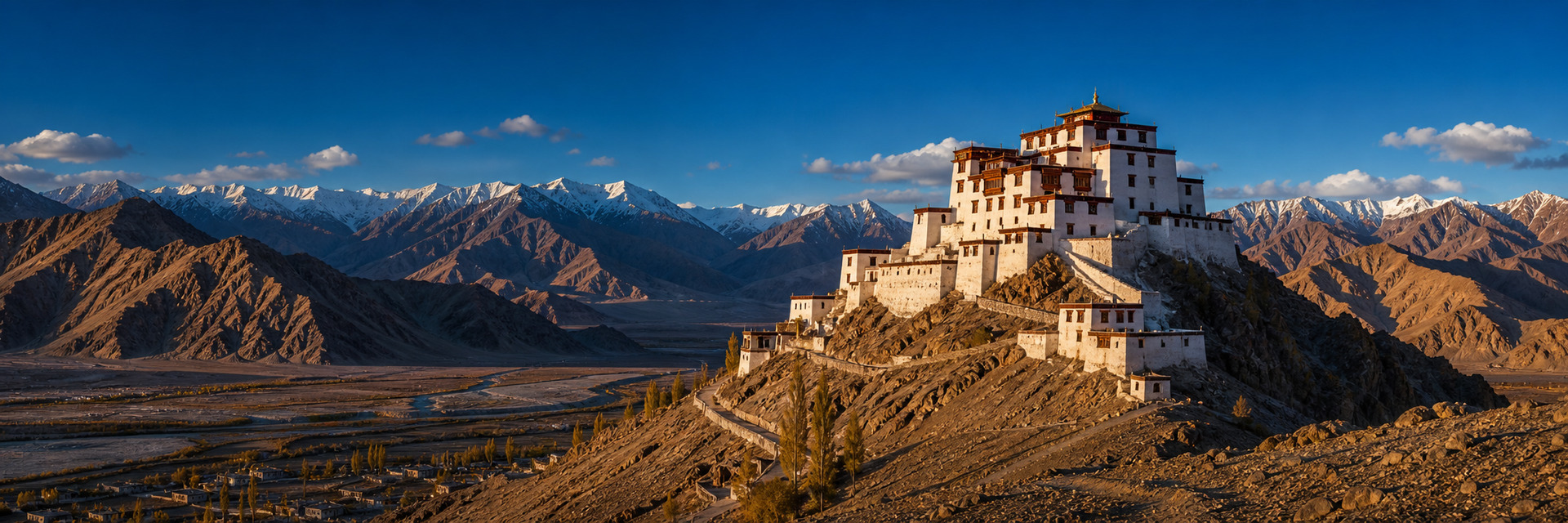
Destination - Ladakh - High-altitude desert
Setting Up a Luxury Resort in Ladakh
Ladakh sells vastness, but water scarcity and a five-month operating window make restraint the core luxury discipline.
Leh, Nubra, Pangong Tso, Thiksey, Hemis and Diskit give Ladakh a bucket-list premium draw, with high-end tented camps and houses such as The Chamba Camp and Nimmu House proving willingness to pay. But the season is short, altitude affects guests and staff, water stress around Leh is real, and border areas require Inner Line or Protected Area Permits. We design Ladakh projects as low-water, passive-solar, permit-aware and seasonal businesses from the first feasibility model.
Water-first
Scarcity decides key count, landscape and operations
May-Oct
A short summer season carries the year
Permit-aware
Nubra, Pangong and border routes need controls
Altitude-safe
AMS protocols are part of luxury service
At a glance
Best-fit micro-markets
Leh and Indus valley, Nimmu/Alchi side, Nubra, Pangong access routes and carefully controlled high-altitude tented or lodge sites.
Operating season
Roads and passes generally support premium travel around May-September/October; winter is extreme and many products close.
Positioning
High-altitude adventure, Buddhist-monastic travel, dark-sky, low-water wellness, tented luxury and bucket-list Himalayan journeys.
Critical approval
UT land/domicile structure, local permissions, environmental and water approvals, Inner Line/Protected Area Permit protocols and safety compliance.
Access
Leh airport, seasonal road access from Manali and Srinagar, and road links to Nubra, Pangong, monasteries and the Indus valley.
Build watch-out
Water scarcity, altitude, extreme cold, air freight, short build season, solar/heating, sewage, defence sensitivity and local hiring.
Water is the first luxury
Ladakh's landscape invites big gestures, but its ecology punishes them. Leh's water stress is a design driver, not a sustainability talking point. Every key, bath, lawn, laundry load, kitchen plan and staff bed must be justified against water availability, treatment and reuse.
That discipline is compatible with luxury. In Ladakh, premium guests are often seeking silence, landscape, altitude, monasteries, dark skies and clarity. A low-water, passive-solar, carefully staffed resort can feel more luxurious than a conventional hotel that imports green lawns into a cold desert.
In Ladakh, key count is a water decision before it is a market decision.
A five-month bucket-list market
The premium season is short. Roads and passes generally support the main leisure cycle from May to September or October, and even air arrivals need acclimatisation planning. The P&L must earn in a compressed window while allowing for weather, road disruption and altitude-driven itinerary pacing.
Demand is strong but specific: high-altitude adventure, Buddhist monasteries, Nubra, Pangong, dark-sky travel, luxury motor itineraries, photographers, cyclists, trekkers and bucket-list families. The product must sell Ladakh's difficulty as carefully managed privilege.
- Leh, Nubra, Pangong and monastery circuits as the core itinerary
- Dark-sky, high-altitude adventure and Buddhist culture as premium layers
- Acclimatisation nights and medical protocols as part of guest design
- Compressed season demanding disciplined rate and length-of-stay strategy
Domicile, permits and border sensitivity
Since becoming a Union Territory in 2019, Ladakh's land and domicile regime has remained politically sensitive and must be checked carefully for any outside-backed project. Site control, local partnership, village acceptance, water rights and environmental legitimacy matter as much as commercial demand.
Many of Ladakh's most famous locations sit in border-sensitive zones. Nubra, Pangong and other areas require Inner Line or Protected Area Permit protocols, and defence sensitivities can affect movement, photography, road timing and site eligibility. The operating model must handle permits as a core guest service.
| Gate | What it controls |
|---|---|
| Water source and reuse | Key count, landscape, laundry, staff housing and kitchen scale |
| Land / local structure | Whether site control is legitimate under the UT context |
| Permit and defence sensitivity | Guest movement to Nubra, Pangong and border routes |
| Altitude and access | Medical protocols, build season and logistics cost |
Ladakh feasibility filters before any high-altitude concept is drawn.
High-altitude clearances and guest safety
The approvals stack can include local land and building permissions, environmental checks, water extraction or supply permissions, sewage and waste approvals, fire and safety, tourism registration, pollution-control consent where applicable, and permit protocols for restricted areas. Because the ecology is fragile, documentation should show low water use, waste discipline and landscape restraint.
Guest safety is part of compliance in practice. AMS screening, oxygen, medical tie-ups, acclimatisation advice, itinerary pacing, staff training and emergency transport must be designed before opening, especially for properties outside Leh.
Passive-solar Ladakhi minimalism
The design should use Ladakhi intelligence: Zanskari stone, mud, timber, thick walls, passive solar, south-facing winter logic, shaded summer courts, dry toilets or low-water systems where appropriate, solar energy and dark-sky lighting. Monastery references should be quiet and respectful.
Luxury can come through warmth, stillness, views, food, oxygen comfort, guides, libraries, fire, tea, stargazing and serious expedition planning. Ladakh does not need excess; it needs competence that feels effortless.
Short summers, air freight and acclimatised teams
The build season is unforgiving. Materials move by air freight or seasonal roads, labour must acclimatise, concrete and finishes face cold and dryness, and procurement mistakes can cost a season. Water, heating, solar, sewage and staff housing must be commissioned early enough to support the first opening window.
Hiring should prioritise local Ladakhi employment, altitude-acclimatised staff and seasonal leadership that can operate with limited supply chains. Training includes AMS response, permit handling, low-water operations, dark-sky discipline and guest communication around weather and roads.
Gladwin's edge in Ladakh
We begin by testing water, land structure, permits, altitude, access, season length, local acceptance and utility self-sufficiency. The resort concept is then sized to what Ladakh can responsibly support, not to what a rendering can show.
As one accountable partner, we run passive-solar design, approvals, low-water systems, procurement, seasonal staffing, acclimatisation protocols and launch. The team is trained to make a difficult landscape feel safe, quiet and premium without overbuilding it.
Planning a resort in Ladakh?
We take single accountability from raw land to a stabilised opening — siting and approvals, market and pricing, design, procurement, and the full team — from General Manager to line level — recruited through our executive search practice and trained for opening.
Speak with a partnerSetting up a resort in Ladakh — FAQs
Water. Scarcity affects key count, bathrooms, laundry, kitchens, staff housing, landscape and operating cost. A serious project must prove its water plan before design scale is fixed.
The main premium season generally runs around May to September or October, depending on roads and weather. The business must earn in that compressed window and plan for winter closure or limited operations.
Yes. Nubra, Pangong and several border areas require Inner Line or Protected Area Permit protocols. The resort should manage permits and itinerary timing as part of the guest journey.
Yes, but the farther it moves from Leh, the more serious altitude, medical, water, staff, road and supply-chain planning become. Some sites are better suited to seasonal camps than permanent resorts.
Low-water, passive-solar, local materials, dark-sky lighting, strong heating and minimal landscape intervention. Ladakh rewards restraint more than conventional luxury excess.
Local Ladakhi employment is important, supported by seasonal specialists and leaders who can acclimatise. Staff housing, rotations and altitude training are part of the operating model.
Explore the cluster
Luxury resorts across India’s destinations
North - Spiti high-desert
Spiti Valley
Spiti has almost no luxury supply, but Section 118 land limits, border permits and a four-to-five-month road season make it a true frontier business.
North - Char Dham high-Himalaya
Kedarnath & the Char Dham
The Char Dham has record yatra demand, but the temples close for winter; the entire business has to earn inside a short, fragile high-Himalaya window.
Northeast - Kanchenjunga high-Himalaya
Sikkim & the Eastern Himalaya
Sikkim has Kanchenjunga views, monasteries and organic-state credibility, but protected land ownership and border permits control what outsiders can build.
Also explore our executive search practice for the General Manager and leadership team, and the wider end-to-end hospitality practice — hotels, residences, clubs and heritage properties.