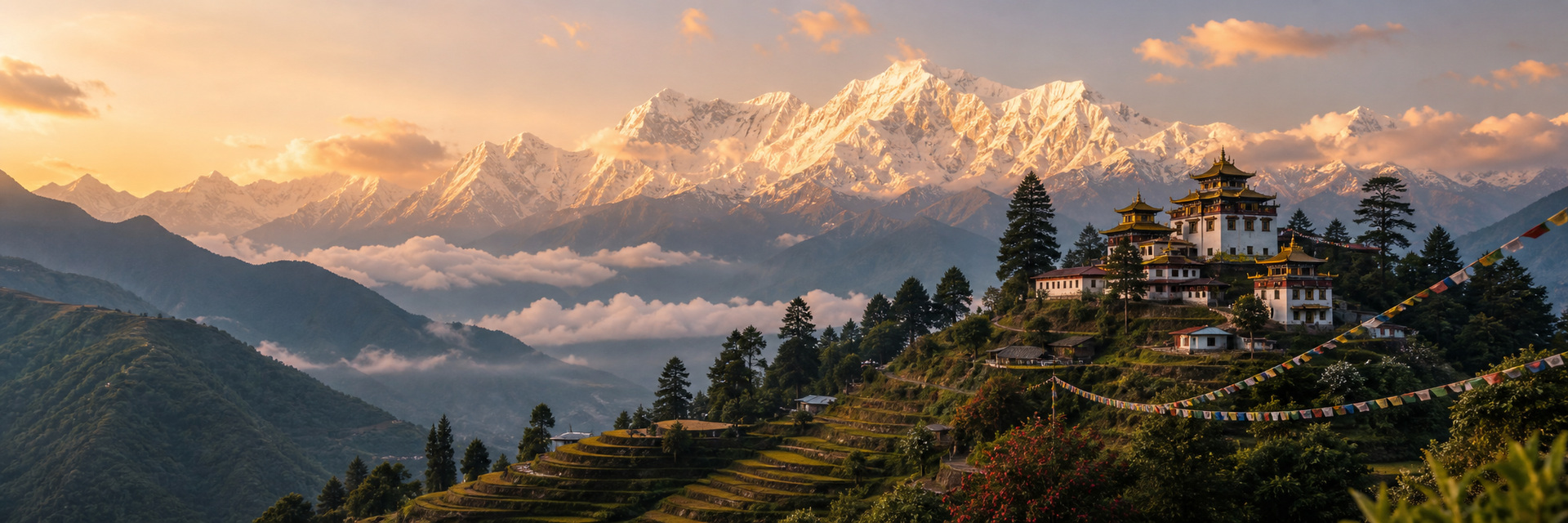
Destination - Northeast - Kanchenjunga Himalaya
Setting Up a Luxury Resort in Sikkim & the Eastern Himalaya
Sikkim has Kanchenjunga views, monasteries and organic-state credibility, but protected land ownership and border permits control what outsiders can build.
Gangtok, Pelling, Rumtek, Pemayangtse, Lachung and Yumthang give Sikkim a strong premium-Himalaya proposition: mountain views, Buddhist monasteries, organic food, wellness and tea-country adjacency. Pakyong airport and Bagdogra improve access, but Sikkim's land laws heavily protect local ownership, border zones require Inner Line or Protected Area Permits, and seismic/landslide ecology makes site selection unforgiving. We structure the project around local legitimacy and mountain safety first.
Protected land
Local ownership rules shape entry strategy
Kanchenjunga
Views can define the rate ceiling
Organic state
Food and wellness can be truly place-led
Seismic Zone IV
Structure and slope safety are core feasibility
At a glance
Best-fit micro-markets
Gangtok, Pelling, Rumtek side, Pemayangtse, tea-estate-adjacent routes and carefully selected lower-risk hill sites with local ownership structure.
Season
Clear mountain-view seasons around spring and autumn are strongest; high zones face winter and landslide access constraints.
Positioning
Kanchenjunga-view luxury, Buddhist-monastic calm, organic wellness, tea heritage and low-impact Himalayan design.
Critical approval
Local land ownership or partnership structure, permits for border/high zones, local sanction, forest/eco checks, seismic design and tourism approvals.
Access
Pakyong airport where operating, Bagdogra gateway, Siliguri road base and mountain roads to Gangtok, Pelling and North Sikkim.
Build watch-out
Protected agricultural land, landslides, seismic design, forest, fragile ecology, local-employment norms and high-altitude logistics.
Kanchenjunga luxury under protected land laws
Sikkim's premium appeal is obvious: Kanchenjunga views, Buddhist monasteries, organic-state identity, mountain roads, tea-country adjacency and a quieter feel than many Himalayan hill stations. Gangtok and Pelling offer different versions of the opportunity, while Rumtek and Pemayangtse add monastic depth.
The entry constraint is equally clear. Sikkim's land regime protects local ownership, especially agricultural land and revenue-block rights, so outside developers need careful local structure rather than assumption-led acquisition. A resort that starts with a weak land thesis will not be rescued by a mountain view.
In Sikkim, the view may sell the room, but the local land structure decides whether the room can exist.
Organic, monastic and mountain demand
The guest wants Himalayan views with a softer cultural and wellness layer: monasteries, organic food, tea, walking, clean air, mountain drives and a sense of Buddhist calm. Domestic HNI travellers, Kolkata and eastern India markets, Bengaluru/Delhi mountain travellers and inbound guests can all fit the right product.
Demand differs by micro-market. Gangtok offers access and urban support; Pelling offers Kanchenjunga drama; Rumtek and Pemayangtse offer monastic depth; Lachung and Yumthang are higher, more seasonal and permit-sensitive. The resort must choose which Sikkim it is selling.
- Kanchenjunga views as the premium emotional driver
- Buddhist monasteries and organic wellness as differentiators
- Gangtok/Pelling as practical luxury bases
- North Sikkim routes as high-value but permit and weather-sensitive extensions
Local ownership, permits and border terrain
Land diligence must establish local ownership, permissible transfer or lease structure, agricultural status, revenue-block rules, forest proximity, road access, slope, water and community acceptance. Outsiders generally cannot assume they can buy agricultural land freely, and any partnership must be bankable, approvable and operationally clear.
High and border zones add another layer. Inner Line and Protected Area Permits apply to several routes, especially North Sikkim and border-facing areas. These permits can support premium programming, but they also limit spontaneous guest movement and require trained operations.
| Gate | What it decides |
|---|---|
| Local land structure | Whether the project can legally control and develop the site |
| Permit zone | Whether guests can access the experience and under what conditions |
| Slope and landslide exposure | Whether the site is safe and buildable |
| Kanchenjunga orientation | Whether the view supports premium pricing |
Sikkim feasibility is local-rights plus mountain-risk diligence.
Sikkim approvals in a seismic ecology
The approvals path can include local land and ownership clearances, building sanction, forest and eco-sensitive checks, environmental thresholds, seismic structural design, fire NOC, pollution-control consent, FSSAI, tourism registration, water and sewage permissions and permit protocols for restricted areas.
Because Sikkim is fragile and seismic, engineering must run in parallel with approvals: slope stability, retaining, drainage, earthquake design, road access, emergency movement and winter operating assumptions. A property can be beautiful and still irresponsible if it ignores the mountain.
A Buddhist-Himalayan resort with an organic spine
The design should draw from Sikkimese and Buddhist cues: timber, stone, prayer-flag colour used with restraint, monastery-view quiet, local craft, deep roofs and warm interiors oriented to Kanchenjunga where possible. The architecture should not overplay monastery imagery; it should create calm.
The organic-state identity should become operational: local vegetables, herbs, teas, millet, fermented foods, wellness menus, farm partnerships and spa programming. This is one of the few Indian resort markets where organic can be a real supply-chain story rather than a brochure word.
Landslides, Bagdogra and local employment
Construction depends on mountain roads, Bagdogra/Siliguri supply chains, Pakyong reliability, weather windows and slope work. Landslides, seismic detailing, damp, cold, staff housing and material storage need careful sequencing. Premium FF&E and MEP will often route through Siliguri, Kolkata or national vendors.
Hiring should respect local employment expectations and Sikkim's service culture. Gangtok and Siliguri can support leadership and hiring, while local associates need training in luxury standards, organic F&B, permit handling and mountain safety.
Gladwin's edge in Sikkim
We begin with the gates that matter: local land rights, partnership structure, permits, slope, seismic design, access, forest, view orientation and whether the project can trade beyond a pretty season. That keeps the owner from building a concept on land assumptions that do not hold.
Then we run approvals, design, procurement, organic F&B strategy, hiring and launch as one accountable programme. The team plan blends Gangtok/Siliguri talent with local employment and training around mountain safety, permits and wellness-led luxury.
Planning a resort in Sikkim & the Eastern Himalaya?
We take single accountability from raw land to a stabilised opening — siting and approvals, market and pricing, design, procurement, and the full team — from General Manager to line level — recruited through our executive search practice and trained for opening.
Speak with a partnerSetting up a resort in Sikkim & the Eastern Himalaya — FAQs
Not freely, especially where agricultural or protected local land is involved. Projects usually require local ownership, lease or partnership structures that satisfy Sikkim's land laws and revenue-block protections.
Pelling and Kanchenjunga-view sites offer powerful premium positioning; Gangtok gives access and operating support; monastery-linked routes add cultural depth. The right site depends on land structure and slope safety.
Yes in border and high zones, especially North Sikkim routes such as Lachung/Yumthang. Permit handling needs to be built into itinerary planning and guest communication.
Serious. Sikkim sits in a high seismic zone, so structural design, slope stability, retaining, drainage and emergency access are central to feasibility, not optional upgrades.
Yes, if it is real. Organic food, wellness, local farm links and tea or highland produce can strengthen the concept, but guests will notice if it is only marketing language.
Gangtok and Siliguri can support operations, with senior talent from wider luxury markets where needed. Local employment and training are important for legitimacy and service quality.
Explore the cluster
Luxury resorts across India’s destinations
Northeast - Khasi-Jaintia highlands
Meghalaya
Meghalaya's landscape is ready for premium travel, but most land is community or clan-held; the resort begins with lease partnership, not purchase.
North - Trans-Himalayan Ladakh
Ladakh
Ladakh sells vastness, but water scarcity and a five-month operating window make restraint the core luxury discipline.
North - Char Dham high-Himalaya
Kedarnath & the Char Dham
The Char Dham has record yatra demand, but the temples close for winter; the entire business has to earn inside a short, fragile high-Himalaya window.
Also explore our executive search practice for the General Manager and leadership team, and the wider end-to-end hospitality practice — hotels, residences, clubs and heritage properties.