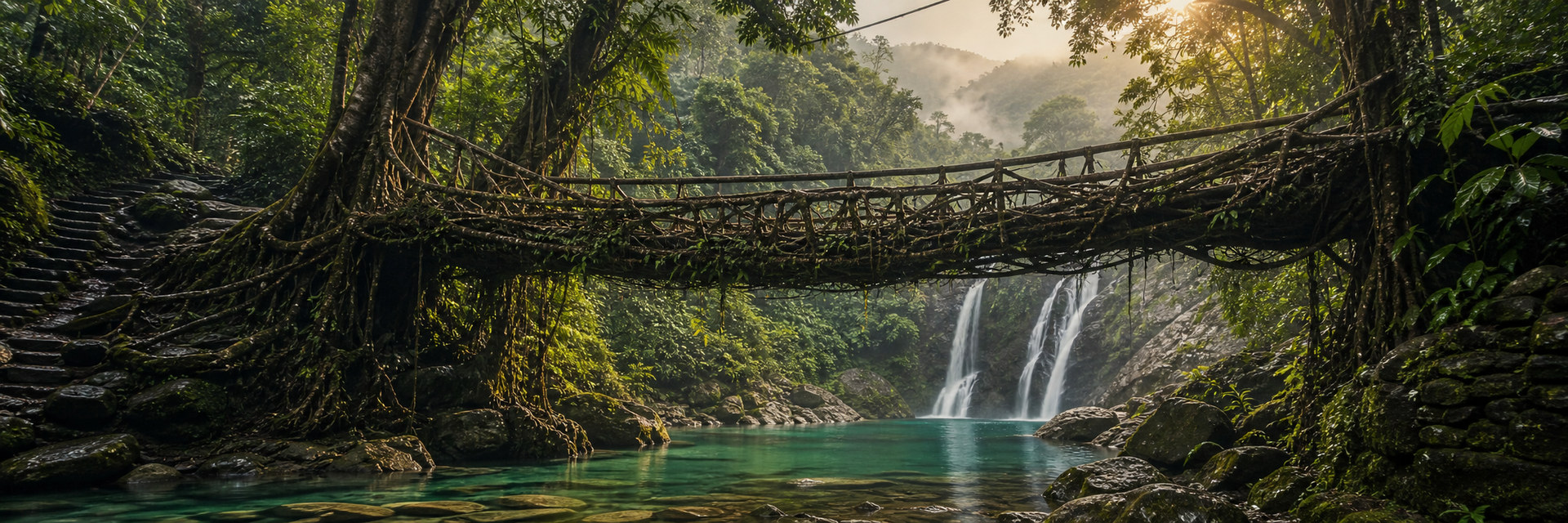
Destination - Northeast - Living-root highlands
Setting Up a Luxury Resort in Meghalaya
Meghalaya's landscape is ready for premium travel, but most land is community or clan-held; the resort begins with lease partnership, not purchase.
Shillong, Sohra, Mawsynram, Dawki, Mawlynnong and the living-root bridges have made Meghalaya one of India's most compelling 'unexplored' leisure destinations. Guwahati access and Umroi airport help, but the defining constraint is not road distance; it is land. As a Sixth Schedule state, much of Meghalaya is governed by Khasi, Jaintia and Garo customary tenure through Autonomous District Councils, meaning outsiders and companies generally build through long lease or community JV. We structure that relationship before design.
Lease-not-buy
Community and clan tenure leads feasibility
Record rainfall
Drainage, damp and slope design are central
Guwahati gateway
Drive access opens premium Northeast leisure
Community-led
Local employment and partnership are operating requirements
At a glance
Best-fit micro-markets
Shillong, Sohra/Cherrapunji, Mawsynram, Dawki/Umngot, Mawlynnong and selected Khasi-Jaintia highland sites with community support.
Season
October-April is easier for travel; monsoon is iconic but operationally demanding in one of the wettest landscapes on earth.
Positioning
Cloud-forest luxury, living-root ecology, Khasi design, slow Northeast travel, rain-embracing wellness and community-led experiences.
Critical approval
Community/clan lease or JV, Autonomous District Council permissions, local sanction, environmental and tourism approvals.
Access
Guwahati is the main gateway, roughly three hours to Shillong; Umroi airport gives limited Shillong access.
Build watch-out
Customary land, rainfall, damp, slope drainage, landslides, road logistics and community employment commitments.
Cloud country with community land
Meghalaya has moved from curiosity to serious premium leisure: Shillong's old hill-station character, Sohra and Mawsynram's rainfall mythology, Dawki's Umngot river, Mawlynnong's village reputation and the living-root bridges give the state a landscape and culture unlike any other Indian resort market.
The project constraint is equally unlike most markets. In a Sixth Schedule state, much land is held through community, clan and customary systems under Autonomous District Council influence. Outside developers generally cannot approach land as a freehold acquisition. The investable route is a long lease, JV or community partnership that is legitimate, locally accepted and operationally clear.
In Meghalaya, land is a relationship before it is a parcel. If the community structure is weak, the resort is weak.
Shillong, Sohra and the new unexplored-India guest
The premium guest wants a Northeast that still feels distinct: cloud, rain, music, food, village landscapes, living-root bridges, waterfalls, caves, clean rivers and a gentler pace. Shillong can support urban-culture stays, while Sohra and Mawsynram carry the rain-and-landscape mythology. Dawki and Mawlynnong add day-trip or circuit depth.
Demand comes through Guwahati, Shillong and increasingly national leisure markets seeking less-crowded India. The resort must handle long drives, rain, local guides, community protocols and a guest who values authenticity but still expects comfort, safety and good food.
- Shillong culture, Sohra rainfall and Dawki river experiences as demand anchors
- Guwahati gateway access as the practical route to premium travellers
- Living-root bridges and village landscapes as carefully managed programming
- Community partnership as part of the guest experience, not a footnote
Lease, JV or do not build
Meghalaya land diligence is not only title diligence; it is customary-tenure diligence. Khasi, Jaintia and Garo land systems, clan consent, village authority, Autonomous District Council rules, lease term, transfer rights, mortgageability, revenue share, employment commitments and exit provisions must be understood before a resort business can be financed.
A beautiful site without community legitimacy is not investable. The project should be structured so the local partner, village and owner understand land control, jobs, procurement, access, sacred or community-use areas, environmental obligations and dispute resolution.
| Question | Why it matters |
|---|---|
| Who can grant rights? | Clan, community and ADC authority determine whether the lease is valid |
| What can the lease permit? | Controls resort use, term, mortgageability, transfer and exit |
| What does the community receive? | Jobs, revenue, access and procurement commitments shape local support |
| What land must remain untouched? | Sacred groves, village paths, water and community-use areas can be non-negotiable |
Meghalaya land feasibility begins with customary control, not only survey boundaries.
ADC permissions, rainfall and eco scrutiny
The approval path can include Autonomous District Council permissions, village/community consent, local building sanction, environmental clearance where thresholds apply, forest or eco-sensitive checks, pollution-control consent, fire NOC, FSSAI, tourism registration and water/waste permissions. The land agreement and approval path must be aligned; one cannot rescue the other.
Rainfall is an approval and engineering issue. Sohra and Mawsynram sit inside global rainfall extremes, and even Shillong-side projects require drainage, damp-proofing, slope stability, road access, stormwater and landslide planning to be treated as core infrastructure.
Khasi design for rain, not against it
The design should embrace Meghalaya's climate: steep roofs, raised floors, deep eaves, covered walks, fireplaces, drying rooms, breathable materials, robust drainage and views that make rain beautiful. Khasi and Jaintia vernacular cues should be used with respect, not turned into decorative costume.
Experience design can include guided root-bridge visits with carrying-capacity discipline, local food, music, cave and waterfall routes, river days at Dawki, village partnerships and wellness that treats rain and cloud as the mood rather than a problem.
Drainage, damp and community hiring
Building in Meghalaya is a rainfall and logistics exercise. Roads from Guwahati, steep slopes, damp, mould, landslide risk, material lead times and site storage all need planning. Drainage is the most important invisible luxury: if it fails, the resort fails quickly.
Hiring must honour the land structure. Local employment is often a lease expectation and should be built into the operating model, with Guwahati and Shillong providing leadership support. We train local teams for premium service while keeping community relationships active after opening, not only during negotiation.
Gladwin's edge in Meghalaya
We begin with land legitimacy: clan or community authority, ADC permissions, lease or JV structure, employment obligations, sacred areas, access, water and environmental constraints. Only then do we test the guest concept and commercial model.
As Owner's Representative we coordinate community partnership, approvals, rain-ready design, procurement, local hiring and launch. The team plan blends Shillong/Guwahati leadership with local employment and training so the resort is both premium and locally anchored.
Planning a resort in Meghalaya?
We take single accountability from raw land to a stabilised opening — siting and approvals, market and pricing, design, procurement, and the full team — from General Manager to line level — recruited through our executive search practice and trained for opening.
Speak with a partnerSetting up a resort in Meghalaya — FAQs
Generally not in the normal freehold sense. Much land is community or clan-owned under Sixth Schedule customary systems, so development usually requires a long lease or JV with legitimate local authority and ADC alignment.
A weak land relationship. If the clan, community, village and ADC position are unclear, the resort can be impossible to finance, approve or operate, even if the site is beautiful.
It changes everything: roofs, drains, damp-proofing, covered circulation, storage, staff movement, slope stability, road access and maintenance. Rain must be designed in, not designed around.
Shillong supports culture and access, Sohra/Cherrapunji and Mawsynram carry rainfall and landscape drama, Dawki adds river experiences, and Mawlynnong/root-bridge circuits add community-led depth. The site should match the positioning.
Often yes, and it should be treated as part of the business rather than a compliance burden. Local employment, procurement and access commitments can be central to lease legitimacy.
Shillong and Guwahati can support leadership and hiring, with some roles drawn from broader hospitality markets. Local teams then need structured training into luxury standards.
Explore the cluster
Luxury resorts across India’s destinations
Northeast - Kanchenjunga high-Himalaya
Sikkim & the Eastern Himalaya
Sikkim has Kanchenjunga views, monasteries and organic-state credibility, but protected land ownership and border permits control what outsiders can build.
Northeast - Brahmaputra wildlife
Kaziranga
Kaziranga's rhino draw is world-class, but the Brahmaputra floods the park every year; lodges must be elevated, flood-aware and corridor-sensitive.
South · Backwaters & coast
Kerala
The one Indian destination that sells the monsoon and the one where the water is the product. Kerala rewards a resort built on Ayurveda and place — but the land beneath it is wetland and CRZ before it is buildable.
Also explore our executive search practice for the General Manager and leadership team, and the wider end-to-end hospitality practice — hotels, residences, clubs and heritage properties.