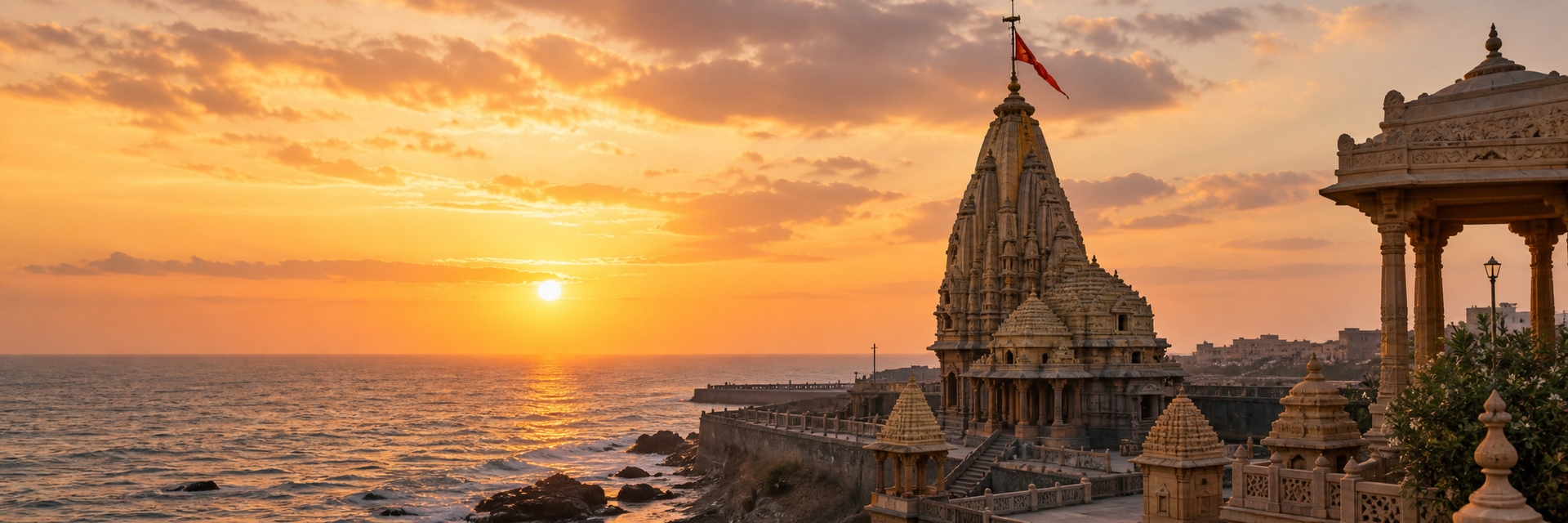
Destination - Gujarat - Spiritual coast
Setting Up a Luxury Resort in Somnath-Dwarka
Somnath and Dwarka can combine pilgrimage with the coast, but Gujarat's dry-state rules and CRZ siting reshape the resort economics from the first line of the model.
The Saurashtra coast links two of India's most powerful sacred addresses: Somnath, the first Jyotirlinga, and Dwarka, a Char Dham destination. The Sudarshan Setu to Beyt Dwarka, improved tourism infrastructure and Gir's lion country nearby turn the corridor into more than a temple stop. We help owners build the right product for this mix - spiritual, coastal and family-led - while solving prohibition, CRZ, corrosion, greenfield land and Saurashtra logistics before they become project shocks.
Dry state
F&B economics built without a normal bar model
CRZ-first
Coastal siting and setbacks decide the plan
Pilgrim + coast
Spiritual demand with leisure upside
Gir circuit
Wildlife extension strengthens stay length
At a glance
Best-fit micro-markets
Somnath-Veraval, Dwarka-Okha-Beyt Dwarka access, Porbandar-side coast, and Sasan Gir extensions for combined wildlife-spiritual circuits.
Demand engine
Somnath Jyotirlinga, Dwarkadhish and Char Dham pilgrimage, family religious travel, coastal drives and Gir lion safaris.
Positioning
Vegetarian-forward spiritual coast, family suites, wellness, coastal calm and circuit packaging with Gir.
Critical approval
Gujarat CRZ/CZMA clearance where coastal, land-use conversion, tourism registration, pollution-control consents and prohibition-compliant F&B licensing.
Access
Rajkot, Porbandar and Diu gateways, road links along the Saurashtra coast, and Sudarshan Setu improving Beyt Dwarka access.
Build watch-out
Salt corrosion, cyclone and wind exposure, remote coastal logistics, water planning and a no-liquor commercial model.
The spiritual coast as a resort circuit
Somnath and Dwarka each carry enough pilgrimage gravity on their own. Together, linked by the Saurashtra coast and strengthened by the Sudarshan Setu to Beyt Dwarka, they create a circuit that can support longer, more comfortable, family-led travel. Add Gir within the wider Saurashtra itinerary and the destination becomes spiritual plus wildlife plus coast, rather than a one-night temple halt.
That is the opportunity for luxury: not nightlife, not a Goa substitute, but a dignified coastal resort with better rooms, food, transport, wellness and itinerary control than the market has historically offered. The guest wants darshan, comfort, family confidence and a sense of Gujarat's coast without losing the sacred purpose of the trip.
The resort that wins here will not fight Gujarat's rules. It will turn spiritual restraint, coastal calm and family service into the premium proposition.
Demand, stay length and the Gir extension
The core demand is domestic and devotional: Gujarati families, western India drive markets, diaspora visitors and all-India pilgrims moving through Jyotirlinga and Char Dham circuits. The coastal setting adds leisure value, especially for families who want the trip to feel less transactional than a temple queue and a night in a city hotel.
Gir is the strategic extension. A well-packaged Somnath-Dwarka-Gir itinerary can lengthen stay, raise spend and appeal to families who want both faith and wildlife. That does not mean the property should become a safari lodge; it means the concierge, transport, content and partnerships should be designed for the circuit from the beginning.
- Somnath and Dwarka pilgrimage as the demand base
- Gujarati, Mumbai, Ahmedabad, Rajkot and diaspora families as core source markets
- Gir and Sasan as a stay-length and itinerary enhancer
- Vegetarian, family-led F&B and large-room formats as practical revenue drivers
Coastal land and CRZ reality
The most attractive sites are also the most regulated. Any coastal parcel must be read through CRZ classification, High Tide Line mapping, setbacks, access, erosion, wind exposure and utilities before design begins. A plot that looks ideal for a beach resort may lose its usable area once the CRZ line, public access and no-development rules are understood.
Greenfield land on the Saurashtra coast can still be viable, especially where road access and circuit logic are strong, but the resort should not depend solely on a sand-edge fantasy. Courtyards, elevated views, coastal landscape, temple access and controlled transport can create a premium experience even when the buildable envelope sits back from the water.
| Filter | Why it matters |
|---|---|
| CRZ classification and HTL | Determines buildable area, setback and environmental clearance path |
| Temple and circuit access | Controls darshan convenience and Gir / Dwarka / Somnath packaging |
| Coastal exposure | Drives corrosion specification, wind loads, landscape and maintenance cost |
| Water and utilities | Can decide feasibility in remote coastal stretches |
Indicative site filters for the Saurashtra spiritual coast.
Approvals and the dry-state business model
Gujarat's prohibition is the defining commercial constraint. A conventional luxury resort model often relies on bar, banquet liquor and high-margin beverage revenue; here the F&B strategy must be rebuilt around excellent vegetarian and regional cuisine, non-alcoholic beverage depth, wellness, family dining, events that do not depend on alcohol, and compliant handling of any legally permitted exceptions.
The formal stack includes land-use conversion, building sanction, CRZ/CZMA clearance for coastal sites, environmental clearance where thresholds apply, fire NOC, FSSAI, pollution-control consent, tourism registration and hotel classification. Gujarat tourism-policy incentives may be relevant, but they need to be tested alongside land and licensing, not treated as a later rebate.
- CRZ/CZMA and environmental approvals for coastal parcels
- Land-use conversion, local building sanction, fire and pollution-control consents
- FSSAI, tourism registration, hotel classification and event permissions where relevant
- Prohibition-compliant F&B design and guest communication from concept stage
Designing a Gujarati spiritual-coast resort
The product should draw from the Saurashtra coast and Gujarati temple idiom without becoming theatrical. Stone, lime-washed walls, shaded courts, jali, coastal planting, local textiles and craft can build place; temple views, prayer pauses, family dining and quiet wellness can build meaning. The design should be robust enough for salt air and wind, and gentle enough for the sacred context.
F&B can be a strength if treated seriously. Kathiawadi, Gujarati thali traditions, fasting menus, premium vegetarian banquets, coastal produce where appropriate and a strong non-alcoholic beverage programme can become a reason to stay, not an apology for the absence of a bar.
Procurement, corrosion and Saurashtra logistics
Building on this coast is a specification and logistics challenge. Salt-laden air punishes poor ironmongery, facade materials, MEP equipment and outdoor furniture. Remote stretches add lead time from Ahmedabad, Rajkot, Surat or Mumbai vendors, while local contractor capacity can vary sharply by district. The procurement plan must therefore over-specify for corrosion and under-assume local availability.
Hiring follows a similar pattern. Rajkot, Ahmedabad and the broader Gujarat hospitality market can provide leadership and specialist talent, while local teams need training around luxury service, pilgrimage sensitivity and a dry-state F&B model. We build the team, SOPs and vendor network before opening pressure forces compromises.
Gladwin's edge on the Somnath-Dwarka coast
We read this market as a spiritual-coast circuit, not as a generic beach play. Before acquisition we test CRZ, land title, circuit access, prohibition economics, utilities and corrosion exposure, then structure the concept and approvals so the asset can perform without relying on a normal resort bar model.
Our operating plan blends Gujarat-aware hospitality with luxury discipline: vegetarian and family-led F&B, trained pilgrimage concierge, circuit partnerships to Gir and Beyt Dwarka, and leadership hired from stronger western India markets. From raw land to a stabilised opening, we act as one accountable partner and Owner's Representative.
Planning a resort in Somnath-Dwarka?
We take single accountability from raw land to a stabilised opening — siting and approvals, market and pricing, design, procurement, and the full team — from General Manager to line level — recruited through our executive search practice and trained for opening.
Speak with a partnerSetting up a resort in Somnath-Dwarka — FAQs
It changes it materially. The resort cannot depend on a conventional bar and banquet-liquor model, so revenue has to come from rooms, family dining, premium vegetarian cuisine, wellness, events, non-alcoholic beverage depth and itinerary-led experiences. We model that from the start.
Only after CRZ classification, High Tide Line mapping, erosion, access and environmental constraints are tested. Many attractive coastal plots have a smaller buildable envelope than they appear to, so the concept should be drawn only after the coastal diligence is complete.
It depends on the demand thesis. Somnath has Jyotirlinga gravity and Gir proximity; Dwarka has Char Dham strength and Beyt Dwarka access. A corridor or circuit strategy can work if transport and stay-length are designed deliberately.
Yes, as an itinerary enhancer. Gir can lengthen stay and increase spend for families who want both pilgrimage and wildlife, but the resort should still know whether its core identity is spiritual coast, wildlife extension or a hybrid.
Coastal corrosion, wind exposure, remote logistics, water and utilities, and variable contractor capacity across Saurashtra. These are specification and programme issues as much as construction issues.
Leadership is typically drawn from Rajkot, Ahmedabad, western India and established luxury markets, while local associates are trained into the service standard. Dry-state F&B and pilgrimage-sensitive service both require specific training before launch.
Explore the cluster
Luxury resorts across India’s destinations
Central - Temple & pilgrimage
Ujjain (Mahakal)
Mahakal Lok has transformed Ujjain's demand curve; the premium resort supply has barely begun to respond.
West - Gujarat lion country
Gir & Saurashtra
Gir is unreplicable because it is the only Asiatic-lion home on earth; the business is constrained by permit-controlled safaris and Gujarat's dry-state model.
West - Gujarat white desert
Rann of Kutch
The White Rann is magical because it is temporary; the same flood season, border sensitivity and dry-state rules define the resort business.
Also explore our executive search practice for the General Manager and leadership team, and the wider end-to-end hospitality practice — hotels, residences, clubs and heritage properties.