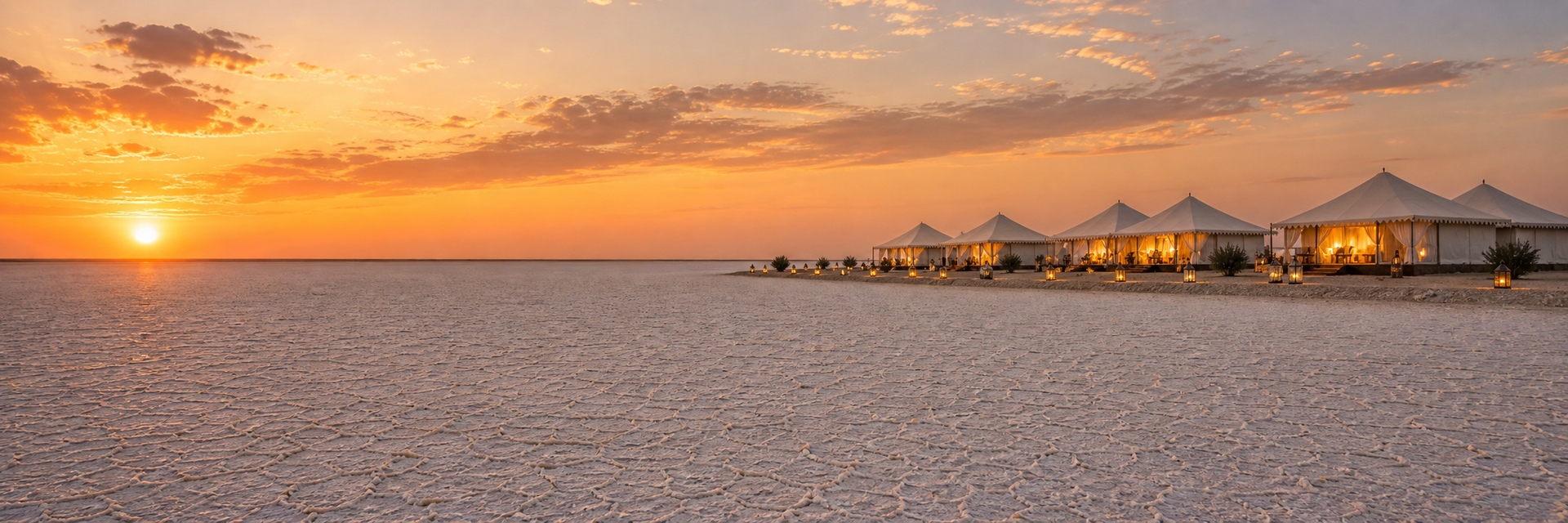
Destination - Gujarat - Salt desert
Setting Up a Luxury Resort in the Rann of Kutch
The White Rann is magical because it is temporary; the same flood season, border sensitivity and dry-state rules define the resort business.
The salt desert around Dhordo has already proved a seasonal luxury format through the Rann Utsav Tent City, full-moon travel and Kutchi craft-led programming. But this is not ordinary desert land: the Rann floods in the monsoon, the operating window is concentrated around November to February, border and BSF sensitivities matter, the Wild Ass Sanctuary adds ecological scrutiny and Gujarat prohibition changes F&B economics. We build the business around that seasonality rather than pretending it is a year-round resort market.
Nov-Feb
The white-desert window the P&L must win
Tent-led
Seasonal and removable formats are proven here
Border-aware
Permits and BSF sensitivity influence guest movement
Dry state
Gujarat prohibition rewrites F&B and events revenue
At a glance
Best-fit micro-markets
Dhordo and White Rann access, Bhuj gateway sites, Hodka craft-village side, and low-impact seasonal sites outside sensitive sanctuary areas.
Operating season
Rann access and full-moon demand peak roughly November-February; monsoon flooding closes the desert landscape.
Positioning
Luxury tented desert camp, Kutchi craft, full-moon/dark-sky programming, low-impact culture-led stays.
Critical approval
Tourism permissions, land or seasonal-use approvals, border-area permits, eco-sensitive checks, fire and dry-state compliance.
Access
Bhuj is the gateway by air and rail; road transfers connect Dhordo, Hodka, White Rann viewing points and craft villages.
Build watch-out
Flooded terrain, water scarcity, remote logistics, temporary infrastructure, Wild Ass Sanctuary sensitivity and no-liquor events.
A white desert that opens by season
The Rann of Kutch is not a conventional resort location. Its most valuable landscape exists when the monsoon water has withdrawn and the salt desert becomes accessible, especially around full-moon nights. Dhordo's recognition as a UN Best Tourism Village and the Rann Utsav Tent City have already taught the market how to buy this place: as a seasonal, cultural, open-sky experience.
That seasonal character is the opportunity and the constraint. A permanent hotel that ignores the flood cycle, dark-sky value and tented precedent will likely feel heavy. The more credible luxury play is low-impact, removable or lightly permanent infrastructure that earns intensely in a short window and uses Kutch's craft, food, music and landscape as the product.
The Rann rewards assets that behave like the landscape: seasonal, light, craft-rich and precise about the months when the white desert actually exists.
Full-moon demand and the tent-city proof
The guest is not coming for a generic desert hotel. They are coming for the White Rann at night, the full moon, cold winter air, Kutchi embroidery, bhunga architecture, folk performance, craft villages, photography and the sense of reaching India's far western edge. Ahmedabad, Mumbai, Gujarat's domestic market, NRIs and culture-led travellers form the core demand.
Rann Utsav proves that guests will accept tents, temporary infrastructure and event-style programming when it is well run. The premium gap is for a more restrained, higher-touch version: fewer guests, better sleep, better food, stronger guides, better craft curation and a deeper sense of place.
- Full-moon and winter weekends as high-yield compression dates
- Kutchi craft, embroidery, bhunga forms and folk performance as real demand drivers
- Bhuj, Ahmedabad, Mumbai and Gujarati diaspora as core source markets
- Seasonal tented luxury rather than year-round room-count thinking
Border land, sanctuary edges and dry-state economics
The Rann sits in a sensitive geography. Proximity to Pakistan means permit regimes, BSF coordination and guest-movement restrictions can matter, especially for foreign travellers and for sites near the White Rann. The Wild Ass Sanctuary and other eco-sensitive areas add another layer: not every empty-looking horizon is development land.
Gujarat's prohibition is the commercial constraint most hotel models underestimate. Event and beverage revenue must be designed without a normal bar, which makes food, culture, guided excursions, wellness, craft retail and premium non-alcoholic beverage programming more important than they would be in a conventional desert resort.
| Constraint | Commercial implication |
|---|---|
| Monsoon flooding | Short operating window; temporary or resilient infrastructure preferred |
| Border and BSF sensitivity | Permits, guest movement and foreign-guest protocols must be planned |
| Wild Ass Sanctuary / eco zones | Site eligibility and impact need early environmental screening |
| Gujarat prohibition | F&B and events cannot rely on conventional liquor revenue |
Rann feasibility is about season, sensitivity and operating permissions rather than land alone.
Approvals for a temporary-feeling asset
A Kutch resort may feel temporary, but the permissions cannot be casual. The stack can include land-use or seasonal-use approval, tourism registration, district permissions, border-area clearances and foreigner-permit protocols, fire and temporary-structure safety, FSSAI, pollution-control consent, water and waste permissions and environmental checks for sanctuary or eco-sensitive proximity.
Gujarat tourism-policy incentives can be relevant, but the filing must fit the asset structure: tented, seasonal, low-impact, permanent-back-of-house or hybrid. We map the operating season and physical format to the approval path before committing to infrastructure.
Kutchi craft without stagecraft
The design should use Kutch's own intelligence: bhunga-inspired forms, mud and lime textures, textiles, embroidery, mirror work, local timber, shaded courtyards and wind-aware planning. The danger is turning living craft into a prop. The better approach is to build procurement and programming with local artisans, so the product has economic and cultural depth.
Experience design should be spare and cinematic: full-moon dinners without alcohol dependency, dark-sky astronomy, salt-desert walks, craft workshops, village visits, music, local cuisine and warm tents that handle the winter night properly.
Building between flood, salt and distance
Construction and operations must accept the terrain. The Rann floods, salt corrodes, water is scarce and logistics from Bhuj to Dhordo are remote enough to punish late procurement. Temporary structures, platforms, MEP, kitchens, staff housing, sewage and waste all need to be designed for fast deployment, safe operation and clean removal or shutdown.
Hiring should combine Bhuj and Ahmedabad leadership with local Kutchi artisans, guides, drivers and service associates. The team must understand border protocols, full-moon compression, no-liquor guest management and the difference between cultural hospitality and cultural performance.
Gladwin's edge in the Rann of Kutch
We treat the Rann as a seasonal, permit-sensitive desert programme, not a normal resort parcel. Before concept freeze we test land or seasonal-use rights, border protocols, sanctuary sensitivity, Gujarat prohibition, water, waste, temporary infrastructure and the exact operating calendar.
Then we run the programme from raw land to a stabilised opening: tented design, craft procurement, district approvals, vendor staging, Bhuj/Ahmedabad hiring, local artisan integration and full-moon season launch. The business is built to win the short window, not to pretend the Rann trades like a city hotel.
Planning a resort in Rann of Kutch?
We take single accountability from raw land to a stabilised opening — siting and approvals, market and pricing, design, procurement, and the full team — from General Manager to line level — recruited through our executive search practice and trained for opening.
Speak with a partnerSetting up a resort in Rann of Kutch — FAQs
Not as a White Rann product. The salt desert floods in the monsoon and is most accessible roughly November to February, with full-moon nights especially valuable. The business plan must earn within that short season.
Often, yes. The proven Rann Utsav format shows that seasonal infrastructure suits the landscape and demand. A premium project can use a hybrid model, but it should stay light, low-impact and honest about flood and closure.
The exact requirements depend on site and guest mix, but border-area permissions, BSF sensitivity and foreigner movement protocols must be checked early. This is especially important near the White Rann viewing zones.
It removes the normal bar and liquor-led events model. The resort has to earn through rooms, food, craft, guided experiences, culture, wellness, retail and premium non-alcoholic beverages instead.
Designing for a dry desert and forgetting the flood. Platforms, utilities, temporary structures, storage, water and waste systems all need to survive or demobilise around the monsoon and salt environment.
Leadership can come from Bhuj, Ahmedabad and established resort markets, while local Kutchi artisans, guides and associates give the product authenticity. Training must cover border protocols, no-liquor service and cultural programming.
Explore the cluster
Luxury resorts across India’s destinations
West - Gujarat spiritual coast
Somnath-Dwarka
Somnath and Dwarka can combine pilgrimage with the coast, but Gujarat's dry-state rules and CRZ siting reshape the resort economics from the first line of the model.
West - Gujarat lion country
Gir & Saurashtra
Gir is unreplicable because it is the only Asiatic-lion home on earth; the business is constrained by permit-controlled safaris and Gujarat's dry-state model.
West · Rajasthan lakes & palaces
Udaipur
The address that made Indian luxury famous — on a shoreline you can barely build on. Udaipur is a land-scarcity and events-yield problem long before it is a design one.
Also explore our executive search practice for the General Manager and leadership team, and the wider end-to-end hospitality practice — hotels, residences, clubs and heritage properties.