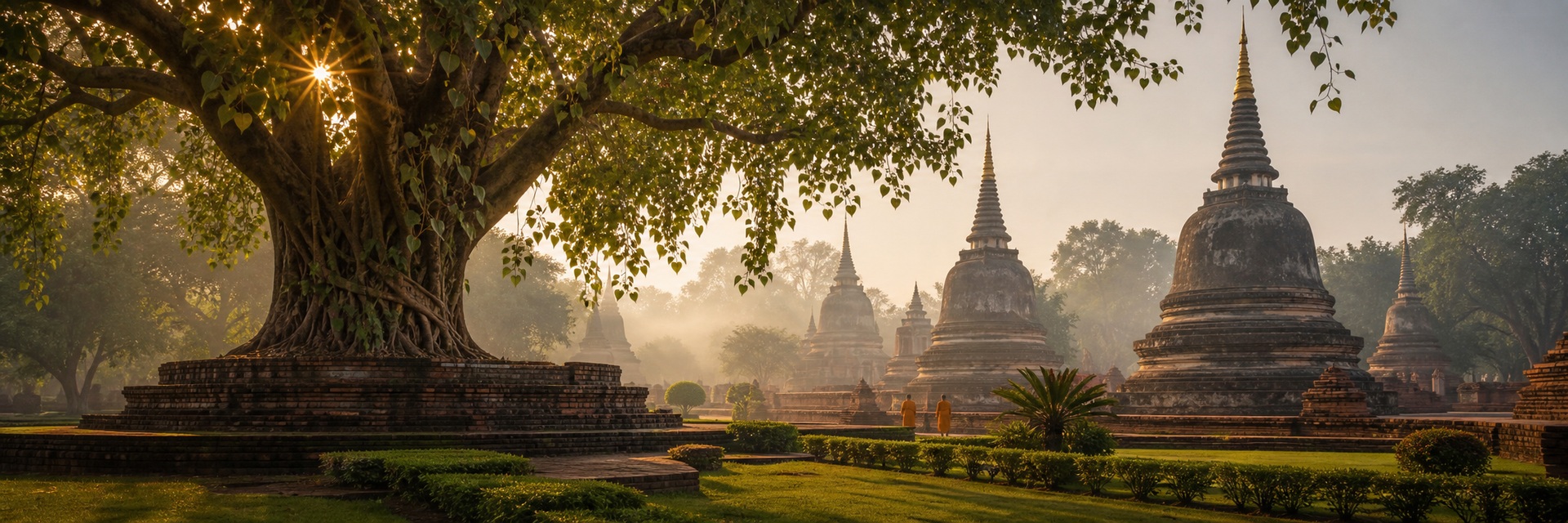
Destination - East India - Buddhist circuit
Setting Up a Luxury Resort in Bodh Gaya & the Buddhist Circuit
Bodh Gaya receives high-value international Buddhist demand, yet the luxury and retreat supply is far below what the circuit can support.
Bodh Gaya is where the Buddha attained enlightenment, with the Mahabodhi Temple as a UNESCO anchor and a circuit that extends to Sarnath, Kushinagar, Rajgir, Nalanda and Vaishali. Gaya and Kushinagar airports strengthen charter and group potential from Sri Lanka, Thailand, Japan, Korea, Vietnam, Myanmar and other Buddhist source markets. We help owners turn that demand into a calm, culturally precise retreat product while solving Bihar/UP land, approvals, build quality and operating-team depth.
UNESCO
Mahabodhi Temple sets the cultural bar
Circuit-led
Bodh Gaya links to Sarnath, Kushinagar and Nalanda
Retreat-ready
Meditation demand needs quiet, not spectacle
Luxury gap
Premium international demand outruns supply
At a glance
Best-fit micro-markets
Bodh Gaya edge sites near but not pressing the Mahabodhi core; Gaya airport axis; Rajgir/Nalanda extensions for circuit retreats.
Demand engine
International Buddhist pilgrims, monastic groups, meditation retreats, government-backed Buddhist Circuit travel and Indian spiritual tourism.
Positioning
Quiet Buddhist-inspired retreat, vegetarian food, group logistics, charter readiness and contemplative wellness.
Critical approval
Local building sanction, land-use conversion, tourism registration, pollution-control and sensitivity around UNESCO/monastery adjacency.
Access
Gaya airport, Kushinagar International Airport for circuit movement, Patna/Varanasi links and road/rail connections through Bihar and UP.
Build watch-out
Emerging contractor capacity, Gangetic-plains heat and monsoon, group-bus logistics, and culturally respectful programming.
Guests from Buddhist Asia
The high-value guest is often international and devotional: travellers from Sri Lanka, Thailand, Japan, Korea, Vietnam, Myanmar and other Buddhist source markets, alongside Indian spiritual tourists and monastic groups. They may travel in groups, follow fixed ritual timings, require multilingual coordination and expect food and service that respect Buddhist sensibilities.
This demand can support retreats, meditation-led stays, circuit itineraries and charter-linked arrivals, but it punishes generic luxury. The property must be peaceful, efficient with buses and groups, careful around monastery relationships, and capable of serving vegetarian, light and culturally familiar food without pretending to be a monastery itself.
- International Buddhist pilgrims as the premium demand core
- Charter and group travel potential through Gaya and Kushinagar
- Meditation retreats and circuit itineraries as stay-length drivers
- Vegetarian, calm and multilingual service as operating essentials
Land near sanctity, not inside pressure
The best land is not necessarily the closest land. Sites too near the Mahabodhi core can face congestion, noise, heritage sensitivity and limited operational space. Edge sites with clean access, landscape, bus movement, group arrival, meditation gardens and controlled transfers often make a stronger resort product while still feeling connected to Bodh Gaya.
Rajgir and Nalanda extensions can also work where the thesis is circuit retreat rather than pure Mahabodhi proximity. The deciding factors are title clarity, road access, utilities, monastery adjacency, noise, group circulation and whether the property can create stillness without isolating the guest from the pilgrimage purpose.
| Filter | Why it matters |
|---|---|
| Distance from Mahabodhi core | Balances spiritual access with congestion, noise and sensitivity |
| Group-bus movement | Controls arrival, luggage, guides and charter-group operations |
| Monastery adjacency | Can add legitimacy but requires respectful boundaries and noise discipline |
| Landscape and quiet | Meditation and retreat positioning need genuine calm |
Bodh Gaya siting filters for a premium retreat or circuit resort.
Approvals and UNESCO sensitivity
A Bodh Gaya project carries normal hospitality approvals - land-use conversion where required, building sanction, fire NOC, FSSAI, pollution-control consent, tourism registration and hotel classification - but the real sensitivity is cultural and spatial. Anything near the Mahabodhi Temple, monastery clusters or protected precincts must be planned with restraint and local consultation.
The technical clearance path should be joined to an operating protocol: noise control, coach movement, waste, water, kitchen smoke, group timing, signage and guest behaviour. In a pilgrimage town, a project can be legally approved and still lose trust if it behaves without respect.
- Land-use conversion and local building sanction by exact jurisdiction
- Fire, FSSAI, pollution-control, tourism registration and hotel classification
- UNESCO and protected-precinct sensitivity around Mahabodhi and nearby heritage
- Monastery-neighbour protocols for noise, traffic, waste and guest movement
A retreat, not a themed hotel
The design should use Buddhist restraint rather than obvious iconography. Courtyards, gardens, shaded walking loops, meditation rooms, soft light, simple materials, water, trees and silence can create a luxury that feels appropriate to Bodh Gaya. Over-theming would cheapen the very thing the guest travelled to honour.
Wellness should be contemplative: meditation, breathwork, gentle therapies, vegetarian cuisine, tea, reading spaces and guided circuit interpretation. The guest journey must allow early rituals, group departures, quiet returns and respectful private time.
Building in an emerging hospitality base
Bihar and eastern UP can build, but luxury resort execution needs closer owner-side control than in mature destinations. Contractor quality, finishing, MEP, kitchen equipment, FF&E and landscape may require vendors from Kolkata, Delhi, Varanasi or other stronger markets. The programme must account for heat, monsoon, road logistics and the extra coordination of charter or group arrivals.
Hiring is equally deliberate. Senior leadership may need to come from established hospitality markets, while local associates are trained for group handling, multilingual basics, calm service and pilgrimage sensitivity. We also plan guide, interpreter and transport partnerships as part of the operating ecosystem rather than leaving them outside the resort.
Gladwin's edge in Bodh Gaya
We de-risk Bodh Gaya by treating it as an international pilgrimage and retreat asset, not a generic hotel project. We test land, access, monastery adjacency, UNESCO sensitivity, group logistics, food, languages and circuit packaging before design is frozen.
Then we govern procurement, approvals, hiring and launch as one accountable partner. The operating team is built for calm: international Buddhist groups, vegetarian kitchens, guide and transport coordination, retreat programming and service that feels respectful without becoming performative.
Planning a resort in Bodh Gaya & the Buddhist Circuit?
We take single accountability from raw land to a stabilised opening — siting and approvals, market and pricing, design, procurement, and the full team — from General Manager to line level — recruited through our executive search practice and trained for opening.
Speak with a partnerSetting up a resort in Bodh Gaya & the Buddhist Circuit — FAQs
Yes, but it is specific demand. International Buddhist pilgrims, monastic groups, retreats and circuit travellers can support premium product if it is calm, culturally precise and operationally ready for group and charter movement.
Not necessarily. Proximity helps, but congestion, sensitivity and lack of operational space can hurt a resort. Edge sites with quiet, landscape, bus movement and controlled transfers often make a stronger premium product.
It means the project must be especially careful around protected precincts, visual impact, traffic, noise and cultural respect. The exact constraints depend on site, but we test heritage and local sensitivity before committing to land.
Yes, if it is built for them: bus arrival, luggage flow, fixed meal timings, multilingual support, vegetarian menus, guide coordination, meditation spaces and airport/charter logistics through Gaya and the wider circuit.
Emerging contractor depth, finishing quality, MEP reliability, heat, monsoon, road logistics and the need to source many premium items from stronger markets. Owner-side programme control is essential.
Senior leadership is likely to come from established hotel markets, supported by local associates trained for pilgrimage, group handling and cultural sensitivity. Transport, guide and interpreter partners are part of the operating team in practice.
Explore the cluster
Luxury resorts across India’s destinations
North - Ganga spiritual city
Varanasi (Kashi)
Kashi's spiritual demand is enormous, but the city gives developers only two honest choices: a difficult riverfront heritage conversion or a disciplined greenfield resort outside the old core.
North - Temple & pilgrimage corridor
Lucknow-Ayodhya Corridor
Ayodhya now has the pilgrim volume; the premium supply, trained operating base and clean greenfield land are still catching up.
Northeast - Brahmaputra wildlife
Kaziranga
Kaziranga's rhino draw is world-class, but the Brahmaputra floods the park every year; lodges must be elevated, flood-aware and corridor-sensitive.
Also explore our executive search practice for the General Manager and leadership team, and the wider end-to-end hospitality practice — hotels, residences, clubs and heritage properties.