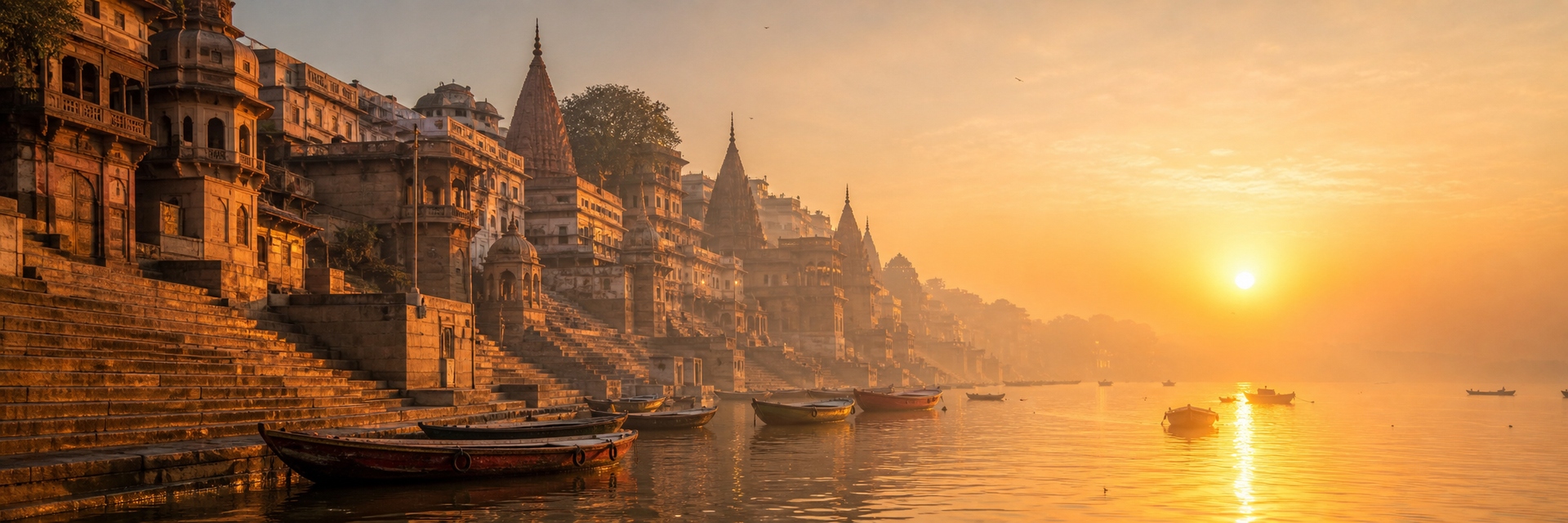
Destination - North India - Spiritual riverfront
Setting Up a Luxury Resort in Varanasi (Kashi)
Kashi's spiritual demand is enormous, but the city gives developers only two honest choices: a difficult riverfront heritage conversion or a disciplined greenfield resort outside the old core.
The Kashi Vishwanath Dham Corridor changed the ghats-to-temple economy, drawing the old city, Dashashwamedh, Assi and the Ganga aarti into a sharper visitor circuit. Yet the top-end supply remains thin: a handful of heritage and palace references carry a market that serves pilgrims, luxury travellers, diaspora families and Sarnath-bound Buddhist visitors. We help owners decide whether the asset should fight for the riverfront or build scale on the ring-road and airport side, then carry it from feasibility to a stabilised opening.
Ghat-led
The riverfront is the product and the constraint
Two routes
Heritage haveli or greenfield ring-road resort
Spiritual
Pilgrim, diaspora and Buddhist circuit demand
Turnkey
Approvals, design, procurement and team under one owner rep
At a glance
Best-fit micro-markets
Old-city ghats for rare heritage conversions; Cantonment and Nadesar for established premium demand; ring-road, airport and Sarnath side for greenfield scale.
Demand engine
Kashi Vishwanath darshan, Ganga aarti, ritual travel, Sarnath, diaspora visits and culture-led luxury travel.
Positioning
Riverfront spiritual luxury if heritage-led; quiet retreat with controlled transfers if greenfield.
Critical approval
Ganga riverfront and NGT sensitivity, ASI heritage proximity, local building sanction, tourism registration and pollution-control compliance.
Access
Lal Bahadur Shastri International Airport, Varanasi Junction, Manduadih/Banaras station and the ring-road system.
Build watch-out
Old-city logistics, monsoon river levels, restricted access lanes, heritage fabric and vegetarian/alcohol sensitivities.
Kashi after the corridor
The Kashi Vishwanath Dham Corridor made the most valuable visitor movement in Varanasi easier to understand: temple, ghat, ritual, aarti, boat and old-city commerce now work as one compressed spiritual economy. That does not make development simpler. It makes the gap more visible. The luxury guest wants the atmosphere of the ghats, but the ghats are dense, fragile, watched by regulators and almost impossible to service like a conventional resort.
The investable opportunity is therefore highly specific. BrijRama Palace proves that riverfront heritage can command attention when the asset is rare enough; Taj Nadesar Palace and Taj Ganges show the value of calmer land away from the river. A new project must choose which problem it wants to solve, because the middle ground - a generic hotel with a Banaras mood board - will not earn a premium.
In Varanasi the river is not a view category. It is the operating logic, the approvals risk, the arrival problem and the emotional reason the guest came.
The guest mix is older than tourism
Varanasi's demand does not behave like a normal leisure market. It includes pilgrims on once-in-a-lifetime ritual journeys, families managing ceremonies for elders, diaspora visitors returning to a civilisational city, culture travellers seeking music, silk, food and the ghats, and Buddhist travellers who combine Kashi with Sarnath. The property has to serve intensity without becoming theatrical.
That means quiet luxury, reliable transfers, high-trust guides and boatmen, respectful ritual facilitation, and an F&B model that can handle vegetarian expectations without making every guest feel constrained. Source markets range from Delhi, Mumbai, Kolkata and Lucknow to overseas Indian families and inbound Buddhist and cultural travellers; the product must feel rooted enough for all of them.
- Darshan and ritual travel as the core demand driver
- Sarnath and the Buddhist circuit as a strong second axis
- Banarasi silk, music, food and boat experiences as premium programming
- Domestic HNI, diaspora and inbound cultural travellers layered together
Riverfront haveli or ring-road resort
The old-city route is emotionally powerful and operationally punishing. A riverfront haveli near Dashashwamedh, Assi or the quieter ghats gives instant story, boat-arrival theatre and a rate ceiling that an inland hotel cannot copy. It also brings narrow lanes, heritage structure, difficult fire and life-safety upgrades, monsoon river-level planning, limited back-of-house and intense scrutiny around anything that touches the Ganga edge.
The greenfield route is less romantic but often more bankable. Sites on the ring-road, airport or Sarnath side can deliver arrival, parking, landscape, wellness, events and operational scale, provided the transfer to the ghats is choreographed beautifully. The question is not which is more prestigious; it is which route fits the owner's capital, patience, operating model and appetite for heritage risk.
| Route | What it gives | What it demands |
|---|---|---|
| Riverfront heritage conversion | Irreplaceable ghat identity, boat arrivals, strong emotional pricing | Heritage retrofit, access limits, Ganga scrutiny, constrained keys |
| Ring-road / airport-side greenfield | Scale, landscape, wellness, parking and easier construction | A flawless transfer and programming strategy so it still feels like Kashi |
| Sarnath-side retreat | Buddhist-circuit positioning and quieter land | Clear separation from the main Kashi pilgrim product |
Two credible Varanasi routes; the specific plot decides the approval and operating plan.
Approvals along the Ganga
A Varanasi resort must be cleared through a stack that changes sharply by site. Riverfront or heritage-adjacent projects have to account for Ganga riverfront restrictions, National Green Tribunal sensitivity, flood and drainage planning, ASI proximity where monuments are involved, local building sanction, fire and life-safety upgrades, and pollution-control consents. Greenfield sites still carry land-use conversion, building sanction, environmental and utility approvals, but they usually avoid the old city's hardest access and conservation issues.
We sequence the approvals around what can actually kill the project: the river edge, heritage status, title, access and life safety. The technical filings are made by the appointed architects, lawyers and environmental consultants; our role is to govern the roadmap so design, licensing and investment decisions move in the same order.
- Ganga riverfront, flood and drainage assessment for any site near the ghats
- NGT and pollution-control sensitivity for discharge, waste and construction impact
- ASI and heritage considerations around protected monuments and old-city fabric
- Development-authority sanction, fire NOC, FSSAI, tourism registration and hotel classification
Designing without turning Kashi into decor
Varanasi does not need imitation temples in the lobby. It needs restraint: stone, timber, courtyards, river-facing pauses, quiet acoustics, Banarasi silk and brass handled as craft rather than costume, and programming that respects the city as living religion. The guest journey should be built around dawn boats, controlled ghat access, aarti, Sarnath, music, food and recovery from the old city's intensity.
The strongest resorts here will be spiritually literate and operationally precise. That means accessible rooms for older guests, guide and boatman partnerships, private dining for families after rituals, vegetarian depth, and a spa or wellness layer that feels contemplative rather than imported.
Build, procurement and the service ecosystem
Old-city construction is a hand-to-hand logistics exercise: small vehicles, restricted hours, heritage fabric, neighbour management and no easy staging yard. Ring-road construction is simpler but still has to solve dust, heat, monsoon drainage and the long supply chain for premium FF&E. In both routes, the procurement plan needs to respect what Banaras does beautifully - silk, metalwork, craft, food - while importing what the local supply base cannot yet deliver to luxury specification.
The team is equally hybrid. A Varanasi property needs luxury leadership, local cultural intelligence, reliable guide and boatman relationships, and training around ritual sensitivity. We build the team and the ecosystem together so the service does not depend on improvisation once the first high-stakes pilgrim family arrives.
Gladwin's edge in Varanasi
We begin with the strategic fork: riverfront heritage conversion, greenfield resort, or Sarnath-side retreat. Then we test the land, Ganga risk, heritage exposure, access and operating model before design sentiment takes over. From there we govern approvals, design, procurement, hiring and opening as one accountable partner.
For the operating team, we blend luxury leaders with Banaras-specific capability: ritual and guide coordination, boatman networks, vegetarian F&B depth, heritage-service training and calm handling of older family guests. The result is not a deck. A business that can function in one of India's most intense hospitality environments.
Planning a resort in Varanasi (Kashi)?
We take single accountability from raw land to a stabilised opening — siting and approvals, market and pricing, design, procurement, and the full team — from General Manager to line level — recruited through our executive search practice and trained for opening.
Speak with a partnerSetting up a resort in Varanasi (Kashi) — FAQs
Only in rare, site-specific circumstances, usually through a heritage conversion rather than a normal new build. Ganga riverfront restrictions, NGT sensitivity, heritage fabric, access and life-safety constraints all need to be tested before any capital is committed.
Yes, if the guest journey is designed properly. Greenfield sites can deliver scale, landscape, wellness and parking that the old city cannot. The resort then needs controlled transfers, guide networks, boat experiences and programming that make Kashi feel close rather than outsourced.
Sarnath adds a Buddhist-circuit layer, especially for inbound travellers from Buddhist source markets and culture-led guests. It can strengthen a quieter retreat concept, but it should not blur the core Kashi proposition unless the site genuinely sits on that axis.
For riverfront and old-city assets: Ganga edge restrictions, NGT scrutiny, heritage or ASI proximity, fire and life safety, and access. For greenfield assets: land use, title, environmental thresholds, utilities and development-authority sanction. The site determines which risk leads.
Not everywhere in the city, but vegetarian and alcohol sensitivity is real around the spiritual guest. We usually model a premium vegetarian-led programme with carefully positioned wider F&B depending on site, target guest and distance from the temple core.
Senior luxury leadership is likely to be hired from established markets, while local associates, guides, boatmen and cultural partners give the property its Kashi fluency. Training is essential because the most valuable guest interactions are often ritual-sensitive and family-sensitive.
Explore the cluster
Luxury resorts across India’s destinations
North - Temple & pilgrimage corridor
Lucknow-Ayodhya Corridor
Ayodhya now has the pilgrim volume; the premium supply, trained operating base and clean greenfield land are still catching up.
East - Buddhist pilgrimage circuit
Bodh Gaya & the Buddhist Circuit
Bodh Gaya receives high-value international Buddhist demand, yet the luxury and retreat supply is far below what the circuit can support.
North - Braj temple region
Mathura-Vrindavan
Braj has enormous devotional demand and almost no true luxury supply, but sacred food norms, floodplain scrutiny and expressway land choices define what can actually be built.
Also explore our executive search practice for the General Manager and leadership team, and the wider end-to-end hospitality practice — hotels, residences, clubs and heritage properties.