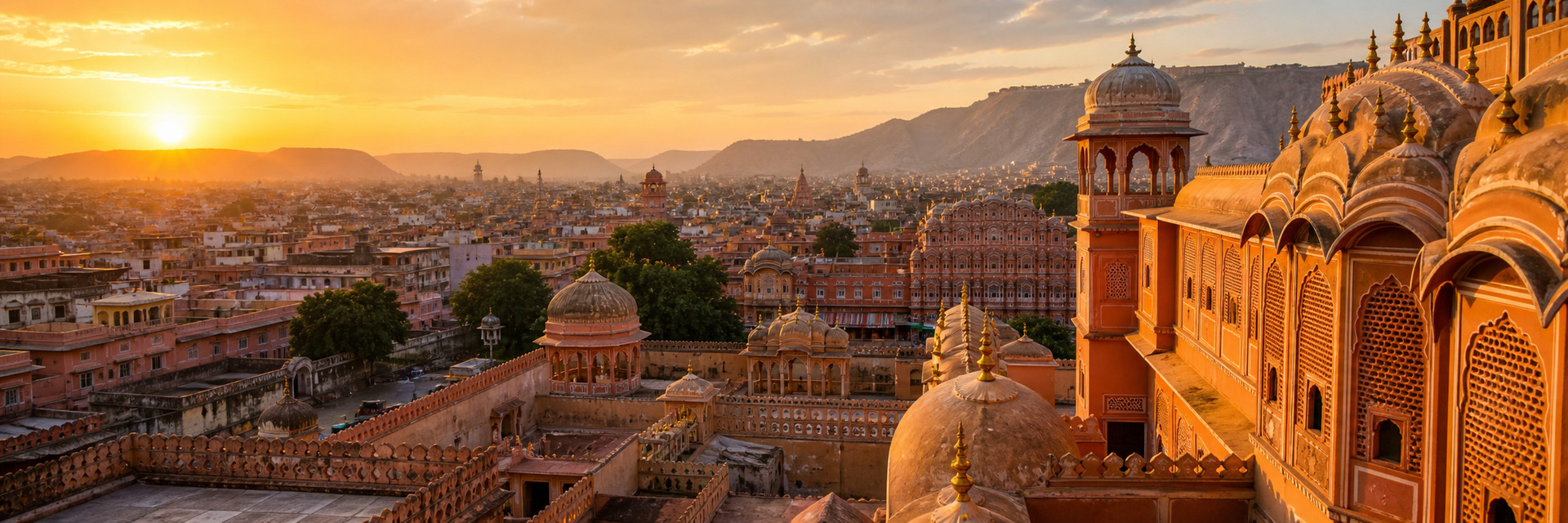
Luxury Hotels · North-West India · Pink City heritage
Setting Up a Luxury Hotel in Jaipur
Jaipur is the market that wrote India's palace-hotel playbook — and it now trades on weddings, MICE and Golden-Triangle demand as much as on royal romance.
The luxury hotel opportunity in Jaipur turns on two questions owners rarely resolve early enough: whether you are restoring a heritage building inside a UNESCO-protected walled city or building resort-scale on the Amer–Kukas–Delhi-road belt, and how you convert the city's weddings-and-MICE demand into ADR rather than one-night stopovers. Gladwin International runs the entire journey as a single accountable programme — reading the heritage-versus-greenfield economics, siting against what the Jaipur Development Authority and the walled-city bylaws actually permit, and taking you from a plot or a palace to a fully staffed, revenue-live hotel.
Palace or greenfield
The product decision we settle first
Weddings + MICE
The demand the model is built around
~4.5 hrs from Delhi
The drive market feeding weekend and event demand
Turnkey
Site to a stabilised opening
At a glance
Best-fit micro-markets
Walled city / civil lines (heritage-constrained); the Amer–Delhi Road corridor; the Kukas belt (Tonk Road, Ajmer Road for resort-scale).
The legacy that set the bar
The palace-hotel tradition — Rambagh Palace, SUJÁN Rajmahal Palace, The Oberoi Rajvilas, Jai Mahal Palace, ITC Rajputana, Fairmont Jaipur.
Demand mix
Destination weddings, MICE (JECC / Jaipur Exhibition & Convention Centre), Golden-Triangle international, and Delhi-driven leisure.
Two product types
Restored palace / heritage conversions inside the city, and resort-scale hotels on the outskirts where land and buildable area are available.
Critical approvals
JDA building approval and zoning; walled-city heritage bylaws; land conversion (change of land use); fire, excise, RIPS incentives.
Siting watch-out
Walled-city plots are UNESCO-protected and bylaw-bound — banqueting and wedding scale usually lives on the outskirts, not inside the pink.
The opportunity
Jaipur is the market that defined heritage luxury in India — the palace conversions here taught a generation of owners what a royal Rajasthan hotel could earn. That legacy is still the brand of the city, but the demand underneath it has broadened. The engine now is events: the destination-wedding trade that treats Jaipur as a first-choice venue, and a MICE market anchored by the Jaipur Exhibition & Convention Centre. Layered on top is steady Golden-Triangle international traffic (Delhi–Agra–Jaipur) and a large, high-frequency Delhi drive market roughly four-and-a-half to five hours up the expressway.
That demand rewards a different product from a pure heritage suite hotel. Wedding and MICE business runs on banqueting halls, pillarless ballrooms, sprawling lawns, a fleet of restaurants and the room count to house a full guest list — capacity that the constrained plots inside the walled city rarely permit. The whitespace is disciplined: either a genuine heritage conversion positioned at the top of the ADR curve, or a resort-scale, events-capable hotel on the outskirts sized for the weddings-and-MICE calendar.
In Jaipur the premium play is a fork, not a spectrum: a top-of-market heritage conversion inside the city, or an events-capable, resort-scale hotel on the outskirts — each answers a different plot, budget and demand.
Palace-conversion versus resort-scale — the decision that shapes everything
The first fork is not brand — it is product. A heritage or palace conversion buys instant provenance and a rate premium no new-build can manufacture, but it comes with a restoration brief governed by conservation practice, structural unknowns, listed-fabric constraints and a room count capped by the building. A resort-scale greenfield on the outskirts buys buildable area, banqueting scale and a clean construction path, but has to earn its sense of place through design rather than inherit it. The two products carry different capital profiles, different timelines and — critically — different demand they can actually serve.
We model both routes against your investment thesis before a rupee is committed: the achievable key count and banqueting footprint on the specific plot or building, the restoration risk and cost-to-complete on a heritage asset, the land, conversion and buildable-area position on a greenfield, and the demand — weddings, MICE, leisure — each can credibly capture. Only then do we take the brand-versus-operator question, because the product decision sets the brief the operator must fit, not the other way round.
- Heritage conversion or resort-scale greenfield — modelled against your ROI, timeline and demand
- Achievable key count and banqueting footprint tested against the actual plot or building
- Restoration risk, structural survey and cost-to-complete assessed before commitment on heritage assets
- Brand-versus-operator (independent, HMA, franchise) taken second, fitted to the product
Siting — the walled city versus the outskirts
Jaipur's historic core is a UNESCO World Heritage city, and the walled-city fabric — the ordered pink grid, the chaupars and havelis — is protected by heritage bylaws that govern facade, height, materials and use. That protection is precisely what makes an in-city heritage hotel valuable, but it also caps scale, forbids the banqueting and lawn footprint a wedding hotel needs, and turns every intervention into a conservation exercise. Civil-lines and near-city plots sit between the two worlds — accessible but often title- and zoning-complex.
The banqueting-and-weddings economics, by contrast, live on the outskirts: the Amer and Delhi Road corridor, the Kukas belt, and the Tonk Road and Ajmer Road approaches, where plots carry the buildable area, the lawns and the arrival experience that events demand — and where the Delhi drive market and the airport are easiest to reach. We resolve the zoning, the land-conversion (change-of-land-use) status and, inside the walls, the heritage-bylaw envelope before capital is committed, and choose the site against the guest and the events calendar you are actually chasing.
| Site type | Best for |
|---|---|
| Walled city (heritage-bylaw bound) | Top-of-market heritage suites and provenance — but capped scale, no banqueting |
| Civil lines / near-city | Boutique heritage-luxury with limited events, subject to title and zoning |
| Amer–Delhi Road / Kukas belt | Resort-scale weddings, MICE and full banqueting with lawns and arrival |
Indicative siting logic — always subject to the JDA zone, heritage-bylaw classification and land-conversion status for the specific plot.
Approvals & incentives — the Jaipur hotel stack
A Jaipur hotel carries a sequenced approvals stack anchored on the Jaipur Development Authority, and — uniquely for a heritage asset in the core — an additional conservation layer. Licensed filings are made by your appointed architects, conservation consultants, engineers and lawyers; we coordinate and govern them to a legally-open asset, and position the project for the Rajasthan investment incentives it qualifies for.
- JDA building-plan approval, zoning and land conversion (change of land use / CLU)
- Walled-city heritage-bylaw clearance for any asset inside the protected core (facade, height, use)
- Rajasthan Investment Promotion Scheme (RIPS) tourism incentives — structured into the project economics
- Excise (liquor) licence — central to a wedding-and-MICE hotel's F&B and events revenue
- Rajasthan Tourism registration and Ministry of Tourism / HRACC classification
- Fire NOC, FSSAI, environmental clearance above threshold, and pollution-control and utility consents
What a Jaipur luxury hotel must be
Jaipur guests — and Jaipur weddings — arrive with an expectation the city itself sets: a Rajput–Mughal idiom handled with conviction, not pastiche. Pink and Dholpur sandstone, jharokhas and jaali, frescoed and mirror-worked interiors, courtyards and stepped water — the local craft supply chain that built the palaces is still here, and a serious hotel uses it rather than decorating around it. But atmosphere alone does not win the events market: the ballroom, the lawns, the mandap-capable outdoor settings, the multiple dining rooms and the arrival sequence have to carry a full destination wedding or a JECC conference delegation.
We brief the concept, the wedding-and-MICE strategy and the guest journey as one problem, so the banqueting, the lawns, the restaurants and the rooms are designed as a single revenue engine — a hotel that photographs as Jaipur and operates as an events machine, matched to the weddings, MICE and Golden-Triangle demand you are targeting.
Procurement & build realities
Building in Jaipur is governed by heat and by craft. The Rajasthan summer — the punishing April-to-June window and the monsoon that follows — dictates the concreting and finishing critical path, and site logistics inside or near the walled city are tight. The upside is a living craft supply chain: sandstone carvers, fresco and meenakari artisans, and stone yards that can deliver the Rajput detailing a heritage-luxury hotel depends on — but craft lead times and quality control have to be programmed, not assumed, and a genuine restoration adds specialist conservation trades on top.
We run the full procurement programme — FF&E, OS&E, kitchens, banqueting and wedding infrastructure, spa and pool plant, and the technology and revenue systems — with independent vendor intelligence, blending imported specification with the local stone-and-craft trades, and a schedule mapped around the summer-heat build windows and to commissioning, so the target opening survives the season.
Gladwin's edge in Jaipur
We treat a Jaipur hotel as the product, siting and events problem it actually is — and we make owners settle the palace-versus-greenfield fork before anyone talks about a flag. Before capital is committed we resolve the heritage-bylaw envelope or the land-conversion path, the restoration risk on a listed building, and the buildable banqueting footprint, model the economics of each route against real weddings-and-MICE demand, and choose the site accordingly — not the plot a broker is selling on royal romance alone. Then we run design, procurement, the operator relationship, the full team hired and trained, and a supported launch as one accountable partner and your Owner's Representative.
The team we build is events-capable and draws on Jaipur's real advantage: a deep palace-hotel service tradition and one of India's strongest hotel-school pipelines. We recruit a General Manager who can run a wedding-and-MICE-led operation and a head-of-department team that understands Rajasthan hospitality, in seat and trained before the first wedding season peak.
Planning a luxury hotel in Jaipur?
We take single accountability from a site and an investment thesis to a stabilised opening — brand-versus-operator strategy, feasibility, design, procurement, PMO and the revenue systems. The team is recruited through our executive search practice and trained for opening.
Speak with a partnerSetting up a luxury hotel in Jaipur — FAQs
It is the first decision, ahead of brand. A heritage or palace conversion buys instant provenance and a rate premium but caps key count and rules out large banqueting, and carries restoration and structural risk. A resort-scale greenfield on the outskirts buys buildable area, lawns and MICE-and-wedding capacity but has to earn its sense of place through design. We model both against your thesis — key count, banqueting footprint, restoration cost and demand — before you commit.
Generally no. Jaipur's historic core is a UNESCO World Heritage city governed by heritage bylaws that cap height, protect the facade and restrict use, so the banqueting halls and lawns a destination-wedding or JECC-scale MICE hotel needs rarely fit inside the walls. That scale lives on the outskirts — the Amer–Delhi Road corridor and the Kukas belt. In-city heritage assets are best positioned as top-of-market suite hotels.
Very. Jaipur sits roughly four-and-a-half to five hours from Delhi by expressway, which feeds a large, high-frequency weekend-leisure and events market on top of Golden-Triangle international traffic and fly-in weddings. We factor the drive market, the airport catchment and the wedding-and-MICE calendar into the demand model and the siting decision.
The core stack runs through the Jaipur Development Authority — building-plan approval, zoning and land conversion (change of land use) — plus, for any asset inside the protected core, walled-city heritage-bylaw clearance. Then the excise (liquor) licence central to events revenue, Rajasthan Tourism and HRACC classification, fire, FSSAI, environmental and utility consents. We also structure the project for Rajasthan Investment Promotion Scheme (RIPS) tourism incentives.
Yes — it is core. We recruit the General Manager and the full head-of-department and pre-opening team through our executive search practice, drawing on Jaipur's deep palace-hotel service tradition and its strong hotel-school pipeline, and run pre-opening training so standards are live before the first wedding-season peak.
Not for the right product. The palace-hotel legacy is crowded at the very top, but the gap is events-capable, resort-scale hotels sized for the weddings-and-MICE demand the city now runs on — real banqueting, lawns, F&B and the key count to house a full wedding — and genuinely differentiated heritage conversions. Commodity mid-market rooms are crowded; events-led luxury priced for ADR is not.
Explore the cluster
Luxury hotels across India’s leading cities
West · Lake city
Udaipur
Udaipur is the market that taught the world what Indian luxury looks like — a lake-palace, wedding and high-end leisure economy where the product is the view, the water and the ceremony.
North · Capital & NCR
Delhi NCR
The national capital runs on four demand engines at once — government, diplomacy, corporate India and the country's largest luxury wedding market — and each rewards a different hotel.
North · Taj / Golden Triangle
Agra
Agra receives some of the highest visitor volume on earth — and converts almost none of it into a luxury overnight stay. That gap is the opportunity.
Also explore our executive search practice for the leadership team, and the wider end-to-end hospitality practice.