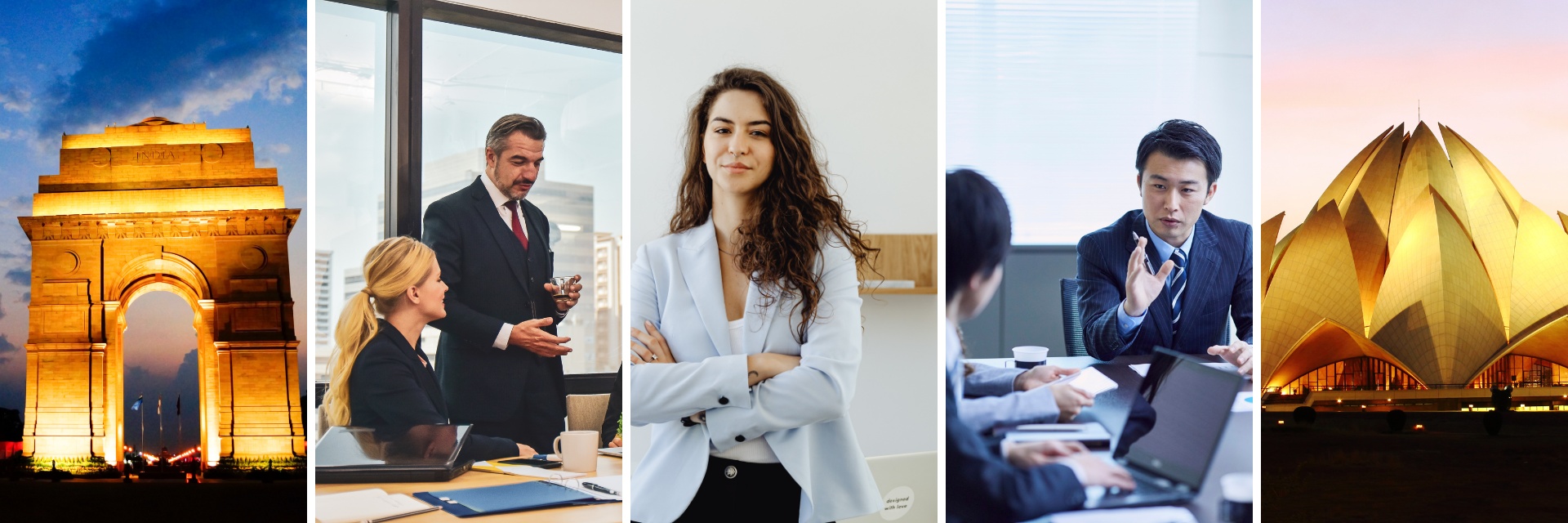
Luxury Hotels · North India · Capital region
Setting Up a Luxury Hotel in Delhi NCR
The national capital runs on four demand engines at once — government, diplomacy, corporate India and the country's largest luxury wedding market — and each rewards a different hotel.
Delhi NCR is not a single market. It is three — the diplomatic prestige of Lutyens' and central Delhi, the purpose-built airport-hotel economy of Aerocity, and the corporate MNC engine of Gurugram — and the difference between a trophy and a stranded asset is choosing the right one before you buy land. Gladwin International runs the whole journey as one accountable programme: reading the brand-versus-operator economics that capital-region distribution demands, siting against what the land regime and the approval maze actually permit, and taking you from a plot to a fully staffed, revenue-live hotel.
Three sub-markets
Lutyens', Aerocity and Gurugram — chosen deliberately
India's #1
Luxury wedding and MICE economy
Branded by default
The flag drives capital-region distribution
Turnkey
Site to a stabilised opening
At a glance
Best-fit sub-markets
Central: Lutyens'/Chanakyapuri (diplomatic prestige). Airport: Aerocity (MICE, transit, corporate). NCR: Gurugram — Golf Course Road, Cyber City, Aerocity-adjacent.
The operator landscape
The market ITC, Taj, The Oberoi, The Leela and international flags defined — the premium set is almost entirely branded.
Demand mix
Government and diplomatic delegations, corporate and MNC business, MICE and conventions, and colossal destination weddings.
The catalyst
Aerocity — the purpose-built airport-hotel district (JW Marriott, Pullman, Roseate House, Andaz) that created a genuine new sub-market beside Terminal 3.
Critical approvals
DDA land use, NDMC/MCD or GMDA building sanction, fire, excise, environmental clearance and aviation height (AAI/NOCAS) near the airport.
Siting watch-out
Central Delhi land is tightly controlled and rarely trades; most greenfield opportunity now sits in Aerocity and Gurugram, not inside Lutyens'.
The opportunity
No other Indian market layers four premium demand engines the way the capital region does. Government and the largest diplomatic corps in the country underpin a year-round base of state visits, delegations and embassy business. Corporate India and the multinationals headquartered across Gurugram drive weekday occupancy and rate. MICE and conventions fill banqueting. And Delhi NCR is, by a distance, India's biggest luxury wedding market — the demand that turns a good hotel into a great one on the P&L.
The strategic question is not whether the demand exists — it is which slice of it you are building for, because the capital is really three markets stacked on one map. The legacy trophies — ITC Maurya, The Oberoi, the two Taj addresses, The Leela Palace Chanakyapuri, The Lodhi — sit in central Delhi. The genuine new whitespace is branded, events- and business-capable hotels sited to Aerocity and Gurugram, where land can still be assembled and the demand map is being redrawn.
In Delhi NCR the premium play is deciding which of three sub-markets you are actually serving — diplomatic-central, airport-Aerocity or corporate-Gurugram — before land is committed, not after.
Three markets, not one — where a hotel must sit
Lutyens' and Chanakyapuri are the diplomatic-prestige belt: embassies, state guests and the highest-security clientele in the country, but land is tightly held, rarely trades and carries heavy heritage and height control. Aerocity is the purpose-built airport-hotel district beside Terminal 3 — the one genuinely new sub-market of the last decade, engineered for transit, corporate and convention demand and anchored by international flags. Gurugram is the corporate and MNC engine, where the Golf Course Road and Cyber City clusters serve weekday business travel and the region's wedding market at scale.
Each sub-market implies a different brand, a different room product and a different banqueting brief. We resolve which one your capital and thesis belong in — reading title, land use, height envelope and the real demand catchment — before a plot is bought, so the asset is aimed at a market that exists rather than one a broker is selling.
| Sub-market | Primary demand | Best-fit hotel |
|---|---|---|
| Lutyens' / Chanakyapuri | Diplomatic, government, state guests | High-security prestige, palace-tier, tightly controlled land |
| Aerocity | Transit, corporate, MICE, conventions | Business and convention-led, airport-adjacent, brand-anchored |
| Gurugram (GGR) | MNC corporate, weddings, weekday business | Corporate rooms with strong banqueting and wedding lawns |
Indicative siting logic — always subject to the specific plot's land use, NOCAS height limit and clear title.
Brand versus operator — the decision that shapes everything
The capital region is the most branded premium market in the country, and for reasons that bite hardest here: government protocol, multinational corporate travel policies and international MICE bookers all route through recognised flags and their global distribution. Whether you stay independent, sign a Hotel Management Agreement or take a franchise is an economic and control decision worth crores over the asset's life — and in a market this brand-conscious the flag also underwrites your rate positioning against the legacy set.
We model the options against your investment thesis — fee structures, brand technical-services standards, key-money and area-of-protection terms, and the corporate, MICE and loyalty distribution upside — and negotiate the agreement as your Owner's Representative, so you enter a decades-long relationship on terms you understand and can hold the operator to.
- Independent, HMA or franchise — modelled against your ROI and control appetite
- Operator selection and HMA / franchise negotiation as your Owner's Representative
- Brand technical-services and design-standard compliance built into the brief
- Revenue systems — PMS, RMS, distribution and loyalty — specified to the flag and to government-rate and corporate-RFP channels
The wedding, MICE and diplomatic revenue engine
In Delhi NCR the events business is not an add-on to the room product — it is often the reason the asset works. The region hosts the country's largest luxury weddings, and a hotel built to win them needs pillar-less ballrooms at scale, sprawling lawns, multiple simultaneous-function capability, valet and arrival choreography for hundreds of cars, and a kitchen brigade that can plate for thousands. The same infrastructure serves the MICE and convention demand that Aerocity and Gurugram were built to capture.
Layered on top, in the central sub-market, is a diplomatic and government demand that carries its own non-negotiable requirements — secure arrival and departure, protocol suites, blast and access considerations, and discretion. We brief banqueting, the room mix and the security and arrival design together, so the ballroom, the lawns, the suites and the operation are one revenue engine matched to the exact demand slice you are chasing.
A capital-region luxury hotel lives or dies on its banqueting and arrival design — the wedding, convention and diplomatic business is engineered in at concept stage, never retrofitted.
Approvals & licences — the NCR hotel stack
The capital region spans multiple planning authorities, and the stack differs by sub-market: a central-Delhi plot answers to the DDA master plan and NDMC or MCD building sanction, while a Gurugram plot runs through GMDA and Haryana's town-and-country planning regime. Near the airport, aviation height clearance (AAI / NOCAS) is a hard constraint that can cap your buildable envelope. We build the sequenced stack into the programme from day one; licensed filings are made by your appointed architects, engineers and lawyers, and we coordinate and govern them to a legally-open asset.
- Land use and building sanction — DDA / NDMC / MCD in Delhi, GMDA and Haryana TCP in Gurugram
- Aviation height clearance (AAI / NOCAS) for Aerocity and airport-adjacent plots
- Environmental clearance (SEIAA / MoEFCC) above the built-up-area threshold
- Ministry of Tourism hotel classification (HRACC) and state tourism registration
- Excise (liquor) licence — central to a capital-region hotel's F&B and wedding economics
- Fire NOC, FSSAI, DJB / HSVP water and sewage, and pollution-control board consents
Design, climate and build realities
Building in the capital region is governed by climate extremes and an air-quality regime that directly shapes the construction schedule. Delhi's swing from 45-degree summers to near-freezing winter mornings drives a demanding envelope and HVAC specification, while the winter smog season triggers construction restrictions under the Graded Response Action Plan (GRAP) and NGT directions — periods when earthworks, demolition and even certain site activity can be curtailed. That risk has to sit in the critical path, not be discovered on it.
We run the full procurement programme — FF&E, OS&E, kitchens, the banqueting and ballroom fit-out, spa, pool and back-of-house plant, and the technology and revenue systems — with independent vendor intelligence and a schedule mapped around the GRAP season and to commissioning. Where the asset serves diplomatic or government guests, we build the security, access-control and arrival design into the specification from the outset rather than layering it on late.
Gladwin's edge in Delhi NCR
We treat a capital-region hotel as the three-market, brand and events problem it actually is. Before a rupee is committed we decide which sub-market — diplomatic-central, airport-Aerocity or corporate-Gurugram — the asset belongs in, resolve title, land use and the NOCAS height envelope, model the brand-versus-operator economics against the legacy set, and design the banqueting and arrival engine to the demand slice you are chasing. Then we run design, procurement, the operator relationship, the full team hired and trained, and a supported launch as one accountable partner and your Owner's Representative.
The team we build is capital-grade: a General Manager who can run a government-, MICE- and wedding-led operation, and a hiring plan that draws on Delhi's deep hospitality talent pool and the region's hotel-school pipeline, in seat and trained before the first winter wedding and convention peak.
Planning a luxury hotel in Delhi NCR?
We take single accountability from a site and an investment thesis to a stabilised opening — brand-versus-operator strategy, feasibility, design, procurement, PMO and the revenue systems. The team is recruited through our executive search practice and trained for opening.
Speak with a partnerSetting up a luxury hotel in Delhi NCR — FAQs
It depends on the demand you are building for. Central Delhi — Lutyens' and Chanakyapuri — is the diplomatic-prestige belt, but land is tightly held and rarely trades. Aerocity is the purpose-built airport-hotel district for transit, corporate and convention demand. Gurugram is the MNC corporate and wedding engine. We resolve which sub-market your capital belongs in, against title, land use and the real catchment, before a plot is bought.
The capital is the most branded premium market in India, because government protocol, multinational corporate travel policies and international MICE bookers all route through recognised flags. We model independent vs Hotel Management Agreement vs franchise against your thesis — fees, technical standards, key money, area of protection, and the corporate, MICE and loyalty distribution upside — and negotiate the agreement as your Owner's Representative.
Often decisive. Delhi NCR is India's largest luxury wedding and MICE market, and a hotel built to win it needs pillar-less ballrooms at scale, lawns, simultaneous-function capability, arrival and valet choreography for hundreds of cars, and a kitchen able to plate for thousands. We engineer the banqueting and arrival design in at concept stage rather than retrofitting it.
Aviation height clearance. Any plot near Indira Gandhi International runs through AAI's NOCAS process, and the height cap can materially limit your buildable envelope and key count — so it has to be resolved before land is committed. Aerocity also skews the demand toward transit, corporate and convention business, which shapes the brand and room product.
The stack differs by sub-market: DDA land use with NDMC or MCD sanction in Delhi, or GMDA and Haryana TCP in Gurugram; aviation height clearance near the airport; environmental clearance above threshold; Ministry of Tourism classification; the excise (liquor) licence central to F&B and weddings; and fire, FSSAI, water/sewage and pollution-control consents. We sequence and govern the whole stack.
Both sit in the critical path. The swing from 45-degree summers to near-freezing winters drives the envelope and HVAC specification, and the winter smog season triggers construction restrictions under GRAP and NGT directions that can curtail site activity for weeks. We map the schedule around the GRAP season and to commissioning so the target opening survives it.
Explore the cluster
Luxury hotels across India’s leading cities
West · Financial capital
Mumbai
Mumbai is India's deepest, most valuable and most contested luxury-hotel market — and the one where land, not demand, is the binding constraint.
North-West · Pink City heritage
Jaipur
Jaipur is the market that wrote India's palace-hotel playbook — and it now trades on weddings, MICE and Golden-Triangle demand as much as on royal romance.
North · Taj / Golden Triangle
Agra
Agra receives some of the highest visitor volume on earth — and converts almost none of it into a luxury overnight stay. That gap is the opportunity.
Also explore our executive search practice for the leadership team, and the wider end-to-end hospitality practice.