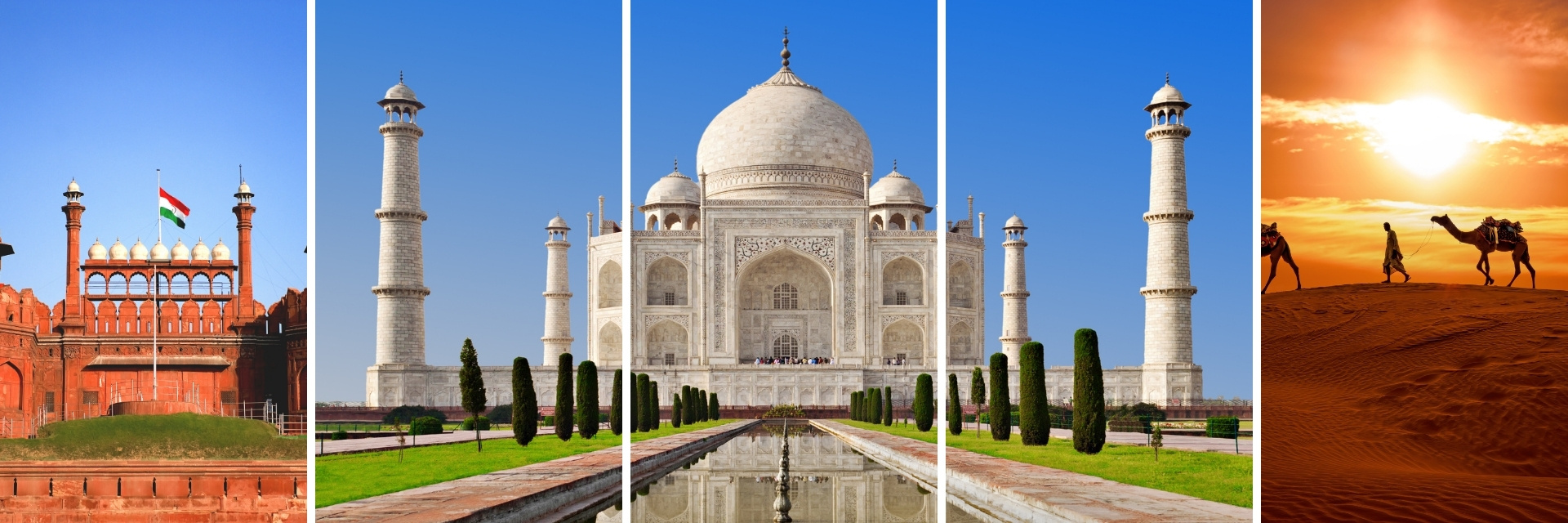
Luxury Hotels · North India · Taj & Golden Triangle
Setting Up a Luxury Hotel in Agra
Agra receives some of the highest visitor volume on earth — and converts almost none of it into a luxury overnight stay. That gap is the opportunity.
The Taj Mahal draws millions, yet the city has struggled for decades to turn that footfall into two-night luxury demand — most arrivals are day-trippers passing through the Golden Triangle. The premium hotel that wins here does two hard things at once: it engineers a reason to stay, and it does so inside the Taj Trapezium Zone, a Supreme-Court-protected environmental envelope that dictates siting, energy and design. Gladwin International runs the whole journey as one accountable programme — reading the length-of-stay economics, siting against the Taj view and the TTZ rulebook, and taking you from a plot to a fully staffed, revenue-live hotel.
Day-trip to two-night
The conversion the whole model turns on
~10,400 sq km
The Taj Trapezium Zone we design inside
The view
An uninterrupted Taj sightline is the trophy asset
Turnkey
Site to a stabilised opening
At a glance
Best-fit micro-markets
Taj-East-Gate / Eastern-bypass belt (view-led); Fatehabad Road hotel strip; Yamuna Expressway corridor (Delhi / Jewar access).
The proof it can be cracked
The Oberoi Amarvilas set the benchmark on Taj views; ITC Mughal, Taj Hotel & Convention Centre, Radisson and Courtyard built the premium base.
The defining constraint
The Taj Trapezium Zone — Supreme-Court-mandated limits on polluting activity and construction, layered with ASI heritage protection near the monuments.
The strategic play
Length-of-stay — Taj-view rooms, Mughlai culinary and cultural programming, and a spa that give guests a reason to stay a second night.
Critical approvals
Agra Development Authority; TTZ / Supreme-Court environmental compliance; ASI heritage rules; UP tourism incentives; fire and excise.
Siting watch-out
The clean-energy mandate and Yamuna floodplain caution constrain both fuel choice and buildable ground — the view plots are scarce and contested.
The opportunity
Agra is one of the most visited destinations on the planet and, for a luxury hotelier, one of the most under-monetised. The Taj Mahal, Agra Fort and Fatehpur Sikri pull enormous volume, but the visitor economy is dominated by day-trippers and short-stay coach tourism moving between Delhi and Jaipur on the Golden Triangle. The city has historically found it hard to hold those guests overnight at a premium rate — and that is precisely where the value sits.
The play is not more rooms; it is better reasons to stay. A hotel that captures the Taj view, programmes the Mughlai and cultural depth of the city, and layers on a serious spa and dining product can convert a passing itinerary into a two-night one at a rate the day-trip market never sees. The Oberoi Amarvilas proved the ceiling; the whitespace is a modern, view-aware, experience-led luxury hotel priced to the guest who will pay to wake up to the Taj.
In Agra the prize is not footfall — the footfall already exists. The prize is the second night, at a luxury rate the day-trip economy has never been able to charge.
The Taj Trapezium Zone — the constraint that shapes everything
Nothing about an Agra hotel can be planned without the Taj Trapezium Zone. The TTZ is a roughly 10,400 square kilometre protected area around the Taj Mahal, placed under Supreme Court supervision to shield the monument from pollution and unregulated development. It carries strict limits on polluting industry and fuels, tighter construction controls, and — closer to the monuments — Archaeological Survey of India heritage restrictions that govern what can be built and how near.
For a developer this reshapes the brief from the ground up: no polluting fuels for kitchens, boilers or power, which pushes the energy strategy toward clean electric, solar and gas alternatives; construction and height controls that must be confirmed for the specific plot; and a design language that has to sit respectfully in a heritage-sensitive setting. We resolve the TTZ classification, the ASI proximity rules and the environmental envelope before capital is committed — because in Agra these are not late-stage compliance items, they are the design brief.
The TTZ is not a hurdle to clear once — it is a permanent design parameter. Energy, materials, height and siting all answer to it from day one.
Siting — the view is the asset, and it is scarce
In Agra the single most valuable variable is the sightline. An uninterrupted view of the Taj Mahal is a genuinely rare asset, and the hotels that command the market command it because they own that view. The Taj-East-Gate and eastern-bypass belt is the view-led corridor; the established Fatehabad Road strip carries the depth of existing premium supply and connectivity; and the Yamuna Expressway corridor is the access-led play, tied to Delhi and the emerging Jewar (Noida International) airport.
But the view plots are constrained on every side — by ASI proximity limits, by TTZ height and construction controls, and by Yamuna floodplain caution that rules out or complicates ground near the river. We survey the sightline, the setback and the buildable envelope together, and choose the site against the guest you are actually chasing: the view-seeker who pays for the second night, the corridor traveller who values access, or the events and MICE demand better served on Fatehabad Road.
| Site type | Best for |
|---|---|
| Taj-East-Gate / eastern bypass | View-led rooms and the two-night luxury guest — the premium ceiling |
| Fatehabad Road strip | Established connectivity, F&B, MICE and events depth |
| Yamuna Expressway corridor | Access-led demand tied to Delhi and the Jewar airport catchment |
Indicative siting logic — always subject to the TTZ controls, ASI proximity rules, floodplain survey and the confirmed sightline for the specific plot.
The length-of-stay model — engineering the second night
The commercial thesis of an Agra luxury hotel is length of stay. A day-tripper contributes almost nothing to a premium P&L; a two-night guest transforms it — through rooms revenue, dining, spa and experiential spend. So the product has to be built to hold the guest, not merely house them for a night between a morning at the Taj and a drive to Jaipur.
That means the property is designed as a destination in its own right: Taj-view rooms and terraces that make the monument the reason to check in; Mughlai and regional culinary programming that treats Agra's food heritage as a headline, not a buffet; a spa and wellness offer that gives an evening and a morning their own purpose; and cultural, craft and heritage-walk programming that fills the hours between monument visits. We brief the concept, the F&B strategy, the wellness offer and the guest journey together, so every element earns its place by adding a reason to stay.
- Taj-view rooms and terraces positioned as the primary demand driver
- Mughlai and regional culinary programming as a signature, not a side note
- A spa and wellness offer built to own the evening and the morning
- Cultural, craft and heritage programming that fills the day-trip gaps
Approvals & licences — the Agra hotel stack
An Agra hotel carries an approvals stack heavier at the environmental end than most Indian markets, because the TTZ and ASI regimes sit on top of the ordinary building path. Licensed filings are made by your appointed architects, engineers and lawyers; we coordinate and govern them to a legally-open asset.
- Agra Development Authority — layout, building plan sanction and construction approvals
- TTZ / Supreme-Court environmental compliance, including the clean-energy and no-polluting-fuel mandate
- ASI heritage clearances where the plot sits within a regulated / prohibited zone of a protected monument
- Environmental clearance (SEIAA) above the built-up-area threshold, plus UP Pollution Control Board consents
- UP tourism registration, hotel classification (Ministry of Tourism / HRACC) and available state tourism incentives
- Excise (liquor) licence, fire NOC, FSSAI and water / sewage sanctions
Design, build & the operating team
In Agra the design has to answer to the Mughal idiom the city gave the world — handled with restraint rather than pastiche — while meeting the TTZ's clean-energy mandate and the Yamuna floodplain caution in the engineering. Materials, height and finishes are chosen inside the heritage envelope; the energy strategy leans on clean electric, solar and gas because polluting fuels are simply not an option; and any plot near the river is engineered for the floodplain from the outset.
The harder, quieter challenge is people. Agra is a Tier-2 labour market, and a luxury operation needs a General Manager and head-of-department bench capable of running a view-led, F&B-and-wellness-heavy property. That team rarely sits locally in depth, so we run a hiring plan that draws experienced luxury talent from Delhi and Jaipur into Agra and blends it with local recruitment, in seat and trained before opening — because in a two-night, experience-led model the service standard is the product.
Gladwin's edge in Agra
We treat an Agra hotel as the conversion and compliance problem it actually is. Before a rupee is committed we resolve the TTZ classification, the ASI proximity rules, the floodplain line and the confirmed Taj sightline, and we build the commercial model around length of stay rather than footfall — because footfall Agra already has in abundance. Then we run design inside the heritage and clean-energy envelope, procurement, the operator relationship, the full team hired and trained, and a supported launch as one accountable partner and your Owner's Representative.
The team we build is deliberately assembled for a Tier-2 market with Tier-1 standards: a General Manager who can run a view-led, culinary- and wellness-driven operation, and a hiring plan that pulls seasoned luxury talent from Delhi and Jaipur into Agra and trains it in seat before the first peak season — so the second-night experience the whole thesis depends on is live from day one.
Planning a luxury hotel in Agra?
We take single accountability from a site and an investment thesis to a stabilised opening — brand-versus-operator strategy, feasibility, design, procurement, PMO and the revenue systems. The team is recruited through our executive search practice and trained for opening.
Speak with a partnerSetting up a luxury hotel in Agra — FAQs
The TTZ is a roughly 10,400 square kilometre area around the Taj Mahal, protected under Supreme Court supervision to limit pollution and unregulated development. For a hotel it dictates the energy strategy (no polluting fuels — clean electric, solar and gas instead), tightens construction and height controls, and — near the monuments — layers on ASI heritage restrictions. We resolve the TTZ and ASI position for the specific plot before design begins, because these are the design brief, not late-stage compliance.
Because most of Agra's visitor volume is day-trippers and short-stay coach tourism moving between Delhi and Jaipur on the Golden Triangle. The city has historically been a stop, not a stay. The opportunity is to engineer a reason to stay a second night — Taj-view rooms, Mughlai culinary and cultural programming, and a spa — at a rate the day-trip market never sees. We build the whole commercial model around that length-of-stay conversion.
It depends on the guest you are chasing. The Taj-East-Gate and eastern-bypass belt is the view-led corridor and commands the premium ceiling; Fatehabad Road offers established connectivity, F&B and MICE depth; and the Yamuna Expressway corridor is the access-led play tied to Delhi and the emerging Jewar airport. The view plots are scarce and constrained by ASI, TTZ and floodplain limits, so we survey the sightline and the buildable envelope together before choosing.
Yes — the Oberoi Amarvilas is proof that a world-class, Taj-view luxury hotel can be delivered inside the TTZ and ASI envelope, and ITC Mughal, the Taj Hotel & Convention Centre, Radisson and Courtyard built the wider premium base. The constraints shape the design rather than prevent it: clean energy, restrained Mughal idiom, careful siting. We design to the rulebook from day one so it becomes an asset, not a fight.
The ordinary path runs through the Agra Development Authority for plan sanction and construction approvals, plus environmental clearance above the threshold, UP tourism registration and classification, excise, fire, FSSAI and water/sewage consents. On top of that sit the TTZ / Supreme-Court environmental compliance with its clean-energy mandate, and ASI heritage clearances where the plot falls within a monument's regulated zone. We sequence and govern the whole stack.
Deliberately. Agra does not carry deep luxury hospitality talent locally, so we run a hiring plan that draws experienced General Manager and head-of-department talent from Delhi and Jaipur into Agra and blends it with local recruitment through our executive search practice. The full pre-opening team is in seat and trained before the first peak — critical, because in a two-night, experience-led model the service standard is the product.
Explore the cluster
Luxury hotels across India’s leading cities
North · Capital & NCR
Delhi NCR
The national capital runs on four demand engines at once — government, diplomacy, corporate India and the country's largest luxury wedding market — and each rewards a different hotel.
North-West · Pink City heritage
Jaipur
Jaipur is the market that wrote India's palace-hotel playbook — and it now trades on weddings, MICE and Golden-Triangle demand as much as on royal romance.
West · Lake city
Udaipur
Udaipur is the market that taught the world what Indian luxury looks like — a lake-palace, wedding and high-end leisure economy where the product is the view, the water and the ceremony.
Also explore our executive search practice for the leadership team, and the wider end-to-end hospitality practice.