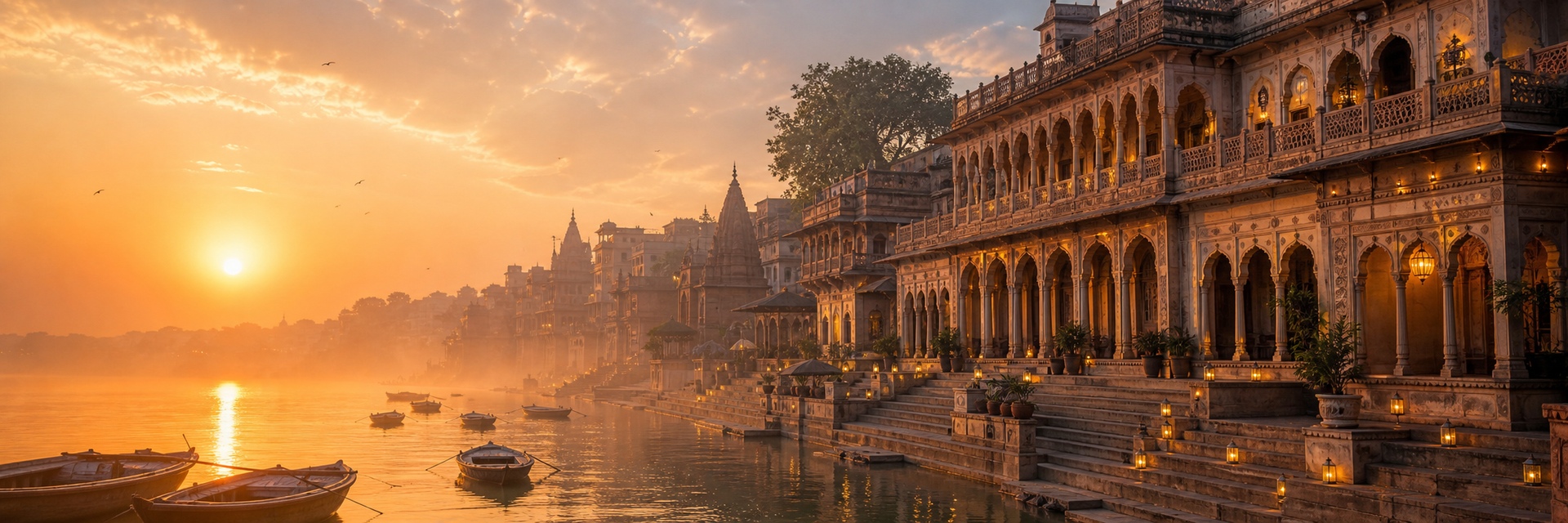
Heritage & Palace Hotels · Uttar Pradesh · Ganga Ghats
Setting Up a Heritage Riverfront Hotel in Varanasi
Varanasi is the oldest living city on earth and India's spiritual capital — and the rarest luxury hotel to build anywhere, because the address is a river of faith and the site is a palace that has been settling into the ghat for two hundred years.
A heritage hotel on the Varanasi ghats is not a construction project with a conservation flavour — it is a conservation project that happens to open as a hotel. The value sits in a crumbling riverfront palace or haveli that no lorry can reach, that the Ganga floods each monsoon, and that only a handful of craftspeople in India still know how to hold up. Gladwin International runs the whole arc as one accountable programme — finding and securing the right ghat-front asset, structuring the conservation so the building survives the river, and taking it from a damp shell to a small-key, high-ADR, experience-led hotel that earns its place above the water.
Conservation-first
A restoration that opens as a hotel, not a build
Small-key
Rooms measured in tens, ADR in the top tier
No vehicle access
Materials and guests move by lane and by boat
Turnkey
From a ghat-side shell to a live, staffed hotel
At a glance
The three asset types
A ghat-front palace conversion (river-facing, trophy); an old-city haveli boutique (behind the ghats, courtyard-led); a Cantonment-area heritage property (garden, vehicle access, calmer).
Market context
BrijRama Palace on Darbhanga Ghat and the Taj's Nadesar Palace and Guleria Kothi have proved the ghat-side and palace-heritage premium exists in Kashi.
The catalyst
The Kashi Vishwanath Corridor has re-set footfall and premium demand across the old city and the ghats since its opening.
The defining constraint
The ghats have no motorable access — every bag of lime, every guest and every gas cylinder arrives on foot through the galis or by boat.
The river
The Ganga rises through the monsoon and floods the lower ghats and ground floors most years — levels and flood lines govern the whole design.
Critical clearances
Heritage / conservation consent, ASI and state-protection proximity where it applies, riverfront and NGT-sensitive approvals, plus religious-sensitivity clearance around the ghats.
The opportunity
Varanasi — Kashi, Banaras — is the oldest continuously inhabited city on earth and the spiritual capital of India, and there is no substitute for it. Pilgrims and travellers have come to die, to pray and to watch the sun rise over the Ganga here for longer than most nations have existed. That is a demand base no marketing can manufacture, and until recently it was almost entirely under-served at the top of the market.
That has changed. The Kashi Vishwanath Corridor reconnected the temple to the river and re-set footfall and premium demand across the old city, while restored ghat-side properties such as BrijRama Palace on Darbhanga Ghat and the Taj's Nadesar Palace and Guleria Kothi have proved that a genuine luxury guest will pay a spiritual-luxury premium to wake up on the water. The whitespace is not another business hotel near the Cantonment — it is a small, deeply crafted heritage hotel that puts a guest to sleep above the Ganga.
In Varanasi the asset is not the room count — it is the address on the river and the age of the walls. Build for the pilgrim-luxury guest who came for the Ganga, not the tourist who came for a bed.
Choosing the asset — palace, haveli or Cantonment
The first and most consequential decision is which kind of heritage you are buying, because it dictates the guest, the constraint set and the entire economics. A river-facing palace conversion on a named ghat is the trophy — direct Ganga frontage, the aarti at your terrace, and the hardest, most expensive building to save. A haveli boutique in the old-city lanes behind the ghats trades the direct river view for a courtyard, more workable structure and a quieter arrival, and often converts at a fraction of the risk. A Cantonment-area or civil-lines heritage bungalow gives you gardens, vehicle access and calm — the softest project — but it is not on the ghats, and the guest knows the difference.
We appraise candidate assets against the guest you intend to serve and the risk you can carry — reading the frontage, the flood exposure, the structural condition, the title and the access before you fall in love with a view. A ghat-front palace can be the making of a hotel or the ruin of a balance sheet; the appraisal is where that is decided.
| Asset type | What it delivers | The trade |
|---|---|---|
| Ghat-front palace | Direct river frontage, aarti-side terraces, trophy address | Highest conservation cost, flood exposure, no access |
| Old-city haveli | Courtyards, workable structure, quieter arrival | River glimpsed, not owned; dense gali context |
| Cantonment bungalow | Gardens, vehicle access, calm and space | Off the ghats — not the Kashi waterfront story |
Indicative asset logic — always subject to the specific building's condition, title, flood line and access.
Acquisition & title on the ghats
Riverfront palaces and old-city havelis rarely come with clean, single-owner title. Many are held across fractured family shares, occupied by tenants under long-standing arrangements, encumbered by religious or trust endowments, or partly given over to non-residential use. Buying the view without buying every share and clearing every occupancy is how a ghat project stalls for years.
We run the acquisition as a diligence programme, not a handshake — resolving the ownership tree and every co-sharer, the tenancy and occupancy position, the endowment and trust status, and the heritage designation that will bind what you can and cannot do to the fabric. We establish what the building actually is before you commit, and structure the purchase so you take possession of a hotel you can lawfully open, not a dispute with a river view.
- Ownership tree, co-sharers and fractured family-share resolution
- Tenancy, occupancy and endowment / trust position on the asset
- Heritage designation and the conservation obligations it imposes
- Flood-line, riverfront and setback status before price is agreed
Conservation — saving a building the river has been claiming
A ghat-side palace has spent two centuries in contact with a rising and falling river, and it shows: lime plaster blown off by rising damp, timber floors softened by moisture, foundations undermined by monsoon flooding, and stonework fretted by salts. This is not a renovation you brief to a contractor — it is a conservation programme that has to be led by people who understand traditional Indian building science, because the wrong repair kills the building faster than neglect.
We assemble and govern the conservation team — conservation architects, structural engineers experienced with river-edge heritage, and the traditional-craft trades — and hold the philosophy to repair-in-kind: lime and surkhi rather than cement, traditional timber and stone, breathable finishes that let two-hundred-year-old walls move and dry. Cement render and modern waterproofing on a damp historic ghat wall trap moisture and accelerate decay; getting this discipline right is the single largest determinant of whether the asset survives the next fifty monsoons.
The fastest way to destroy a ghat palace is to restore it like a modern building. Lime, breathable finishes and repair-in-kind are not aesthetics here — they are structural survival.
The old-city constraint set — access, flood and sensitivity
Building on the ghats breaks every logistical assumption a hotel developer normally makes. There is no vehicle access to the waterfront: the galis are metres wide, stepped and shared with pilgrims, cattle and processions, so every load of lime, every FF&E crate, every gas cylinder and every guest's luggage arrives head-loaded through the lanes or by boat across the river. The build programme, the deliveries and the eventual back-of-house all have to be designed around that reality from day one.
Layered on top are the river and the setting. The Ganga rises through the monsoon and floods the lower ghats and ground floors most years, so levels, plant siting, the flood-line strategy and the seasonal operating plan are fundamental design inputs, not afterthoughts. And the ghats are a living sacred landscape — cremation grounds, aarti, bathers and ash are the daily context — so the hotel must be built and run with real religious sensitivity, and water-quality optics around the guest experience have to be handled with honesty and care rather than pretending the river is a swimming pool.
- No motorable access — logistics by narrow gali and by boat, planned into the programme
- Monsoon flood rise — flood lines, plant siting and a seasonal operating plan
- Damp and structural fragility as permanent conditions, not one-off repairs
- Religious sensitivity around cremation ghats, aarti and bathing — in design and in operation
- Water-quality optics handled with candour in the guest journey, not concealment
The spiritual-luxury product & experience programming
A Varanasi heritage hotel earns its ADR on emotion, not amenity. The guest did not come for a gym and a buffet — they came for the Ganga, and the product has to be built entirely around that. Small keys, each one different because the building refuses to be standardised, with river-facing terraces, restored jharokhas and courtyards, and a stillness that the city outside does not have. The scarcity is the strategy: a handful of rooms above the water command a premium that a hundred cannot.
The experience is the real inventory. A private boat at dawn to watch the sun come up over the far bank; a reserved vantage for the Ganga aarti; a walk through the lanes with someone who can read the city's layers; a Vedic or wellness ritual that belongs here rather than a generic spa menu; vegetarian, sattvic and Banarasi cuisine that honours the place. We brief the concept, the guest journey and the experience programme together, so the rooms, the terraces, the food and the rituals form one spiritual-luxury proposition matched to the pilgrim-luxury guest.
Staffing a hotel the lanes can barely reach
Running a small, high-ADR hotel with no vehicle access, seasonal flooding and a demanding luxury guest is an operational discipline in itself, and it starts with the team. This is not a property where a large brigade rotates anonymously — it is an intimate house where a few people, well chosen and genuinely of Banaras, carry the entire guest experience, from the boatman and the aarti host to the chef and the storyteller-guide.
We recruit and train the team through our executive search practice — a General Manager who can run a small-key luxury operation under old-city constraints, and a service and experience team that blends Banaras's own people and knowledge with luxury-hotel standards. We plan the head-loaded and boat-borne supply chain, the flood-season protocols and the pre-opening training so the house is calm, capable and fully live before the first season on the river.
Gladwin's edge in Varanasi
We treat a Varanasi hotel as the conservation-and-constraint problem it actually is, not a build with a heritage label. Before capital is committed we appraise the asset against the guest and the flood line, resolve the fractured title and the endowment position, and assemble a conservation team that will repair the building in kind so it survives the river. Then we run the design, the head-loaded and boat-borne procurement, the experience programme and the full team hired and trained as one accountable partner and your Owner's Representative.
The discipline that sets a ghat project apart is respect — for the fabric, for the river's seasons and for the sacred life of the ghats. We build and staff a house that a pilgrim-luxury guest recognises as of Kashi, priced for the small-key premium that only Varanasi's address on the Ganga can command.
Planning a heritage or palace hotel in Varanasi?
We take single accountability from a heritage asset and a conservation brief to a stabilised, high-ADR opening — restoration and adaptive reuse, brand-versus-operator strategy, artisan-led design and procurement, PMO and the service culture. The team is recruited through our executive search practice and trained for opening.
Speak with a partnerSetting up a heritage or palace hotel in Varanasi — FAQs
Three types, each a different bet. A river-facing palace conversion on a named ghat is the trophy — direct Ganga frontage and the aarti at your terrace, but the hardest and costliest to save. An old-city haveli behind the ghats trades the direct river view for courtyards and a more workable structure at lower risk. A Cantonment-area heritage bungalow gives gardens and vehicle access but is off the ghats. We appraise candidates against the guest you want and the risk you can carry.
Because the ghats have no vehicle access — every load of lime, every FF&E crate and every guest's luggage arrives head-loaded through metre-wide lanes or by boat — and because the Ganga floods the lower ghats and ground floors most monsoons. The building itself is usually damp, structurally fragile and two hundred years old. These are permanent conditions to design around, not one-off problems to fix.
As a conservation programme led by specialists, not a contractor's renovation. We assemble conservation architects, river-edge structural engineers and traditional-craft trades, and hold to repair-in-kind — lime and surkhi rather than cement, breathable finishes that let old walls move and dry. Cement and modern waterproofing trap moisture and accelerate decay on a historic ghat wall; getting this right is what decides whether the asset survives the next fifty monsoons.
Because scarcity is the strategy. A Varanasi guest pays a spiritual-luxury premium to sleep above the Ganga, and a handful of river-facing rooms command an ADR that a hundred cannot. The building also refuses to be standardised, so each key is different. The return comes from a small number of deeply crafted rooms and an experience programme — dawn boat, aarti, rituals, Banarasi cuisine — not from volume.
The ghats are a living sacred landscape — cremation, aarti, bathing and ash are the daily context — so the hotel is designed and operated with genuine religious sensitivity rather than treated as a generic waterfront. On water quality, we build the guest journey on candour: the value is the Ganga as a spiritual presence experienced from terraces and boats, not the river presented as a swimming pool. Honesty here protects the brand.
Yes — and on the ghats it is decisive. Riverfront palaces and havelis are often held across fractured family shares, occupied by tenants or bound by religious endowments and trusts. We run acquisition as a diligence programme — resolving the ownership tree, occupancy, endowment status and heritage designation, and the flood-line and riverfront position — so you take possession of a hotel you can lawfully open, not a dispute with a view.
Explore the cluster
Heritage & palace hotels across India
Madhya Pradesh · Bundelkhand
Gwalior & Orchha
Gwalior and Orchha are two different heritage propositions on one circuit — a Scindia-scale city palace and a medieval Bundela riverfront — and each rewards a completely different hotel.
West Bengal · Colonial
Kolkata
Kolkata holds the richest stock of colonial architecture in India — and the country's most under-exploited heritage-hotel opportunity outside Rajasthan.
Rajasthan · Lakes
Udaipur
Udaipur is the world's premier lake-palace destination — and a heritage hotel here is won or lost on conservation judgement, not construction schedules.
Also explore our executive search practice for the leadership team, and the wider end-to-end hospitality practice.