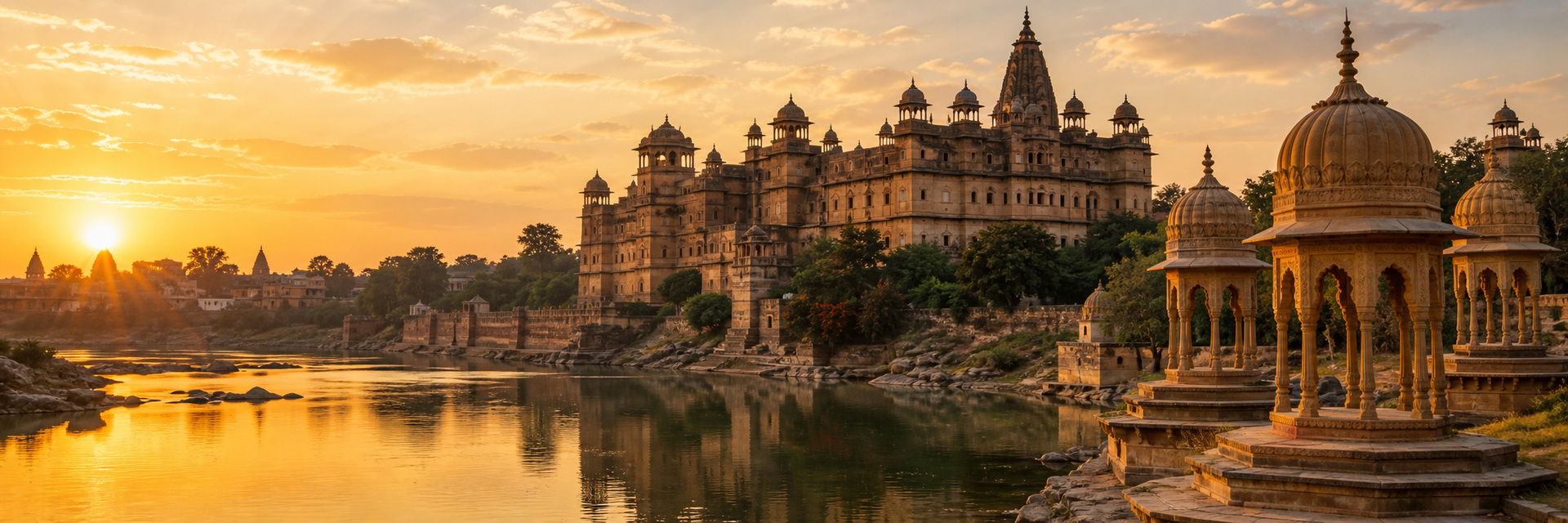
Heritage & Palace Hotels · Madhya Pradesh · Bundelkhand
Setting Up a Heritage & Palace Hotel in Gwalior & Orchha
Gwalior and Orchha are two different heritage propositions on one circuit — a Scindia-scale city palace and a medieval Bundela riverfront — and each rewards a completely different hotel.
A heritage hotel is not a new-build with old photographs on the wall; it is a conservation project that happens to trade rooms. Get the sequence wrong — restore before you have read the byelaws, key-count before you understand the fabric — and the asset never earns the rate the story deserves. Gladwin International runs the whole journey as one accountable programme: reading what the structure and the heritage regime will actually permit, setting the small-key high-ADR model the building can carry, sourcing the artisans a Bundela façade or a Scindia interior demands, and taking you from a protected shell to a fully staffed, revenue-live hotel.
Conserve first
Restoration leads; the room count follows the fabric
Small-key, high-ADR
The heritage model, not volume
One circuit
Khajuraho–Gwalior–Agra, marketed as a route
Turnkey
Protected shell to a stabilised opening
At a glance
The two products
Gwalior — a city palace hotel at Scindia scale, banqueting and heritage-wedding capable. Orchha — an intimate riverside Bundela boutique on the Betwa.
Gwalior anchors
The hilltop Gwalior Fort, the Scindia legacy at Jai Vilas Palace, and Taj Usha Kiran Palace as live market context; real air and rail links.
Orchha anchors
Jehangir Mahal and Raj Mahal, the riverfront chhatris/cenotaphs and temples; boutique-scale heritage precedent (Amar Mahal, the Sheesh Mahal).
Policy tailwind
Madhya Pradesh's heritage-hotel and tourism incentive policy supports adaptive reuse of period properties.
The constraints
Mixed connectivity, moderate luxury demand that needs circuit-led marketing, ASI setbacks on Orchha's protected monuments, and a shallow conservation-skills pool.
Critical approvals
Heritage/conservation byelaws, ASI regulated/prohibited-area clearances near protected monuments, riverfront and municipal consents, tourism registration and classification.
The opportunity
Central India's Bundelkhand belt is the rare heritage market that is still under-supplied at the top. Gwalior and Orchha sit on the Khajuraho–Gwalior–Agra axis, close enough to feed off Rajasthan and Agra spill-over demand yet distinct enough to be a destination in their own right. The whitespace is not another Rajasthan haveli conversion — it is a genuinely conservation-led property that gives the discerning heritage traveller a Bundela and Scindia story they cannot get elsewhere.
The two towns demand two answers. Gwalior is a real city — a fort, the Scindia legacy, air and rail links — that can carry a larger city palace hotel with banqueting and the heritage-wedding trade. Orchha is a magical, still under-touristed medieval town on the Betwa, where the play is an intimate riverside boutique that trades on silence, sightlines to the chhatris, and scale restraint. Conflate the two and you build the wrong asset in both.
The heritage prize here is authenticity at small scale — a conserved building trading a Bundela or Scindia narrative — not a large branded box competing on facilities.
Conservation-led restoration & adaptive reuse — the discipline that leads
A heritage hotel is delivered spine-first: a conservation assessment of the fabric, then a restoration philosophy of minimal intervention and reversibility, and only then a hotel programme fitted to what the building can bear. Load-bearing masonry, timber, lime plaster and original stone detailing set the terms — where you can insert services, where a bathroom can and cannot go, how many keys the structure honestly supports. Owners who lead with a room count and force the fabric to follow either destroy the heritage value or breach the byelaws; usually both.
We run adaptive reuse the right way round — commissioning the condition survey and conservation plan, agreeing the intervention philosophy with heritage authorities, and only then setting the key-count, the service routing and the guest journey against the structure. Modern comfort — climate control, water, fire safety, accessibility — is threaded in without erasing the reason the guest came.
- Fabric condition survey and conservation management plan before any programming
- Minimal-intervention, reversible restoration agreed with heritage authorities
- Key-count, services routing and back-of-house fitted to what the structure carries
- Modern comfort and life-safety threaded in without erasing the period character
Heritage byelaws, ASI setbacks & the approvals stack
The heritage layer is what separates this from a conventional build, and Orchha and Gwalior carry it differently. In Orchha, several of the great monuments — Jehangir Mahal, the Raj Mahal, the riverfront chhatris — are protected, and the Ancient Monuments regime imposes prohibited and regulated zones around them; construction, height and even restoration within those radii need clearance and are sometimes barred outright. A riverside site also carries riverfront and flood-line setbacks along the Betwa. In Gwalior, heritage conservation byelaws govern how a period property may be altered and what a new insertion may look like.
We resolve the heritage line before capital is committed: mapping ASI regulated/prohibited-area distances against the plot, reading the conservation byelaws that will govern the restoration, and sequencing the wider stack. Licensed filings are made by your appointed conservation architects, engineers and lawyers; we coordinate and govern them to a legally-open, heritage-compliant asset.
| Layer | What governs it |
|---|---|
| Monument proximity (Orchha) | ASI prohibited/regulated zones around protected structures |
| Restoration & alteration | Heritage conservation byelaws and the conservation plan |
| Riverfront siting (Betwa) | Flood-line and riverbank setbacks, municipal consents |
| Trade & classification | MP Tourism registration, hotel classification, fire, FSSAI, excise |
Indicative approvals logic — always subject to the specific plot's monument proximity, protection status and municipal zone.
The small-key, high-ADR model
Heritage economics invert the volume playbook. The building typically yields few keys — often twenty to forty in a palace, fewer in a riverside boutique — so the return has to come from rate, not room-nights, and from ancillary revenue that suits the setting: a signature dining room in a restored hall, curated experiences, a spa fitted sensitively into the fabric, and heritage weddings where the structure allows. In Gwalior a larger palace footprint can support banqueting and the wedding trade; in Orchha the model leans deliberately intimate, protecting the very scarcity that lets it command the rate.
We build the commercial model around the fabric's true capacity — sizing keys, F&B covers and experience revenue to what the building and the byelaws permit, and pricing to a heritage guest who pays for authenticity and scarcity, not facilities. Where Madhya Pradesh's heritage-hotel and tourism incentive policy applies, we factor the support into the investment case rather than assuming it.
Artisan procurement & the restoration supply chain
A conservation hotel lives or dies on craft. Lime mortar and plaster, hand-dressed local stone, restored timber and jharokha detailing, period-appropriate ironmongery, and Bundela and Scindia decorative traditions cannot be met off a standard FF&E schedule — they need identified master artisans, conservation-grade materials, and a procurement programme that treats the makers as long-lead items, not commodities. This is the single deepest supply constraint in Bundelkhand, where the skilled restoration pool is shallow and must be sourced, vetted and often brought in.
We run a dual procurement track: the conservation supply chain — artisans, lime, stone, timber and specialist restoration trades scheduled against the works — alongside the conventional hotel programme of FF&E, OS&E, kitchens, spa and pool plant, and the technology and revenue systems. Independent vendor intelligence and a schedule mapped to the restoration critical path protect both the heritage integrity and the opening date.
Brand-versus-operator, circuit demand & staffing
Heritage assets sit awkwardly with the big flags — a soft heritage brand or a specialist small-luxury operator often fits the story better than a full international HMA, and independent operation with strong distribution is genuinely viable at this scale. We model the options — independent, a soft-brand affiliation, or a specialist operator — against your control appetite and the rate the asset can command, and negotiate any agreement as your Owner's Representative.
Demand is circuit-led, not standalone: Gwalior and Orchha earn their rate as part of a curated Khajuraho–Gwalior–Agra journey, sold through the heritage and luxury-tour trade, so the go-to-market has to be built into the model rather than assumed. Staffing carries the same heritage premium — a General Manager fluent in conservation-sensitive operation, and a team that can deliver luxury service in a town with a thin hospitality labour pool, hired and trained before the first season. We build the whole team through our executive search practice and run pre-opening training so standards are live at opening.
- Independent, soft-brand or specialist-operator — modelled to scale and control appetite
- Circuit-led go-to-market across the Khajuraho–Gwalior–Agra route and the luxury-tour trade
- A conservation-fluent General Manager and heritage-service team, recruited and trained pre-opening
- A hiring plan that answers the thin local luxury-hospitality labour pool
Gladwin's edge in Gwalior & Orchha
We treat these as the two different conservation problems they actually are. Before a rupee is committed we survey the fabric, read the heritage byelaws and map the ASI setbacks, and set the key-count and the small-key high-ADR model to what the building and the regime permit — a city palace hotel in Gwalior, an intimate Betwa-side boutique in Orchha. Then we run the restoration, the artisan and conventional procurement, the operator or soft-brand relationship, the circuit-led go-to-market, and the full team hired and trained, as one accountable partner and your Owner's Representative.
The team we build is heritage-capable and local-market-realistic: a General Manager who can run a conservation-sensitive luxury operation, and a hiring plan that answers Bundelkhand's thin hospitality labour pool — in seat and trained before the first circuit season, not after.
Planning a heritage or palace hotel in Gwalior & Orchha?
We take single accountability from a heritage asset and a conservation brief to a stabilised, high-ADR opening — restoration and adaptive reuse, brand-versus-operator strategy, artisan-led design and procurement, PMO and the service culture. The team is recruited through our executive search practice and trained for opening.
Speak with a partnerSetting up a heritage or palace hotel in Gwalior & Orchha — FAQs
No — and treating it that way is the most expensive mistake owners make here. A heritage hotel is a conservation project first: you survey the fabric, agree a minimal-intervention restoration philosophy with the heritage authorities, and only then fit the hotel programme to what the structure honestly carries. Lead with a room count and force the building to follow and you either destroy the heritage value or breach the byelaws.
No. Gwalior is a real city with a fort, the Scindia legacy and air and rail links — it can support a larger city palace hotel with banqueting and heritage weddings. Orchha is an intimate, under-touristed medieval town on the Betwa, where the right product is a small riverside boutique that trades on scarcity and sightlines to the chhatris. Building the same asset in both is the classic error.
Materially. Several of Orchha's great structures are protected monuments, and the Ancient Monuments regime imposes prohibited and regulated zones around them where construction, height and even restoration are controlled or barred. A riverside plot also carries Betwa flood-line and riverbank setbacks. We map the monument proximity and the protection status against your specific plot before capital is committed.
On rate and ancillary revenue, not volume. The building may yield only twenty to forty keys, so the return comes from a high ADR paid by a guest who values authenticity and scarcity, plus signature dining in restored spaces, curated experiences, a sensitively fitted spa, and — where the structure allows, more so in Gwalior — heritage weddings and banqueting. We size and price the model to the fabric's true capacity.
Yes — it is one of the deepest constraints in Bundelkhand and core to what we do. Lime plaster, hand-dressed stone, restored timber and Bundela and Scindia decorative traditions need identified master artisans and conservation-grade materials treated as long-lead items. We run a dedicated conservation supply chain alongside the conventional FF&E and OS&E programme, with independent vendor intelligence and a schedule tied to the restoration critical path.
Usually not a full international HMA. At this scale a soft heritage brand, a specialist small-luxury operator, or well-distributed independent operation often fits the story and the economics better. We model the options against your control appetite and the rate the asset can command, negotiate any agreement as your Owner's Representative, and build the circuit-led go-to-market across the Khajuraho–Gwalior–Agra route so demand is engineered, not assumed.
Explore the cluster
Heritage & palace hotels across India
Rajasthan · Pink City
Jaipur
A palace or haveli is not a building plot with a view — it is a listed, load-bearing, hand-made object that has to earn a luxury tariff without losing the thing that makes it worth the tariff.
Uttar Pradesh · Ganga
Varanasi
Varanasi is the oldest living city on earth and India's spiritual capital — and the rarest luxury hotel to build anywhere, because the address is a river of faith and the site is a palace that has been settling into the ghat for two hundred years.
Tamil Nadu · Chettinad
Chettinad
Chettinad is not a build — it is a rescue. The asset already stands: a colossal Chettiar mansion of Burma teak, Athangudi tile and Belgian glass, waiting to be brought back as a hotel.
Also explore our executive search practice for the leadership team, and the wider end-to-end hospitality practice.