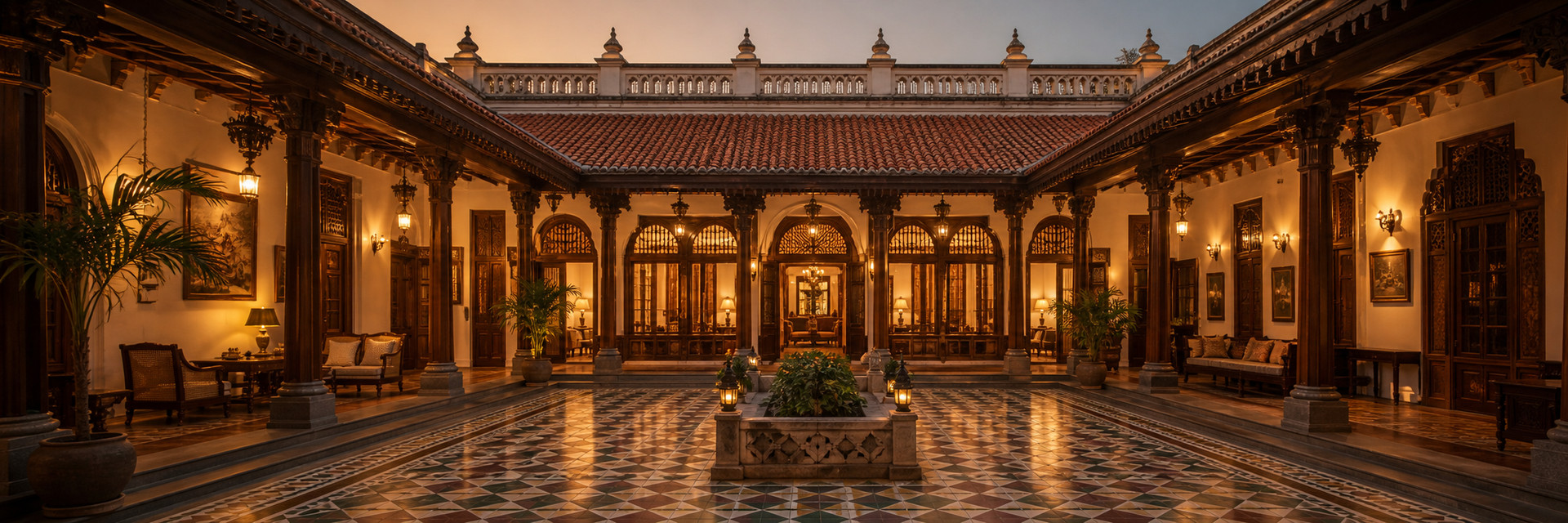
Heritage & Palace Hotels · Tamil Nadu · Chettiar Mansions
Setting Up a Heritage Mansion Hotel in Chettinad
Chettinad is not a build — it is a rescue. The asset already stands: a colossal Chettiar mansion of Burma teak, Athangudi tile and Belgian glass, waiting to be brought back as a hotel.
You do not develop a Chettinad hotel so much as recover one. The defining move is securing a palatial Nattukottai Chettiar merchant house — most of them shuttered, absentee-owned and slowly losing their roofs — and converting it, conservation-first, into a small-key hotel that trades on rarity rather than volume. Gladwin International runs that whole journey as one accountable programme: untangling fragmented diaspora title, commissioning the specialist tile, teak and lime-plaster restoration these houses demand, and taking the mansion from a locked front door to a fully staffed, revenue-live heritage hotel priced for its scarcity.
Mansion first
The asset is the building, not the plot
Conservation-led
Restore the fabric before you monetise it
Small-key, high-ADR
Rarity, not room count, drives the model
Turnkey
Locked mansion to a stabilised opening
At a glance
Where it sits
The Chettinad region of Sivaganga and Pudukkottai districts — Karaikudi, Kanadukathan and roughly seventy villages of mansion clusters.
The asset
An early-20th-century Nattukottai Chettiar mansion: vast pillared courtyards, Burma teak, Athangudi handmade tiles, Italian marble and Belgian mirrors.
The market context
A proven but thin restoration category — Visalam (CGH Earth), The Bangala and Chettinadu Mansion have established heritage-stay demand.
The core challenge
Fragmented, absentee diaspora ownership and unclear title — many houses are jointly held across scattered family branches.
The craft
Athangudi tile-making, Kandangi weaving, chettinad lime and egg-white plaster, and teak joinery — living crafts you restore with and sell to guests.
Demand watch-out
Remote, hot and dry, with thin luxury infrastructure and seasonal demand — the model must be built to justify the journey.
The opportunity — a scarce asset, not a greenfield
Chettinad is unlike almost any other Indian hotel opportunity because you are not clearing a site and pouring concrete — you are acquiring a building that can never be reproduced. In the early twentieth century the Nattukottai Chettiars, a banking and trading community whose interests ran across Burma, Ceylon and South-East Asia, brought their fortunes home and built palatial mansions across some seventy villages around Karaikudi and Kanadukathan. They imported Burma teak by the shipload, laid floors of handmade Athangudi tiles, hung Belgian mirrors and Italian marble, and wrapped it all around cavernous open-to-sky pillared courtyards.
With the community long dispersed across India and the world, a great many of these houses now stand locked and decaying — roofs failing, teak columns sold off, families unable to maintain them. That is precisely the opening. A conservation-led hotel does what the market has proven works here: it gives a dying mansion an economic reason to survive, and it gives a guest a room inside a building no new hotel can imitate. The scarcity is the product.
In Chettinad the whitespace is not more rooms — it is more rescued mansions. The asset is finite, irreplaceable and quietly disappearing, which is exactly what makes it a defensible hotel.
Acquiring the mansion — title is the real deal
The hardest part of a Chettinad hotel is not the building work — it is buying the building cleanly. These mansions are almost never held by a single, resident owner. Decades of inheritance across an emigrant, globe-scattered diaspora mean a typical house is owned in undivided shares by many branches of one family, some of whom cannot be traced, disagree on selling, or hold sentimental veto over an ancestral home. A hotel cannot be financed, insured or safely operated on that footing.
We treat acquisition as a title and family problem first and a price problem second. We map the ownership tree, identify every co-sharer and their legal share, verify the chain of title, patta and encumbrance position, and negotiate a partition, consolidation or long-lease structure that delivers you a marketable, financeable interest — before a rupee of restoration capital is committed.
- Ownership-tree mapping — tracing every co-sharer across the diaspora and their share
- Title, patta, encumbrance and litigation diligence on ancestral joint-family property
- Structuring the deal — outright purchase, partition, share consolidation or long lease
- Owner-family sensitivities handled — the house's name, heirlooms and legacy respected
Conservation of the fabric — the discipline this hotel lives or dies on
A Chettinad mansion is a conservation object, and the temptation to 'renovate' it into something glossy is the fastest way to destroy its only advantage. The materials are extraordinary and unforgiving: Burma teak columns and rafters that must be treated for termite and rot rather than replaced; Athangudi tiles, each hand-cast on site with local sand and oxide, which have to be lifted, matched and re-laid rather than tiled over; lime-and-egg-white burnished plaster walls that need traditional recipes, not cement render; and Belgian mirror, Italian marble and carved teak doors that reward restoration and punish substitution.
We build the project around a conservation architect and the region's own surviving craftspeople — the Athangudi tile-makers, teak joiners and lime-plaster masters — so the fabric is stabilised and restored to a standard a discerning heritage guest can read, while quietly threading in the modern services (wiring, plumbing, cooling, fire safety, connectivity) that a paying hotel needs. The rule is adaptive reuse, not reinvention: everything new is reversible and deferential to what is already there.
- Structural stabilisation of teak columns, rafters and load-bearing lime walls
- Athangudi tile conservation — lift, match, re-cast and re-lay to original pattern
- Lime, egg-white and myrobalan plaster restored with traditional recipes, not cement
- Discreet modern services — electrical, water, cooling, fire and connectivity — hidden in the fabric
The mansion's value is its authenticity. Every conservation decision is judged against one test: would a heritage guest who came for the real thing feel they got it?
The model — small keys, high ADR, and the demand problem
The commercial logic of a mansion hotel is the inverse of a resort. A single house yields relatively few keys — often a dozen to a couple of dozen — because the courtyards, thinnais (raised verandahs) and grand halls that make the place special cannot be chopped into corridors of rooms. So the model has to earn its return on rate and experience, not volume: a low-key, high-ADR heritage hotel where the building, the food and the story command a premium and the occupancy is driven by scarcity and intent.
The honest challenge is demand. Chettinad is remote, hot and dry, off the main tourist arteries, with thin surrounding luxury infrastructure and a pronounced season. A mansion hotel therefore cannot wait for footfall — it has to manufacture reasons to make the journey: positioning within the cultural-and-culinary circuit that Chettinad already owns, packaging with heritage and craft itineraries, and distributing to the small-luxury, experiential and cultural-travel channels that will pay for rarity. We build the revenue model, the rate architecture and the distribution plan around that reality from the outset.
| Format | Best for |
|---|---|
| Single-mansion boutique | One restored house, a dozen-plus keys, intimate high-ADR heritage stay |
| Multi-mansion village stay | Several houses in one village as a dispersed hotel with shared dining and experiences |
| Anchor mansion + annexe | Heritage core for rooms and F&B, with sympathetic new-build keys behind for scale |
Two mansion-hotel formats — chosen against your capital, the asset and the ambition.
The experience — cuisine, craft and the Chettinad circuit
Chettinad has one asset almost every other heritage destination would envy: its cuisine is globally famous in its own right. A mansion hotel that treats food as the headline — a proper Chettinad table, cooked to the region's own recipes, ideally in the house's original kitchen and dining hall — has a draw that needs no invention. Around it sits a genuine circuit of experience: the Athangudi tile workshops, Kandangi cotton weaving, the antique and architecture trails through neighbouring mansion villages, and the temples and craft of the wider region.
We brief the guest journey, the food-and-beverage concept and the experience programme as one proposition, so the restored halls, the courtyards, the kitchen and the crafts are woven into a stay that justifies the distance — and gives the hotel the cultural authority to hold a premium rate.
Staffing a remote heritage house
Running a small, high-touch heritage hotel in a remote district is a specific staffing problem, not a generic one. The service model is intimate and personal rather than departmentalised, so you need multi-skilled hospitality people who can flex across roles, led by a manager who understands both luxury heritage standards and the pace of a small house. And because the region's own hospitality labour pool is thin, part of the plan is deliberately local: recruiting and training from the surrounding villages, and drawing on the community's own cooks and craftspeople so the house feels staffed by Chettinad, not imported into it.
We recruit the general manager and the core team through our executive-search practice, design a lean, cross-trained organisation suited to a small-key house, and run pre-opening training so heritage-standard service is live before the first season — while building the local hiring and craft partnerships that make the operation both authentic and sustainable in a remote setting.
Gladwin's edge in Chettinad
We treat a Chettinad hotel as what it actually is — a rescue of a scarce, irreplaceable building — and we solve the two things that sink most attempts: title and fabric. Before restoration capital is committed we untangle the fragmented diaspora ownership into a clean, financeable interest, and we scope the conservation of teak, Athangudi tile and lime plaster honestly, with a conservation architect and the region's own craftspeople, so the mansion is restored rather than ruined by renovation.
Then we run the whole programme as one accountable partner: the small-key, high-ADR commercial model built for a remote, seasonal, under-touristed market; the demand generation, distribution and cultural-circuit positioning that makes people make the journey; and the lean heritage team hired, trained and locally rooted before the first guest arrives. One mansion, one programme, one owner's representative from locked door to revenue-live.
Planning a heritage or palace hotel in Chettinad?
We take single accountability from a heritage asset and a conservation brief to a stabilised, high-ADR opening — restoration and adaptive reuse, brand-versus-operator strategy, artisan-led design and procurement, PMO and the service culture. The team is recruited through our executive search practice and trained for opening.
Speak with a partnerSetting up a heritage or palace hotel in Chettinad — FAQs
The buildings. The Nattukottai Chettiars built palatial mansions of Burma teak, Athangudi tile, Belgian mirror and Italian marble across some seventy villages around Karaikudi and Kanadukathan, and with the community long dispersed, many now stand locked and decaying. Restoring one into a small-key heritage hotel gives the mansion an economic reason to survive and gives you an asset no new-build can imitate. Visalam, The Bangala and Chettinadu Mansion have already proven the demand.
Because ownership is fragmented. Decades of inheritance across an emigrant, globe-scattered diaspora mean a typical mansion is held in undivided shares by many branches of one family — some untraceable, some unwilling to sell, some with sentimental veto. A hotel can't be financed or insured on that footing, so we map the ownership tree, verify title, patta and encumbrances, and structure a purchase, partition, consolidation or long lease that delivers a clean, marketable interest before any capital is committed.
Conservation, not renovation. Burma teak columns and rafters are treated and stabilised rather than replaced; Athangudi tiles are lifted, matched and re-laid; lime-and-egg-white burnished plaster is restored with traditional recipes rather than cement; and Belgian mirror, marble and carved doors are conserved. We work with a conservation architect and the region's own tile-makers, joiners and plaster masters, threading modern services discreetly into the fabric so nothing new overwhelms what's already there.
Usually few — often a dozen to a couple of dozen keys — because the courtyards, verandahs and grand halls that make the house special can't be carved into room corridors. So the model earns its return on rate and experience, not volume: a low-key, high-ADR heritage hotel where the building, the cuisine and the story command a premium. Where more scale is needed, an anchor mansion can be paired with sympathetic new-build keys, or several houses run as a multi-mansion village stay.
It has to be manufactured, and Chettinad gives you strong material to do it with: a world-famous cuisine, living crafts like Athangudi tile-making and Kandangi weaving, and a genuine architecture-and-heritage circuit across the mansion villages. We build the model around the small-luxury, experiential and cultural-travel channels that pay for rarity, package the stay with the circuit, and design a rate and distribution architecture suited to a seasonal, under-touristed market rather than waiting for footfall.
Yes — that's the point of the programme. From mansion acquisition and title, through conservation-led restoration, the commercial model, licensing and distribution, to hiring. We recruit the general manager and core team through our executive-search practice, design a lean, cross-trained organisation for a small heritage house, and root it locally by training from the surrounding villages and the community's own cooks and craftspeople, with pre-opening training so heritage-standard service is live before the first season.
Explore the cluster
Heritage & palace hotels across India
Kerala · Fort Kochi
Fort Kochi
Fort Kochi is India's most layered colonial trading port — and a heritage hotel here is made in old stone and timber, not on a new-build plot.
Telangana · Deccan
Hyderabad
Hyderabad is the Nizam's city — and its Paigah palaces and Deccan havelis are the rarest hospitality asset in India: buildings that cannot be built again.
West Bengal · Colonial
Kolkata
Kolkata holds the richest stock of colonial architecture in India — and the country's most under-exploited heritage-hotel opportunity outside Rajasthan.
Also explore our executive search practice for the leadership team, and the wider end-to-end hospitality practice.