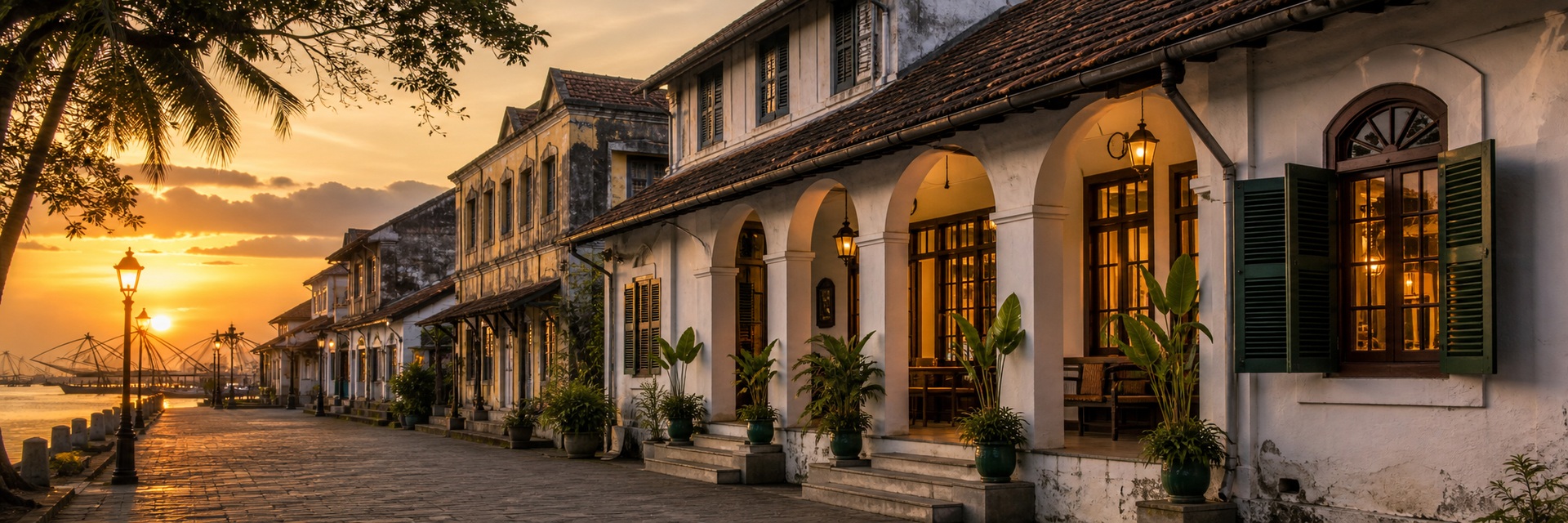
Heritage & Palace Hotels · Kerala · Colonial Quarter
Setting Up a Heritage Hotel in Fort Kochi
Fort Kochi is India's most layered colonial trading port — and a heritage hotel here is made in old stone and timber, not on a new-build plot.
A heritage hotel in Fort Kochi is not a construction project; it is the disciplined recovery of a five-hundred-year Portuguese–Dutch–British inheritance — a merchant's colonial bungalow on the Fort Kochi side, or a spice godown across the water in Mattancherry — brought to a paying-guest standard without erasing the salt-worn, cardamom-scented character that commands the tariff. Gladwin International runs the whole journey as one accountable programme: securing the asset and unpicking its Kerala-particular title, reconciling conservation against services hidden in old laterite and rosewood, defending the fabric against salt, monsoon and termite, and taking you from a heritage shell to a fully staffed, high-ADR opening on the harbour.
Restore, not build
Adaptive reuse of a colonial building or godown
Small keys, high ADR
The economics a boutique-heritage hotel runs on
Conservation-led
Fabric first, services retrofitted around it
Shell to opening
Single accountability, end to end
At a glance
Asset types
Portuguese/Dutch/British-era merchant bungalows and boatyard buildings on the Fort Kochi peninsula; spice godowns and warehouse floors across Mattancherry and Jew Town; harbour-front and canal-side structures on the water's edge.
The market context
A mature boutique-heritage market — the standard the CGH Earth, Malabar House and Old Harbour houses set — proves the demand for small, characterful, high-ADR heritage stays is real, deep and international, not a frontier.
The economics
Small key counts (often 15–40), high ADR, a curated experience premium and a strong European/international leisure mix — but the fabric, the plot and the lanes cap how many keys the site can honestly carry.
Conservation regime
Coastal Regulation Zone (CRZ) control on the waterfront and canal edges, heritage-zone conservation byelaws over the colonial quarter, and change-of-use sanction from the Cochin/Kochi civic authorities.
The fabric enemy
Salt-laden coastal air, the June–September southwest monsoon and a heavy termite load on old timber — rosewood, teak and jackwood rafters, floors and trusses — all working against unretrofitted structures year-round.
Access & seasonality
Tight colonial lanes and small plots limit vehicle access and plant delivery; demand concentrates in the October–March season, spiking around the Kochi-Muziris Biennale art calendar.
The opportunity
Fort Kochi is unlike any other heritage-hotel setting in India, because the history is layered rather than singular. This is the trading port the Portuguese fortified, the Dutch rebuilt and the British inherited, wrapped around a working harbour — the Chinese fishing nets on the foreshore, St Francis Church, the streets of Mattancherry, Jew Town and the Paradesi Synagogue, and street after street of spice godowns and merchant bungalows raised on the pepper, cardamom and ginger trade. That density of genuine, stacked colonial fabric is the product: a heritage hotel here sells a trading-port story no new build in Kerala can manufacture.
The market has already proved the demand. The boutique-heritage houses that CGH Earth, Malabar House and the Old Harbour operation established turned restored colonial buildings into small, high-ADR properties with a durable international following, and the Kochi-Muziris Biennale has layered a serious art-and-culture tourism season on top. That is market colour, not a template to copy. The whitespace is the next sensitive conversion the established names have not already taken — a merchant bungalow or a spice warehouse recovered with real conservation judgement — and the prize is a small-key, high-ADR hotel with authenticity that cannot be built from scratch.
In Fort Kochi the product is not a hotel built on a plot — it is a colonial building or a spice godown restored into one. The value and the risk both live in the fabric.
Bungalow or godown — two different heritage hotels
The single most consequential early decision in Fort Kochi is which kind of heritage asset you are converting, because a Fort-Kochi colonial bungalow and a Mattancherry spice warehouse become very different hotels. A merchant's bungalow on the Fort Kochi side — verandahs, high timbered ceilings, a garden or courtyard, intimate room proportions — lends itself to an intimate, residential boutique of a handful of characterful rooms, where the charm is domestic scale and colonial detail. A spice godown or warehouse floor across the water in Mattancherry offers something different: long-span volumes, exposed timber trusses and thick masonry, and the raw industrial grandeur of the pepper trade, which suits a bolder, loft-scaled conversion with dramatic public rooms and larger-format suites.
Each carries its own economics and its own constraints, and choosing wrongly is expensive. We assess both routes against the specific asset, the guest you intend to serve and the tariff you can hold — the bungalow's intimacy and garden versus the warehouse's volume and drama — and we set the key count, the public-room strategy and the experience brief to the building you are actually restoring, not a generic boutique template.
| Asset archetype | Character & commercial fit |
|---|---|
| Fort Kochi colonial bungalow | Intimate residential boutique; verandahs, garden/courtyard, domestic-scale rooms and a curated experience |
| Mattancherry spice godown / warehouse | Loft-scaled conversion; long-span volumes, exposed trusses, dramatic public rooms and larger suites |
| Harbour / canal-front structure | Waterfront rooms and dining, but CRZ binds hardest and salt exposure is highest |
Indicative heritage-asset archetypes in the Fort Kochi–Mattancherry quarter — key counts and load ceilings are always set by the specific fabric and conservation assessment.
Securing the asset — acquisition and the Kerala title question
Heritage property in the Fort Kochi quarter rarely changes hands cleanly. Merchant bungalows and godowns are frequently held under joint family ownership or ancestral partition that was never formally settled, and Kerala's own land history — tenancy reform, partition among heirs across generations, and trust, temple or community interests — can complicate title in ways a straightforward sale deed hides. Many of the finest buildings are held by old trading families and released on long lease or joint venture rather than sold outright, which changes the deal structure and the alteration rights you inherit.
We resolve the ownership and the acquisition-or-lease structure before restoration capital is committed — clean title or a defensible long lease with the renovation and signage rights the hotel needs, an honest read of any heritage listing or protected status, and clarity on which parts of the fabric you may alter and which you may only conserve. On a colonial building the wrong structure is not a delay; it can be an unrecoverable trap.
- Title and partition due diligence — joint family, tenancy-reform and trust/community interests unpicked before commitment
- Acquisition versus long lease versus family JV — structured for renovation, signage and operating rights
- Heritage-listing and protected-status obligations established up front, not discovered mid-restoration
- Vacant-possession, occupant and encumbrance risk priced into the deal, not left as the surprise later
Conservation versus modern services — the retrofit no guest should see
This is where a Fort Kochi heritage hotel is won or lost. A luxury guest expects silent climate control, high-pressure plumbing, discreet lighting, fibre and full fire safety — and none of it existed when a spice merchant raised the building. Threading modern MEP through thick laterite and lime walls, timber floors and open-truss roofs, without cutting through the very rosewood joinery, jackwood rafters and Athangudi-style or Cuddapah floors that carry the character, is a specialist discipline rather than a standard M&E fit-out. In a warehouse conversion the challenge inverts: the long-span timber trusses and the industrial volume are the design, so services must be woven into the roof, the floor build-up and discreet new cores without domesticating the space.
We run the project on a conservation-first hierarchy: a measured survey and condition assessment before any design, structural stabilisation of walls, timber trusses and foundations with compatible, breathable methods, and a services strategy that hides plant, ducting and cabling in new-build back-of-house and service cores where the fabric allows — so the historic rooms carry the experience and the machinery lives out of sight.
- Measured survey, condition assessment and structural stabilisation before any design commitment
- Breathable, reversible conservation of masonry and timber — repair and consolidate, not seal in with cement
- MEP, fire and IT routed through new service cores and back-of-house, kept out of joinery and truss-lined rooms
- Discreet climate control and acoustic separation engineered into heavy walls and open volumes without visible intervention
The test of a heritage retrofit is simple: the guest feels the comfort of a modern hotel and sees only a colonial merchant's house or a spice warehouse.
The coastal enemy — salt, monsoon and termite
Fort Kochi's setting is its charm and its punishment. Salt-laden air off the harbour corrodes fixings, ironmongery and services and works relentlessly at external finishes; the June–September southwest monsoon drives penetrating and rising damp into laterite and lime that has stood for centuries; and Kerala's climate carries one of the heaviest termite and wood-borer loads in India — a direct threat to the rosewood, teak and jackwood rafters, trusses, floors and joinery that are the whole point of these buildings. A conversion that ignores this fabric reality does not fail slowly; it fails visibly, in the first monsoon and the first season.
We build the defence into the programme, not bolt it on at handover: diagnosis of existing decay and infestation before design, timber treatment and selective replacement in matching species, breathable damp management that lets old walls dry rather than trapping moisture behind cement render, corrosion-rated specification for every fixing, fitting and service exposed to salt air, and a maintenance regime designed for a building that will fight the coast every day it operates. On the water's edge this discipline is non-negotiable; it is the difference between a heritage asset that lasts and one that is eaten.
- Termite and wood-borer survey and treatment; timber consolidated or replaced in matching rosewood/teak/jackwood
- Breathable damp management for laterite and lime — managed to dry, never sealed behind cement
- Corrosion-rated ironmongery, fixings, HVAC and external finishes specified for salt-laden harbour air
- Monsoon-aware detailing of roofs, drainage and verandahs, with a maintenance regime built for the coast
CRZ, heritage byelaws and the approvals stack
Converting in Fort Kochi means working inside a regulatory frame a new-build resort elsewhere never meets. The waterfront, canal edges and much of the low-lying quarter fall under the Coastal Regulation Zone, which governs what may be built or altered near the water, the setbacks that apply, and the consents a harbour- or canal-front structure needs. Over the colonial quarter sit heritage-zone conservation byelaws that constrain façades, heights, materials, colour and the treatment of listed and heritage-grade buildings — the very controls that keep Fort Kochi worth visiting, and that a conversion must design within rather than around.
Layered on top are the ordinary approvals — change-of-use and building sanction from the Kochi civic and planning authorities, Kerala Tourism registration and hotel classification, fire NOC in a dense low-rise fabric, excise for a luxury F&B operation, FSSAI, and Kerala pollution-control and sewage/effluent consents where the site drains toward the backwaters. Licensed filings are made by your appointed conservation architects, structural engineers and lawyers; we sequence and govern the whole stack so the hotel opens legally and its heritage status is protected, not compromised.
- CRZ classification, setbacks and consents resolved for waterfront, canal-front and low-lying plots before commitment
- Heritage-zone byelaw compliance — façade, height, materials and listed-building treatment built into the brief
- Change-of-use and building sanction from Kochi civic/planning authorities for adaptive reuse to a hotel
- Kerala Tourism classification, fire NOC, excise, FSSAI and pollution-board/effluent consents sequenced and governed
Small keys, tight lanes and the season the model runs on
A colonial building sets its own limits. You cannot add floors to a listed bungalow, you cannot widen a merchant's staircase, and heritage byelaws and the load capacity of old timber and masonry cap how much wet area, kitchen and public-room weight the structure will bear. The plots are small and the colonial lanes are tight — which constrains not only the key count but the delivery of plant and FF&E during the build and the servicing of the hotel in operation. That is why a serious Fort Kochi heritage hotel runs a small key count — often fifteen to forty rooms — at a high ADR, with revenue concentrated in a few distinctive suites, a strong food-and-beverage and bar offer, and a curated experience, rather than the volume model a new-build resort would chase.
Demand is also seasonal and, increasingly, cultural. The October–March window carries the international leisure season, and the Kochi-Muziris Biennale has added an art-and-culture calendar that draws a design-literate, high-spend guest and lengthens the shoulder. We size the model honestly against all of this: how many keys the fabric and the plot truly support, how the tight lanes shape servicing and access, and how to programme experience, F&B and the Biennale calendar so the property earns through the season rather than only at its peak — and holds occupancy in the quieter monsoon months.
Positioning, operator route and the experience that holds the tariff
Fort Kochi's proven model is independent boutique-heritage rather than international flag — the CGH Earth, Malabar House and Old Harbour houses built their following on tightly held, individual properties, and the small-key economics and the art-and-spice-trade story reward an owner who keeps the concept close. A management arrangement with a boutique or lifestyle operator can still make sense for distribution and systems; we model the routes honestly — independent versus a boutique HMA — against ROI, control and the fabric's real constraints, and negotiate as your Owner's Representative so those constraints are written into the operating brief, not discovered later.
Whichever route, the tariff is paid for experience and service culture, not square footage. The Fort Kochi story is made tangible through harbour and heritage-walk access, spice-trade and Jew Town provenance, Kerala's own culinary depth handled seriously, art programming keyed to the Biennale, and a service culture true to Malayali hospitality without pastiche. That demands a particular team: a General Manager fluent in small-format heritage operations, service staff trained to a boutique standard, and a conservation-aware maintenance function that protects timber, masonry and finishes against the coast every day the hotel runs — in seat and trained before the season opens.
- Independent boutique-heritage versus a boutique/lifestyle HMA modelled against ROI, control and fabric constraints
- Operator or partner selection negotiated as your Owner's Representative, conservation covenants included
- Experience programming — harbour and heritage walks, spice-trade provenance, serious Kerala F&B, Biennale-keyed art
- Heritage-fluent GM and boutique team recruited and trained; conservation-aware maintenance to protect the asset in operation
Gladwin's edge in Fort Kochi
We treat a Fort Kochi hotel as the conservation and inheritance problem it actually is, not a construction project with old walls. Before capital is committed we resolve the title and acquisition-or-lease structure, establish the CRZ line and the heritage-zone obligations, commission the measured survey and condition assessment, and decide honestly whether the asset is a Fort-Kochi bungalow boutique or a Mattancherry warehouse conversion — and how many keys its fabric and its plot will truly bear. Only then do we run restoration, the salt-and-monsoon-and-termite defence, the services retrofit, the operator or partner route and the full team hired and trained — as one accountable partner and your Owner's Representative — so nobody can hide a conservation shortcut inside a design package.
Our advantage is that we hold together the two disciplines a heritage project usually splits: the conservation-first restoration that protects a five-hundred-year-old trading-port building against the coast, and the small-key/high-ADR boutique model that makes it pay. We defend the timber and the laterite, keep the modern services out of the historic rooms, and programme the property to the season and the Biennale calendar — so it opens reading as an authentic colonial merchant's house or spice warehouse while running like a modern luxury hotel, which is the only reason the tariff holds.
Planning a heritage or palace hotel in Fort Kochi?
We take single accountability from a heritage asset and a conservation brief to a stabilised, high-ADR opening — restoration and adaptive reuse, brand-versus-operator strategy, artisan-led design and procurement, PMO and the service culture. The team is recruited through our executive search practice and trained for opening.
Speak with a partnerSetting up a heritage or palace hotel in Fort Kochi — FAQs
A restoration project — and treating it as construction is the classic, expensive mistake. The product is the adaptive reuse of an existing colonial building or spice godown, so the discipline is conservation-led: measured survey and condition assessment first, structural stabilisation of masonry and timber with compatible, breathable methods, and modern services threaded in without harming the historic fabric. We run it on a conservation-first hierarchy from day one.
They become genuinely different hotels, so the choice is the first big decision. A Fort Kochi colonial bungalow — verandahs, timbered ceilings, a garden or courtyard — suits an intimate, residential boutique of a few characterful rooms. A Mattancherry godown offers long-span volumes and exposed timber trusses that suit a bolder, loft-scaled conversion with dramatic public rooms and larger suites. We assess both against the specific asset, the guest and the tariff, and set the key count and brief to the building you are actually restoring.
By building the defence into the programme rather than bolting it on. We survey and treat termite and wood-borer infestation and consolidate or replace timber in matching rosewood, teak or jackwood; we manage damp with breathable methods that let laterite and lime dry rather than sealing moisture behind cement; and we specify corrosion-rated fixings, ironmongery, HVAC and external finishes for salt-laden harbour air, with monsoon-aware detailing and a maintenance regime designed for a building on the coast.
The waterfront, canals and much of the low-lying quarter fall under the Coastal Regulation Zone, which governs building and alteration near the water and the applicable setbacks. Heritage-zone conservation byelaws constrain façades, heights, materials and the treatment of listed buildings across the colonial quarter. On top sit change-of-use and building sanction from the Kochi authorities, Kerala Tourism classification, fire NOC, excise, FSSAI and pollution-control consents. We sequence and govern the whole stack.
Because the fabric and the plot set the ceiling — you cannot add floors to a listed building, overload old timber and masonry, or widen the tight colonial lanes that limit servicing and delivery. That is why serious properties run roughly fifteen to forty keys at a high ADR, with revenue concentrated in distinctive suites, a strong F&B and bar offer and a curated experience. It is a proven model here, not a compromise — the established boutique-heritage houses show the demand is deep and international.
Fort Kochi's proven route is independent boutique-heritage rather than an international flag — the small-key economics and the art-and-spice-trade story reward an owner who keeps the concept tightly held. A management arrangement with a boutique or lifestyle operator can still add distribution and systems. We model independent versus a boutique HMA against ROI, control and the fabric's constraints, and negotiate as your Owner's Representative so those constraints are written into the operating brief rather than discovered later.
Explore the cluster
Heritage & palace hotels across India
Tamil Nadu · Chettinad
Chettinad
Chettinad is not a build — it is a rescue. The asset already stands: a colossal Chettiar mansion of Burma teak, Athangudi tile and Belgian glass, waiting to be brought back as a hotel.
Telangana · Deccan
Hyderabad
Hyderabad is the Nizam's city — and its Paigah palaces and Deccan havelis are the rarest hospitality asset in India: buildings that cannot be built again.
Rajasthan · Lakes
Udaipur
Udaipur is the world's premier lake-palace destination — and a heritage hotel here is won or lost on conservation judgement, not construction schedules.
Also explore our executive search practice for the leadership team, and the wider end-to-end hospitality practice.