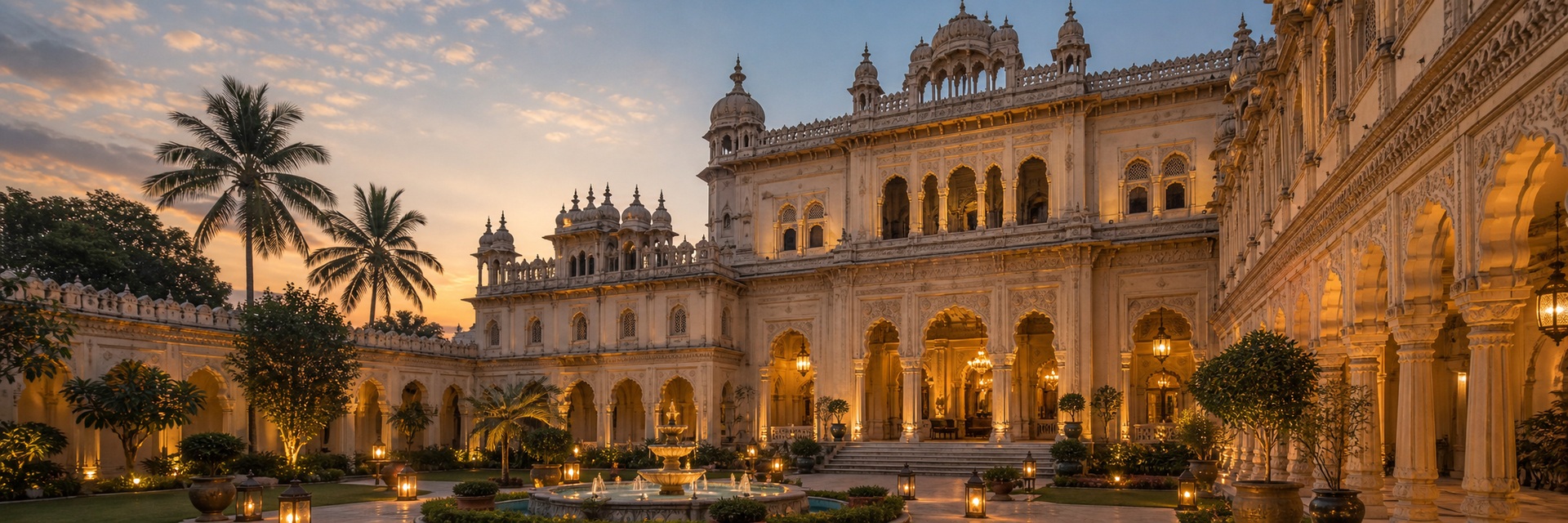
Heritage & Palace Hotels · Telangana · Deccan
Setting Up a Heritage & Palace Hotel in Hyderabad
Hyderabad is the Nizam's city — and its Paigah palaces and Deccan havelis are the rarest hospitality asset in India: buildings that cannot be built again.
A palace or haveli hotel in Hyderabad is not a construction project with a heritage skin — it is a restoration project that happens to become a hotel. The value is the fabric itself: Osmanian stucco, Belgian mirror-work, teak and Burma-timber joinery, the Deccan courtyard geometry. Get the conservation, the title and the heritage byelaws right and you own an asset a new-build can never replicate, at the ADR only scarcity commands. Get them wrong and you have destroyed the very thing you paid for. Gladwin International runs the whole journey as one accountable programme — conservation-led restoration, layered Nizam-trust and Wakf title, adaptive reuse within the byelaws, artisan procurement, and a small-key operation taken from a shuttered palace to a revenue-live hotel.
Restore, not rebuild
Conservation is the whole discipline
Small-key · high-ADR
The economics of rarity
Palace vs haveli
Two distinct products we scope apart
Turnkey
Shuttered palace to a stabilised opening
At a glance
Market benchmark
Taj Falaknuma Palace — the restored Nizami palace that proves the ceiling for Deccan palace-hotel ADR, weddings and fine dining.
The heritage stock
Paigah-nobility palaces (the Falaknuma, Paigah, Chowmahalla, Purani Haveli lineage) and Old City Deccan havelis around Charminar and the Char Kaman.
Two products
A grand palace hotel (banqueting, weddings, destination dining) versus an intimate Old-City haveli boutique — different scale, capex and guest.
The demand base
Hyderabad's tech and pharma HNI wealth underwrites palace weddings, private celebrations and premium Hyderabadi fine dining.
Title complexity
Layered ownership — Nizam trust interests, Wakf-board land, and fragmented private family shares — must be cleared before capital.
Deccan crafts
Bidri metalwork, Hyderabadi pearls, zardozi and Karchob embroidery — the procurement palette that makes the interiors authentically of the place.
The opportunity
Hyderabad holds something almost no other Indian city can offer at scale: a stock of genuine palaces and noble havelis built by the Nizams and their Paigah nobility, in a distinct Deccan idiom that fused Mughal, Persian, Rajput and European influence. The Taj Falaknuma Palace has already proved what the top of this market is worth — a restored Nizami palace commanding rates, weddings and destination dining that no new-build luxury box in the city comes close to. That is the whitespace: the next great restored palace or haveli hotel, not another glass business hotel in HITEC City.
The demand is real and local before it is anything else. Hyderabad's tech and pharma economy has produced a deep base of high-net-worth families for whom a palace wedding, a private anniversary, or a table at a Nizami fine-dining room is the aspiration. Layer on inbound luxury and heritage travellers, and a small-key palace or haveli can price on scarcity rather than square footage — the economics that make an expensive, slow restoration finally pencil.
The asset here is the building itself. A restored palace is scarce by definition — and scarcity, not room count, is what sets the ADR.
Palace or haveli — two different businesses
The first decision is which heritage product you are actually building, because a grand Paigah-lineage palace and an Old-City Deccan haveli are different businesses with different capex, guests and revenue engines. A palace hotel — larger grounds, a durbar hall, banqueting and lawns — is a weddings-and-destination-dining machine, where the events and F&B lines can eclipse rooms. An intimate haveli near the Charminar is a small-key boutique that sells immersion in the Old City, courtyard living and craft, at a high rate to a guest who wants intimacy rather than a ballroom.
We scope the two apart before any capital is committed — reading the specific building's footprint, its grounds or lack of them, the access and the surrounding fabric — and build the concept, the key count and the revenue model to what the asset can genuinely be, not to a brochure ambition the walls cannot carry.
| Product | Best for |
|---|---|
| Grand palace (Paigah lineage) | Weddings, banqueting and destination Nizami dining as the primary revenue |
| Old-City Deccan haveli | Small-key, high-ADR boutique selling Charminar immersion and craft |
| Suburban Deccan mansion | Private-celebration and residential-scale luxury away from Old-City congestion |
Indicative product logic — always subject to the specific structure, grounds, byelaws and title of the plot.
Restoration & adaptive reuse — the discipline that defines the asset
This is where a heritage hotel is won or lost. A Nizami palace is a lime-mortar, load-bearing structure of Osmanian stucco, jaali screens, Belgian mirror and glass, teak and Burma-timber joinery, and often Minton or encaustic flooring — none of which behaves like modern construction. Cement pointing, an over-eager damp treatment or the wrong intervention destroys the fabric and the value with it. The right approach is conservation-led: material-matched lime work, reversible structural strengthening, and the retention of every element that carries the story.
Adaptive reuse is then the art of threading a modern hotel through a protected shell — bathrooms, HVAC, fire safety, accessibility, and the back-of-house of a functioning luxury operation — without gutting the rooms that give the building its worth. We assemble and govern a team built for exactly this: conservation architects, structural engineers experienced in historic masonry, and craft specialists, working to a restoration brief that treats the fabric as the asset, then engineers the hotel around it.
- Conservation-led restoration — lime mortar and stucco, jaali, mirror-work, timber and stone, material-matched and reversible
- Structural strengthening and services (HVAC, fire, electrical, plumbing) threaded through a load-bearing historic shell
- Adaptive reuse of durbar halls, courtyards and zenana/mardana wings into rooms, dining and events without erasing them
- Accessibility and life-safety compliance achieved within heritage constraints, not by demolition
Heritage byelaws & protected-monument constraints
A heritage building is not a free canvas. Depending on the structure's listing and location, it may fall under heritage-conservation byelaws, State Archaeology or ASI protection, and — for anything near a protected monument — the regulated and prohibited zones that impose strict setbacks and restrictions on new construction and even alteration. Old City structures also sit within congested, historically sensitive precincts around the Charminar and the Char Kaman where any intervention is scrutinised. Getting a hotel approved inside these regimes is a specialist path, not a routine building licence.
We map the exact heritage status of your specific building and its surroundings at the outset — listing grade, protected-monument proximity, permitted interventions and the conservation approvals required — and shape the design brief to what is genuinely permissible. Filings are made by your appointed architects and heritage consultants; we coordinate and govern them to a lawfully-open asset, so an ambition the byelaws will never sanction is never designed in the first place.
- Heritage listing grade and permissible-intervention envelope established before the design brief is fixed
- Protected-monument regulated / prohibited-zone setbacks resolved where the building sits near a listed monument
- State Archaeology / ASI and heritage-conservation-committee approvals sequenced into the programme
- Old-City precinct and congestion constraints (access, servicing, parking) designed around, not against
Title & ownership — the layered Deccan question
Nowhere is the ownership harder than in the Nizam's city. A palace or haveli may carry interests held by a Nizam family trust, land vested with or claimed by the Wakf board, and private shares fragmented across generations of a noble family — sometimes all layered on the same asset. A leasehold, a redevelopment or a management structure on an unresolved title is the fastest way to sink capital into a dispute rather than a hotel.
We run title and ownership diligence to the depth this market demands — the chain of title, trust and Wakf interests, family shareholdings, encumbrances and any litigation — and structure the transaction or lease so the restoration proceeds on ground that will hold. Where ownership is fragmented, we help design the acquisition, lease or partnership vehicle that consolidates control before a rupee goes into the fabric.
Craft, cuisine & the Deccan guest experience
A Hyderabad palace hotel earns its rate on authenticity that money cannot fast-track. The interiors should be finished in the crafts of the Deccan — Bidri metalwork from Bidar, Hyderabadi pearls, zardozi and Karchob embroidery, and the region's stone and timber work — sourced from the master artisans who still hold these skills, not approximated by a generic five-star fit-out. The service should carry the Dakhni courtliness the setting implies. And the food is a revenue engine in its own right: authentic Hyderabadi Nizami cuisine — the biryanis, haleem, the dum and the sheermal — served as destination dining that the city's own HNI base will fill on merit.
We brief the concept, the F&B strategy and the guest journey together with the restoration, so the durbar hall, the courtyards, the dining rooms and the wedding lawns are shaped as one experience — and we build the artisan and specialist-supplier procurement into the programme so those crafts are commissioned early, to the lead times handwork demands, rather than compromised under opening pressure.
Brand, operator & the small-key operating model
A restored palace can carry a luxury flag, a soft-brand collection, or run independent — and the right answer depends on the distribution you need, the fee economics, and how much of the palace's own identity you want the brand to subordinate. The Falaknuma benchmark shows an international operator can lift a Nizami palace to the top of the market; equally, a distinctive haveli may be worth more as an independent or a soft-brand member where the building, not the flag, is the story. It is an economic and control decision we model against your thesis and negotiate as your Owner's Representative.
Either way, a heritage hotel is a small-key, high-touch operation with an unusual cost base — conservation-grade upkeep, higher service ratios, and delicate fabric that cannot be run like a modern box. We build the operating model and the team to match: a General Manager who can run a palace as much as a hotel, heads of department for events and destination F&B, and a Hyderabad hiring plan that blends the city's hospitality and culinary talent with the artisans and specialists heritage upkeep requires — in seat and trained before the first wedding season.
- Independent, soft-brand or full operator — modelled against distribution, fees and how much identity the palace should keep
- Operator / collection selection and agreement negotiated as your Owner's Representative
- Small-key operating model built for conservation-grade upkeep and high service ratios
- General Manager and pre-opening team recruited through our executive-search practice and trained before the first peak
Gladwin's edge in Hyderabad
We treat a Hyderabad palace or haveli as the restoration-and-title problem it actually is, not a build with heritage styling. Before capital is committed we resolve the layered Nizam-trust, Wakf and private title, establish exactly what the heritage byelaws and any protected-monument zone permit, and scope the palace-versus-haveli product to what the specific building can genuinely become. Then we run conservation-led restoration, adaptive reuse, Deccan artisan procurement, the operator relationship, the full team and a supported launch as one accountable partner and your Owner's Representative.
The distinction we bring is conservation discipline married to hotel economics: a team that will not let a contractor cement-point Osmanian stucco to hit a date, and a commercial model that turns a scarce, slow, expensive restoration into the small-key, high-ADR asset only Hyderabad's palaces and havelis can be — filled by the city's own tech and pharma wealth as much as by the inbound luxury traveller.
Planning a heritage or palace hotel in Hyderabad?
We take single accountability from a heritage asset and a conservation brief to a stabilised, high-ADR opening — restoration and adaptive reuse, brand-versus-operator strategy, artisan-led design and procurement, PMO and the service culture. The team is recruited through our executive search practice and trained for opening.
Speak with a partnerSetting up a heritage or palace hotel in Hyderabad — FAQs
Fundamentally. A new-build is a construction project; a palace hotel is a restoration project that becomes a hotel. The asset and the value are the historic fabric itself — the Osmanian stucco, mirror-work, timber and courtyard geometry — which is scarce and cannot be recreated. That changes everything: conservation-led restoration replaces conventional construction, heritage byelaws replace a routine building licence, and the ADR is set by rarity rather than room count. Get the conservation wrong and you destroy the very thing you paid for.
They are two different businesses. A grand palace — Paigah-lineage scale, durbar hall, grounds — is a weddings-and-destination-dining machine where events and F&B can eclipse rooms. An Old-City Deccan haveli near the Charminar is a small-key boutique selling intimacy, courtyard living and craft at a high rate. We scope the two apart against your specific building's footprint, grounds, access and title before any capital is committed.
Significantly. Depending on listing grade and location, the building may fall under heritage-conservation byelaws, State Archaeology or ASI protection, and — near a protected monument — regulated and prohibited zones with strict setbacks on construction and alteration. Old-City precincts around Charminar add congestion and servicing constraints. We map the exact status of your building and surroundings first and shape the design brief to what is genuinely permissible, so an unapprovable ambition is never designed in.
Because ownership is layered in the Nizam's city — a single asset can carry Nizam family-trust interests, Wakf-board land, and private shares fragmented across generations of a noble family, sometimes all at once. Restoring on an unresolved title risks sinking capital into a dispute. We run title diligence to that depth — chain of title, trust and Wakf interests, family shares, encumbrances and litigation — and structure the acquisition, lease or partnership so control is consolidated before the fabric is touched.
By treating conservation as a discipline and craft as procurement. Restoration is material-matched and reversible — lime mortar and stucco, jaali, Belgian mirror-work, teak and stone — governed by conservation architects and historic-masonry engineers, never cement-pointed to save time. Interiors are finished in the crafts of the Deccan: Bidri metalwork, Hyderabadi pearls, zardozi and Karchob embroidery, commissioned early from master artisans to the lead times handwork demands.
From weddings and private celebrations, destination Nizami fine dining, and small-key high-ADR rooms — in that order for a grand palace. And the demand is local before it is inbound: Hyderabad's tech and pharma HNI base underwrites palace weddings and premium Hyderabadi dining on merit, which is what lets a scarce, restored asset price on rarity rather than volume. The Taj Falaknuma Palace is the benchmark for what the top of this market sustains.
Explore the cluster
Heritage & palace hotels across India
Tamil Nadu · Chettinad
Chettinad
Chettinad is not a build — it is a rescue. The asset already stands: a colossal Chettiar mansion of Burma teak, Athangudi tile and Belgian glass, waiting to be brought back as a hotel.
West Bengal · Colonial
Kolkata
Kolkata holds the richest stock of colonial architecture in India — and the country's most under-exploited heritage-hotel opportunity outside Rajasthan.
Rajasthan · Lakes
Udaipur
Udaipur is the world's premier lake-palace destination — and a heritage hotel here is won or lost on conservation judgement, not construction schedules.
Also explore our executive search practice for the leadership team, and the wider end-to-end hospitality practice.