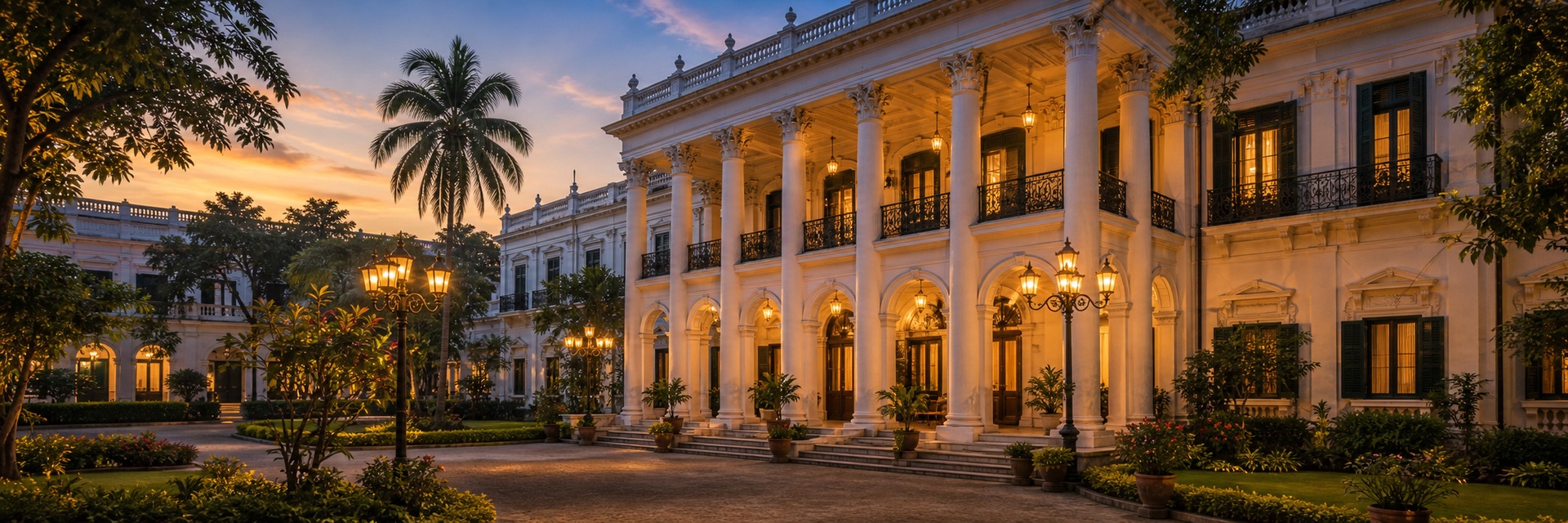
Heritage & Palace Hotels · West Bengal · Colonial & Rajbari
Setting Up a Heritage Hotel in Kolkata
Kolkata holds the richest stock of colonial architecture in India — and the country's most under-exploited heritage-hotel opportunity outside Rajasthan.
The former capital of the Raj is a city of Georgian and Palladian mansions, Chowringhee facades, Dalhousie counting-houses and, to the north and out in rural Bengal, the great zamindar rajbaris — palace houses that once ran whole estates. Almost none of it has been turned into hotels. Converting one of these buildings is not a construction project; it is an acquisition, a conservation programme and a cultural act at once — governed by heritage grading, tangled by multi-heir ownership, and rewarded, when it is done properly, with a small-key asset that commands a rate no new-build in the city can touch. Gladwin International runs the whole journey as one accountable programme: securing the building and its title, conserving the architecture to grade, and taking it from a decaying shell to a fully staffed, revenue-live heritage hotel.
Small keys
20–40 rooms, high ADR, not scale
Grade I / IIA / IIB
The KMC listing dictates what you may touch
Conserve, not rebuild
The discipline the whole model turns on
Turnkey
Acquisition to a stabilised opening
At a glance
Two distinct products
Central-Kolkata colonial-mansion boutique (Park Street, Chowringhee, BBD Bagh belt) versus a rural-Bengal rajbari retreat (north-Kolkata palace houses; countryside estates such as the Bawali–Budge Budge belt).
The building stock
Raj-era Georgian, Palladian and neo-classical mansions and counting-houses; ornate Bengali rajbaris with thakur dalans, courtyards, Corinthian columns and lime-plaster detail.
Heritage control
Kolkata Municipal Corporation heritage grading (Grade I, IIA, IIB, III) governs demolition, facade and interior alteration under the Heritage Conservation Committee.
The hard part
Fragmented, multi-heir rajbari title and colonial-mansion tenancy — not the restoration. Assembling clean ownership is the real gate.
Positioning
Cultural and culinary heritage-luxe — Bengali cuisine, the arts, adda, literature and craft — not beach or golf leisure.
The climate tax
Humidity, monsoon damp and biological decay attack lime plaster, timber and ironwork continuously; conservation is a running commitment, not a one-off.
The opportunity
For roughly two centuries Kolkata was the capital of British India, and it was built to look the part. The result is a density of colonial-era architecture — Georgian, Palladian and neo-classical mansions, the Chowringhee frontage, the counting-houses and chambers of the Dalhousie and BBD Bagh quarter — that no other Indian city can match. Alongside it stands a parallel, indigenous grandeur: the Bengali rajbari, the palace house of the zamindar families, with its central courtyard, its thakur dalan for the annual Durga Puja, its Corinthian columns and shuttered verandahs. The finest sit in north Kolkata — the Shobhabazar and Jorasanko neighbourhoods — and out in rural Bengal, where whole estate houses stand behind their gates.
What is striking is how little of this has become hospitality. Rajasthan turned its forts and havelis into one of the world's great heritage-hotel economies decades ago; Bengal, sitting on a comparable or richer stock, has barely begun. A handful of pioneering rajbari conversions in the countryside have proved the demand — the cultured traveller who wants Durga Puja, Bengali kitchens, literature and the arts rather than a spa and a golf buggy. The whitespace is real: a conservation-led, small-key heritage hotel that trades on architecture and culture no competitor can replicate, because there is only one of each building.
The scarcity is the moat. A heritage conversion cannot be copied down the road — the ADR is defended by a building that exists exactly once.
Colonial mansion or rajbari — two different businesses
The first decision is which heritage you are buying, because a central-Kolkata colonial mansion and a rural-Bengal rajbari are not the same product with a different postcode — they are different businesses. A restored Park Street, Chowringhee or Dalhousie mansion is an urban boutique: a small house of large, high-ceilinged rooms serving the city's business, cultural and diaspora traveller, with a bar, a restaurant that can hold its own against Kolkata's own dining scene, and a rooftop or courtyard the city cannot offer elsewhere. It lives on the calendar of the city — the pujas, the literary and film festivals, the winter season, the weddings.
A rajbari retreat is a destination in its own right. Guests travel out to it; the draw is the architecture, the courtyards, the estate setting and an immersive Bengali cultural and culinary programme. The room count is small, the stays are longer, and the operation is closer to a country house than a city hotel. We help you choose the product against your capital, your appetite for operating complexity and the guest you actually want — and then design the whole model around that single decision, because it dictates the site, the key count, the food and beverage and the staffing.
| Product | What it is best for |
|---|---|
| Central-Kolkata colonial mansion | Urban boutique — city business, cultural and diaspora demand, event calendar, F&B and bar |
| North-Kolkata rajbari | Palace-house boutique in the old city — architecture-led stays, puja and cultural immersion |
| Rural-Bengal rajbari estate | Destination retreat — longer stays, country-house operation, full cultural programme |
Two heritage products — the choice shapes site, key count, F&B and operating model.
Acquisition & title — the real gate
The hardest part of a Bengal heritage conversion is almost never the restoration; it is buying the building with clean, defensible title. Rajbaris were the seats of extended zamindar families, and generations of inheritance have fractured ownership across dozens of heirs — some abroad, some estranged, some untraceable — often with no partition ever formalised. A colonial mansion in the old city may carry decades of protected tenancy, disputed shares and encumbrances that a casual sale conceals. Committing capital before the title is assembled is how these projects die.
We run the acquisition as a forensic exercise before any money moves: tracing the full chain of heirs and shares, resolving or buying out tenancies, testing for encumbrances, ownership disputes and any URBAN LAND CEILING legacy, and confirming that the building's heritage grade actually permits a hotel use. Only once the ownership is clean and the permissions are credible do we underwrite the conversion — so you are restoring an asset you unambiguously own, not litigating one.
- Multi-heir rajbari title traced and consolidated — full chain of succession and partition
- Colonial-mansion tenancy, protected occupancy and encumbrance resolved before purchase
- Heritage grade confirmed to permit hotel adaptive reuse under the KMC regime
- Structural, damp and conservation due diligence built into the acquisition decision
Heritage grading & the KMC byelaws
Kolkata's heritage buildings are listed and graded by the Kolkata Municipal Corporation, and the grade is not a plaque — it is a legal control on what you may do. Under the KMC's Heritage Conservation Committee, a Grade I building's exterior and, often, key interiors are protected against demolition and alteration; Grade IIA and IIB allow progressively more internal change while the facade and character are held; Grade III is the most permissive. Any intervention on a graded building — a new bathroom core, a lift, a rooftop, a change of external appearance — requires sanction, and the grade determines whether it is even possible.
This is where a conversion succeeds or fails on paper. We read the grade before acquisition and design the hotel within it, not against it: agreeing the conservation approach with the Heritage Conservation Committee, threading modern services and fire and life-safety through a protected fabric without disfiguring it, and using the licensed conservation architects who file the sanctions. The discipline is to make the building work as a hotel while keeping every protected element the grade requires — because that fabric is the entire reason the asset commands its rate.
- Grade I / IIA / IIB / III implications read before purchase, not after
- Conservation approach agreed with the KMC Heritage Conservation Committee
- Sanctions for adaptive reuse, service cores, fire and life-safety filed by licensed conservation architects
- Trade licence, tourism registration and hotel classification aligned to a graded-building use
Conservation of the architecture
Restoring a Raj-era or rajbari building is a craft discipline, not a general-contracting one. The fabric is lime — lime plaster, lime mortar, lime wash — which breathes and which cement finishes trap and destroy; it is Burma teak and shutter timber, cast and wrought ironwork, Corinthian and Ionic columns, jaali, stained glass, decorative floor tiles and moulded cornices. Kolkata's climate is the standing enemy: relentless humidity, monsoon ingress and rising damp feed the biological decay — the salt, the fungus, the timber rot — that has hollowed so many of these houses. Conservation here is not a one-off restoration; it is a continuing regime the asset carries forever.
We assemble and run the conservation team — conservation architect, structural engineer, lime and plaster specialists, timber and metal craftspeople — and hold them to a genuine conservation brief: consolidate and repair rather than replace, match original materials and techniques, and reverse the damp and drainage causes rather than paper over the symptoms. The craft that built these buildings has thinned, so part of the job is finding, and often reviving, the artisans who can still work lime, timber and stucco to the standard the fabric demands.
Cement is the enemy of a lime building. Conserving to the original materials is what protects both the architecture and the ADR — a botched restoration destroys the very asset it was meant to save.
Positioning, experience & the small-key economics
A Kolkata heritage hotel does not compete on scale, spa menus or sea view — it competes on culture, and its economics reflect that. The model is deliberately small: twenty to forty large, characterful rooms rather than a hundred standard ones, run for a high average rate and a guest who is buying an experience that exists nowhere else. The positioning is unapologetically Bengali and cultural: the cuisine — the zamindar and Bengali kitchen taken seriously — the arts, literature, music, adda, the pujas and festivals, and the building itself as the headline. This is heritage-luxe for the cultured traveller, the design and architecture enthusiast and the returning diaspora, not mass leisure.
We build the concept, the culinary strategy and the guest journey around the building's own story, so the courtyard, the thakur dalan, the verandahs, the library and the dining room each earn their place in the experience and in the rate. Small keys mean every room, every meal and every cultural touchpoint has to work harder — which is exactly why the concept and the operating standard, not the room count, decide whether the asset performs.
Staffing a heritage house
A heritage hotel is staffed differently from a branded new-build. The house is small and the service is personal and immersive, so the team is closer to that of a private estate than a chain hotel: a General Manager who can run a culture-led, high-touch operation, a kitchen genuinely fluent in Bengali and zamindar cuisine rather than a generic five-star menu, and front-of-house who can host — narrate the building, the family history and the city — as much as serve. The building itself also demands a maintenance discipline most hotels never carry: people who understand lime, damp and timber, and a preventive regime that protects the fabric year-round.
We recruit and train the whole team through our executive search practice, blending Kolkata's deep hospitality and culinary talent with the specialist trades a heritage house needs, and run pre-opening training so the service, the storytelling and the conservation-aware maintenance are all live before the doors open. In a small-key heritage asset the team is not a cost line — it is most of the product.
- A General Manager for a culture-led, high-touch, small-key operation — not a scale hotel
- A kitchen fluent in Bengali and zamindar cuisine as the culinary headline
- Host-grade front-of-house able to narrate the building, the family and the city
- Conservation-aware maintenance embedded so the fabric is protected year-round
Gladwin's edge in Kolkata
We treat a Kolkata heritage hotel as the acquisition, conservation and cultural problem it actually is — not a build. Before capital is committed we assemble the fractured rajbari or colonial-mansion title, read the KMC heritage grade to know exactly what the building will permit, and underwrite the conversion against a real conservation cost, not a wishful one. Then we run the conservation programme to the original materials, design the small-key, high-ADR model around the building's own culture, hire and train a house-grade team, and take the asset to a supported, revenue-live opening as one accountable partner and your Owner's Representative.
Bengal's heritage stock is the richest and least exploited in India, and that is precisely why it punishes the unprepared — the title is tangled, the grading is strict and the humid climate never stops attacking the fabric. Our edge is doing the hard, unglamorous work first: clean ownership, an honest conservation brief and a positioning that turns a decaying Raj-era mansion or zamindar palace into an asset whose rate no new-build in the city can match.
Planning a heritage or palace hotel in Kolkata?
We take single accountability from a heritage asset and a conservation brief to a stabilised, high-ADR opening — restoration and adaptive reuse, brand-versus-operator strategy, artisan-led design and procurement, PMO and the service culture. The team is recruited through our executive search practice and trained for opening.
Speak with a partnerSetting up a heritage or palace hotel in Kolkata — FAQs
Because the stock is comparable or richer and almost untouched. As the former capital of the Raj, Kolkata holds India's densest concentration of colonial architecture, plus the Bengali rajbaris — zamindar palace houses in north Kolkata and rural Bengal. Rajasthan converted its forts and havelis decades ago; Bengal has barely started, so the scarcity and the cultural distinctiveness are still available to a first mover.
The title, not the restoration. Rajbaris are typically owned across dozens of heirs with no formal partition, and old-city mansions can carry protected tenancy and disputed shares. Assembling clean, defensible ownership before any capital moves is the real gate — we run that acquisition forensically before we underwrite the conversion.
Decisively. The Kolkata Municipal Corporation grades listed buildings I, IIA, IIB and III, and the grade legally controls demolition, facade and interior alteration under the Heritage Conservation Committee. Grade I protects the exterior and often key interiors; IIA and IIB allow progressively more internal change. We read the grade before purchase and design the hotel — service cores, fire safety, a lift — within what it permits.
Small. The model is typically twenty to forty large, characterful rooms run for a high average rate, not a hundred standard keys. The value is in scarcity and culture — the building, the Bengali cuisine, the arts and the experience — so the concept and the operating standard, not the room count, drive the returns.
It is continuous. Kolkata's humidity, monsoon damp and rising moisture drive biological decay in the lime plaster, timber and ironwork these buildings are made of, so conservation is a running regime, not a one-off. We conserve to the original materials — lime rather than cement, repair rather than replacement — reverse the damp causes, and embed a conservation-aware maintenance discipline that protects the fabric year after year.
Yes — all of it, as one programme. We assemble the title, confirm the heritage grade permits a hotel, run the conservation team to a genuine brief, secure the KMC sanctions and hotel licences through licensed professionals, design the small-key cultural model, and recruit and train a house-grade team through our executive search practice — taking the asset from a decaying building to a stabilised opening as your Owner's Representative.
Explore the cluster
Heritage & palace hotels across India
Uttar Pradesh · Ganga
Varanasi
Varanasi is the oldest living city on earth and India's spiritual capital — and the rarest luxury hotel to build anywhere, because the address is a river of faith and the site is a palace that has been settling into the ghat for two hundred years.
Telangana · Deccan
Hyderabad
Hyderabad is the Nizam's city — and its Paigah palaces and Deccan havelis are the rarest hospitality asset in India: buildings that cannot be built again.
Tamil Nadu · Chettinad
Chettinad
Chettinad is not a build — it is a rescue. The asset already stands: a colossal Chettiar mansion of Burma teak, Athangudi tile and Belgian glass, waiting to be brought back as a hotel.
Also explore our executive search practice for the leadership team, and the wider end-to-end hospitality practice.