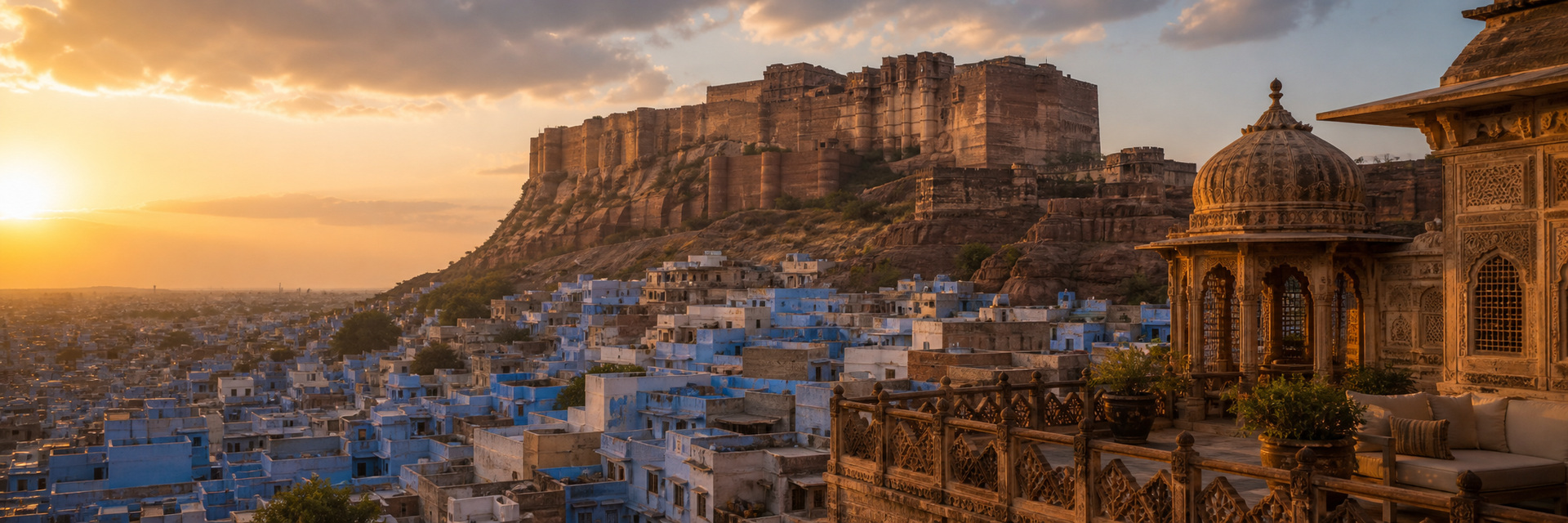
Heritage & Palace Hotels · Rajasthan · Blue City
Setting Up a Heritage & Palace Hotel in Jodhpur
Jodhpur does not need another new-build. Its scarcest asset is a restored one — a fort, a haveli or a Marwar estate given a second life as a hotel without losing what made it worth saving.
A heritage hotel is not a resort with old walls. It is a conservation project that happens to trade — where the sandstone, the jharokhas and the fort-view sightlines are the product, and every decision is bounded by what a listed building and the Blue City's stepped lanes will actually permit. Gladwin International runs the whole journey as one accountable programme: reading the asset honestly, restoring it under conservation discipline rather than demolishing it, resolving the heritage byelaws and access, and taking it from a decaying royal property to a small-key, high-ADR hotel that a discerning international guest crosses continents for.
Restore, not rebuild
The discipline the whole project turns on
Small keys, high ADR
The model heritage rewards
Artisan-made
Sandstone, lime, jali and inlay by hand
Turnkey
Ruin or estate to a stabilised opening
At a glance
Asset archetypes
Grand palace or fort estate; blue old-city haveli; fort-view rooftop boutique; Marwar country garh or estate.
The benchmarks
Umaid Bhawan Palace (Taj) as the grand palace-hotel standard; RAAS Jodhpur as the modern haveli-conversion boutique; Ajit Bhawan as market context.
Best-fit micro-markets
Below Mehrangarh in the blue old city; the Umaid Bhawan / Ratanada belt; and Marwar estates on the city's rural edge.
The scarcity
Genuine restorable heritage with clean title and buildable access is finite — the moat is the asset, not the keys.
Conservation watch-outs
Fort-view sightline preservation, sandstone and lime restoration, and heritage byelaws that cap height, façade and intervention.
Guest demand
High-spend international leisure, buy-out weddings, and experience-led travellers paying for authenticity and provenance.
The opportunity
Jodhpur sits at the top of the world's palace-hotel imagination. Under the ramparts of Mehrangarh, in a city painted blue, the Marwar royal legacy left behind a stock of forts, havelis and estates that no developer could recreate at any price. The single greatest of them, Umaid Bhawan Palace, is run by Taj as one of the finest palace hotels on earth — and it sets the reference every heritage project here is measured against. That heritage, not a beach or a view alone, is the asset class.
The opportunity is not another concrete build competing on room count. It is adaptive reuse — taking a fort, a blue-city haveli or a Marwar country estate and restoring it into a small-key, high-ADR hotel where the walls themselves are the reason a guest pays. The market has already proven the two ends of the range: the grand palace at one extreme, and, at the other, an intimate haveli conversion such as RAAS Jodhpur, which showed that a boutique property tucked beneath the fort can command international rates on atmosphere and provenance.
In Jodhpur the play is to restore something irreplaceable into a hotel — not to build a new one that pretends to be old.
Grand palace hotel or fort-view haveli — two very different products
The first and most consequential decision is which heritage product you are actually creating, because a grand palace or fort estate and a blue-city haveli boutique are different businesses with different capital, guest and operating logic. A palace or large garh estate carries scale, sweeping grounds and the gravitas that anchors a full-service operation and a serious wedding book; a haveli conversion trades on intimacy, rooftop fort views and a hand-made sense of place, at a fraction of the keys.
We define the archetype against the asset and your investment thesis before design begins, because it dictates everything downstream — the key count, the F&B and events footprint, the service model, the brand-or-independent choice, and the ADR you can credibly hold. A palace overbuilt on keys loses its magic; a haveli stretched beyond its intimate scale loses its premium.
| Heritage archetype | Best for |
|---|---|
| Grand palace / fort estate | Scale, full-service, buy-out weddings and a landmark room product |
| Blue old-city haveli | Intimate boutique, rooftop fort views, high ADR on atmosphere |
| Marwar country garh / estate | Rural seclusion, experiential stays and destination weddings |
Indicative archetype logic — always subject to the specific asset, its title, its heritage listing and its buildable envelope.
Conservation-led restoration — the discipline the whole project turns on
A heritage hotel lives or dies on restraint. The temptation on a decaying property is to strip and rebuild for programme certainty; the discipline is to conserve — to repair sandstone and lime rather than replace them, to retain original jharokhas, jali screens, courtyards and carved detail, and to make the modern hotel serve the building rather than the reverse. Reversibility matters: mechanical, electrical, plumbing, fire and modern comfort systems must be threaded through thick masonry without scarring the fabric, so that what is inserted could, in principle, be removed.
We run the asset honestly from the outset — a conservation-led condition survey of the structure, the sandstone, the roofs and the water ingress before any commitment — and set the brief so restoration leads and the hotel programme follows. The result is a building that reads as authentically old because it is, not one re-skinned to look the part.
- Conservation condition survey — structure, sandstone, lime plaster, roofs and drainage — before capital is committed
- Repair-first specification: original masonry, jharokhas, jali and carved stone retained and conserved
- Reversible, concealed MEP, fire and comfort systems threaded through heritage fabric
- A restoration-led brief where the hotel programme is fitted to the building, not carved out of it
Heritage byelaws, fort sightlines & Blue City access
Building a hotel into Jodhpur's heritage is bounded by rules a new-build never meets. Around and below Mehrangarh, heritage and old-city byelaws constrain height, façade treatment, signage and the extent of intervention permitted on and near listed and character buildings — and the fort's dominance over the skyline means view corridors and sightlines are a planning consideration, not merely a marketing one. A rooftop that steals a fort view can equally be the elevation a byelaw protects.
Then there is the Blue City itself: the dense, stepped lanes below the fort were never built for construction logistics, coaches or arriving guests. Access, material handling, parking and a dignified arrival sequence have to be solved on paper before a property is bought, because a beautiful haveli with no workable approach is a liability. We resolve the heritage envelope, the sightline constraints, the title — royal, trust and ancestral holdings can be intricate — and the access reality before capital is committed.
The fort view that sells the room and the byelaw that limits your roofline are often the same line on the plan — read it before you buy.
Small keys, high ADR — the heritage business model
Heritage economics run opposite to volume hospitality. The keys are few — a haveli may yield a dozen or two, a palace a modest count relative to its footprint — and the whole return depends on holding a high average daily rate, deep occupancy through the season, and a high-spend guest who values scarcity. That model only works if the restoration is genuine, the service is proportionate to the rate, and the ancillary revenue — destination and buy-out weddings, private dining in courtyards, and curated Marwar experiences — is designed in from the start rather than bolted on.
We build the commercial model around what heritage actually monetises: rarity, provenance and experience. That means resisting the pressure to add keys at the cost of atmosphere, pricing to the international leisure and wedding guest rather than the domestic mid-market, and engineering the wedding and events capability the Marwar market rewards without letting it overwhelm the hotel's character.
Artisan procurement & the craft supply chain
A Jodhpur heritage hotel is only as authentic as the hands that restore it. The region's craft economy — Jodhpur sandstone carving, lime and araish plaster, jali and jharokha stonework, hand-block textiles, brass and traditional inlay — is the procurement backbone, and sourcing it is a matter of finding, vetting and scheduling genuine artisans and karigars, not placing an FF&E order. Restoration-grade stone, lime and traditional finishes carry long, weather-sensitive lead times and cannot be rushed without showing.
We run the full procurement programme against the restoration schedule — conservation materials and skilled artisan trades alongside the hotel's FF&E, OS&E, kitchens, spa and technology — with independent vendor intelligence, so the craft that makes the property credible is secured, sequenced and quality-controlled rather than improvised late. Where original craft skills are scarce, we plan for it early rather than compromising the fabric at the end.
Brand versus operator on a listed asset
A heritage property forces the brand-or-independent question in a sharper form than a new-build. An international or domestic flag brings distribution, a wedding and MICE machine and the reassurance of a name — Umaid Bhawan under Taj is the proof of what a great operator does with a great palace — but a brand's standardised technical and design standards can sit awkwardly against a listed building that cannot, and should not, be forced to comply. An independent or a specialist boutique operator may protect the property's character better, at the cost of reach.
We model the options against the asset and your thesis — management agreement, franchise, a specialist heritage operator, or a well-run independent — and where a brand is right, we negotiate as your Owner's Representative so the technical standards flex to the building rather than the building being cut to fit the flag. The heritage comes first; the badge serves it.
- Independent, management agreement, franchise or specialist heritage operator — modelled against the asset and your ROI
- Brand technical standards negotiated to flex around a listed, non-standard building
- Distribution, weddings and loyalty upside weighed against protecting the property's character
- The whole agreement negotiated and governed as your Owner's Representative
Experience & staffing — where a palace earns its rate
In heritage the experience is the product, and Jodhpur offers material no new-build can buy: Mehrangarh at dusk, the blue lanes, Marwari horses and desert country, royal-kitchen Marwari cuisine, and the living craft of the city. The guest journey — arrival, private dining in a courtyard, curated fort and old-city experiences, and a wedding staged against the ramparts — has to be designed with the same care as the restoration, because that is what justifies the rate.
The team must match it. A heritage or palace hotel needs a General Manager and hosts who can carry Marwar hospitality with genuine warmth and story, service standards proportionate to a very high ADR, and local talent trained to international finish. We recruit the leadership and pre-opening team through our executive search practice, blend Jodhpur's own hospitality and craft talent with seasoned heritage operators, and run pre-opening training so the service is live and the story is fluent before the first guest — and the first wedding — arrives.
Gladwin's edge in Jodhpur
We treat a Jodhpur project as the conservation problem it actually is, not a build with a Rajasthani skin. Before a rupee is committed we survey the asset honestly, resolve the heritage byelaws, the fort sightlines, the title and the Blue City access, and define whether you are creating a grand palace hotel or an intimate haveli boutique — because that decision governs the keys, the ADR and the whole commercial model. Then we run restoration, artisan procurement, the operator relationship, the full team hired and trained, and a supported launch as one accountable partner and your Owner's Representative.
Our discipline is restraint: restore rather than rebuild, hold the atmosphere rather than chase key count, and price to the high-spend international and wedding guest that scarcity commands. The team we build is heritage-fluent — a General Manager who can run a small-key, high-ADR property with a serious wedding book, and hosts who carry Marwar hospitality and its story with credibility, in seat and trained before the first season.
Planning a heritage or palace hotel in Jodhpur?
We take single accountability from a heritage asset and a conservation brief to a stabilised, high-ADR opening — restoration and adaptive reuse, brand-versus-operator strategy, artisan-led design and procurement, PMO and the service culture. The team is recruited through our executive search practice and trained for opening.
Speak with a partnerSetting up a heritage or palace hotel in Jodhpur — FAQs
In Jodhpur the value is in the restoration. A genuine fort, haveli or Marwar estate is irreplaceable and commands ADR and demand a new-build cannot fake, while a new build competing on room count sits in a crowded field. We assess the asset honestly first — condition, title, byelaws and access — and only take on what can be restored into a viable small-key, high-ADR hotel.
They are different businesses. A grand palace or fort estate — Umaid Bhawan under Taj is the benchmark — carries scale, grounds, a full-service operation and a large wedding book. A blue-city haveli conversion, in the vein of RAAS Jodhpur, trades on intimacy, rooftop fort views and hand-made atmosphere at a fraction of the keys. We define which product fits your asset and thesis before design, because it governs everything downstream.
Around and below Mehrangarh, heritage and old-city byelaws constrain height, façade, signage and the extent of intervention on listed and character buildings, and the fort's dominance makes view corridors a planning consideration. The rooftop that sells a fort view can also be the elevation a byelaw protects. We resolve the heritage envelope, the sightlines, the title and the Blue City access before a property is bought.
Heritage restricts what you can build — you fit the hotel to the building, not the reverse — so keys are few. The model works because it is not a volume play: the return depends on a high ADR, a high-spend international and wedding guest, and experience-led ancillary revenue. Adding keys at the cost of atmosphere destroys the very premium the property is built on, so we protect scarcity rather than dilute it.
The region's craft — Jodhpur sandstone carving, lime and araish plaster, jali and jharokha work, hand-block textiles and inlay — is the procurement backbone. We find, vet and schedule genuine artisans and karigars against the restoration programme, plan for long weather-sensitive lead times on conservation materials, and quality-control the work, so the craft that makes the property credible is secured early rather than improvised at the end.
Sometimes — a flag brings distribution and a wedding and MICE machine, and a great operator can be transformative, as Taj is at Umaid Bhawan. But a brand's standardised technical standards can clash with a listed building. We model management agreement, franchise, specialist heritage operator or a well-run independent against your asset and thesis, and where a brand is right, we negotiate as your Owner's Representative so the standards flex to the building rather than the building being cut to fit the flag.
Explore the cluster
Heritage & palace hotels across India
Rajasthan · Thar Desert
Jaisalmer
Jaisalmer is a small-key, high-ADR heritage market — won by conserving carved sandstone honestly and siting the desert product where the dunes, not the fragile fort, will carry it.
Rajasthan · Lakes
Udaipur
Udaipur is the world's premier lake-palace destination — and a heritage hotel here is won or lost on conservation judgement, not construction schedules.
Rajasthan · Thar Frontier
Bikaner
Bikaner is Rajasthan’s quiet frontier — a red-sandstone city of forts, palaces and merchant havelis that the Golden Triangle circuit has yet to price. That is precisely the opportunity.
Also explore our executive search practice for the leadership team, and the wider end-to-end hospitality practice.