Heritage & Palace Hotels · Rajasthan · Golden City
Setting Up a Heritage & Palace Hotel in Jaisalmer
Jaisalmer is a small-key, high-ADR heritage market — won by conserving carved sandstone honestly and siting the desert product where the dunes, not the fragile fort, will carry it.
A Jaisalmer hotel is not a build; it is a restoration and a stewardship. The Golden City’s value sits in its carved yellow-sandstone havelis and its living fort — and the responsible, bankable play is a conservation-led haveli conversion in the walled town paired with, or in place of, a luxury desert camp on the dunes beyond it. Gladwin International runs the whole journey as one accountable programme — reading the heritage byelaws and the fort’s ecological limits, restoring the stonework to a standard that commands rate, and taking you from a crumbling haveli or a bare desert plot to a fully staffed, revenue-live hotel.
Restore, don’t build
The discipline the whole programme runs on
Small-key · high-ADR
The Jaisalmer heritage economic model
Outside the fort
Where new hospitality load belongs
Turnkey
Ruin or dune to a stabilised opening
At a glance
Two distinct products
Haveli boutique conversion in the walled town, and luxury tented desert camp on the dunes — different assets, guests and cost bases.
The living fort constraint
Sonar Qila is one of very few inhabited forts on earth and is ecologically fragile — modern water and sewage from hotels inside have caused seepage and structural collapse; new hospitality load belongs below and beyond the walls.
Best-fit sites
Walled-town havelis (Patwon-ki-Haveli lineage of carved jharokhas and jali), fort-view boutiques on the ridge, and camps at Sam and Khuri dunes.
Market context
Desert luxury the market of Suryagarh and The Serai has defined — small-inventory, experience-led properties at strong rate.
Critical constraints
Extreme desert heat and remoteness, a delicate water table, and the slow, skilled restoration of hand-carved sandstone jali and jharokhas.
Connectivity
Limited air access and long road distances from Jodhpur — the demand model and logistics must be built around remoteness.
The opportunity
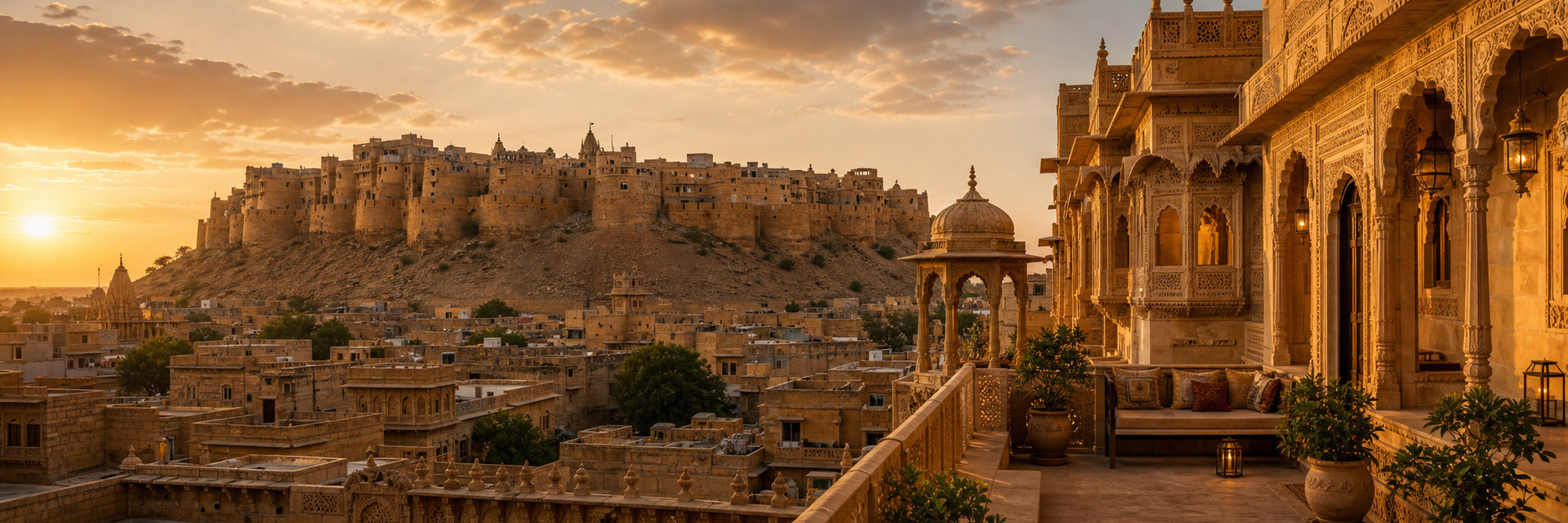
Jaisalmer sells something almost no other Indian destination can: a whole city carved from golden sandstone, marooned in the Thar Desert, glowing at sunset. The heritage guest — long-haul, high-spend, staying to experience rather than to transit — pays a premium for authenticity, intimacy and craft, not for a large room count. That makes Jaisalmer a small-key, high-ADR market in which a beautifully restored twelve-to-thirty-key haveli or an intimate desert camp will out-earn, per key, a far larger conventional hotel.
The whitespace is not more rooms; it is more properties restored and run to an international standard. A great many of the city’s havelis are decaying or crudely converted, and much of the desert-camp supply is either backpacker-basic or over-scaled. The gap Gladwin builds into is the conservation-led, experience-rich, correctly-sited heritage property — restored honestly, priced for rate, and operated to hold that rate.
In Jaisalmer the money is in fewer keys done impeccably — conserved sandstone, real craft and a genuine desert experience — not in room count.
The fort constraint — why new load belongs outside the walls
Jaisalmer Fort — Sonar Qila — is one of the very few still-inhabited forts on earth, and that is precisely why it cannot absorb new hospitality. The fort was never engineered for the water a modern hotel consumes; seepage from guesthouses, kitchens and sewage inside the walls has raised the water table, undermined foundations and contributed to the collapse of bastions and buildings. Conservation bodies actively discourage new hospitality load inside the fort, and any responsible sponsor must plan accordingly.
So the honest, defensible play sits below and beyond the fort: haveli conversions in the walled town, fort-view boutiques on the ridge that borrow the view without burdening the monument, and desert camps out on the dunes. We resolve, at feasibility, exactly where a property can responsibly sit — and steer capital away from the trophy-inside-the-fort proposition that reads well on a brochure and fails on conservation and consent.
The living fort is a monument to be seen from, not built into. Responsible Jaisalmer hospitality sits in the walled town and on the dunes — never adding water and sewage load inside Sonar Qila.
Haveli boutique versus desert luxury camp — two different businesses
A carved-sandstone haveli in the walled town and a luxury tented camp on the dunes are both ‘heritage Jaisalmer’, but they are different assets with different guests, cost bases and operating disciplines — and conflating them is how owners lose money. The haveli is a fixed, permanent, conservation-governed building: intimate, low-key-count, sold on craft, courtyards and the city at the door. The camp is a low-footprint, largely reversible, seasonal or climate-managed product on open desert: sold on space, silence, dunes and the night sky.
We help you choose the right product — or the right pairing of the two — against your land, your capital and the guest you want, then brief and cost each on its own terms rather than forcing one model onto the other.
| Product | What it is, and what it must get right |
|---|---|
| Haveli boutique (walled town) | Conservation-led conversion of a carved-sandstone haveli — few keys, intimate, sold on stonework, courtyards and city access; governed by heritage byelaws |
| Fort-view boutique (ridge) | New or converted property that borrows the fort view without burdening the monument — heritage-sympathetic design, no load inside the walls |
| Desert luxury camp (dunes) | Low-footprint, largely reversible tented resort at Sam or Khuri — sold on space, dunes and night sky; won on power, water, cooling and logistics |
Two heritage products, deliberately distinguished — the choice drives siting, capital, approvals and operating model.
Conservation, adaptive reuse & the heritage byelaws
Restoring a Jaisalmer haveli is a conservation project before it is a hotel project. The walled town and its havelis carry heritage protection, and any intervention has to respect the byelaws governing façades, heights, materials and the carved sandstone fabric — you conserve and adapt, you do not demolish and reinvent. Modern services — plumbing, electrical, cooling, fire safety, accessibility — must be threaded into a fragile historic structure without destroying the very fabric that gives the property its value.
We run the restoration as a governed conservation programme: a condition survey and structural assessment first, a conservation architect and heritage-competent contractors appointed, an adaptive-reuse strategy that inserts contemporary comfort reversibly and honestly, and the heritage approvals sequenced and coordinated so the work is defensible and the fabric protected.
- Condition and structural survey of the sandstone fabric before any design commitment
- Adaptive-reuse strategy — modern services and comfort inserted reversibly, without gutting the historic fabric
- Heritage byelaw compliance on façades, heights, materials and carved detail
- Conservation architect and heritage-competent trades appointed and governed, not generalist contractors
Restoring the carved sandstone — the skilled, slow work
Jaisalmer’s golden stone is the whole proposition, and it is unforgiving. The city’s signature jali screens and jharokha balconies — the lace-like carving of the Patwon-ki-Haveli lineage — were cut by hand, and they can only be conserved and matched by hand. This is slow, specialist work: sourcing compatible yellow sandstone, retaining the master carvers who can still cut it, consolidating weathered surfaces, and resisting the temptation to replace craft with cast or machine substitutes that read as fake and never command rate.
We build the stonework into the programme as a critical path in its own right — carver capacity, stone sourcing, sample panels and sign-off standards — because a haveli conversion is only worth its ADR if the carving is right, and the carving cannot be rushed.
In Jaisalmer the carving is the product. Rushed or machine-substituted sandwork is visible, and it caps the rate for the life of the asset.
Desert build realities — heat, water, remoteness & logistics
Building and operating in the Thar tests everything. Summer heat is extreme, which governs the season, the cooling loads and the specification of every finish and system; the desert water table is delicate and precious, so water sourcing, storage, treatment and reuse have to be engineered, not assumed. Remoteness compounds it: Jaisalmer sits a long haul from Jodhpur, air access is limited and seasonal, and skilled trades, materials and most FF&E have to be brought in and planned around.
We run the full procurement and delivery programme against these realities — FF&E, OS&E, kitchens, spa and pool plant, and off-grid-capable power, water and cooling for the desert camps — with a schedule mapped to the desert season, independent vendor intelligence, and logistics planned for the distance so the target opening survives the heat, the remoteness and the supply chain.
- Water strategy — sourcing, storage, treatment and reuse — engineered for a delicate desert table
- Cooling, power and season planned around extreme Thar heat; off-grid capability for dune camps
- FF&E, kitchens and plant procured and freighted with lead times built for the distance from Jodhpur
- Delivery schedule mapped to the operable season, not an all-year assumption
Gladwin’s edge in Jaisalmer
We treat a Jaisalmer hotel as the conservation, siting and small-key economics problem it actually is. Before capital is committed we resolve where the property can responsibly sit — a haveli conversion or fort-view boutique in and around the walled town, a camp on the dunes, and never new load inside the fragile living fort — survey the sandstone fabric, cost the restoration honestly, and model the small-key, high-ADR return that a Jaisalmer heritage asset lives or dies by. Then we run conservation-led restoration, artisan procurement, the full team hired and trained, and a supported launch as one accountable partner and your Owner’s Representative.
The team we build fits a remote, experience-led, low-key-count property: a general manager comfortable running an intimate operation far from a metro labour pool, a service culture matched to a heritage guest who came for craft and quiet, and a hiring and training plan that draws on Jaisalmer’s own artisans, guides and hospitality talent, in seat before the cool-season peak.
Planning a heritage or palace hotel in Jaisalmer?
We take single accountability from a heritage asset and a conservation brief to a stabilised, high-ADR opening — restoration and adaptive reuse, brand-versus-operator strategy, artisan-led design and procurement, PMO and the service culture. The team is recruited through our executive search practice and trained for opening.
Speak with a partnerSetting up a heritage or palace hotel in Jaisalmer — FAQs
No. Sonar Qila is a still-inhabited, ecologically fragile fort, and modern water and sewage load from hotels inside it has raised the water table, undermined foundations and contributed to structural collapse. Conservation bodies discourage new hospitality inside the walls. The responsible play is a haveli conversion in the walled town, a fort-view boutique on the ridge that borrows the view without burdening the monument, or a desert camp on the dunes.
They are different businesses, and it depends on your land, capital and target guest. A carved-sandstone haveli conversion is a fixed, conservation-governed building sold on craft, courtyards and city access; a desert camp is a low-footprint, largely reversible product on the dunes sold on space, silence and the night sky. We help you choose one — or pair the two — and cost each on its own terms.
Because the heritage guest pays for authenticity, intimacy and craft, not for room count. A beautifully restored twelve-to-thirty-key haveli or an intimate camp will out-earn a far larger conventional hotel per key. The whitespace is more properties restored and run to an international standard, not more rooms — so we build the model around rate and experience, not scale.
It is slow, specialist conservation. Jaisalmer’s jali screens and jharokha balconies were hand-carved and can only be conserved and matched by hand — sourcing compatible yellow sandstone, retaining master carvers, consolidating weathered stone, and refusing cast or machine substitutes that read as fake. We treat the stonework as its own critical path, because the carving is the product and it cannot be rushed.
They govern everything. Extreme Thar heat drives the season, the cooling loads and every specification; the delicate desert water table means water sourcing, storage, treatment and reuse must be engineered, not assumed; and remoteness from Jodhpur, with limited air access, means trades, materials and most FF&E are freighted in on long lead times. We map the delivery schedule and logistics to those realities so the opening survives them.
Yes — it is core. We recruit the general manager and full head-of-department team, and the wider pre-opening team, through our executive search practice, matching a remote, intimate, experience-led operation and drawing on Jaisalmer’s own artisans, guides and hospitality talent, then run pre-opening training so standards are live before the cool-season peak.
Explore the cluster
Heritage & palace hotels across India
Rajasthan · Blue City
Jodhpur
Jodhpur does not need another new-build. Its scarcest asset is a restored one — a fort, a haveli or a Marwar estate given a second life as a hotel without losing what made it worth saving.
Rajasthan · Thar Frontier
Bikaner
Bikaner is Rajasthan’s quiet frontier — a red-sandstone city of forts, palaces and merchant havelis that the Golden Triangle circuit has yet to price. That is precisely the opportunity.
Rajasthan · Lakes
Udaipur
Udaipur is the world's premier lake-palace destination — and a heritage hotel here is won or lost on conservation judgement, not construction schedules.
Also explore our executive search practice for the leadership team, and the wider end-to-end hospitality practice.