Heritage & Palace Hotels · Rajasthan · Frontier
Setting Up a Heritage & Palace Hotel in Bikaner
Bikaner is Rajasthan’s quiet frontier — a red-sandstone city of forts, palaces and merchant havelis that the Golden Triangle circuit has yet to price. That is precisely the opportunity.
The heritage hotel game in Bikaner is not won by adding rooms; it is won by restoring the right building well and then generating the demand that the destination does not yet hand you for free. Off the Jaipur–Jodhpur–Udaipur flow, Bikaner offers first-mover advantage on genuinely rare stock — a never-conquered fort city, the Karni royal legacy of Lalgarh and Laxmi Niwas, and the carved red-sandstone Rampuria havelis — at land and asset values a fraction of the saturated markets. Gladwin International runs the whole journey as one accountable programme: conservation-led restoration inside the heritage byelaws, a small-key high-ADR model built to travel, artisan procurement, the operator-versus-brand decision, and the marketing engine an emerging destination actually requires.
Restore, don’t build
Conservation-led adaptive reuse, not a new-build
Small keys, high ADR
The economics a heritage asset must be run to
First-mover
An under-touristed, high-upside frontier market
Turnkey
Ruin or bare palace wing to a stabilised opening
At a glance
Market context
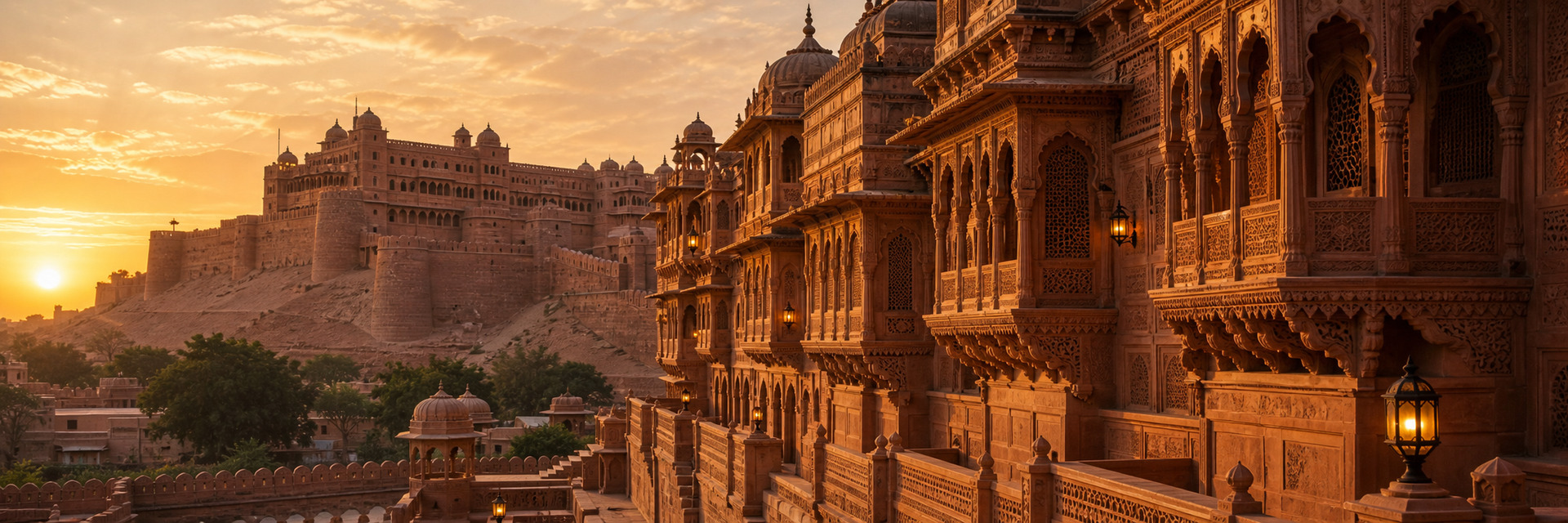
Junagarh Fort — one of the rare Rajput forts never taken in battle — plus Lalgarh Palace and Laxmi Niwas, the Karni royal legacy; the red-sandstone Rampuria havelis define the merchant-quarter grain.
The positioning
A quieter, more exclusive alternative to the Golden-Triangle-plus-Udaipur circuit — first-mover advantage, but off the main tourist flow and demand must be generated.
Two distinct products
A palace-scale asset (grand public volumes, gardens, banqueting) versus a Rampuria-haveli boutique (intimate, 8–18 keys, courtyard-led) — different capital, ADR and operating logic.
Distinctive draws
Camel country and the National Research Centre on Camel; Karni Mata temple at Deshnok; the Bikaner Camel Festival; Junagarh, Lalgarh and the old walled city.
Core constraints
Thinner luxury demand and a lower base ADR needing active marketing; remoteness and connectivity; fragile red-sandstone requiring specialist restoration; an extreme desert climate.
Critical approvals
Heritage-precinct byelaws and conservation controls in the walled city; ASI-adjacency where relevant; state heritage-hotel classification; excise, fire, FSSAI and pollution consents.
The opportunity — an under-priced frontier, not another palace on the circuit
Bikaner sits deliberately apart from the routes that made Rajasthan expensive. Jaipur, Jodhpur and Udaipur are supply-rich and demand-mature; their trophy heritage assets have long been captured and their land re-rated. Bikaner has the same raw material — a never-conquered fort in Junagarh, the Karni dynasty’s Lalgarh and Laxmi Niwas palaces, and a merchant quarter of carved red-sandstone havelis unmatched anywhere in the state — but it has not been priced by the same demand. For an owner willing to lead rather than follow, that gap is the entire thesis.
The catch, stated plainly, is that Bikaner does not yet hand you occupancy the way a Jaipur address does. The upside is real but it is earned: you are buying rare stock and a low entry basis, and you are underwriting a demand-generation effort to fill it. We size that trade honestly at feasibility — the ADR a restored asset can command against the marketing spend and lead-time it takes to build the bookings — so the model is built on the destination Bikaner actually is, not the one a broker describes.
Bikaner’s edge is scarcity at a low basis: genuinely rare heritage stock, off the crowded circuit, at a fraction of Golden-Triangle land and asset values — provided you underwrite the demand it does not yet give away.
Palace-scale or Rampuria-haveli — two very different hotels
The first decision shapes everything after it. A palace-scale asset — a wing of a Lalgarh-type property, or a comparable royal or aristocratic building — trades on grand public volumes, gardens, banqueting and a sense of arrival; it can carry weddings, buy-outs and larger key counts, but it demands heavy capital, long restoration and a management model built for scale. A Rampuria-style haveli, by contrast, is an intimate 8-to-18-key boutique organised around carved courtyards, jharokhas and terraces — lower capital, faster to restore, and run for rarity and a high per-key ADR rather than volume.
These are not interchangeable. They imply different guests, different distribution, different staffing ratios and different exit economics. We model both against the specific building and your investment thesis before a rupee is committed, so the concept, the key count and the ADR strategy are set by the asset and the market — not retrofitted to a plot you have already fallen for.
| Product | Best for |
|---|---|
| Palace-scale asset | Grand arrival, gardens and banqueting; weddings, buy-outs and larger key counts |
| Rampuria-haveli boutique | Intimate 8–18 keys, courtyard-led; rarity, high per-key ADR, faster restoration |
| Restored fort/mansion | A middle path — character volumes at a boutique key count, if the fabric allows |
Indicative product logic — always subject to the specific building, its heritage classification and a demand study for the asset.
Conservation-led restoration — the fabric is the product
In a heritage hotel the building is not a container for the offer; it is the offer. That reframes the whole build. The work is conservation-led adaptive reuse — stabilising and repairing historic fabric, then inserting the services, wet areas and life-safety a luxury hotel needs without erasing what the guest came for. Bikaner’s signature material, the local red and pink sandstone that the Rampuria carvers worked, is beautiful and comparatively soft: it weathers, spalls and delaminates, and it must be repaired with lime-based mortars and like-for-like stone by masons who understand it, never patched with cement that will trap salts and accelerate decay.
We run the restoration as a governed programme led by conservation architects and structural specialists: a measured survey and condition assessment first, then a phased scope that separates urgent stabilisation from finishes, and a materials and craft strategy that protects carved jharokhas, courtyards and painted surfaces while quietly threading modern MEP, fire compartmentation and accessibility through the historic plan. The test is simple — the hotel should read as the building restored, not a new hotel wearing an old façade.
- Measured survey, condition assessment and a phased stabilise-then-finish scope
- Lime-based repair and like-for-like red-sandstone matching by specialist masons
- Discreet insertion of MEP, wet areas, fire compartmentation and accessibility into historic fabric
- Carved jharokhas, courtyards and any painted or mirror work conserved, not replaced
Heritage byelaws & approvals — the frontier stack
Restoring within a heritage precinct carries controls a new-build never meets, and they must shape the design brief rather than surprise it late. In Bikaner’s walled city and around its principal monuments, work engages heritage-precinct byelaws and conservation controls on façades, heights, materials and interventions; where a building sits within a regulated distance of a protected monument, Archaeological Survey of India adjacency rules can constrain what is permitted. Layered on top is the ordinary hotel stack — land title and any tenancy or trust interests common to old family properties, change-of-use, and the operating licences.
We resolve the heritage envelope and the title before capital is committed, and sequence the approvals so licensed filings by your appointed architects, conservation consultants and lawyers proceed in the right order to a legally-open, correctly-classified heritage hotel.
- Heritage-precinct byelaws and conservation controls — façade, height, material and intervention limits
- ASI-adjacency clearance where the building lies within a protected monument’s regulated zone
- Title, tenancy and trust interests resolved on old family/aristocratic properties before purchase
- Change-of-use, state heritage-hotel classification (Ministry of Tourism / RTDC where applicable)
- Excise (liquor) licence, fire NOC, FSSAI and pollution-control consents for operation
The economics — small keys, high ADR, and a demand engine
Heritage hotels do not win on scale; they win on rate. A conservation-led asset is expensive to restore and slow to build, carries a modest key count and higher per-room operating cost, and cannot be value-engineered like a new-build — which means the model only works at a genuinely premium ADR and a guest willing to pay for rarity and story. That is achievable in Bikaner, but only if the marketing is treated as core infrastructure rather than an afterthought, because the destination’s thinner luxury demand and lower base rate will not fill the rooms on their own.
We build the commercial model around that reality: a positioning and rate strategy anchored to the asset’s rarity, distribution through the luxury-leisure channels and consortia that reach the traveller who seeks the road less taken, and a demand-generation plan — PR, experiential storytelling, the right OTA and travel-advisor relationships — funded and timed into the pre-opening budget. The measure of success is not keys sold but ADR held and a reputation built ahead of the competition that will inevitably follow into the market.
In Bikaner the risk is never oversupply of heritage character — it is under-generation of demand. The marketing spend is not overhead; it is the thing that converts a rare building into a bookable hotel.
Artisan procurement, desert build realities & staffing
Furnishing a heritage hotel is a procurement problem unlike a branded new-build. Much of the value is bespoke and artisanal — restored and reproduction furniture, hand-blocked textiles, brass and lac work, and the stone and jaali detailing that ties the interiors to the fabric — and Bikaner sits in a living craft belt that can supply it if the sourcing is managed with genuine vendor intelligence rather than left to a contractor. Against that, the desert imposes hard constraints: extreme summer heat and dust dictate the specification of glazing, insulation, HVAC and water systems, water itself is a scarce and governing input, and Bikaner’s remoteness lengthens lead times for anything not made locally.
Staffing an emerging luxury market is its own challenge and one we plan for from the outset. The deep hospitality labour pools sit in the mature circuit cities, so the plan blends recruited leadership and specialists with locally trained talent — building a service culture around Bikaner’s own warmth and camel-country identity, and getting the team in seat and trained ahead of the festival and winter high season rather than scrambling at opening.
- Artisan and bespoke FF&E sourced from the regional craft belt with independent vendor intelligence
- Desert-grade specification — glazing, insulation, HVAC and water systems for heat, dust and scarcity
- Lead-time planning for a remote market where most non-local goods must be brought in
- A staffing plan that imports leadership and specialists and trains local talent to a luxury standard
Gladwin’s edge in Bikaner
We treat a Bikaner heritage hotel as the conservation, positioning and demand problem it actually is — not as a room-count exercise. Before capital is committed we resolve the heritage byelaws, the ASI adjacency and the title, choose between a palace-scale asset and a Rampuria-haveli boutique on the evidence, and stress-test the small-key high-ADR model against the marketing spend an off-circuit market truly requires. Then we run the conservation-led restoration, artisan procurement, the operator-versus-brand decision, the full team hired and trained, and a launch built around demand-generation — as one accountable partner and your Owner’s Representative.
On the operator question we are deliberately clear-eyed: an international flag brings distribution but can flatten exactly the character that makes an emerging heritage market worth entering. We model brand, a heritage-specialist operator and a well-run independent against your thesis, so you own a hotel that trades on its rarity — and reaches the traveller looking for the frontier the crowd has not yet found.
Planning a heritage or palace hotel in Bikaner?
We take single accountability from a heritage asset and a conservation brief to a stabilised, high-ADR opening — restoration and adaptive reuse, brand-versus-operator strategy, artisan-led design and procurement, PMO and the service culture. The team is recruited through our executive search practice and trained for opening.
Speak with a partnerSetting up a heritage or palace hotel in Bikaner — FAQs
Because the raw material is comparable but the price is not. Bikaner has genuinely rare stock — the never-conquered Junagarh Fort, the Karni legacy of Lalgarh and Laxmi Niwas, and the carved red-sandstone Rampuria havelis — at land and asset values a fraction of the saturated circuit cities. The trade-off is that it sits off the main tourist flow, so demand has to be generated. We size that trade honestly at feasibility so the model reflects the destination as it is.
They are two different businesses. A palace-scale asset trades on grand volumes, gardens and banqueting — weddings, buy-outs, larger key counts — but demands heavy capital and long restoration. A Rampuria-haveli boutique is an intimate 8–18-key, courtyard-led product run for rarity and a high per-key ADR, with lower capital and faster restoration. We model both against the specific building and your investment thesis before you commit.
The building is the product, so the work is conservation-led adaptive reuse rather than construction. Bikaner’s local red and pink sandstone is beautiful but relatively soft — it spalls and delaminates and must be repaired with lime-based mortars and like-for-like stone by masons who understand it, never cement. We run a measured survey and a phased stabilise-then-finish scope, threading modern services, fire safety and accessibility discreetly through the historic fabric.
Beyond the ordinary hotel stack, restoring in a heritage precinct engages conservation byelaws on façades, heights, materials and interventions, plus ASI-adjacency rules where the building lies near a protected monument. Then there is title and any tenancy or trust interest on old family properties, change-of-use, state heritage-hotel classification, and the operating licences — excise, fire, FSSAI and pollution consents. We resolve the heritage envelope and title before purchase and sequence the rest.
Yes, but only on rate, not volume. A restored asset carries a modest key count and higher operating cost and cannot be value-engineered, so the model must be run to a genuinely premium ADR and a guest who pays for rarity. That is achievable in Bikaner if — and only if — demand-generation is funded as core infrastructure: positioning, luxury-leisure distribution, PR and travel-advisor relationships timed into the pre-opening budget. We build the commercial model around holding ADR, not filling rooms cheaply.
Yes — end to end. We run artisan and bespoke FF&E procurement from the regional craft belt with independent vendor intelligence, specify a desert-grade build for heat, dust and water scarcity, and plan lead times around Bikaner’s remoteness. We recruit leadership and specialists through our executive search practice and train local talent to a luxury standard, with the team in seat before the festival and winter high season, and support the demand-led launch.
Explore the cluster
Heritage & palace hotels across India
Rajasthan · Thar Desert
Jaisalmer
Jaisalmer is a small-key, high-ADR heritage market — won by conserving carved sandstone honestly and siting the desert product where the dunes, not the fragile fort, will carry it.
Rajasthan · Blue City
Jodhpur
Jodhpur does not need another new-build. Its scarcest asset is a restored one — a fort, a haveli or a Marwar estate given a second life as a hotel without losing what made it worth saving.
Rajasthan · Shekhawati
Shekhawati
Shekhawati is the open-air fresco gallery of Rajasthan — and its decaying merchant havelis are the rarest raw material in Indian heritage hospitality.
Also explore our executive search practice for the leadership team, and the wider end-to-end hospitality practice.