Heritage & Palace Hotels · Rajasthan · Painted Havelis
Setting Up a Heritage Haveli Hotel in Shekhawati
Shekhawati is the open-air fresco gallery of Rajasthan — and its decaying merchant havelis are the rarest raw material in Indian heritage hospitality.
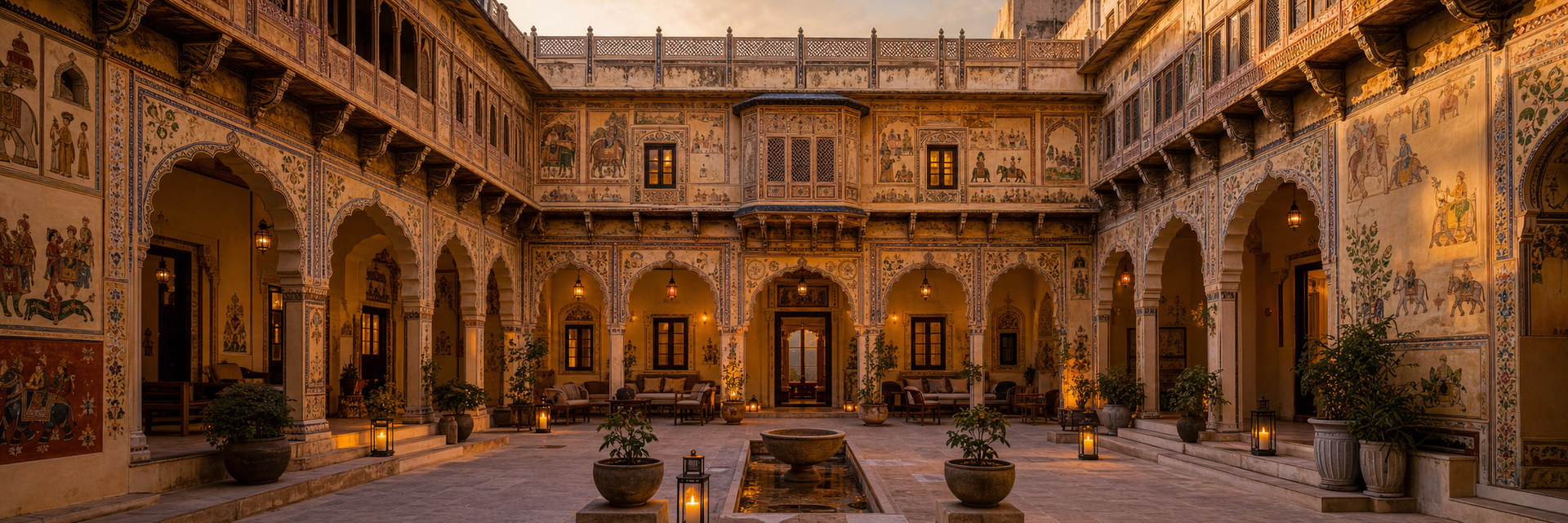
A Shekhawati hotel is not built; it is recovered. The asset is a painted Marwari haveli — courtyards, jharokhas and walls covered in eighteenth- and nineteenth-century frescoes, most of it derelict, absentee-owned and quietly eroding. Getting it right turns on things no new-build ever faces: buying fragmented family title cleanly, conserving lime-plaster murals without repainting away their value, and threading a boutique guest experience through rooms that must stay small. Gladwin International runs the whole recovery as one accountable programme — from the haveli you should acquire, through a conservation-first restoration, to a staffed, revenue-live boutique hotel that trades on authenticity rather than key count.
Restore, not build
The asset is a painted haveli, recovered
Small keys, high ADR
The economic model the product forces
Fresco-first
Conservation drives the critical path
Turnkey
Derelict haveli to a stabilised opening
At a glance
The heritage towns
Mandawa, Nawalgarh, Fatehpur, Ramgarh, Dundlod and Mukundgarh — the densest concentration of painted havelis in India.
The defining asset
18th–19th-century Marwari merchant havelis: courtyard mansions with lime-plaster frescoes across façades, gateways and inner walls.
Market context
An established but off-beat boutique circuit — Castle Mandawa, Mandawa Haveli, the Neemrana-restored Piramal Haveli set the reference points.
Core demand
European FITs, heritage and photography travellers, and Delhi–Jaipur–Bikaner road-trip stopovers on the painted-town trail.
The hard constraints
Fragile fresco conservation and a thin pool of skilled restorers; absentee, fragmented haveli title; sparse local luxury infrastructure.
Seasonality
A sharp October–March window; extreme summer heat suppresses demand and dictates the operating calendar.
The opportunity
Shekhawati is unlike any other heritage market in Rajasthan. In the arid belt between Jaipur, Bikaner and the Haryana border, the Marwari trading families of the eighteenth and nineteenth centuries poured their fortunes into havelis — courtyard mansions whose every surface, from the arched gateway to the innermost women's court, was painted. The result is a region often called an open-air art gallery: whole towns of frescoed façades, most now half-empty, their owners long dispersed to Kolkata, Mumbai and abroad. That decay is the paradox at the heart of the opportunity — the raw material is extraordinary, irreplaceable and, in many cases, quietly falling down.
The market that exists is deliberately off-beat. Shekhawati draws the heritage traveller, the European FIT and the photographer rather than the wedding-and-banqueting crowd, and it trades as a boutique circuit — a night or two on the painted-town trail between the bigger Rajasthan anchors. The whitespace is not another palace-scale resort; it is a small, immaculately conserved haveli that lets a discerning guest sleep inside the frescoes. That is a supply-constrained, authenticity-led play, and the constraint is precisely what protects the rate.
In Shekhawati the product is scarcity itself — a genuinely conserved painted haveli is rare, cannot be replicated new, and commands a rate that key-count can never buy.
Acquiring the haveli — title, fragmentation and the absentee owner
The first and hardest problem in Shekhawati is buying cleanly. A century of migration has left most havelis owned by large, dispersed families — a single mansion may be held across dozens of heirs, some untraceable, some in disagreement, with informal partitions, occupied portions and undocumented succession. A handshake with one branch is worth nothing if another surfaces after you have committed capital and craft.
We run acquisition as a title and structuring exercise before it is a design one — tracing the ownership tree, resolving co-owner consents and partition realities, and identifying havelis whose title, scale and fresco quality actually support a boutique conversion. The wrong haveli is not the derelict one; it is the one you cannot secure end-to-end, or whose paintings are too far gone to conserve honestly.
- Ownership-tree tracing across dispersed, absentee and multi-heir families
- Co-owner consent, partition and succession diligence before capital is committed
- Fresco and structural condition survey feeding the go / no-go on each candidate
- Acquisition structuring — outright purchase versus long-lease of a family asset
Fresco conservation — the specialist craft that defines the project
The frescoes are the asset, and conserving them is a discipline, not a decorating job. Shekhawati's murals sit on lime plaster and use natural earth and mineral pigments; the finest were executed in true fresco, painted into wet lime so the colour became part of the wall. Restoring them means stabilising failing plaster, cleaning centuries of soot and overpaint, consolidating flaking pigment and filling losses with matched lime and natural colour — reversibly, and without inventing detail that was never there. The commonest and most destructive mistake in the region is to simply repaint the walls in bright modern enamel, which erases the very heritage that justified the hotel.
The scarcity here is human: the number of restorers genuinely skilled in Shekhawati lime-fresco work is small, and they are the true critical path. We build conservation into the programme from day one — commissioning a proper condition assessment, engaging specialist conservators rather than ordinary painters, sequencing mural work ahead of and around the building trades, and protecting completed frescoes through the dust and vibration of the wider restoration.
- Lime-plaster stabilisation and structural consolidation of painted surfaces
- Cleaning soot, overpaint and later distemper without abrading original pigment
- Reversible, matched lime-and-natural-pigment infilling of losses — no invented detail
- Specialist conservators scheduled as the true critical path, not treated as decorators
Repainting a Shekhawati haveli in modern enamel destroys its value. Conservation-first restoration is not a nicety here — it is the entire investment thesis.
Adaptive reuse — a merchant home into a boutique hotel
A haveli was built for an extended trading family, not for guests, and its logic has to be respected while a hotel is threaded through it. The plan turns on the courtyards — the outer mardana and inner zenana courts — which become the social and dining heart, while rooms are carved from the surrounding chambers. Those rooms are irregular, often small, and cannot be forced into a standard-key grid; the count stays low precisely because the fabric will not tolerate being gutted. Discreetly inserting modern services — bathrooms, climate control, wiring, water and drainage — into thick lime walls without cutting into painted surfaces is the central design craft.
We brief the conversion so the guest experience is built around the building rather than in spite of it: a handful of characterful keys, courtyard dining, shaded terraces and rooftops for the desert light, and back-of-house tucked where the frescoes are not. Contemporary comfort is delivered invisibly, so the guest reads a living painted home, not a hotel wearing a haveli as costume.
| Haveli element | Hotel role |
|---|---|
| Outer & inner courtyards | Dining, gathering and arrival — the social heart |
| Painted chambers | A small number of characterful, non-standard keys |
| Façades, gateways & jharokhas | Conserved signature — the frescoes stay the hero |
| Rooftops & terraces | Desert-light dining, sundowners and events |
Indicative adaptive-reuse logic — always subject to the specific haveli's fabric, fresco locations and structural survey.
Heritage byelaws, approvals and the licence stack
Restoring a listed or heritage-grade haveli is not a free hand. Adaptive reuse must respect conservation byelaws and the character of the historic town — what may be altered, added or demolished is constrained, and painted surfaces are protected, so the design has to work within the fabric rather than around it. Beyond the heritage line sits the ordinary Rajasthan hotel stack, which we sequence in parallel.
Licensed filings are made by your appointed architects, conservation professionals and lawyers; we coordinate and govern them to a legally-open, heritage-compliant asset.
- Heritage / conservation byelaw compliance and any listed-building consents for alterations
- Municipal building and change-of-use sanction within the historic town fabric
- Rajasthan Tourism heritage-hotel registration and Ministry of Tourism classification (HRACC)
- Excise (bar) licence, Fire NOC, FSSAI and pollution-control consents
- Water, power and sewage provisioning against thin local infrastructure
Positioning, demand and the operating reality
Shekhawati's economics are the inverse of a big resort: few keys, high rate, and revenue earned on authenticity and story rather than volume. A well-conserved haveli hotel targets the European FIT, the heritage and photography traveller and the design-led road-tripper, and it lives on the Delhi–Jaipur–Bikaner axis as an off-beat, memorable stop rather than a destination in itself. Demand is sharply seasonal — a strong October-to-March window and a hard summer, when extreme heat suppresses travel — so the model must earn its year inside that window and manage the low season deliberately.
Because the market is off-beat, demand does not arrive on its own. Distribution has to be built for it: direct and boutique-OTA channels, curated heritage and experiential travel networks, PR and photography-led storytelling around the frescoes, and experiences that make the haveli worth the detour — haveli and painted-town walks, master classes on the fresco tradition, regional Marwari cuisine, folk music and desert excursions. We also plan for the region's thin luxury infrastructure and skilled-labour scarcity: a lean, cross-trained team recruited and trained largely in-region, so that a small operation still delivers a genuinely premium standard.
The single most important strategic fork: a stand-alone single-haveli boutique is one business; a multi-haveli village circuit across Mandawa, Nawalgarh or Fatehpur is a materially larger and more complex one. We size the ambition before the first purchase.
Gladwin's edge in Shekhawati
We treat a Shekhawati hotel as the conservation and title problem it actually is, not a build. Before a rupee is committed we trace and secure the fragmented family ownership, survey the frescoes honestly, and decide whether the play is a single boutique haveli or a multi-haveli village circuit — a decision that changes everything downstream. Then we run conservation-first restoration with genuine lime-fresco specialists on the critical path, a design that threads modern comfort invisibly through protected painted fabric, the heritage-byelaw and licence stack, and a launch built for off-beat, seasonal, authenticity-led demand — as one accountable partner and your Owner's Representative.
The team we build fits the reality of the region: a lean, multi-skilled operation, recruited and trained largely from Shekhawati's own towns, capable of holding a genuinely premium standard at low key-count and through a demanding seasonal calendar — in seat and trained before the October-to-March window opens.
Planning a heritage or palace hotel in Shekhawati?
We take single accountability from a heritage asset and a conservation brief to a stabilised, high-ADR opening — restoration and adaptive reuse, brand-versus-operator strategy, artisan-led design and procurement, PMO and the service culture. The team is recruited through our executive search practice and trained for opening.
Speak with a partnerSetting up a heritage or palace hotel in Shekhawati — FAQs
Because the value is the original painted fabric, and it cannot be replicated new. A genuinely conserved Shekhawati haveli lets a guest sleep inside eighteenth- and nineteenth-century frescoes — an experience a themed new-build can only imitate. That authenticity is what commands the rate and protects the asset in a supply-constrained, off-beat market.
Ownership. A century of Marwari migration has left many havelis held across large, dispersed, sometimes untraceable families, with informal partitions and undocumented succession. Buying cleanly means tracing the ownership tree and resolving co-owner consents before any capital or craft is committed — the wrong haveli is often the one you cannot secure end-to-end, not the most derelict one.
Shekhawati's murals sit on lime plaster in natural pigments, and conserving them means stabilising failing plaster, cleaning soot and overpaint, consolidating flaking colour and filling losses reversibly with matched lime and pigment — never repainting in modern enamel, which is the region's most destructive and value-erasing mistake. Skilled lime-fresco restorers are scarce, so this work sits on the critical path and defines the project.
Small by design. A haveli's chambers are irregular and cannot be forced into a standard-key grid without destroying the fabric, so key-count stays low and revenue is earned on high ADR, authenticity and story rather than volume. Inserting bathrooms, climate control and services invisibly into thick painted walls is the central design craft, and it is what keeps the count modest.
That is the defining strategic decision, and we resolve it before the first purchase. A single-haveli boutique is a focused, lower-complexity business; a multi-haveli circuit across a painted town such as Mandawa, Nawalgarh or Fatehpur is a materially larger undertaking in title, capital, conservation and operations. Each is viable — but they are different businesses and must be sized deliberately.
Deliberately, because it does not arrive on its own. We build distribution for the heritage FIT and experiential traveller — direct and boutique-OTA channels, curated heritage-travel networks, and photography-led PR around the frescoes — and pair it with experiences that justify the detour: painted-town walks, fresco master classes, Marwari cuisine and desert excursions, all planned around the sharp October-to-March season.
Explore the cluster
Heritage & palace hotels across India
Rajasthan · Pink City
Jaipur
A palace or haveli is not a building plot with a view — it is a listed, load-bearing, hand-made object that has to earn a luxury tariff without losing the thing that makes it worth the tariff.
Rajasthan · Thar Frontier
Bikaner
Bikaner is Rajasthan’s quiet frontier — a red-sandstone city of forts, palaces and merchant havelis that the Golden Triangle circuit has yet to price. That is precisely the opportunity.
Rajasthan · Blue City
Jodhpur
Jodhpur does not need another new-build. Its scarcest asset is a restored one — a fort, a haveli or a Marwar estate given a second life as a hotel without losing what made it worth saving.
Also explore our executive search practice for the leadership team, and the wider end-to-end hospitality practice.