Higher Education & Universities · Madhya Pradesh · Capital
Setting Up a University or Higher-Education Institution in Bhopal
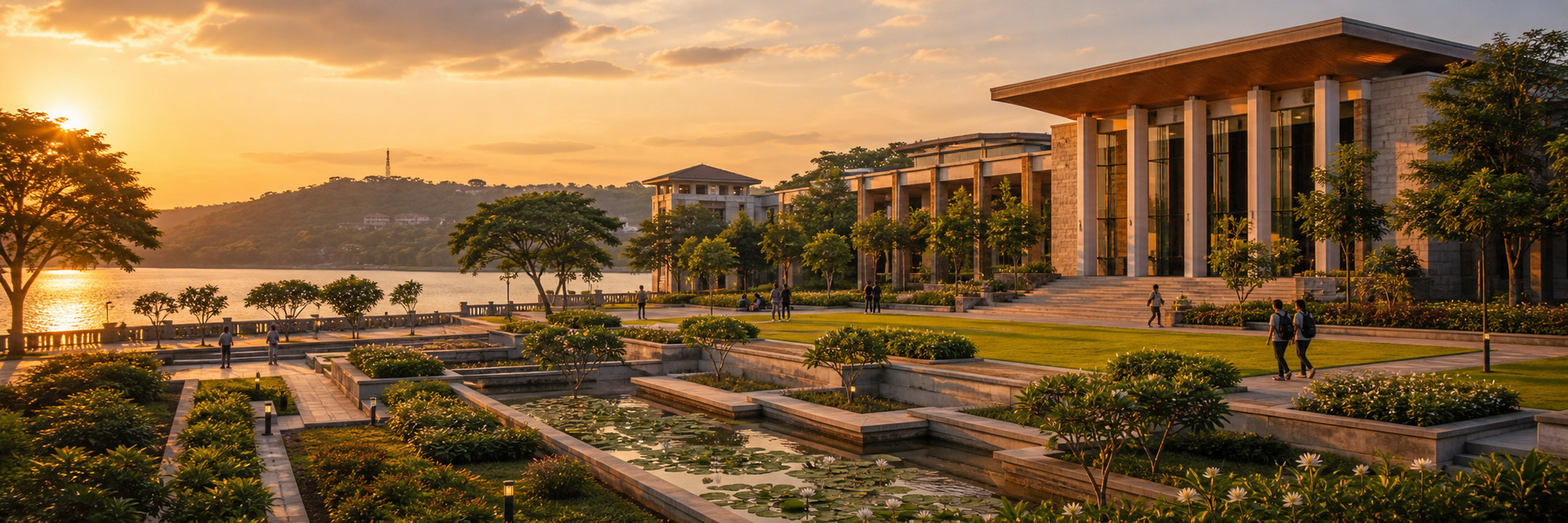
Bhopal is Madhya Pradesh's capital and its education anchor — a green, lake-fronted, planned city where a residential university can be built on land you can actually afford, at the administrative centre of central India.
Few Indian cities offer a founder this combination: a state capital with the government, regulators and public-sector weight that a new institution needs close at hand; a genuine intellectual pedigree in MANIT, IISER Bhopal, AIIMS Bhopal and NLIU; a central-India catchment that funnels students through the capital; and — unusually — affordable, contiguous land in a lake-and-forest setting made for a residential campus. The hard part is not the site. It is choosing the vehicle that will hold the institution — a university under the Madhya Pradesh private-universities law, UGC deemed status, or a college affiliated to Barkatullah University, RGPV or MP Medical Science University — and then clearing the UGC, AICTE and professional-council gates in the right order. Gladwin International runs the whole journey as one accountable programme, from a sponsoring not-for-profit and a shortlist of sites to a recognised, accredited institution taking its first admissions.
Three routes
MP Private Universities Act, UGC deemed, or affiliated college
2(f) & 12(B)
The UGC recognition that confers legitimacy and grant eligibility
Capital anchor
State government, regulators and central-India catchment
Turnkey
Sponsoring trust to first cohort admitted
At a glance
Establishment routes
A university under the Madhya Pradesh Private Universities (Establishment and Operation) Act; UGC Section 3 deemed-to-be-university status; or a college affiliated to Barkatullah University (arts, science, commerce), RGPV (engineering and technology) or MP Medical Science University (health sciences).
Core regulators
UGC (recognition, norms), AICTE (technical), the MP Private Universities Regulatory Commission, plus the relevant professional council — PCI, COA, BCI, NMC/DCI/INC, VCI or NCTE — by discipline.
Accreditation & ranking
NAAC (institutional grade), NBA (programme-level, professional streams), and NIRF as the national reputational benchmark.
Sponsoring body
A not-for-profit — a registered Society, a Public Charitable Trust, or a Section 8 company — must own the assets and run the institution.
Where campuses land
The Kolar Road, Kerwa–Kaliasot and Ratibad belts to the south, the Raisen Road and Bairagarh–Sehore corridors, and the BHEL / Mandideep industrial edge — where large, contiguous, green footprints remain affordable.
The Bhopal edge
A state capital with government proximity, a City-of-Lakes residential setting, a central-India catchment, and the pull of MANIT, IISER, AIIMS and NLIU as a talent and collaboration cluster.
The opportunity — why Bhopal, and for whom
Bhopal is unusual among Indian cities in being both a working state capital and a genuine centre of learning. As the seat of the Madhya Pradesh government, it puts the higher-education department, the regulators and the public-sector institutions a founder must deal with within the same city — a practical advantage that is easy to underrate until you are filing for approvals. Around that administrative core sits a real academic cluster: the Maulana Azad National Institute of Technology, the Indian Institute of Science Education and Research, AIIMS Bhopal and the National Law Institute University set a standard, and a broad affiliated base under Barkatullah University and RGPV proves that a mass higher-education market already functions here. A founder entering Bhopal is entering an established, governed education economy, not an empty one.
The catchment is central-Indian and the setting is distinctive. Madhya Pradesh is a large, populous state whose students have historically had to leave for the metros; Bhopal, as the capital, is the natural place to keep and attract them. And the city itself — planned, green, built around its lakes — lends itself to exactly the kind of residential, campus-based institution that is hard to build in a land-starved metro. The decision that shapes everything is what kind of institution you intend: a research-led multidisciplinary university that leans on the IISER-and-MANIT ecosystem, or a focused professional or health-sciences institution that plugs into the state's medical, technical and legal demand. That single choice drives the legal vehicle, the land, the faculty and the capital plan.
Bhopal's advantage is the reverse of a metro's. Land is affordable and the setting is genuinely residential — so the differentiator is not whether you can build a campus, but whether you build an institution the state capital and its regulators take seriously from day one.
Choose the vehicle — MP Private Universities Act, UGC deemed, or affiliated college
Every downstream decision — degree-granting power, autonomy, capital, timeline and land — flows from which of three legal vehicles you adopt, and this is the first thing we resolve with you. A private university in Madhya Pradesh is established under the State's Private Universities (Establishment and Operation) Act, brought in through the higher-education department and overseen by the MP Private Universities Regulatory Commission; it grants degrees in its own name from inception, but carries the State's land, corpus-fund, sponsoring-body and governance conditions, which the Commission scrutinises closely. A deemed-to-be-university is conferred by the Central Government under Section 3 of the UGC Act on the advice of the UGC — but it is granted to an institution of proven standing, so it is a maturation path rather than a standing start.
The third route is an affiliated college: you establish a college that grants degrees under an existing affiliating university — Barkatullah University in Bhopal for arts, science and commerce, Rajiv Gandhi Proudyogiki Vishwavidyalaya (the state technical university, headquartered in Bhopal) for engineering, technology, pharmacy and architecture, or Madhya Pradesh Medical Science University for medical, dental, nursing and allied-health programmes. It is the fastest and lightest-capital way in, and the natural starting point for a professional or health-sciences institution, but you inherit the affiliating body's syllabus, examinations and autonomy limits. We model the three against your ambition, capital and horizon — and, where the plan is a college now and a university later, we structure the sponsoring body and the campus so an affiliated college can graduate into private-university or deemed status without being rebuilt.
| Route | Degree-granting | Best for |
|---|---|---|
| MP Private Universities Act | In its own name, from inception | A well-capitalised multidisciplinary university with autonomy from day one |
| UGC Section 3 deemed status | In its own name, once conferred | A maturing institution of standing seeking autonomy and research depth |
| Affiliated college (Barkatullah / RGPV / MPMSU) | Under the affiliating university | A focused professional or health-sciences institution — fastest, lightest-capital entry |
The three establishment routes — indicative; the right vehicle depends on your capital, horizon and degree-granting ambition.
The recognition, approval and accreditation stack
Whichever vehicle you choose, recognition is what makes the institution real. UGC recognition under Section 2(f) brings the institution within the University Grants Commission's ambit; inclusion under Section 12(B) confers eligibility for central grants and is, in practice, the reputational threshold that serious partners and students look for. Professional programmes then carry a second layer of statutory approval that must be secured before intake: AICTE for engineering, management, pharmacy and architecture, and the discipline's council — the Pharmacy Council of India, the Council of Architecture, the Bar Council of India for law, the National Medical, Dental or Nursing Councils for health sciences, the Veterinary Council, or NCTE for teacher education. Where the vehicle is a state private university, the MP Regulatory Commission's ongoing oversight sits alongside these.
Accreditation is where the market forms its judgement. NAAC grades the institution, NBA accredits individual professional programmes, and NIRF has become the national scoreboard against which India's institutions — Bhopal's central ones included — are read. Launching without a credible, sequenced path to accreditation is launching into a headwind, particularly for a new name competing against the city's established public institutions. We build the approval calendar backwards from your target first-intake, so the AICTE and council sanctions, the affiliation or the Act, and the accreditation readiness are all standing when admissions open — and we govern each licensed filing to that date.
- UGC recognition — Section 2(f) inclusion and the Section 12(B) grant-eligibility threshold
- AICTE approval for technical programmes; the relevant council (PCI, COA, BCI, NMC/DCI/INC, VCI, NCTE) by discipline
- The MP Private Universities Act and the Regulatory Commission's process, deemed-status route, or affiliation with Barkatullah / RGPV / MPMSU
- NAAC (institutional), NBA (programme-level) and a deliberate NIRF-readiness trajectory
- MP higher-education-department clearances, land-diversion and building approvals for the campus
The sponsoring not-for-profit, the land and the campus
Indian higher education is not-for-profit by law, so the institution must sit under a not-for-profit sponsoring body — a Society registered under the Madhya Pradesh Societies Registrikaran Adhiniyam, a Public Charitable Trust, or a Section 8 company — which owns the land and assets and carries the governance. For a state private university the MP Private Universities Regulatory Commission examines this sponsoring body, its object clauses, its corpus and its governing-council composition directly, so getting the structure right at the outset matters and is expensive to restructure later. We establish or reshape the sponsoring body, the corpus and endowment arrangements, and the governance framework to withstand that scrutiny.
Then comes the part where Bhopal helps rather than hinders. Unlike a land-starved metro, the capital and its edges still offer large, contiguous, affordable holdings in a genuinely attractive setting — the Kolar Road, Kerwa and Kaliasot belts to the south, the Ratibad, Raisen Road and Bairagarh–Sehore corridors, and the BHEL and Mandideep industrial edge — where the acreage a university needs to meet State and UGC norms is achievable without metro pricing, and a green, lake-adjacent, residential campus is realistic rather than aspirational. We resolve title, land-diversion (from agricultural use where required) and zoning, and master-plan the campus, laboratories, libraries and residences in phases matched to enrolment, so capital is not sunk into empty buildings ahead of demand.
Academic programme, research and faculty
The academic plan is where a Bhopal institution earns its distinctiveness. We design the programme architecture — the schools, the degrees, the specialisations and the research centres — to fit the city and the state: a research-led multidisciplinary university can lean on the IISER-and-MANIT science-and-technology ecosystem and the AIIMS health-sciences base, while a professional institution can target the state's real demand in engineering, health, law, management, education and agriculture. NEP 2020's push toward multidisciplinary, credit-mobile, research-embedded institutions is the natural shape of a serious new university, and the space and setting Bhopal affords make a genuine research campus, rather than a teaching shop, achievable.
None of it works without faculty, and this is the practical test. UGC norms govern cadre ratios, qualification and NET/PhD requirements, student-faculty ratios and the professor-associate-assistant structure. Bhopal's capital status and its cluster of central institutions give it a real pull to attract and retain academics, and a residential campus in a liveable city is a genuine recruiting advantage over a congested metro. We build the faculty plan to UGC norms, run the leadership and senior-faculty search through our executive-search practice, and set up the research infrastructure, funding pathways, sponsored chairs and foreign-university academic collaborations — twinning, joint and dual-degree partnerships under the UGC framework — that a research-intensive institution needs to be taken seriously.
- Programme and school architecture matched to the IISER/MANIT science base, AIIMS health-sciences depth and the state's professional demand
- Faculty plan built to UGC cadre, qualification and student-faculty-ratio norms
- Leadership, dean and senior-faculty search through our executive-search practice
- Research centres, sponsored chairs and foreign-university joint / dual / twinning partnerships
- Laboratory, library and technology specification matched to programme accreditation standards
Industry linkage, employability and admissions
Employability has to be engineered, not assumed. Bhopal's own base — the BHEL heavy-engineering complex, the Mandideep and Pilukhedi industrial belts, the state's growing pharmaceutical and health-sciences sector, and the administrative and public-sector economy of a capital city — gives a new institution genuine anchors for internships, live projects, sponsored research and placements, and its position as capital opens government, PSU and policy linkages that a non-capital city cannot match. We structure the industry-and-institution linkage framework — advisory boards, co-designed and apprenticeship-embedded curricula, sponsored research and chairs, incubation and entrepreneurship pathways, and a career-services and placement engine — so that employability is a designed-in outcome and the institution's reputation compounds from its first graduating cohorts.
Finally, admissions. A new institution in Bhopal must fill high-quality seats against established public names and a central-India catchment that has options — a brand, positioning and go-to-market problem as much as an academic one. We build the admissions strategy, the counselling and outreach engine across the MP and central-India catchment, the scholarship and financial-aid architecture, the digital enrolment technology and the student-information and learning-management systems, and align the fee positioning to the State's regulated fee structures and the value the market will actually pay — so the institution opens with a full, well-matched first cohort rather than an empty prospectus.
Gladwin's edge in Bhopal
We treat a Bhopal institution as the vehicle, recognition and governance problem it actually is — with the land question, for once, on the founder's side. Before capital is committed we settle the fork — a university under the MP Private Universities Act, UGC deemed status, or a Barkatullah / RGPV / MPMSU affiliated college — structure the not-for-profit sponsoring body and governance to withstand the MP Regulatory Commission's scrutiny, and secure large, contiguous, affordable land in the capital's green corridors where a real residential campus is realistic. Then we sequence the UGC 2(f)/12(B) recognition, the AICTE and council approvals, and the NAAC / NBA / NIRF accreditation path backwards from your target first-intake, and govern every licensed filing to that date as one accountable partner.
Our differentiator is that we build for the city Bhopal is: a state capital and a central-India anchor. We shape the academic programme, the research centres and the placement engine around the IISER/MANIT/AIIMS cluster, the state's professional demand and the government-and-PSU economy a capital affords, and hire the founding leadership and faculty to UGC norms through our executive-search practice — so the institution opens recognised, accreditation-ready, staffed and connected, not merely built.
Planning a university or higher-education institution in Bhopal?
We take single accountability from a sponsoring trust and a plot of land to a running, accredited institution — the university-establishment pathway, UGC/AICTE and council approvals, NAAC/NBA/NIRF accreditation, academic programme and research development, campus and labs, procurement, PMO, leadership and faculty search, governance, SOPs, technology and admissions. The team is recruited through our executive search practice and trained for opening.
Speak with a partnerSetting up a university or higher-education institution in Bhopal — FAQs
It depends on your capital, horizon and degree-granting ambition. A private university under the Madhya Pradesh Private Universities Act grants degrees in its own name from inception but carries the State's land, corpus and governance conditions and sits under the MP Regulatory Commission's oversight. UGC Section 3 deemed status is conferred on an institution of proven standing, so it is a maturation path rather than a standing start. An affiliated college under Barkatullah University, RGPV or MP Medical Science University is the fastest, lightest-capital entry — ideal for a professional or health-sciences institution — but you work within the affiliating body's syllabus and autonomy. We model all three against your plan, and can structure a college now to graduate into university status later.
Section 2(f) brings the institution within the University Grants Commission's recognition, and Section 12(B) confers eligibility for central grants. In practice, 12(B) status is the reputational threshold serious students and partners look for. The path to each depends on your vehicle and maturity, and we build it into the establishment programme from the outset rather than treating it as an afterthought.
Yes — it is one of the city's genuine strengths. A university needs a large, contiguous holding to meet State and UGC norms, and in a metro that land prices like commercial real estate. Around Bhopal — the Kolar Road, Kerwa–Kaliasot and Ratibad belts, the Raisen Road and Bairagarh–Sehore corridors, and the BHEL/Mandideep edge — that acreage is affordable and in a green, lake-adjacent setting suited to a residential campus. We resolve title, agricultural land-diversion and zoning, and master-plan the campus in phases matched to enrolment.
Beyond UGC recognition and your affiliation or the Act, technical programmes need AICTE approval, and each discipline needs its statutory council's sanction — engineering and pharmacy flow through AICTE with RGPV affiliation (PCI for pharmacy), health sciences through the relevant medical, dental or nursing council with MP Medical Science University affiliation, architecture through COA, and law through the Bar Council of India. We sequence every sanction backwards from your target first-intake so they are all standing when admissions open.
Materially. Bhopal puts the higher-education department, the MP Private Universities Regulatory Commission and the public-sector institutions you must deal with in the same city, which speeds approvals and relationships. It also opens government, PSU and policy linkages for internships, research and placements that a non-capital city cannot match, alongside the pull of the MANIT, IISER, AIIMS and NLIU cluster for faculty and collaboration. We build those linkages into the institution rather than leaving them to chance.
Yes — both are core. We build the faculty plan to UGC cadre, qualification and student-faculty-ratio norms and run the Vice-Chancellor, Registrar, dean and senior-faculty search through our executive-search practice — where a liveable, residential capital is a genuine recruiting advantage. On the front end, we build the admissions strategy, outreach and counselling engine across the MP and central-India catchment, scholarship architecture, enrolment technology and student-information systems, so the institution opens fully staffed and with a strong, well-matched first cohort.
Explore the cluster
Universities & higher-education institutions across South India
Madhya Pradesh · Malwa
Indore
Indore is central India's education capital — the only Indian city with both an IIT and an IIM — and a rare place where a serious institution can still be built on affordable land inside a national catchment.
Maharashtra · Vidarbha
Nagpur
Nagpur sits at the exact geographic centre of India — the one place a new university can draw a genuinely pan-regional catchment while building on land it can actually afford.
Rajasthan · Capital
Jaipur
Jaipur is India's private-university capital — the one state where the enabling legislation is not a barrier to clear but a road already built, and used more than anywhere else.
Also explore our executive search practice for the leadership team, and the wider end-to-end education practice.