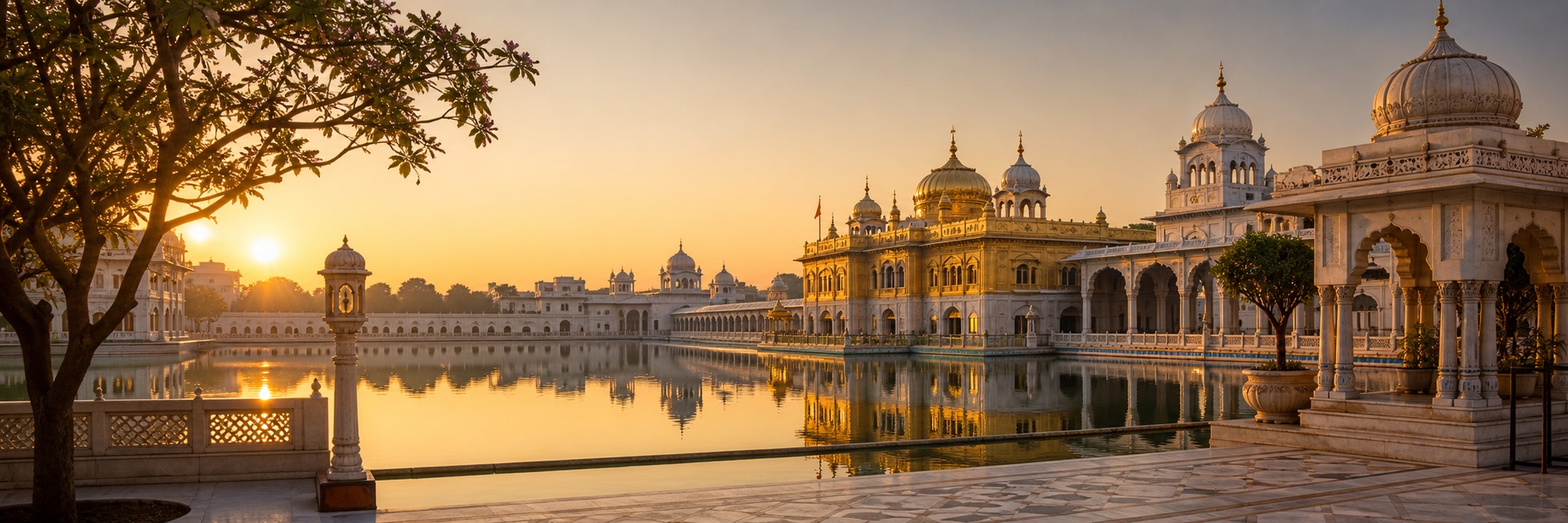
Destination - Punjab - Spiritual & heritage
Setting Up a Luxury Resort in Amritsar
Amritsar has world-scale spiritual footfall and diaspora demand, but the luxury opportunity sits between a sacred walled city and the practical land of the airport and GT Road.
The Golden Temple, Jallianwala Bagh, the Partition Museum, the Wagah border ceremony and the Kartarpur Corridor give Amritsar an emotional density few Indian cities can match. The premium supply, however, is thin for a market with such NRI, diaspora and international pull. We help owners choose between heritage-city intimacy and airport-side resort scale, then design a product that respects Sikh sensibilities, Punjabi hospitality and the realities of dense-city construction.
Golden Temple
Spiritual demand at global scale
Diaspora-led
NRI and international family travel are core
Two land plays
Walled-city heritage or airport / GT Road greenfield
Turnkey
Approvals, design, hiring and opening under one programme
At a glance
Best-fit micro-markets
Walled-city and heritage-street conversions for boutique intimacy; airport road, Ajnala Road and GT Road for resort-scale land.
Demand engine
Golden Temple pilgrimage, diaspora family visits, Jallianwala Bagh, Partition Museum, Wagah, Kartarpur Corridor and Punjabi weddings.
Positioning
Sikh-heritage luxury, Punjabi warmth, family rooms, high-quality vegetarian and Punjabi cuisine, and border/heritage programming.
Critical approval
Municipal building sanction, heritage constraints in the old city, fire and life safety, tourism registration, FSSAI and excise sensitivity by site.
Access
Sri Guru Ram Dass Jee International Airport, Amritsar Junction, GT Road and road links to Wagah and the wider Punjab circuit.
Build watch-out
Dense walled-city access, old structures, parking, sensitivity around tobacco and alcohol near the shrine, and high wedding-season compression.
The guest is often coming home
Amritsar's premium guest is frequently a Punjabi family, NRI or diaspora visitor for whom the city is personal. They may combine darshan at Harmandir Sahib with a family wedding, ancestral travel, Wagah, Partition Museum, food trails and shopping. International leisure exists, but the emotional and commercial depth is in family-led travel and diaspora return.
That changes the resort brief. Suites and connecting rooms matter. Private transport matters. Food matters enormously. The service must be warm without being casual, and the property must know how to handle temple visits, head-covering guidance, no-tobacco expectations, alcohol sensitivity near the shrine and multi-generational dining.
- Golden Temple pilgrimage and family visits as the core
- NRI and diaspora travellers as a premium, repeatable source market
- Wagah, Partition Museum and food trails as itinerary extensions
- Punjabi weddings and social events as a major revenue layer
Walled city character or greenfield control
The walled-city route gives atmosphere and proximity. A heritage conversion near the redeveloped approach streets can feel deeply Amritsari, but it also brings narrow lanes, parking difficulty, structural retrofit, fire compliance, neighbour management and limited back-of-house. It is a boutique, high-care play rather than a resort-scale answer.
The airport and GT Road route gives operational control: larger parcels, landscape, banqueting, parking, logistics and easier guest movement to the Golden Temple and Wagah. The risk is placelessness. A greenfield Amritsar resort has to work harder through design, food, craft, service and programming so it does not feel like a generic highway hotel.
| Route | What it offers | What it risks |
|---|---|---|
| Walled-city heritage | Proximity, atmosphere, strong story | Access, fire retrofit, parking, constrained back-of-house |
| Airport / Ajnala Road | International access, resort land, events, easier logistics | Needs strong cultural identity to avoid airport-hotel blandness |
| GT Road greenfield | Drive access, scale, weddings and family demand | Distance from the sacred core must be solved with transport |
Two Amritsar routes; the right answer depends on scale, guest and event strategy.
Approvals and cultural operating permissions
The formal approvals path includes land-use and building sanction through the municipal or relevant planning authority, fire NOC, FSSAI, pollution-control consents, tourism registration, hotel classification where useful, and excise permissions where the site and concept allow. Heritage conversions add structural, conservation and local-area constraints that should be assessed before purchase.
The informal permission is equally important. A luxury property near the Golden Temple must handle Sikh sensibilities seriously: no tobacco norms, head-covering and shrine etiquette, careful alcohol positioning, and guest communication that feels respectful rather than instructive. These are operating-design matters, not front-desk reminders.
- Municipal or planning-authority building sanction and land-use compliance
- Fire, life-safety and structural diligence, especially for heritage conversions
- FSSAI, tourism registration, hotel classification and pollution-control consents
- Excise and alcohol positioning handled sensitively by site and guest mix
Designing Punjabi hospitality with restraint
Amritsar gives a rich design vocabulary: brick, courtyards, phulkari, brass, carved timber, the colour and generosity of Punjabi homes, and the disciplined calm of Sikh spiritual spaces. The resort should use that vocabulary with confidence but not excess. Guests do not need a theme park; they need a property that feels proud, warm and rooted.
The food and beverage strategy can carry the brand. Amritsari kulcha, lassi, Punjabi vegetarian cooking, tandoor, seasonal produce and banquet-scale food culture can become luxury when executed with sourcing, presentation and service discipline. The langar tradition is not to be imitated commercially, but its scale, humility and hospitality should inform the tone.
Build, procurement and people
Old-city projects are constrained by access, staging, structure and fire compliance. Greenfield projects are easier to build but still need careful procurement for premium kitchens, FF&E, banqueting inventory and landscape. Punjab has strong contractors and suppliers, but luxury hospitality specifications and pre-opening sequencing need owner-side governance to avoid a wedding-hall finish masquerading as a resort.
The team can be a strength. Punjab has hospitality talent, strong food-service culture and diaspora-facing confidence, but the resort still needs luxury leadership, sales strength for weddings and NRIs, and training around Sikh sensibilities. We recruit and train for that exact mix before the first high-stakes family event arrives.
Gladwin's edge in Amritsar
We help owners choose the correct Amritsar route - boutique heritage, airport-side resort or GT Road event-led property - by testing land, access, shrine flow, wedding revenue, cultural sensitivity and approvals together. Then we run design, procurement, hiring and launch as one accountable partner.
Our team plan is built around diaspora-facing service, Punjabi F&B excellence and respect for Sikh codes. We recruit the General Manager, events leadership, chefs and operating team, then train them for family-led luxury, temple logistics and high-compression wedding and pilgrimage periods.
Planning a resort in Amritsar?
We take single accountability from raw land to a stabilised opening — siting and approvals, market and pricing, design, procurement, and the full team — from General Manager to line level — recruited through our executive search practice and trained for opening.
Speak with a partnerSetting up a resort in Amritsar — FAQs
Both exist, but the resort opportunity is strongest where land can support family stays, weddings, parking, food and transport. Airport-side and GT Road sites can work well if they are culturally rooted and not treated like generic business hotels.
Yes, but usually as a boutique, high-care conversion. Narrow access, old structures, fire and life safety, parking and back-of-house constraints must be assessed before purchase. The story can be exceptional, but the operating model has to fit the building.
Very sensitive near the Golden Temple and for many Sikh family guests. Depending on site and licence, alcohol may still exist in some formats, but it has to be positioned discreetly and never allowed to define the property.
Jallianwala Bagh, the Partition Museum, Wagah, Kartarpur-related travel, food trails, shopping, weddings and diaspora family visits all extend the stay and deepen spend. The resort should package these deliberately.
Building a property that is physically premium but culturally generic. Amritsar guests notice service tone, food, shrine etiquette, family handling and respect for Sikh codes. Training and leadership matter as much as the build.
Punjab offers a strong base for hospitality and food-service talent, supported by senior hires from established luxury markets. We blend both and train specifically for diaspora-facing, family-led and shrine-sensitive service.
Explore the cluster
Luxury resorts across India’s destinations
North - Temple & pilgrimage corridor
Lucknow-Ayodhya Corridor
Ayodhya now has the pilgrim volume; the premium supply, trained operating base and clean greenfield land are still catching up.
North - Braj temple region
Mathura-Vrindavan
Braj has enormous devotional demand and almost no true luxury supply, but sacred food norms, floodplain scrutiny and expressway land choices define what can actually be built.
North - Ganga spiritual city
Varanasi (Kashi)
Kashi's spiritual demand is enormous, but the city gives developers only two honest choices: a difficult riverfront heritage conversion or a disciplined greenfield resort outside the old core.
Also explore our executive search practice for the General Manager and leadership team, and the wider end-to-end hospitality practice — hotels, residences, clubs and heritage properties.