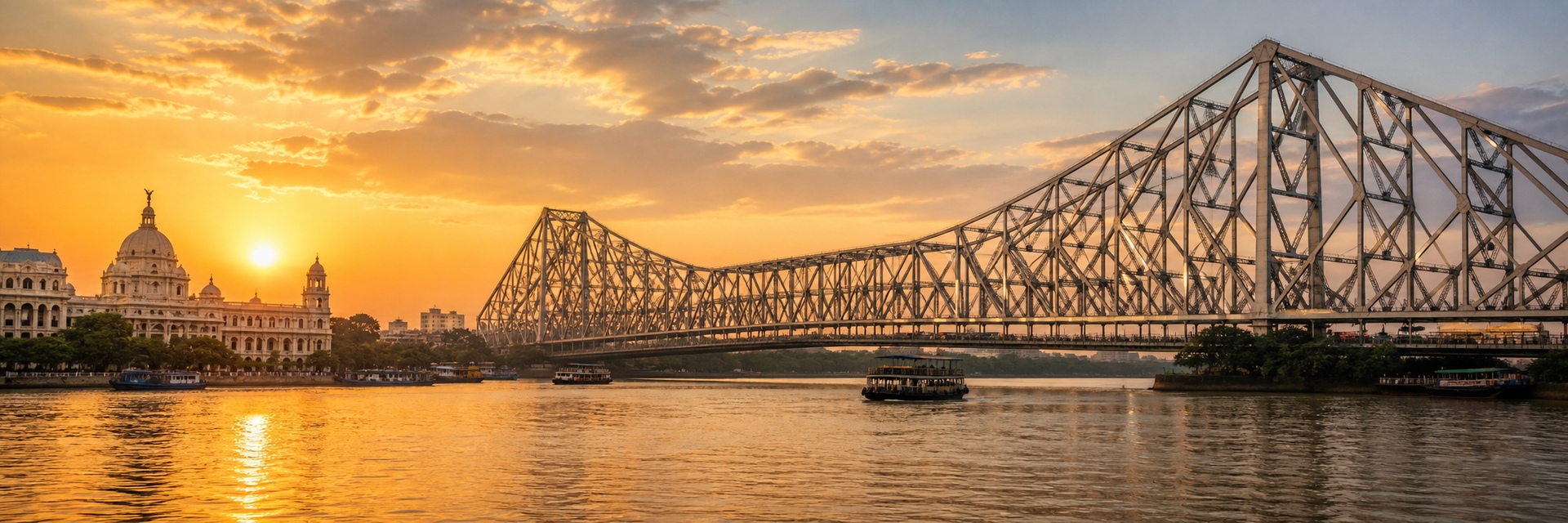
Luxury Hotels · East India · Bengal gateway
Setting Up a Luxury Hotel in Kolkata
Kolkata is the metro the luxury operators under-built — an underserved market where heritage prestige, a resurgent corporate base and India's largest weddings meet a genuine supply gap.
The City of Joy is eastern India's business and cultural gateway and the springboard to the Northeast, Bhutan and Bangladesh — yet its premium hotel supply has lagged every peer metro for a generation. That is the opportunity: a whitespace defended by a small legacy set rather than a crowded field. Gladwin International runs the whole journey as one accountable programme — reading the heritage-conversion-versus-new-build decision, siting between the Chowringhee prestige core, the Rajarhat–New Town business corridor and old-money Alipore, and taking you from a plot or a period building to a fully staffed, revenue-live hotel.
Underserved metro
A supply gap the metros do not share
Heritage or new-build
The decision we own with you first
Gateway city
Northeast, Bhutan and Bangladesh
Turnkey
Site to a stabilised opening
At a glance
Best-fit micro-markets
CBD/Chowringhee–Park Street (heritage prestige), EM Bypass and Rajarhat–New Town (business, IT and airport corridor), Alipore (old-money prestige).
The legacy set
A short bench — The Oberoi Grand (the Grande Dame of Chowringhee), Taj Bengal, ITC Sonar, The Park — which is precisely why the market is under-supplied.
Demand mix
Resurgent corporate travel, heritage and cultural tourism, and very large Bengali and Marwari weddings; gateway transit for the East and neighbours.
The heritage angle
Kolkata's colonial building stock makes conversion a real strategy — and a differentiator no new-build metro can copy.
Critical approvals
KMC/KMDA building sanction; West Bengal HIRA if a residential component; fire, excise, wetland sensitivity near Rajarhat.
Siting watch-out
The East Kolkata Wetlands are a protected Ramsar site abutting the Rajarhat/EM Bypass corridor — the buildable line must be resolved before capital moves.
The opportunity
Kolkata is the anomaly among India's big metros: a city of the scale, wealth and business gravity to sustain a deep luxury hotel field, yet served by only a handful of genuinely five-star houses. Where Mumbai, Delhi and Bengaluru have seen wave after wave of branded openings, the eastern gateway has been quietly passed over. For a developer that reads it correctly, that under-supply is the whole thesis — a market where a well-conceived hotel competes against a thin legacy bench rather than a saturated one.
The demand behind it is real and broadening. A resurgent corporate scene along the EM Bypass and in Rajarhat's IT and financial back-offices is rebuilding weekday occupancy; heritage and cultural tourism draws on Kolkata's standing as India's intellectual and artistic capital; and the city stages some of the largest weddings in the country, where Bengali and Marwari families spend at a scale that rewards serious banqueting. Above all, Kolkata is the springboard for the Northeast, Bhutan and Bangladesh — a gateway function no other Indian metro holds.
Kolkata is not an over-built market fighting for share — it is an under-built one where the right luxury hotel meets demand that has had nowhere premium to go.
Heritage conversion versus new-build — the decision that shapes everything
In most Indian cities the only question is where to build. In Kolkata there is a second, richer one: whether to convert. The city's colonial and early-twentieth-century building stock — the mansions of Alipore, the commercial palaces off Chowringhee and BBD Bagh — offers period assets that a new tower can never replicate, and a heritage conversion can carry a story, a location and a soul that command rate. It is also the harder path: grade-listed fabric, floor-plate and services constraints, and a conservation regime that governs what can be touched.
We model the two routes side by side against your investment thesis — the premium and differentiation a heritage house can command versus the flexibility, key-count efficiency and speed of a purpose-built new asset — and, where conversion wins, we run the listed-building and structural due diligence before a rupee is committed. Whichever route, we then decide the brand-versus-operator question that follows from it: Kolkata's premium field is overwhelmingly branded, and the flag delivers the corporate and international distribution the market's demand runs on.
- Heritage conversion vs new-build modelled against your ROI, timeline and differentiation appetite
- Listed-building, conservation and structural due diligence where a period asset is in play
- Independent, HMA or franchise — the operator route that follows from the asset decision
- Operator selection and negotiation as your Owner's Representative, brand standards built into the brief
Siting — Chowringhee prestige, the Rajarhat corridor and Alipore
Kolkata's premium demand is not evenly spread, and the right address depends on the guest you are chasing. The Chowringhee–Park Street CBD carries the city's deepest heritage prestige and the footfall of its cultural and business core — the natural home of a conversion or a trophy address. The EM Bypass and Rajarhat–New Town corridor is the new business geography: the IT parks, financial back-offices and the airport, where weekday corporate demand and access-led travel concentrate. Alipore is the old-money enclave — discreet, green and residential, where a boutique luxury house or a converted mansion trades on exclusivity rather than footfall.
The corridor that looks most opportunity-rich also carries the city's defining planning constraint. The East Kolkata Wetlands — a protected Ramsar site — abut the Rajarhat and EM Bypass belt, and the buildable line, drainage and environmental sensitivities have to be resolved on the specific plot before it is underwritten. We choose the site against the demand you actually want, and we resolve title, zoning and the wetland boundary before capital is committed.
| Micro-market | Best for |
|---|---|
| Chowringhee–Park Street (CBD) | Heritage prestige, culture and business; conversion or trophy address |
| EM Bypass / Rajarhat–New Town | Corporate, IT and airport-corridor demand with full banqueting |
| Alipore | Old-money exclusivity; boutique luxury or converted mansion |
Indicative siting logic — always subject to the KMC/KMDA zoning, heritage grading and East Kolkata Wetlands boundary for the specific plot.
Approvals & licences — the Kolkata hotel stack
A Kolkata hotel carries a sequenced approvals stack shaped by the municipal authority governing the plot and by the wetland sensitivity of the eastern corridor. Licensed filings are made by your appointed architects, engineers and lawyers; we coordinate and govern them to a legally-open asset.
- KMC or KMDA building sanction (per jurisdiction) and, near Rajarhat, HIDCO / New Town approvals
- West Bengal HIRA registration where a saleable residential or branded-residence component is included
- Heritage / conservation clearance where a listed building is being converted or extended
- Environmental clearance (SEIAA) above the built-up-area threshold, with East Kolkata Wetlands sensitivity for eastern plots
- Excise (liquor) licence — central to a Kolkata hotel's F&B and wedding-banqueting economics
- Fire NOC, FSSAI, WBPCB pollution-control consents, and Ministry of Tourism / HRACC classification
What a Kolkata luxury hotel must be
Kolkata rewards authenticity over import. A hotel here has to speak Bengal — the colonial idiom handled with restraint, the city's craft, art and literary culture woven through the guest experience, and a food-and-beverage programme that takes Bengali and Anglo-Indian cuisine as seriously as the international menu a corporate guest expects. This is a city that judges a table; the restaurants and bars have to earn their place against a proud dining tradition.
It also has to be a wedding and banqueting machine. Bengali and Marwari weddings are among the largest in India, and the ballroom, the pre-function space, the outdoor lawns and the catering plant are a primary revenue engine, not an afterthought. We brief the concept, the F&B strategy, the banqueting capacity and the guest journey together, so the events business, the restaurants and the rooms are designed as one engine matched to the corporate-heritage-weddings demand you are targeting.
In Kolkata the banqueting hall is not an amenity bolted onto a hotel — for the Bengali and Marwari wedding market it is often the commercial heart of the asset.
Design, procurement & build realities
Building in Kolkata is governed by the monsoon and by humidity, by a dense-city logistics problem, and — where you convert — by the discipline of working within listed fabric. The June–September monsoon and the city's high year-round humidity drive corrosion-rated specification of ironmongery, HVAC and external finishes, and a waterproofing standard that a coastal delta city demands. Congested access in the old core makes staging, deliveries and crane logistics a planning exercise in their own right.
Kolkata's advantage is its people and its craft: a deep, cost-competitive labour market with a genuine service tradition, and living heritage trades — joinery, plasterwork, metalwork — that a conversion can put to work authentically. We run the full procurement programme — FF&E, OS&E, kitchens, banqueting plant, spa and technology and revenue systems — with independent vendor intelligence and a schedule mapped to the monsoon and to commissioning, and, on a conversion, a specialist restoration package that protects the heritage fabric while delivering a modern luxury operation.
Gladwin's edge in Kolkata
We treat a Kolkata hotel as the whitespace it actually is — an under-supplied metro where the winning move is a differentiated asset, not a me-too tower. Before a rupee is committed we resolve the heritage-conversion-versus-new-build decision, the title, the KMC/KMDA zoning and the East Kolkata Wetlands line, model the brand-versus-operator economics, and choose the site against the corporate-heritage-weddings demand you want. Then we run design, procurement, the operator relationship, the full team hired and trained, and a supported launch as one accountable partner and your Owner's Representative.
The team we build plays to Kolkata's strength. The city has one of India's deepest and most cost-competitive service traditions, and we recruit a General Manager who can run a banqueting- and wedding-led operation alongside a corporate base, then hire and train the full head-of-department and pre-opening team so standards are live before the first winter wedding peak.
Planning a luxury hotel in Kolkata?
We take single accountability from a site and an investment thesis to a stabilised opening — brand-versus-operator strategy, feasibility, design, procurement, PMO and the revenue systems. The team is recruited through our executive search practice and trained for opening.
Speak with a partnerSetting up a luxury hotel in Kolkata — FAQs
Yes — that is the core of the opportunity. Kolkata is a major metro with only a short bench of genuinely five-star houses (The Oberoi Grand, Taj Bengal, ITC Sonar, The Park), where peer cities have seen repeated branded openings. A well-conceived luxury hotel competes against a thin legacy field rather than a saturated one, provided it is sited and positioned correctly.
It depends on your thesis, but Kolkata is one of the few Indian cities where conversion is a serious strategy. The colonial building stock offers period assets — in Alipore, off Chowringhee, around BBD Bagh — that command a premium a new tower cannot replicate, at the cost of conservation constraints and floor-plate limits. We model both routes against your ROI, timeline and differentiation appetite and run listed-building due diligence where a period asset is in play.
It follows the guest. Chowringhee–Park Street carries the deepest heritage prestige and cultural footfall — the natural home of a conversion or trophy address. The EM Bypass and Rajarhat–New Town corridor holds the corporate, IT and airport demand. Alipore trades on old-money exclusivity for a boutique or converted-mansion product. We choose against the demand you want and resolve zoning and the wetland boundary for the specific plot.
KMC or KMDA building sanction depending on jurisdiction (and HIDCO/New Town approvals near Rajarhat); West Bengal HIRA registration if there is a saleable residential component; heritage/conservation clearance for a listed conversion; environmental clearance where applicable, with East Kolkata Wetlands sensitivity on eastern plots; the excise (liquor) licence central to F&B and weddings; and fire, FSSAI, WBPCB and Ministry of Tourism classification. We sequence and govern the whole stack.
It is often the commercial heart of the asset. Bengali and Marwari weddings are among the largest in India, and the ballroom, pre-function space, lawns and catering plant are a primary revenue engine. We design the banqueting capacity, F&B and guest journey as one engine alongside the corporate and heritage demand rather than treating events as an amenity.
Yes — it is core. We recruit the General Manager and full head-of-department team, and the wider pre-opening team, through our executive search practice. Kolkata offers one of India's deepest, most cost-competitive service labour markets with a genuine hospitality tradition, and we run pre-opening training so standards are live before the first winter wedding and corporate peak.
Explore the cluster
Luxury hotels across India’s leading cities
West · Financial capital
Mumbai
Mumbai is India's deepest, most valuable and most contested luxury-hotel market — and the one where land, not demand, is the binding constraint.
North · Capital & NCR
Delhi NCR
The national capital runs on four demand engines at once — government, diplomacy, corporate India and the country's largest luxury wedding market — and each rewards a different hotel.
South · Tech capital
Bengaluru
Bengaluru is India's deepest corporate hotel-demand engine — a technology and Global Capability Centre capital where the room base sells business, all year, in a genteel garden city.
Also explore our executive search practice for the leadership team, and the wider end-to-end hospitality practice.