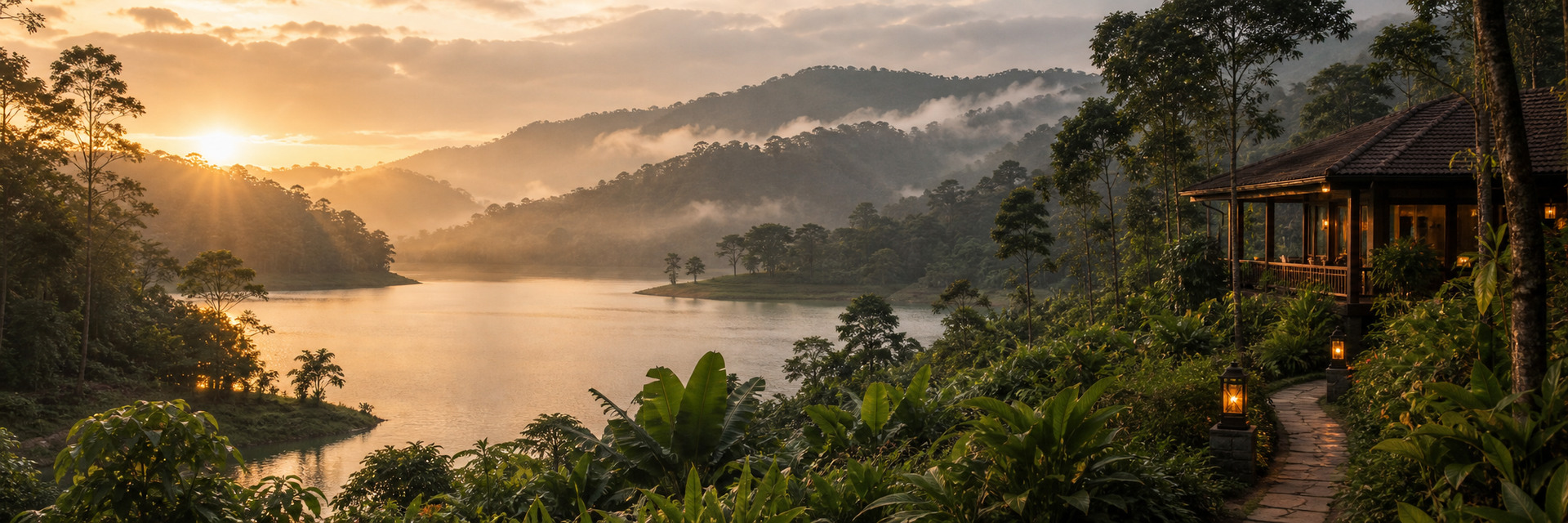
Destination · Kerala spice highlands
Luxury Wellness Resorts in Thekkady & the Cardamom Hills
Ayurveda grown where you take it: spice-estate Panchakarma on the fringe of the Periyar forest.
Thekkady is the one place in India where the Ayurveda and the garden are the same thing — the cardamom, pepper, clove and nutmeg that the pharmacy grinds into oils and decoctions grow on the slope outside the treatment room, and the Periyar Tiger Reserve lays a protected forest against the estate boundary. That combination — a working spice plantation, a living Western Ghats forest and Kerala's own clinical Ayurveda — is a wellness story no coast or hill station can borrow. We help owners build a genuinely physician-led, unmistakably Cardamom-Hills resort on the plantation fringe, and run it from concept through the state's classification, build and hiring to a stabilised opening.
Spice garden
Ayurveda's own botanicals grown on the estate
Periyar
Tiger reserve and lake at the property's edge
Green Leaf
Kerala's own Ayurveda-centre classification
~900 m
Cardamom-Hills altitude — cool air, forest quiet
At a glance
Positioning
Spice-estate Ayurveda — physician-led Panchakarma with plantation botanicals and Periyar forest wellness
Peak season
Oct–Mar highland winter escape; Jun–Sep monsoon 'Karkidaka' sold as the Ayurveda peak
Signature modalities
Ayurveda & Panchakarma with spice-based therapies (lead), naturopathy & mud therapy, yoga & meditation
Guest profile
European long-stay Ayurveda guests, domestic HNI, Gulf NRI, Periyar wildlife travellers converting to wellness
Typical asset
25–50 key low-density wellness resort on the plantation fringe near Kumily
Classification
Kerala Tourism 'Green Leaf' / 'Olive Leaf'; AYUSH, NABH, Clinical Establishment Act; Periyar ESZ & Western Ghats constraints
The opportunity
Thekkady's assets are three things no competing destination holds at once: a working spice plantation, a protected tiger forest and Kerala's clinical Ayurveda tradition — and the wellness proposition is the point where they meet. Ayurveda has always leaned on the botanicals of these hills; cardamom, black pepper, clove, nutmeg, cinnamon and coffee are grown on the very slopes the guest can walk, then carried into the oils, decoctions and dietary regimen a course is built on. Nowhere else in India can a resort say the medicine and the garden are the same landscape, and mean it literally.
Yet Thekkady's supply barely touches this. Kumily and its surrounds are overwhelmingly a two-night wildlife stop — boat the lake, walk a plantation, move on to the backwaters or Munnar — served by mid-market spice-garden homestays and a thin band of resorts. There is almost no serious, physician-led wellness operation here, and nothing that pairs classical Panchakarma rigour with real luxury against the forest edge. The demand walks past the door for want of a reason to stay a fortnight rather than a night.
The whitespace is exactly that reason. A resort that turns the spice estate from a photo-stop into the substance of the treatment — botanicals grown on site, a forest as the setting, Ayurveda as the whole proposition rather than a spa menu — converts Thekkady from a place travellers pass through into a place they book a season ahead. That is the shift from transient wildlife traffic to long-stay, programme-led, repeat wellness demand, and it is wide open here.
Thekkady is the only Indian destination where the Ayurveda grows on the hillside and a tiger forest sits at the fence. Today it sells that as a two-night photo-stop; the opening is to make it a fortnight.
The spice garden as the wellness proposition
The differentiator here is not the view — it is provenance the guest can trace. Kerala Ayurveda is a botanical medicine, and the Cardamom Hills are one of its raw-material heartlands; a Thekkady property can close the loop no coastal or tea-hill resort can, growing and processing the very spices that go into the treatment on the estate itself. A guest walks the cardamom and pepper in the morning and takes an oil or kashayam drawn partly from that garden in the afternoon. That traceability is the brand, and it is defensible because it is true.
It also opens a therapy register that is genuinely local rather than generic. Alongside classical Panchakarma, spice-forward treatments — warm cardamom, clove and pepper in the oils and steam, spice-and-herb poultices, plantation-grounded dietary regimens — give the centre a signature that reads as authentically of this place. Set against the Periyar forest, the offer widens naturally into nature-wellness: guided forest immersion, plantation walks and the cool highland air doing restorative work before a treatment is booked.
- Estate-grown botanicals — cardamom, pepper, clove, nutmeg, cinnamon — traceable into the oil pharmacy and the kitchen
- Classical Panchakarma anchored by a locally grounded, spice-forward therapy signature
- Periyar forest and plantation as a nature-wellness layer that converts wildlife travellers to Ayurveda
- A provenance story — 'the medicine grows here' — that no coast or tea hill can replicate
Elsewhere the spices are procured. In Thekkady they are grown, ground and given on the same estate — a farm-to-therapy claim that is the property's single most valuable asset.
The guest & demand — spice, forest and the monsoon
Thekkady sits on an unusually broad funnel because two streams already arrive at Kumily. The first is the wellness guest Kerala owns — Europeans and, increasingly, domestic HNI and Gulf NRI who understand a two-to-four-week Ayurveda course and choose provenance; for them the spice-estate story is a stronger pull than another beach or tea lawn. The second is the Periyar wildlife and plantation traveller, currently a one- or two-night visitor, who is precisely the person a well-designed nature-wellness intro converts into a longer Ayurveda stay. The property's job is to turn the second stream into the first.
The seasonal move is Kerala's alone and applies in full here. Ayurvedic tradition holds the cool, humid monsoon to be the ideal window for Panchakarma, when the body best absorbs oils and treatment — and the Cardamom Hills in the rains, mist rolling off the Ghats, are as evocative a monsoon-Ayurveda setting as the state offers. Karkidaka-month therapy (roughly June to September) turns the wildlife off-season into a genuine wellness peak with its own rate line. A serious resort designs for the October–March highland winter escape and the monsoon-Ayurveda season at once, so the calendar fills where a wildlife-only property empties.
- Kerala's proven long-stay Ayurveda guest, drawn by an origin claim no rival destination holds
- Periyar wildlife and plantation travellers as a warm feeder pool for nature-wellness intros
- Domestic HNI and Gulf NRI on shorter detox and restorative stays in the cool highland air
- Karkidaka monsoon (Jun–Sep) sold as the Ayurveda peak — a second earning window against the wildlife lull
Pricing & commercial model
The economics are programme-led, not nightly-rate-led. A Thekkady wellness resort earns most of its revenue and nearly all its margin from multi-week, physician-supervised Ayurveda journeys, where the room is bundled into a course rather than sold à-la-carte. We model length-of-stay, repeat value and treatment-revenue dominance first, then scale clinical capacity — consultation rooms, Panchakarma theatres, therapist rosters and the oil pharmacy — to the programme plan rather than to key count. The spice-provenance signature supports a premium the generic Ayurveda hotel cannot hold.
Above the long-stay core sits a shorter, broader tier the location generates for free: five-to-ten-night spice-and-forest nature-wellness stays that capture the Periyar traveller and feed the classical courses, with the estate setting carrying a premium of its own. The monsoon adds a third window with its own Karkidaka rate line. The model is built to earn across all three — highland winter escape, shoulder, and monsoon-Ayurveda — instead of the single dry-season peak a wildlife property lives and dies on.
| Revenue line | Model | Planning note |
|---|---|---|
| Ayurveda programmes | 14–28 night all-inclusive, physician-led | Primary revenue & margin; design Panchakarma theatres to it |
| Spice & forest wellness | 5–10 night nature-wellness intros | Captures the Periyar traveller; feeder to longer courses |
| Monsoon Karkidaka season | Dedicated Jun–Sep rate line | Turns the wildlife off-season into a third earning window |
| Estate & botanical premium | Provenance-led rate uplift | The 'grown here' story the generic Ayurveda hotel cannot charge for |
Indicative structure; modelled to the specific asset, estate and brand.
Classification & regulatory realities
Kerala is the one state that classifies Ayurveda centres itself, and credibility in this market runs through that classification. Kerala Tourism operates the 'Green Leaf' and 'Olive Leaf' certification — Green Leaf the premium tier, Olive Leaf the standard one — grading facilities, physician and therapist qualifications, hygiene and treatment standards. For the guest choosing a serious Ayurveda property it is a recognised signal of authenticity, and we design the facility and staffing to earn the Green Leaf from the outset rather than retrofit toward it.
The clinical layer sits on top: Ministry of AYUSH standards for Ayurveda practice, physicians, therapists and the medicinal-oil pharmacy; NABH wellness / AYUSH accreditation for a hospital-grade treatment operation; and registration under the Clinical Establishment Act for the medical dimension of the centre. On a property whose signature is estate-grown botanicals, the pharmacy and its provenance also fall under this regime — the 'grown here' claim has to be documented and compliant, not just charming.
Thekkady then adds a land-and-forest regime sharper than anywhere else in Kerala Ayurveda. The Periyar Tiger Reserve and its buffer carry eco-sensitive-zone protections, and the surrounding Cardamom Hills fall under the Western Ghats ecologically sensitive framework — so the build belongs on the plantation fringe, never inside the reserve or its core buffer, and forest, wildlife-corridor and setback rules govern siting, height, lighting and effluent. Plantation land carries its own conversion and use questions, and the gradient dictates the civil approach. We resolve which zone a plot sits under, and what it permits, before capital is committed.
- Kerala Tourism 'Green Leaf' / 'Olive Leaf' Ayurveda-centre classification — designed for from day one
- Ministry of AYUSH standards for practice, physicians, therapists and the medicinal-oil pharmacy
- NABH wellness / AYUSH accreditation for a hospital-grade treatment operation
- Clinical Establishment Act registration for the medical dimension of the centre
- Periyar Tiger Reserve eco-sensitive-zone and buffer rules — build on the plantation fringe, not the reserve
- Western Ghats ecologically-sensitive framework, plantation-land conversion and slope-stability constraints
Two overlays govern a Thekkady site at once — Kerala's Ayurveda classification and the Periyar forest's eco-sensitive protections. The build lives on the plantation fringe, and both are resolved before capital moves.
Facility, spa & clinical design & procurement
The treatment wing is the building here, not an amenity bolted to the side. A credible property needs Ayurveda-hospital-grade clinical space — physician consultation rooms, dedicated Panchakarma theatres, and the wet, humid, drainage-heavy therapy areas classical treatment demands, laid out to Green Leaf and NABH logic. The signature apparatus is unmistakable and has to be planned from the drawing stage: the Droni (the carved wooden treatment table for oil therapies), Shirodhara rigs, steam and swedana chambers, and — distinctively for Thekkady — an estate-linked medicinal-oil pharmacy and spice-processing space that turns plantation botanicals into the pharmacopoeia a long-stay programme runs on.
The architecture should belong to the Cardamom Hills. Kerala vernacular handled with restraint — the nalukettu courtyard logic, sloping Mangalore-tiled roofs pitched for heavy rain, laterite, reclaimed timber and deep verandahs — set low-density into the plantation so the estate and forest, not the built mass, carry the guest experience. Forest-edge siting means dark-sky lighting, wildlife-sensitive boundaries, generous separation between blocks and a footprint that works with the slope rather than cutting into it. The spice garden itself becomes part of the treatment landscape, not a backdrop.
Procurement is a monsoon-and-terrain exercise. The high-Ghats damp and heavy rains force corrosion-rated ironmongery, mould- and damp-resistant finishes, generous drainage and moisture-controlled treatment rooms, and the same monsoon that fills the beds governs the build calendar. Thekkady's inland hill logistics — no coast, hairpin approaches from Kochi and the Madurai gateway — shape how apparatus and fit-out reach site. We run the full programme: Panchakarma apparatus, the medicinal-oil pharmacy and spice-processing chain, hydro and wet areas, the sattvic and Ayurvedic kitchens drawing on estate produce, and FF&E and OS&E specified for the wet and the slope, leaning on Kerala's genuine strength in timber, coir and local craft.
Talent & hiring map
Kerala's real moat is its people, and Thekkady draws on it. The state holds the deepest pool of qualified Ayurvedic physicians and therapists in India — the clinical talent is genuinely here — and the Cardamom Hills add a second, unusual pool: spice-estate managers, plantation agronomists and Periyar naturalists who can run the garden-to-pharmacy chain and the forest-wellness programme that make this property distinct. The clinical and the estate sides both matter, and a Thekkady team is staffed across both.
The harder hire is the one Kerala always presents: luxury-hospitality leadership that respects clinical primacy and runs a premium P&L around a Chief Ayurvedic Physician rather than overriding them. We build the team around that seam — a General Manager and Wellness Director fluent in long-stay, programme-led operation, paired with the Chief Ayurvedic Physician, the vaidyas, and a therapist team with same-gender therapy built in as standard, then joined to the estate and naturalist roles the location needs. Retention is state-specific: Kerala's best physicians and therapists are pulled hard by Gulf and out-of-state migration, and Thekkady's inland remoteness adds a relocation and rotation layer the coast does not, so the hiring plan is designed to attract, train and hold that team through the first winter and monsoon seasons the model is built to win.
Gladwin's edge in the Cardamom Hills
Thekkady turns on assembling a team that most owners cannot: luxury-hospitality leadership that defers to clinical authority instead of overriding it, sitting over India's deepest but most-poached pool of Ayurvedic physicians and therapists — and joined here to a spice-estate and Periyar-naturalist ecosystem the garden-to-therapy proposition depends on. That is precisely the seam Gladwin works. As an India-headquartered executive-search firm, we draw on both our Healthcare & Life Sciences and Hospitality & Travel practices to build a team where a Chief Ayurvedic Physician sets the clinical standard, a luxury GM runs the P&L around it, and estate and forest specialists keep the provenance story real — then plan the retention that holds Kerala's best people against the Gulf and out-of-state pull that constantly drains them.
We also build the classification, accreditation and land pathway in from the start, because in this market the authenticity claim is the brand and it has to be defensible: the Green Leaf, AYUSH, NABH and Clinical Establishment standards designed into the facility and the estate pharmacy, and the double overlay of the Periyar Tiger Reserve eco-sensitive zone and the Western Ghats framework resolved so the build lands cleanly on the plantation fringe. One accountable partner, from a spice-estate plot to a stabilised first Karkidaka season.
- Recruit luxury leadership that respects, not overrides, the Ayurvedic clinical lead
- Deep access to Kerala's vaidya and therapist pools, joined to spice-estate and Periyar naturalist talent
- Design in the Green Leaf / Olive Leaf, AYUSH, NABH and Clinical Establishment pathway — pharmacy provenance included
- Resolve the Periyar eco-sensitive-zone, Western Ghats and plantation-land constraints so the build sits on the fringe
Planning a resort here?
We take single accountability from concept to a stabilised opening — market and pricing strategy, design, procurement, and the full leadership and expert team hired.
Speak with a partnerThekkady & the Cardamom Hills — frequently asked questions
Provenance you can trace. The Cardamom Hills grow the very spices — cardamom, pepper, clove, nutmeg, cinnamon — that Kerala Ayurveda has always used, so a Thekkady property can grow, process and give the medicine on the same estate, closing a loop no beach or tea-hill resort can. Add the Periyar Tiger Reserve at the boundary and you have a spice-and-forest wellness story that is genuinely singular in India.
Yes, and it is the property's core asset — but it has to be built and documented, not just claimed. We plan an estate-linked medicinal-oil pharmacy and spice-processing space, and design the botanical supply into the facility so plantation cardamom, pepper and clove feed the oils, decoctions and kitchen. Because it is a medical claim, the pharmacy and its provenance sit under AYUSH and Clinical Establishment standards, so the 'grown here' story is compliant as well as compelling.
They are decisive. The Periyar reserve and its buffer carry eco-sensitive-zone protections and the surrounding Cardamom Hills fall under the Western Ghats ecologically sensitive framework, so the resort belongs on the plantation fringe — never inside the reserve or core buffer — with forest, wildlife-corridor, lighting, height and effluent rules governing siting. Plantation land also carries conversion and slope questions. We resolve which zone a plot sits under, and what it permits, before capital is committed.
Because Ayurvedic tradition holds the cool, humid rains to be the ideal window for Panchakarma, when the body best absorbs oils and treatment — and the Cardamom Hills in the monsoon, mist off the Ghats, are among the state's most evocative settings for it. Karkidaka-month therapy (roughly June–September) turns the wildlife off-season into an Ayurveda peak with its own rate line, so a serious resort earns across the winter escape and the monsoon season both.
Kerala has the deepest pool of qualified Ayurvedic physicians and therapists in India, and the Cardamom Hills add spice-estate managers and Periyar naturalists for the garden-to-therapy and forest-wellness sides. The harder task is luxury leadership that respects clinical primacy, and holding the best physicians against strong Gulf and out-of-state migration — sharper still given Thekkady's inland remoteness. We recruit across all these pools and design the retention and rotation plan to hold the team through the first winter and monsoon seasons.
Yes — as one accountable partner. We run positioning and the market study, the Green Leaf / AYUSH / NABH and Clinical Establishment pathway, the Periyar eco-sensitive-zone and Western Ghats site work on the plantation fringe, place-rooted design of the treatment wing, Panchakarma theatres and estate pharmacy, procurement of apparatus and monsoon-spec fit-out, and the full clinical, leadership and estate team hired and trained through a stabilised first Karkidaka season.
Related
Explore the rest of the cluster
Wellness modality · Traditional Eastern
Ayurveda & Panchakarma
India's most valuable wellness asset — if it is authentic, and run as one.
Wellness modality · Traditional Eastern
Naturopathy & Mud Therapy
Drugless, nature-cure healing — accessible, programme-friendly and uniquely Indian.
Wellness modality · Traditional Eastern
Yoga & Meditation
India's birthright modality — and the easiest to do badly.
Destination · Kerala Ayurveda — hills & coast
Munnar & Kovalam
Kerala's deepest Ayurveda: the tea hills of Munnar and the classic Panchakarma coast of Kovalam.
Destination · Kerala highland forests
Wayanad
Plantation-and-forest wellness in the high Western Ghats, delivered with real Kerala Ayurveda — and built to survive an eco-sensitive slope.