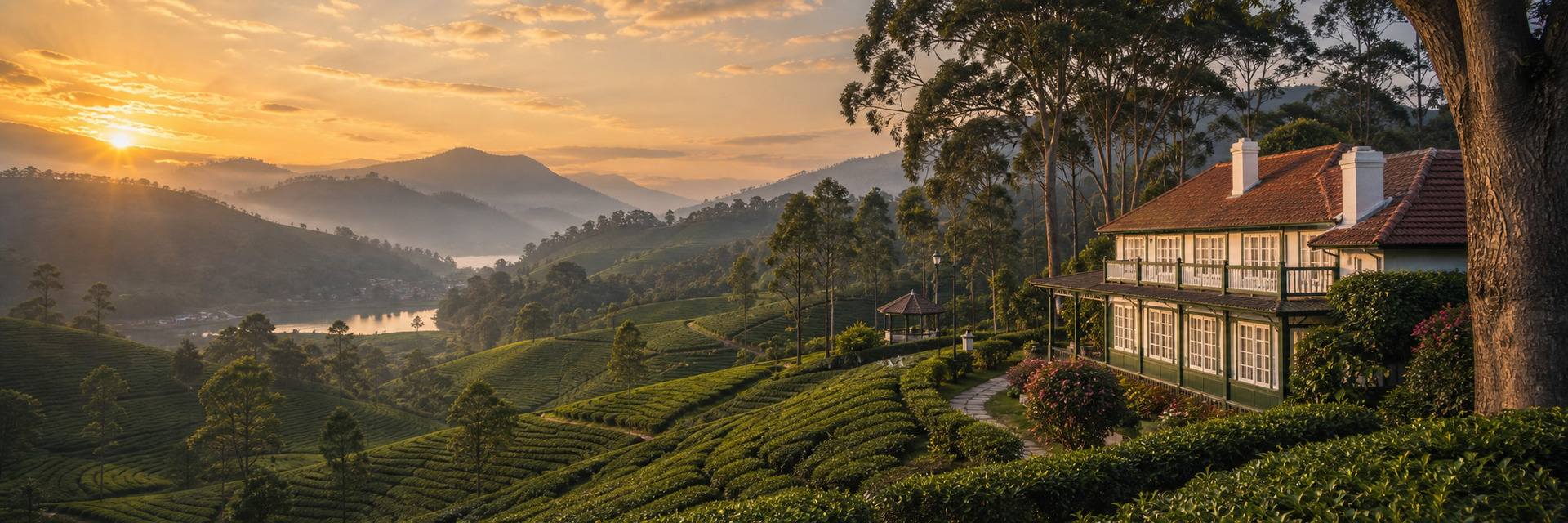
Destination · Tamil Nadu · Nilgiri hills
Luxury Wellness Resorts in Ooty & the Nilgiris
Tamil Nadu's hill-station cure: Siddha and naturopathy at altitude, in India's oldest colonial wellness climate.
Ooty was built as a place to get well. The British made Udhagamandalam the summer capital because the Nilgiri air did what medicine could not, and the Queen of Hill Stations has traded on cool, clean, high-altitude climate ever since. What the market has never had is that colonial climate premise fused with Tamil Nadu's own clinical inheritance — Siddha, the state's home-grown system, and a naturopathy and nature-cure tradition that is among the strongest in the country. We help owners build wellness resorts that hold both at once, and run them from concept through AYUSH and the Nilgiris' unusually strict eco regime to a stabilised opening.
Queen of hills
India's original colonial climate-cure station
Home of Siddha
Tamil Nadu's own indigenous medical system
UNESCO reserve
Nilgiris Biosphere; strict eco & building limits
~2,200 m
High-altitude climate therapy year-round
At a glance
Positioning
Colonial hill-station climate wellness fused with Tamil Nadu's Siddha and naturopathy traditions
Peak season
Apr–Jun summer escape from the plains; Sep–Nov shoulder; a defensible year-round cool-climate proposition
Signature modalities
Naturopathy & nature-cure and Siddha (lead), Ayurveda, yoga & meditation, climate therapy
Guest profile
Domestic HNI from Bengaluru, Chennai and Coimbatore, Gulf NRI, and long-stay detox and lifestyle guests
Typical asset
30–60 key wellness resort — restored colonial estate, tea-garden retreat or a naturopathy-Siddha nature-cure house
Regulatory frame
Ministry of AYUSH (Siddha, naturopathy, Ayurveda), NABH, Clinical Establishment Act; HACA and Nilgiris eco-sensitive-area norms
The opportunity
Ooty is one of the very few places in India where a wellness proposition does not have to be argued from scratch — it is the reason the town exists. The British moved the Madras summer capital to Udhagamandalam precisely for the climate, and for two centuries the Nilgiris have sold the same thing: cool, clean, high-altitude air that reads as restorative before a treatment is ever mentioned. That is a climate-wellness premise most Indian destinations would have to invent; here it is inherited, and it carries a colonial heritage — the club-and-cottage architecture, the tea gardens, the Nilgiri Mountain Railway — that no new-build hill station can manufacture.
What the Nilgiris have never done is put a serious clinical operation behind that climate. The supply is overwhelmingly view-led: heritage hotels, tea-estate stays and family resorts that trade on the setting and the season, with wellness reaching, at most, a token spa menu. Almost nothing here is physician-led, programme-driven or classified. A resort that brings real clinical depth up to the hill can own a category the destination has never had.
And Tamil Nadu supplies a clinical spine that is genuinely distinctive. This is the home of Siddha — the state's own indigenous medical system, not a borrowed one — and Tamil Nadu carries one of India's deepest naturopathy and nature-cure traditions. A Nilgiri property built on Siddha, naturopathy and climate therapy is not a copy of the Kerala Ayurveda model relocated up a hill; it is a different, defensibly Tamil proposition that the neighbouring hill markets cannot replicate.
Ooty already owns the climate claim that other destinations invent. What it has never had is a serious clinical operation behind it — and Tamil Nadu's Siddha and naturopathy give that operation an identity no other hill station can copy.
The wellness proposition — climate, Siddha and nature-cure
The Nilgiri proposition rests on three things that reinforce one another. The first is climate itself as therapy: at roughly 2,200 metres the air is cool and thin year-round, and a stay here is sold on rest, respiratory ease, sleep and the physiological reset that altitude and clean air deliver — a premise the plains simply cannot offer for eight months of the year. The second is Tamil Nadu's clinical inheritance, and here the distinctive move is Siddha. Where Kerala trades on Ayurveda, Tamil Nadu can lead with the system that is native to it, giving a Nilgiri resort a clinical identity that is genuinely its own rather than a borrowed one.
The third is naturopathy and nature-cure, a tradition Tamil Nadu holds as strongly as any state in India. Naturopathy's diet, hydrotherapy, mud, fasting and lifestyle regimes sit naturally in a cool, clean, green hill setting, and they convert the modern wellness guest — the detox, weight, stress and lifestyle-disease seeker — who is not ready for a three-week Panchakarma but will book a structured week of nature-cure. Layered with yoga, meditation and the tea garden itself, the Nilgiri resort can run a genuinely differentiated menu: Siddha and naturopathy at the clinical core, Ayurveda and yoga alongside, climate and the landscape doing work no treatment room can.
- Climate therapy — high-altitude cool air, respiratory ease, sleep and reset as a year-round premise
- Siddha — Tamil Nadu's own indigenous system, a clinical identity no other hill station owns
- Naturopathy & nature-cure — diet, hydrotherapy, mud and fasting regimes suited to the hill setting
- Ayurveda, yoga and meditation alongside; tea-garden and forest as the restorative backdrop
Modality fit — why the Nilgiris suit these systems
Not every wellness system belongs everywhere, and part of the discipline here is matching modality to place rather than defaulting to whatever the market expects. The Nilgiris fit naturopathy and Siddha unusually well — and for concrete, physiological reasons, not marketing ones.
Naturopathy leads because the environment is the treatment. A cool, clean, green hill at altitude is the natural home of a nature-cure regime: light, air, water, diet and rest are the medicine, and the Nilgiris supply all of them without a facility having to fabricate them. Siddha follows as the indigenous clinical anchor, giving the property a Tamil identity and a physician-led credibility that a spa cannot claim. Ayurveda and yoga extend the menu for guests who arrive expecting them, and climate therapy underwrites the whole stay. The table below sets out the fit each system has with this specific destination.
| Modality | Role at the Nilgiris | Why it fits the hill |
|---|---|---|
| Naturopathy & nature-cure | Lead — structured detox and lifestyle programmes | Cool, clean, high-altitude setting is itself the therapy |
| Siddha | Clinical anchor — Tamil Nadu's own system | Native to the state; a distinctive, defensible identity |
| Ayurveda | Complementary — familiar to the wellness guest | Broadens the menu without leading the positioning |
| Yoga & meditation | Everyday layer across every programme | Altitude, quiet and forest suit contemplative practice |
| Climate therapy | The underwriting premise of every stay | ~2,200 m air, respiratory ease, sleep and reset |
Indicative modality fit for the Nilgiris; refined to the concept and guest during the market study.
The guest & demand — the climate escape and the year-round cure
The Nilgiri guest today is overwhelmingly domestic, and the calendar is built on the summer escape: April to June, when Chennai, Bengaluru, Coimbatore and the wider south flee the heat for the hills, is the peak, with a September–November shoulder around the post-monsoon clarity. That is real, reliable demand — but it is leisure demand, and it is seasonal. The opportunity in a wellness property is to convert a slice of it into something longer, higher-yielding and far less seasonal.
A serious wellness resort here sells two demand shapes at once. The first is the affluent leisure guest who comes for the climate and can be programmed into a naturopathy or Siddha stay — a wellness overlay on a trip they were going to take anyway. The second, and the more valuable, is the intentional wellness guest: the detox, weight, stress and lifestyle-disease seeker, the repeat naturopathy patient, the Gulf-NRI and metro HNI who will book a structured week or fortnight for the programme itself. Because the Nilgiri climate is a year-round asset rather than a monsoon or winter window, a physician-led property can hold that intentional guest across the calendar, filling the shoulders and the off-season that leisure-only resorts leave empty.
- Summer climate escape (Apr–Jun) from Chennai, Bengaluru and Coimbatore — the reliable leisure peak
- Intentional wellness guests — detox, weight, stress and lifestyle-disease seekers on structured stays
- Gulf NRI and metro HNI booking Siddha and naturopathy programmes for their own sake
- A year-round cool climate that fills shoulder and off-season windows leisure-only resorts cannot
AYUSH, NABH and the Nilgiris' eco regime
The clinical layer is what separates a licensed, physician-led operation from a hotel spa, and it must be designed in from the outset. Because the Nilgiri proposition leads with Siddha and naturopathy, the Ministry of AYUSH — which governs Siddha, naturopathy and Ayurveda alike — is the central authority, setting the standards for practice, practitioners and pharmacy. NABH wellness and AYUSH accreditation give the treatment operation hospital-grade credibility, and registration under the Clinical Establishment Act covers the medical dimension of the centre. For a property whose whole claim is that it is clinically serious, these are not polish applied afterwards; they are the licence to hold a long-stay clinical guest.
The site regime is where the Nilgiris differ sharply from every other wellness destination, and it is the constraint that most often surprises owners. This is a UNESCO Biosphere Reserve and an ecologically sensitive area, and building here is tightly governed. The Hill Area Conservation Authority (HACA) regulates development across the Nilgiri hill area, and layered over it are the ecologically-sensitive-area norms, forest and reserve boundaries, strict building-height and coverage limits designed to protect the hill-station character, slope-stability rules, and the district's plastic and eco restrictions. Land conversion, tea-estate status, tree cover and gradient all bear on what can be built and how. We resolve exactly which of these bind a given plot before capital is committed — because in the Nilgiris the eco regime, not the market, is usually the binding constraint.
- Ministry of AYUSH standards for Siddha, naturopathy and Ayurveda practice, practitioners and pharmacy
- NABH wellness / AYUSH accreditation for a hospital-grade treatment operation
- Clinical Establishment Act registration for the medical dimension of the centre
- HACA (Hill Area Conservation Authority) approval across the Nilgiri hill area
- Ecologically-sensitive-area norms, forest and reserve boundaries, and building-height / coverage limits
- Slope-stability rules, tea-estate land status, tree cover and district plastic / eco restrictions
In most wellness markets the site risk is commercial. In the Nilgiris it is ecological — HACA, the sensitive-area norms and the hill-station building limits decide the project before the market does, so they are resolved first.
Facility, design & procurement
The building should read as Nilgiri, not as generic hill resort. Two hundred years of colonial hill-station architecture give a genuine vernacular to draw on — stone and timber, steep-pitched roofs and dormers, deep verandahs and fireplaces, the club-and-cottage grammar of the old estates — and the strongest properties either restore that heritage or build sympathetically within it, working with the tea gardens and the slope rather than against them. Height and coverage limits force a low, dispersed, landscape-led plan in any case; the design discipline is to make that constraint the character.
The treatment wing is the clinical heart, and it is specified for Siddha and naturopathy rather than borrowed from an Ayurveda template. That means Siddha consultation and therapy rooms and an on-site Siddha pharmacy for the varmam, herbal and mineral preparations the system uses; and, for naturopathy, a full nature-cure suite — hydrotherapy and water-treatment rooms, mud-therapy areas, massage and steam, a therapeutic and fasting kitchen, and the diet-and-lifestyle infrastructure that nature-cure runs on. Physician consultation, yoga and meditation halls and the wet, drainage-heavy therapy areas are laid out to NABH and AYUSH logic from the drawing stage.
Procurement is a cold-and-damp exercise, unlike the coastal builds most wellness procurement assumes. The Nilgiri climate is cool and wet for much of the year, so climate-controlled comfort — heating, insulation, moisture and mould control in every treatment and guest room — is a core specification, not a luxury. Damp-resistant finishes, generous drainage, and the hill-logistics reality of hairpin approaches and a fragile road network all shape the programme. We run the full scope — Siddha and naturopathy apparatus, the herbal and nature-cure supply chain, hydro and wet areas, the therapeutic and sattvic kitchens, FF&E and OS&E — specified for the cold, the damp and the gradient, and drawing on the Nilgiris' own strengths in stone, timber and tea-country craft.
Talent & the practitioner pool
The practitioner base is a real Tamil Nadu advantage, and it is different in kind from Kerala's. Tamil Nadu trains and holds India's deepest pool of Siddha physicians — this is the home of the system, with the state's Siddha colleges and hospitals feeding a talent stream no other state can match — alongside a strong naturopathy and yoga-and-naturopathy practitioner base and Ayurveda physicians who work across the south. That clinical depth is exactly the moat a serious property needs, and it is the reason the Nilgiris can lead with Siddha and naturopathy credibly rather than as a marketing line.
The hospitality layer is a genuine strength too. Coimbatore, ninety kilometres down the hill, is a substantial city with a real hospitality and service labour draw, and the Nilgiris' long tourism history means front-of-house talent is available in a way remote hill destinations rarely enjoy. The harder hire is the same one every clinical resort faces: luxury-hospitality leadership that runs a premium P&L around a Chief Siddha or naturopathy physician rather than overriding the clinical lead. We build the team around that seam — a General Manager and Wellness Director fluent in programme-led operation, paired with the lead physicians, the Siddha and naturopathy practitioners, and a therapist roster with same-gender therapy built in as standard — and plan the retention and the Ooty-relocation logistics that hold that team through the seasons the model is built to win.
Gladwin's edge in the Nilgiris
The Nilgiri opportunity turns on a combination almost no single partner covers: a genuinely Tamil clinical identity — Siddha and naturopathy rather than relocated Ayurveda — built on a colonial climate premise, and delivered through one of India's strictest eco regimes. That is precisely the seam Gladwin works. As an India-headquartered executive-search firm, we draw on both our Healthcare & Life Sciences and Hospitality & Travel practices to assemble a team where a Chief Siddha or naturopathy physician sets the clinical standard and a luxury GM runs the P&L around it, hiring into Tamil Nadu's deep Siddha and naturopathy pool and the Coimbatore hospitality draw, then planning the retention and hill-relocation logistics that hold that team.
We also build the regulatory and accreditation pathway in from the start, because in the Nilgiris the eco regime decides the project before the market does. The AYUSH, NABH and Clinical Establishment standards are designed into the facility, and the HACA, ecologically-sensitive-area, building-height and slope constraints are resolved on the specific plot before capital moves — restored heritage or new-build, tea estate or nature-cure house. One accountable partner, from a Nilgiri plot to a stabilised opening season.
- Lead with a genuinely Tamil identity — Siddha and naturopathy, not relocated Ayurveda
- Recruit into Tamil Nadu's deep Siddha and naturopathy pool and the Coimbatore hospitality draw
- Design in the AYUSH, NABH and Clinical Establishment pathway for a physician-led operation
- Resolve HACA, eco-sensitive-area, building-height and slope constraints before capital moves
Planning a resort here?
We take single accountability from concept to a stabilised opening — market and pricing strategy, design, procurement, and the full leadership and expert team hired.
Speak with a partnerOoty & the Nilgiris — frequently asked questions
Two things. First, Ooty inherits a colonial climate-cure premise — the Nilgiris were built as a place to get well, and high-altitude cool air is a proven, year-round wellness asset the plains cannot offer. Second, the clinical identity is Tamil, not Keralan: this is the home of Siddha and one of India's strongest naturopathy traditions, so a Nilgiri resort leads with Siddha, naturopathy and climate therapy rather than relocating the Kerala Ayurveda model up a hill.
Because they are genuinely Tamil Nadu's own and they fit the place. Siddha is the state's indigenous system, giving the property a distinctive clinical identity no other hill station can claim, and naturopathy's diet, hydrotherapy, mud and lifestyle regimes suit a cool, clean, green hill setting exactly. Ayurveda and yoga extend the menu for guests who expect them, but Siddha and naturopathy — under the same Ministry of AYUSH — are the defensible lead.
The Hill Area Conservation Authority regulates development across the Nilgiri hill area, which — as a UNESCO Biosphere Reserve and ecologically sensitive area — is tightly protected. HACA sits alongside ecologically-sensitive-area norms, forest and reserve boundaries, strict building-height and coverage limits, slope-stability rules and district eco restrictions. In the Nilgiris the eco regime is usually the binding constraint on a project, so we resolve exactly what applies to a plot before capital is committed.
Yes, and that is the core of the opportunity. The summer climate escape from Chennai, Bengaluru and Coimbatore is a reliable leisure peak, but a physician-led property adds a second, more valuable demand shape: intentional wellness guests — detox, weight, stress and lifestyle-disease seekers, repeat naturopathy patients, Gulf NRI and metro HNI — who book structured Siddha and naturopathy stays for their own sake. Because the Nilgiri climate is a year-round asset, that demand fills the shoulders and off-season leisure-only resorts leave empty.
Tamil Nadu holds India's deepest pool of Siddha physicians — this is the home of the system, with the state's Siddha colleges and hospitals feeding it — plus a strong naturopathy and yoga practitioner base and Ayurveda physicians across the south. Front-of-house talent is available too, drawn from Coimbatore ninety kilometres down the hill and the Nilgiris' long tourism history. The harder hire is luxury leadership that respects clinical primacy, which we recruit and pair with the physician lead.
Yes — as one accountable partner. We run positioning and the market study, the AYUSH, NABH and Clinical Establishment pathway, the HACA and eco-sensitive-area site work, place-rooted design of a Siddha and naturopathy treatment wing whether restoring heritage or building new, procurement of apparatus, the herbal and nature-cure supply chain and cold-and-damp-spec fit-out, and the full leadership and clinical team hired and trained through a stabilised first season.
Related
Explore the rest of the cluster
Wellness modality · Traditional Eastern
Naturopathy & Mud Therapy
Drugless, nature-cure healing — accessible, programme-friendly and uniquely Indian.
Wellness modality · Traditional Eastern
Yoga & Meditation
India's birthright modality — and the easiest to do badly.
Wellness modality · Traditional Eastern
Ayurveda & Panchakarma
India's most valuable wellness asset — if it is authentic, and run as one.
Destination · Tamil Nadu · Nilgiri tea country
Coonoor
The quiet Nilgiri alternative to Ooty — tea-estate slow luxury, restored planter bungalows, small-scale wellness at altitude.
Destination · Tamil Nadu · Palani hills
Kodaikanal
The Princess of Hill Stations, made for silence: shola-forest retreat wellness in the Palani hills.