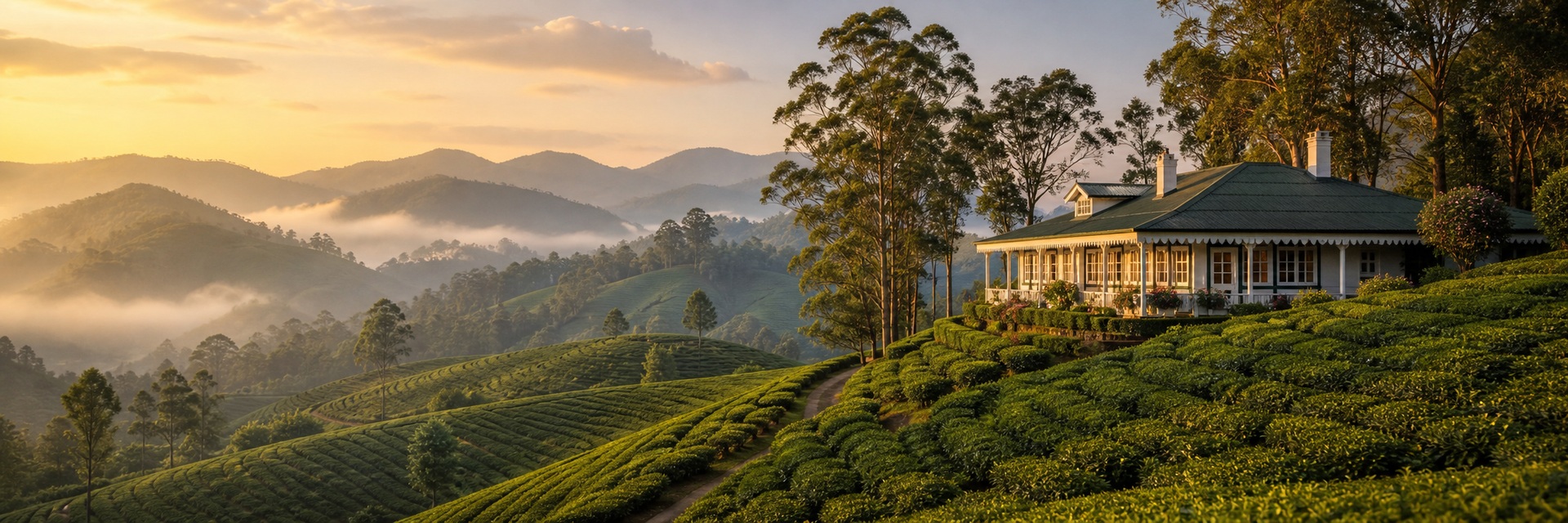
Destination · Tamil Nadu · Nilgiri tea country
Luxury Wellness Resorts in Coonoor
The quiet Nilgiri alternative to Ooty — tea-estate slow luxury, restored planter bungalows, small-scale wellness at altitude.
Coonoor is the Nilgiris' understated register: a greener, higher, far quieter town a few miles below the Ooty crowds, wrapped in the high-grown tea gardens that give India its 'champagne' Nilgiri teas. It is where the region's heritage planter bungalows are quietly becoming boutique luxury — small, private, and deliberately hard to reach. We help owners build genuinely intimate tea-estate wellness houses here, from a single restored bungalow to a low-key estate retreat, and run them from concept through the AYUSH, NABH and Nilgiri hill-conservation reality to a stabilised opening.
Below Ooty
Quieter, greener, more exclusive Nilgiri register
High-grown
Home of the 'champagne of Indian teas'
Planter bungalows
Heritage tea houses converting to boutique luxury
Siddha country
Tamil Nadu's own tradition alongside Ayurveda
At a glance
Positioning
Intimate tea-estate slow luxury — small-scale, high-touch, the exclusive alternative to Ooty
Peak season
Apr–Jun summer hill escape and Sep–Nov; year-round cool, gentle monsoon shoulder
Signature modalities
Naturopathy & climate/nature wellness (lead), Siddha and Ayurveda, yoga & meditation, tea-based therapies
Guest profile
Domestic HNI, privacy-seeking couples and families, NRI returnees, discerning long-weekenders from Bengaluru/Chennai
Typical asset
12–30 key boutique retreat — a restored planter bungalow or a small tea-garden estate
Regulation
Ministry of AYUSH, NABH, Clinical Establishment Act; Nilgiris eco-sensitive / HACA and forest and height limits
The opportunity
Coonoor is what Ooty was before the traffic. Six miles and a few hundred metres of altitude separate them, but the towns have diverged completely: Ooty is the mass hill station of day-trippers, boating queues and honeymoon coaches, while Coonoor stays green, quiet and largely residential — the address the Nilgiris' old planter families and retired officers actually kept. That divergence is the whole opportunity. There is a real, underserved appetite for a Nilgiri stay that is exclusive rather than crowded, and Coonoor is the only side of the hill that can credibly offer it.
The supply that exists is telling. Coonoor already carries the region's most characterful conversions — the celebrated old planter houses and a handful of boutique estates — but they are scarce, mostly small, and almost none run a serious, physician-led wellness operation behind the heritage. The market has proven that guests will pay a strong premium for a restored bungalow on a tea slope; it has not yet been shown a property that pairs that setting with genuine clinical wellness. That combination — planter-bungalow intimacy plus real Siddha, naturopathy and Ayurveda depth — is the space to own.
And the raw material is unmatched. Coonoor sits inside the high-grown tea gardens that produce India's finest Nilgiri leaf, the 'champagne of Indian teas', with Sim's Park, Dolphin's Nose, Lamb's Rock and the toy-train stations of the Nilgiri Mountain Railway within a short drive. It is a setting that reads as nature-wellness before a single treatment is offered — and a story, tea, that a wellness brand can build an entire proposition around.
Ooty owns scale; Coonoor owns exclusivity. The whitespace is a genuinely clinical wellness house behind the heritage tea-bungalow setting the town is already famous for.
Not Ooty — the exclusivity premise
The single most important decision in a Coonoor project is refusing to become a smaller Ooty. The value here is not the hill station; it is the tea estate and the privacy — a proposition built on scarcity, seclusion and slowness rather than on views and volume. An owner who builds keys to a spreadsheet, chases the coach trade, or leans on the same attractions Ooty already saturates will erase the one advantage the town has.
That means designing the asset small and deliberately hard to over-fill. Coonoor's register is a dozen to thirty keys, walk-in-the-garden pacing, and a guest who comes for a week to disappear — not a two-hundred-room hotel processing weekends. The tea garden is the amenity, the bungalow is the experience, and the wellness programme is the reason to stay past the second night.
| Dimension | Coonoor (this project) | Ooty (what to avoid becoming) |
|---|---|---|
| Register | Intimate tea-estate slow luxury, seclusion | Mass hill station, volume and attractions |
| Scale | 12–30 keys, high-touch, low-density | Large hotels, coach and day-trip trade |
| Premise | Privacy, tea, altitude, restorative wellness | Views, lake, sightseeing circuit |
| Guest & stay | HNI couples/families, 4–7 night restorative | Weekenders and day-trippers, short stays |
Indicative contrast; refined against the specific plot and concept during the market study.
Coonoor's premium is scarcity. The brief is to protect it — small, private and slow — not to dilute it toward Ooty's numbers.
The guest & demand — privacy, altitude and tea
Coonoor's guest is defined by what they are avoiding as much as what they seek. This is the domestic and NRI HNI who wants the Nilgiris without the crowds — the privacy-conscious couple, the multi-generational family that has rented the same bungalow for years, the founder or professional from Bengaluru or Chennai who can reach the hills in half a day and wants to genuinely switch off. It is a shorter-haul, higher-yielding, repeat-prone base than the mass hill-station traffic next door, and it converts readily to a four-to-seven-night restorative stay when the property gives it a reason to.
The wellness pull is climate and nature first. Coonoor's year-round cool, clean, high-altitude air is itself the therapy the guest arrives believing in — a nature-and-detox premise that suits naturopathy, yoga and gentle Siddha and Ayurveda far better than a hard clinical framing. The tea gives it a language no other Indian hill wellness destination owns: garden walks, tea tastings, and tea-leaf and tea-oil treatments that turn the estate into the spa menu. Demand is genuinely year-round here, peaking in the Apr–Jun summer escape and again Sep–Nov, with a soft, walkable monsoon shoulder rather than the wash-out coastal Kerala plans around.
- Privacy-seeking domestic HNI and NRI returnees — the Nilgiris minus the Ooty crowds
- Half-day drive-in catchment from Bengaluru, Chennai, Coimbatore and Kochi
- Climate-and-nature wellness — cool high-altitude air as the premise, not a spa add-on
- Tea as the signature: garden walks, tastings, tea-based therapies as the property's language
Pricing & commercial model
The economics are exclusivity-led, not occupancy-led. A Coonoor house earns its return from a high rate on a small, protected key count and from length of stay — a restorative four-to-seven-night programme, whole-bungalow buyouts, and repeat guests — rather than from filling rooms. We model rate integrity, buyout and villa premiums and treatment attachment first, and size the wellness operation to the stay pattern rather than to a large room block that would undercut the very scarcity the rate depends on.
Wellness is the margin engine and the reason the rate holds. A guest who books for the tea gardens can be converted into a naturopathy-and-yoga programme, tea-based treatments and Siddha or Ayurveda consultations, lifting both spend per guest and length of stay well above a view-led boutique hotel. Year-round demand and a walkable monsoon shoulder mean the property is not living off two dry-season peaks the way many hill assets do, which lets the model plan for a fuller, steadier calendar than the seasonality alone would suggest.
| Revenue line | Model | Planning note |
|---|---|---|
| Restorative wellness stays | 4–7 night naturopathy/yoga programmes | Primary margin; size the spa to the stay, not the key count |
| Whole-bungalow buyouts | Villa / heritage-house exclusive-use premium | Coonoor's scarcity monetised directly |
| Tea-based & Siddha treatments | À-la-carte and programme-bundled | The property's signature; lifts spend per guest |
| Year-round calendar | Apr–Jun & Sep–Nov peaks, soft monsoon shoulder | Steadier than a two-peak hill asset |
Indicative structure; modelled to the specific asset, site and brand.
Classification & regulatory realities
The clinical layer is Tamil Nadu's, and it has its own accent. The Ministry of AYUSH governs practice across Siddha, Ayurveda and naturopathy — and Siddha matters here in a way it does not in Kerala, because it is Tamil Nadu's own indigenous tradition, taught and regulated in the state and a credible, distinctive part of a Coonoor wellness identity. On top of AYUSH sit NABH wellness / AYUSH accreditation for a hospital-grade treatment operation and registration under the Tamil Nadu Clinical Establishment framework for the medical dimension of the centre. On a small property the discipline is to design a right-sized but genuinely licensed clinical wing from the outset rather than badging a spa with the word.
The site regime is where Coonoor bites hardest, and it is the reason projects here need resolving before capital moves. The Nilgiris are an eco-sensitive district governed by the Hill Area Conservation Authority (HACA), whose rules constrain land use, tree felling, cutting and slope disturbance, and — critically for a bungalow conversion or a new build — building height and footprint on hill land. Add forest-area proximity, plantation-land status on tea estates, and steep Nilgiri gradient, and the buildable envelope is narrow and specific to each plot. Much of Coonoor's charm is precisely that these rules have held development back; a serious project works with them, not against them.
For heritage conversions the layer is thornier still. Restoring a colonial planter bungalow to a licensed wellness operation means reconciling old-structure realities — floor plates, ceiling heights, services — with HACA limits and clinical-wing requirements at once. We establish which regime a plot and structure sit under, and what a conversion can and cannot legally add, before an owner commits.
- Ministry of AYUSH standards across Siddha, Ayurveda and naturopathy — Siddha as Tamil Nadu's own tradition
- NABH wellness / AYUSH accreditation for a hospital-grade treatment operation
- Clinical Establishment Act registration for the medical dimension of the centre
- Nilgiris eco-sensitive district and HACA rules — land use, tree felling, slope, height and footprint limits
- Forest-area proximity and plantation-land status on tea-estate plots
- Heritage-bungalow conversion reconciled with HACA and clinical-wing requirements from the outset
In the Nilgiris the constraint is the product. HACA and eco-sensitive rule are what kept Coonoor quiet — a serious project designs to them from day one rather than discovering them after purchase.
Facility, design & procurement
The bungalow is the brief. Coonoor's asset is most often a restored planter house or a small purpose-built estate that has to feel as though it has always sat on the slope — steep-pitched roofs, gabled and dormered fronts, timber floors, stone fireplaces, deep monkey-tops and verandahs looking down the tea, gardens doing as much work as the architecture. Restraint is everything: the guest is paying for authenticity and quiet, so the design protects the heritage character and the sightlines rather than overbuilding the plot, which HACA would not permit in any case.
The wellness wing is small but real. Rather than a Panchakarma-scale theatre block, a Coonoor property needs a right-sized clinical suite — physician and Siddha/Ayurveda consultation, naturopathy and hydrotherapy treatment rooms, steam and swedana, yoga and meditation space, and a compact tea-and-herb apothecary — laid out to NABH and AYUSH logic on a boutique footprint. The signature is the estate itself: tea-garden treatment pavilions, walking and forest-bathing trails, and tea-leaf and tea-oil rituals that make the plantation the spa.
Procurement is a cold-and-damp, hard-access exercise. Coonoor's altitude brings genuine cold, near-constant damp and a long, wet monsoon, so specification runs to damp- and mould-resistant finishes, effective heating and dehumidification, generous drainage and weather-tight restoration of old timber and stone. The hill logistics are the other constraint: narrow ghat roads and the toy-train corridor mean plant, FF&E and OS&E have to be sized and sequenced for a difficult approach, with the build calendar planned around the monsoon. We lean on Coimbatore — the nearest industrial base and gateway — for supply, contractors and skilled trades, and on local Nilgiri timber and craft for the character work.
Talent & hiring map
The talent story is Tamil Nadu's, anchored on Coimbatore. The state has a deep bench of naturopathy and Siddha practitioners and a strong Ayurveda pool, and Coimbatore — a major education and healthcare hub an hour and a half down the ghat, and the destination's gateway — is the natural catchment for physicians, therapists, wellness and hospitality staff. That proximity is a real advantage over more isolated hill destinations: a Coonoor property can recruit and rotate a clinical team without the relocation friction a remote estate imposes.
The build is around a boutique, high-touch operation rather than a large clinical machine. We assemble a lean team where a resident wellness physician and Siddha/Ayurveda lead set the clinical standard, a naturopathy and therapy roster runs the day-to-day programme with same-gender therapy built in as standard, and a hands-on General Manager fluent in small-luxury and heritage-property operation runs a premium P&L around them. Retention is the specific task on a small hill asset — a Coonoor house cannot carry a deep bench, so it has to attract and hold a few genuinely good people, train for versatility, and design rotation and housing that make hill posting attractive against the pull of city hospitals and Gulf migration.
Gladwin's edge in Coonoor
Coonoor rewards a partner who understands that the value is scarcity, not scale — and who can staff a small, high-touch clinical operation without overbuilding it. That is precisely the seam Gladwin works. As an India-headquartered executive-search firm, we draw on both our Healthcare & Life Sciences and Hospitality & Travel practices to assemble a lean team where a wellness physician and Siddha or Ayurveda lead set the standard and a heritage-fluent luxury GM runs a premium P&L around them — recruiting out of the Coimbatore and Tamil Nadu pool the destination naturally draws on, and designing the retention that holds a few excellent people on a hill posting.
We also carry the Nilgiri-specific groundwork most operators discover too late. The HACA and eco-sensitive envelope, forest and plantation-land status, building-height and slope limits, and the reconciliation of a heritage planter-bungalow conversion with a licensed AYUSH, NABH and Clinical Establishment wing — resolved before capital commits, not after. One accountable partner, from a restored tea-estate bungalow to a stabilised opening that stays true to why guests choose Coonoor over Ooty in the first place.
- Protect the exclusivity premise — small, private, slow — against the pull to become a smaller Ooty
- Recruit a lean Siddha/Ayurveda/naturopathy and heritage-luxury team from the Coimbatore catchment
- Design in the AYUSH, NABH and Clinical Establishment pathway on a boutique footprint
- Resolve HACA, eco-sensitive, forest, plantation-land and heritage-conversion constraints before capital moves
Planning a resort here?
We take single accountability from concept to a stabilised opening — market and pricing strategy, design, procurement, and the full leadership and expert team hired.
Speak with a partnerCoonoor — frequently asked questions
Because they are opposite propositions on the same hill. Ooty is the mass Nilgiri hill station of day-trippers, traffic and volume; Coonoor is greener, higher, quieter and residential — the exclusive register. There is real, underserved demand for a Nilgiri stay that is private rather than crowded, and Coonoor is the only side of the hill that can credibly offer it, wrapped in heritage tea-planter bungalows and high-grown tea gardens.
Coonoor sits inside the high-grown gardens that produce India's finest Nilgiri leaf — the 'champagne of Indian teas' — so tea is a language no other Indian hill wellness destination owns. It becomes the property's signature: garden walks and tastings, forest-bathing trails, and tea-leaf and tea-oil treatments that turn the estate itself into the spa. It also frames the whole nature-and-climate wellness premise the cool high-altitude air already sells.
A nature-and-climate frame leads — naturopathy, yoga and meditation suited to the cool altitude and restorative pace — with Siddha and Ayurveda as the clinical depth. Siddha matters here specifically: it is Tamil Nadu's own indigenous tradition, regulated and taught in the state, and a distinctive part of a Coonoor identity that a Kerala Ayurveda house cannot claim. The framing is gentle and restorative rather than a hard Panchakarma-scale clinical programme.
The Nilgiris are an eco-sensitive district governed by the Hill Area Conservation Authority (HACA), which constrains land use, tree felling, slope disturbance, and building height and footprint on hill land — alongside forest proximity and plantation-land status on tea estates. On top sit the AYUSH, NABH and Clinical Establishment requirements for the wellness wing. For heritage conversions these have to be reconciled with an old structure at once. We resolve which regime a plot sits under before capital is committed.
Yes — it is exactly what the Coonoor market is already doing, and it is the town's strongest product. The work is reconciling old-structure realities — floor plates, ceiling heights, services — with HACA height and footprint limits and a licensed clinical wing, restoring the character (steep roofs, timber, verandahs, monkey-tops) while damp-proofing and heating for a cold, wet Nilgiri climate. We establish what a given bungalow can legally and physically add before an owner commits.
Yes — as one accountable partner. We run positioning and the market study that protects the exclusivity premise, the AYUSH / NABH / Clinical Establishment pathway on a boutique footprint, the HACA, eco-sensitive and heritage-conversion site work, place-rooted design of the bungalow and the right-sized clinical wing, monsoon- and hill-spec procurement out of Coimbatore, and the lean Siddha, naturopathy and heritage-luxury team hired and trained through a stabilised opening.
Related
Explore the rest of the cluster
Wellness modality · Traditional Eastern
Naturopathy & Mud Therapy
Drugless, nature-cure healing — accessible, programme-friendly and uniquely Indian.
Wellness modality · Traditional Eastern
Yoga & Meditation
India's birthright modality — and the easiest to do badly.
Wellness modality · Traditional Eastern
Ayurveda & Panchakarma
India's most valuable wellness asset — if it is authentic, and run as one.
Destination · Tamil Nadu · Nilgiri hills
Ooty & the Nilgiris
Tamil Nadu's hill-station cure: Siddha and naturopathy at altitude, in India's oldest colonial wellness climate.
Destination · Tamil Nadu · Palani hills
Kodaikanal
The Princess of Hill Stations, made for silence: shola-forest retreat wellness in the Palani hills.