Destination · Andhra Pradesh · Emerging hill escapes
Luxury Wellness Resorts in Andhra's Hill Escapes — Horsley Hills & Lambasingi
Two greenfield Andhra hill escapes, near-zero luxury supply: cool-climate wellness on a genuine first-mover frontier.
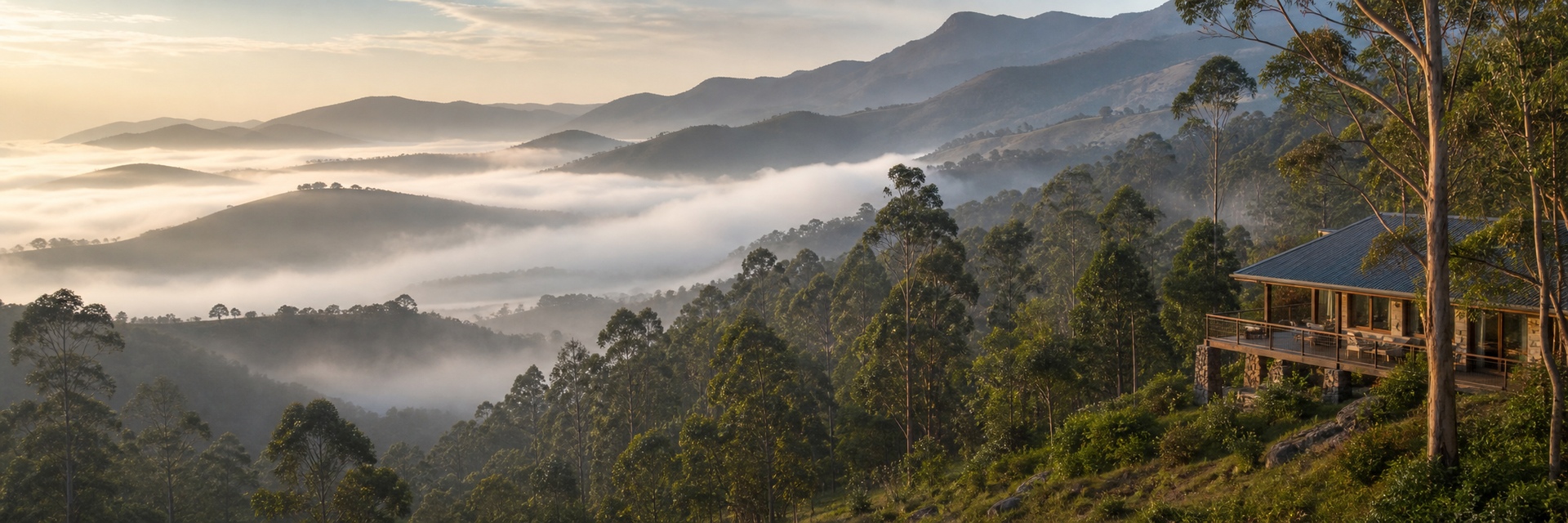
Horsley Hills is Andhra's answer to Ooty — eucalyptus, reserve forest and 1,265 metres of clean air an easy drive from Bengaluru and from the Tirupati pilgrim stream. Lambasingi, high in the Eastern Ghats above Chintapalli, is the only corner of South India where frost forms and temperatures brush freezing, a cold-climate novelty on the Vizag–Araku circuit. Neither has a single credible luxury wellness resort. We help owners move first on both — building genuinely clinical, climate-appropriate hill retreats and running them from concept through AYUSH, NABH, forest and tribal-land clearance to a stabilised opening.
First mover
Near-zero luxury wellness supply on either hill
~1,265 m
Horsley Hills — 'the Ooty of Andhra'
Near-freezing
Lambasingi — the only South Indian frost belt
Two markets
Bengaluru/Tirupati and Vizag/Araku, in one thesis
At a glance
Positioning
Cool-climate hill wellness — nature-cure, yoga, Ayurveda and forest/climate therapy on a greenfield frontier
Peak season
Horsley: pleasant year-round, Oct–Feb best; Lambasingi: Nov–Jan frost window is the demand spike
Signature modalities
Naturopathy & mud therapy (lead), yoga & meditation, Ayurveda, forest and climate therapy
Guest profile
Bengaluru weekenders, Tirupati pilgrim spillover, Vizag & Hyderabad HNI, Araku-circuit travellers
Typical asset
25–45 key eco-hill wellness retreat, low-impact, built on the reserve-forest fringe
Regulation
AYUSH, NABH, Clinical Establishment Act; plus AP forest/eco rules and — at Lambasingi — Fifth Schedule tribal land restrictions
The opportunity
Both hills are effectively empty of the product we build. Horsley Hills carries a handful of state-tourism cottages and modest resorts trading on the view and the cool air; Lambasingi runs on homestays, tented camps and day-trippers who drive up before dawn to photograph frost on the grass. Neither hill holds a single physician-led, properly clinical wellness resort. For an owner, that is the rarest thing in Indian wellness real estate — a first-mover position on a destination that already has a name and a following, but no supply worth the name.
The demand is not speculative, and it arrives from two different directions. Horsley Hills sits within a half-day of Bengaluru's enormous wellness-literate market and squarely beside Tirupati, where millions of pilgrims pass every year and a quiet, restorative hill an hour or two away is an obvious spiritual-tourism spillover. Lambasingi draws on Visakhapatnam and Hyderabad, and rides the established Vizag–Araku travel circuit, where the frost belt is a genuine novelty that already pulls weekend traffic the region cannot properly house.
The gap is identical on both hills: real natural assets and real footfall, met by accommodation that tops out at 'nice view, basic room'. Nobody has yet delivered altitude, forest and a serious nature-cure or Ayurveda operation together, at a standard that holds a paying wellness guest for a week. That is the category to create — and being first to create it is the whole thesis.
Two named hills with a following and near-zero credible supply. The opportunity is not to compete — it is to be the first serious wellness resort either hill has ever had.
Two hills, one cool-climate wellness thesis
Horsley Hills and Lambasingi are not one destination in two spellings — they are complementary micro-markets that share a cool-climate, nature-forward wellness premise and almost nothing else. The catchment, the season logic, the terrain and, critically, the land regime all fork by hill, and an owner should treat them as two deliberate bets rather than a single averaged one.
Horsley Hills is the softer, more accessible register: eucalyptus and reserve forest at a comfortable 1,265 metres, pleasant most of the year, feeding off Bengaluru's volume and Tirupati's pilgrim overflow. Lambasingi is the sharper, more remote proposition: higher, colder, deeper in the Eastern Ghats, with a genuine frost-and-freezing novelty no other South Indian site can claim — and a tougher access, forest and tribal-land reality to match.
| Dimension | Horsley Hills (Chittoor) | Lambasingi (Visakhapatnam) |
|---|---|---|
| Wellness premise | Eucalyptus air, reserve forest, gentle altitude, restorative calm | Cold-climate novelty, frost belt, dense Eastern Ghats forest |
| Lead modality | Naturopathy, yoga, Ayurveda in a nature frame | Nature-cure with climate and forest therapy as the hook |
| Catchment & guest | Bengaluru weekenders, Tirupati pilgrim spillover | Vizag & Hyderabad HNI, Araku-circuit travellers |
| Peak demand | Year-round pleasant; Oct–Feb the strongest | Nov–Jan frost window drives the visible spike |
| Defining constraint | Reserve-forest proximity, hill/eco rules, gradient | Fifth Schedule tribal (Agency) land, forest, remoteness |
Indicative contrast; refined against the specific plot and concept during the market study.
The guest & demand — cool air, frost and the pilgrim spillover
Horsley Hills is a proximity play. It sits close enough to Bengaluru that a wellness-fluent metro audience can reach it for a long weekend or a five-night reset, and close enough to Tirupati that the pilgrim economy — one of the densest religious-tourism flows in India — spills naturally toward a quiet hill for rest before or after the temple. That combination gives Horsley a broad, year-round demand base: metro detox-and-yoga guests, domestic HNI families wanting cool air, and a spiritually primed pilgrim audience already in a wellbeing frame of mind.
Lambasingi is a novelty-and-circuit play. Its draw is visceral and specific — the only place in South India where frost forms and the temperature can drop to near or below freezing — and that singularity already pulls weekenders up the Vizag–Araku route to see it. The frost window from roughly November to January is the visible demand spike, but the underlying asset is broader: coffee, apple and strawberry trials, dense forest, and an Eastern Ghats setting that suits forest-bathing and climate therapy across the cooler half of the year. The task is to convert a photograph-at-dawn day-tripper into a multi-night wellness guest.
Across both hills the guest is early-market and needs educating, which is a first-mover's advantage as much as a burden: there is no incumbent luxury brand shaping expectations, so a well-conceived resort defines what cool-climate Andhra wellness means. The programme design leans naturopathy and yoga — accessible, nature-led, low-intimidation entry points — with Ayurveda and forest/climate therapy layered for depth and length of stay.
- Horsley: Bengaluru long-weekend and detox demand, plus Tirupati pilgrim spillover primed for rest and wellbeing
- Lambasingi: the South Indian frost novelty (Nov–Jan spike) on the proven Vizag–Araku circuit
- Domestic HNI and metro wellness-seekers from Bengaluru, Hyderabad and Vizag across both hills
- First-mover latitude to define the category — no incumbent brand owns 'cool-climate Andhra wellness' yet
Modality fit — nature-cure, forest and climate therapy
The right clinical spine here is nature-cure led, not Ayurveda-first, because the hills sell what naturopathy sells: cool clean air, forest, water, diet and movement. Horsley's eucalyptus and reserve forest and Lambasingi's cold, misted Eastern Ghats both read as naturopathic assets before a single treatment room is built — hydrotherapy, mud therapy, therapeutic diet, sun and air baths, and yoga sit naturally in these settings, and they are the low-intimidation entry point an early market needs.
Climate and forest therapy are the differentiators the geography hands you for free. Lambasingi's frost belt is a genuine cold-climate wellness proposition of a kind no other South Indian resort can offer — cool-air conditioning of the body, brisk forest walks, warming therapies against the chill — while Horsley's gentler altitude supports restorative, breath-led and forest-immersion programming year-round. Ayurveda and Panchakarma belong in the mix as the deeper, longer-stay clinical layer, but as a complement to the nature-cure core rather than the headline the way a Kerala property would frame it.
- Naturopathy & mud therapy as the clinical lead — hydrotherapy, therapeutic diet, sun/air baths, yoga
- Forest therapy and guided immersion in reserve-forest and Eastern Ghats settings
- Climate therapy built on Lambasingi's cold-belt singularity and Horsley's gentle altitude
- Ayurveda & Panchakarma as the deeper, longer-stay clinical complement, not the headline
Let the land lead the medicine: nature-cure and forest therapy are what these hills already are, and Lambasingi's frost turns cold-climate wellness into a proposition no rival South Indian site can copy.
Regulation, forest and tribal-land realities
The clinical layer is the same national spine any serious wellness resort must clear: Ministry of AYUSH standards for the practice, physicians, therapists and pharmacy; NABH wellness / AYUSH accreditation to run a hospital-grade treatment operation rather than a spa menu; and registration under the Clinical Establishment Act for the medical dimension of the centre. On a first-mover site with no local precedent, designing to these standards from day one is what tells an early-market guest the operation is real.
The site regime is where these two hills turn genuinely distinctive, and it forks hard. Both sit against protected forest — Horsley's reserve forest and Lambasingi's dense Eastern Ghats — so Andhra Pradesh forest and eco rules, proximity buffers to reserve land, and the state's hill-area development norms govern what can be built and how close. The discipline on both is the same: build low-impact on the fringe, not inside the protected canopy, and treat the forest as the asset to be seen from and walked in rather than cut into.
Lambasingi carries a further constraint that reshapes the deal itself. Chintapalli falls within a Fifth Schedule / tribal 'Agency' area, where the Andhra land-transfer regime sharply restricts the sale of land to non-tribals and, in effect, protects tribal ownership. An owner cannot simply buy and build there as on open-market land; the viable routes run through long-lease structures, community and revenue-sharing models, and scrupulous engagement with local and tribal authorities. We resolve which regime a plot sits under — and, at Lambasingi, whether a defensible tenure structure even exists — before any capital is committed.
- Ministry of AYUSH standards for practice, physicians, therapists and pharmacy
- NABH wellness / AYUSH accreditation for a hospital-grade treatment operation
- Clinical Establishment Act registration for the medical dimension of the centre
- AP forest and eco rules, reserve-forest proximity buffers and hill-area development norms — build low-impact on the fringe
- Lambasingi: Fifth Schedule / tribal (Agency) area land-transfer restrictions — long-lease and community models, not open-market purchase
At Lambasingi the first question is not what to build but whether you can hold the land at all. Fifth Schedule tribal-area rules make tenure the deciding constraint, and it is resolved before design, not after.
Facility, design & procurement
The right building on both hills is low, light and climate-appropriate — an eco-hill resort that touches the ground gently, reads as belonging to the forest, and never fights the terrain. Reserve-forest proximity and hill-area norms push the whole design toward a low-density, fringe-sited footprint: villas and treatment pavilions stepped down the slope, minimal cut-and-fill, glazing turned to the eucalyptus at Horsley and the misted Ghats at Lambasingi, and the landscape doing as much of the wellness work as the built form.
The treatment programme is nature-cure-shaped and has to be planned from the drawing stage: hydrotherapy and mud-therapy suites with the drainage and water they demand, yoga and meditation shalas oriented to forest and dawn, physician consultation and diet-therapy space, and warm, sheltered indoor treatment areas that matter far more at frost-belt Lambasingi than in most Indian wellness builds. Cold-climate design is a real discipline here — thermal comfort, heating, insulation and warm water are not afterthoughts on a hill where the mercury drops toward freezing.
Procurement is a remoteness-and-climate exercise more than a coastal-corrosion one. Both hills sit at the end of winding hill roads with thin local supply chains, and Lambasingi's cold and damp add their own material demands — damp- and mould-resistant finishes, proper insulation, reliable heating and hot water, and robust off-grid-capable services where the grid is weak. We run the full programme — nature-cure and hydro apparatus, the AYUSH pharmacy and consumables, sattvic and therapeutic kitchens, FF&E and OS&E — specified for cold, damp, hill logistics, and leaned wherever possible on regional craft and low-impact local material rather than trucking everything up the ghats.
Talent & hiring map
Talent is the hardest single problem on a greenfield hill, and it is solved deliberately rather than assumed. Andhra Pradesh has a real base of naturopathy and yoga practitioners and AYUSH physicians to draw on, and the nature-cure lead we recommend plays to that regional strength; but neither hill has a resident luxury-hospitality labour pool, and both are remote enough that the plan has to combine local hiring with relocated specialists and a workable rotation for senior clinical and hospitality roles.
We build the team around that reality: a Chief Medical Officer or lead naturopath setting the clinical standard, a Wellness Director and General Manager fluent in a nature-cure, programme-led operation, and a therapist team with same-gender therapy built in as standard — anchored by local hiring and community employment, which at Lambasingi is not merely good practice but part of the social licence a tribal-area project depends on. Retention on a remote hill is its own discipline: housing, rotation, training and a genuine career path are what hold specialists through the first seasons, and — at Lambasingi especially — visible local employment is what keeps the surrounding community invested in the resort's success.
Gladwin's edge in Andhra's hill country
These two hills reward the operator who treats a greenfield frontier as an advantage and its constraints as solvable rather than fatal. That is where Gladwin works. As an India-headquartered executive-search firm, we draw on both our Healthcare & Life Sciences and Hospitality & Travel practices to assemble a team that does not exist locally — a lead naturopath or Chief Medical Officer setting the clinical standard, a luxury GM running the P&L around it, and a therapist and practitioner base built from Andhra's genuine nature-cure and AYUSH talent plus the relocated specialists a remote hill needs, with the rotation and retention plan to hold them.
We also carry the regulatory and tenure pathway from the start, because on these hills that pathway is the project's real risk. We design in the AYUSH, NABH and Clinical Establishment standards, resolve the AP forest and reserve-proximity rules so the build sits low-impact on the fringe, and — decisively at Lambasingi — establish whether a Fifth Schedule tribal-area plot can be held at all through long-lease or community structures before a rupee of capital moves. One accountable partner, from a first-mover hill plot with no precedent to a stabilised opening on a category the hill has never had.
- Build a leadership and clinical team a greenfield hill cannot supply — nature-cure lead, luxury GM, relocated and local talent, retained through the first seasons
- Design in the AYUSH, NABH and Clinical Establishment pathway from day one on a site with no local precedent
- Resolve AP forest, reserve-proximity and hill-area rules — low-impact, fringe-sited, climate-appropriate building
- Establish defensible tenure at Lambasingi under Fifth Schedule tribal-land rules — long-lease and community models — before capital commits
Planning a resort here?
We take single accountability from concept to a stabilised opening — market and pricing strategy, design, procurement, and the full leadership and expert team hired.
Speak with a partnerHorsley Hills & Lambasingi — frequently asked questions
They are Andhra's two emerging cool-climate hill escapes, and both are near-empty of credible luxury supply — a genuine first-mover position. Horsley Hills, 'the Ooty of Andhra' at ~1,265 metres, feeds off Bengaluru and the Tirupati pilgrim spillover; Lambasingi, 'the Kashmir of Andhra', is the only South Indian frost belt and rides the Vizag–Araku circuit. They share a cool-climate, nature-forward wellness premise but differ in catchment, terrain and land regime, so an owner picks the hill deliberately — or backs both as complementary bets.
Lambasingi is the one place in South India where frost forms and temperatures occasionally drop to near or below freezing — a cold-climate singularity no other southern resort can claim. That supports genuine climate and forest therapy across the cooler months and a visible demand spike in the frost window of roughly November to January. The task is to convert the dawn day-tripper who drives up to see the frost into a multi-night wellness guest, which a serious resort with warm, well-designed cold-climate facilities can do.
Nature-cure leads: naturopathy and mud therapy, hydrotherapy, therapeutic diet, sun and air baths, and yoga all sit naturally in Horsley's eucalyptus-and-reserve-forest setting and Lambasingi's cold Eastern Ghats. Forest and climate therapy are the differentiators the geography hands you — especially Lambasingi's frost belt. Ayurveda and Panchakarma belong in the mix as the deeper, longer-stay clinical layer, but as a complement to the nature-cure core rather than the headline a Kerala property would lead with.
Both hills carry the national clinical spine — AYUSH, NABH and Clinical Establishment Act — plus AP forest and eco rules and reserve-forest proximity buffers that push the build low-impact onto the fringe rather than into protected canopy. Lambasingi adds a decisive constraint: Chintapalli sits in a Fifth Schedule tribal 'Agency' area where land transfer to non-tribals is sharply restricted. That usually rules out open-market purchase and points instead to long-lease, community and revenue-sharing structures. We establish whether defensible tenure exists before any capital is committed.
It is the hardest single problem and it is solved deliberately. Andhra Pradesh has a real base of naturopathy, yoga and AYUSH practitioners the nature-cure lead plays to, but neither hill has a resident luxury-hospitality workforce. We combine local hiring — which at Lambasingi is part of the tribal-area social licence — with relocated specialists and a workable senior rotation, then build the housing, training, career path and retention plan that holds a team through the first seasons on a remote hill.
Yes — as one accountable partner. We run positioning and the market study, the AYUSH / NABH / Clinical Establishment pathway, the AP forest and reserve-proximity site work and — at Lambasingi — the Fifth Schedule tenure question, low-impact climate-appropriate design of the treatment and nature-cure facilities, procurement specified for cold, damp and hill logistics, and the full leadership and clinical team hired, relocated and trained through a stabilised opening on a category neither hill has had before.
Related
Explore the rest of the cluster
Wellness modality · Traditional Eastern
Naturopathy & Mud Therapy
Drugless, nature-cure healing — accessible, programme-friendly and uniquely Indian.
Wellness modality · Traditional Eastern
Yoga & Meditation
India's birthright modality — and the easiest to do badly.
Wellness modality · Traditional Eastern
Ayurveda & Panchakarma
India's most valuable wellness asset — if it is authentic, and run as one.
Destination · Andhra Pradesh · Eastern Ghats coffee hills
Araku Valley
Organic coffee, high-Ghats air and Adivasi country: a clean, remote nature-cure destination with almost no luxury supply.
Destination · Telangana · Forest hills near Hyderabad
Ananthagiri Hills
Telangana's first serious luxury-wellness play: a forest digital-detox two hours from a wealthy, underserved Hyderabad.