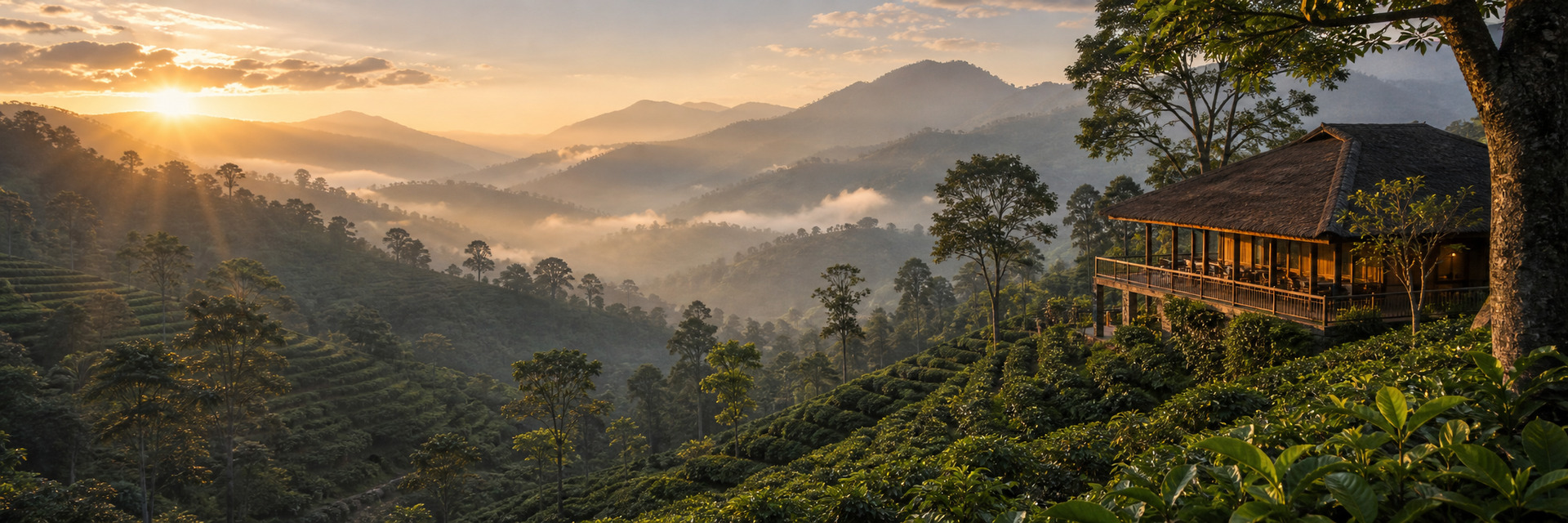
Destination · Andhra Pradesh · Eastern Ghats coffee hills
Luxury Wellness Resorts in Araku Valley
Organic coffee, high-Ghats air and Adivasi country: a clean, remote nature-cure destination with almost no luxury supply.
Araku is one of the last genuinely blank pages in Indian wellness — an award-winning organic-coffee valley in the Eastern Ghats, four hours by the Kirandul railway or the Borra Caves road from Visakhapatnam, with tribal culture, waterfalls and forest but effectively no luxury resort to its name. That emptiness is the opportunity and the discipline: the land is Adivasi Agency country under the Fifth Schedule, so a resort here is built through long lease and community partnership, not open-market purchase. We help owners read that constraint correctly and build a naturopathy-led, unmistakably Araku wellness property on it — from concept through AYUSH and clinical accreditation, a low-impact build and hiring, to a stabilised opening.
First-mover
Near-zero luxury supply in the whole valley
~110 km
From Visakhapatnam by the scenic Kirandul railway
Award coffee
Araku organic coffee — feted at the Prix Épicures, Paris
Fifth Schedule
Tribal Agency land — lease and partnership, not purchase
At a glance
Positioning
Organic-coffee-hill nature cure — naturopathy and Ayurveda in a remote Eastern Ghats forest frame
Peak season
Oct–Feb cool-dry window; the monsoon greens the valley but roads and rail govern access
Signature modalities
Naturopathy & mud therapy (lead), yoga & meditation, Ayurveda, tribal-eco and forest immersion
Guest profile
Vizag and Hyderabad HNI, urban South-Indian detox seekers, conscious-travel and slow-tourism guests
Typical asset
20–40 key low-density eco-wellness retreat on or beside a working coffee estate
Land & tenure
Fifth Schedule Agency area — 1/70 Regulation restricts non-tribal purchase; developed by lease / community JV
The opportunity
Araku is that rare thing in Indian hospitality — a destination with a real, ownable story and almost no serious supply to tell it. The valley already has global equity most new resort locations would spend a decade building: its organic, shade-grown tribal coffee has won on the world stage, taking honours at the Prix Épicures in Paris, and the name carries a clean, high-altitude, forest-and-Adivasi association that reads as wellness before a treatment room is drawn. Yet the accommodation on the ground is state guesthouses, homestays and a thin band of mid-market hotels. The luxury tier is empty.
The access story has quietly turned in Araku's favour. The Kirandul line from Visakhapatnam — tunnels, viaducts and the descent past the Borra Caves — is one of India's most beautiful rail journeys and a reason to come in itself, while the ghat road puts the valley within a comfortable drive of a coastal city and its airport. A guest can arrive by a route that is part of the experience, which very few hill-wellness destinations can claim.
The gap, then, is not demand or story but format. Araku has been sold as a day trip and a coffee-and-waterfalls weekend; no one has built the deep, physician-led, genuinely comfortable nature-cure retreat the setting invites. The first property to do it — organic, remote, low-impact and clinically credible — defines the category rather than competing inside it.
Araku has world-class coffee equity and a beautiful way in, but no luxury resort at all. The first serious nature-cure retreat here writes the category, it doesn't join one.
The wellness proposition — coffee, altitude and nature cure
Araku's proposition is not classical destination-Ayurveda transplanted to a hill; it is a nature-cure destination in its own right, and it should be built as one. The raw materials are unusually aligned: cool high-Ghats air, spring water, forest quiet, organic food grown in the valley, and a working coffee landscape that gives the whole stay a sense of place and a set of experiences no spa can manufacture. That is the exact terroir naturopathy and Panchakarma-style detox thrive in — a clean environment where the setting does half the therapeutic work.
The coffee is the differentiator, and it should run through the wellness programme rather than sit beside it as a gift-shop note. Estate walks and harvest immersion, the story of shade-grown organic cultivation, the antioxidant and ritual dimension of coffee handled with restraint — all of it gives Araku a signature that Kerala, Rishikesh or the naturopathy heartland of coastal Karnataka simply do not have. The property that owns 'organic-coffee-hill nature cure' owns a phrase no competitor can honestly repeat.
The valley's terroir is the treatment. Clean air, spring water, organic food and a working coffee estate do half the therapeutic work before a single therapy begins.
Modality fit — naturopathy-led, not Ayurveda-first
Getting the modality mix right is the single most important concept decision in Araku, and the honest answer is that this is naturopathy country first. Nature cure — hydrotherapy, mud therapy, therapeutic diet, fasting and detox, sun and air treatment — maps directly onto what the valley naturally offers, and it carries none of the origin-authenticity burden that Ayurveda drags into a non-Kerala hill. Yoga and meditation belong at the core alongside it: the forest, the altitude and the silence make Araku an obvious retreat setting for structured practice, digital detox and breathwork.
Ayurveda has a real place, but as a supporting register rather than the headline. A physician-led Ayurveda and Panchakarma wing adds clinical depth and a familiar programme for guests who want it, and it pairs naturally with naturopathy under one wellness governance. The layer that makes the whole thing unrepeatable is the tribal-eco and forest-immersion dimension — respectful, well-designed Adivasi cultural and craft experiences, guided forest and coffee-estate immersion, and food built on indigenous millets and produce. That is the modality no other Indian wellness destination can offer, and it should be designed with the community rather than performed at it.
- Naturopathy & mud therapy as the lead — hydrotherapy, therapeutic diet, fasting, detox
- Yoga & meditation at the core — forest retreat, digital detox, breathwork, silence
- Ayurveda & Panchakarma as a physician-led supporting wing, not the headline claim
- Tribal-eco and forest immersion — the signature layer, designed with the community
The guest & demand
Araku's near-term wellness guest is domestic and reachable, and that is a strength rather than a compromise. Visakhapatnam is a growing coastal city on the doorstep, and Hyderabad sits within easy reach — two pools of HNI and upper-middle professionals who already know Araku as a weekend name and are ready to be sold a deeper reason to stay. Layer on the pan-South-Indian detox and slow-travel market — Bengaluru, Chennai — that already fills naturopathy retreats elsewhere, and the demand base is real without needing a single international arrival to underwrite the model.
The stay shape follows the market. Expect three-to-seven-night restorative and detox stays as the core, with a shorter coffee-and-nature discovery visit feeding first-timers toward proper wellness programmes, and a growing conscious-travel and experiential segment drawn by the organic, low-impact, tribal-eco story. The international guest is upside, not the foundation — the responsible, remote-nature positioning will in time attract the wellness traveller who seeks exactly this kind of undiscovered place, but the property should be built to profit on domestic demand first and treat inbound as the margin on top.
- Vizag and Hyderabad HNI — a weekend name ready to be sold a deeper stay
- Pan-South-Indian detox and naturopathy seekers from Bengaluru and Chennai
- Conscious-travel and slow-tourism guests drawn by the organic, tribal-eco story
- International wellness travellers as upside — the model profits on domestic demand first
Land, tenure & regulation — the Fifth Schedule reality
Araku's defining constraint is not ecology or altitude — it is land tenure, and it must be understood before any other decision. The valley sits inside a Scheduled (Agency) area under the Fifth Schedule of the Constitution, tribal country where the Andhra Pradesh Land Transfer Regulation — the 1/70 Act — restricts the transfer of land to non-tribals and limits entry and open-market purchase. A developer cannot simply buy an estate here the way one would on the plains or the coast. Get this wrong and there is no project; get it right and the barrier that stops everyone else becomes the moat that protects the first mover.
The workable path is tenure by partnership: long-lease structures, community and tribal-cooperative joint ventures, revenue-share and employment-anchored models, and development on land held or assigned in ways the Regulation permits — always with genuine, documented community benefit rather than a device to route around the law. This is slower and more relationship-heavy than a normal acquisition, and it is exactly the work that separates a resort that opens from a plot that never clears title. We treat it as the first workstream, not a downstream legal formality.
On top of tenure sit the ecological and clinical regimes. The Eastern Ghats bring forest, eco-sensitive-zone and environmental-clearance constraints that cap density, height and footprint and push the whole build toward low impact. The wellness operation then answers to the national frame every serious property does — Ministry of AYUSH standards for naturopathy and Ayurveda practice and pharmacy, NABH wellness / AYUSH accreditation for a hospital-grade treatment operation, and registration under the Clinical Establishment Act for the medical dimension of the centre. We resolve tenure, ecology and clinical licensing as one interlocking pathway before capital is committed.
| Layer | What governs | Planning implication |
|---|---|---|
| Land & tenure | Fifth Schedule Agency area; AP LTR 1/70 Regulation | No open-market purchase — long lease / community JV, documented benefit |
| Ecology | Eastern Ghats forest & eco-sensitive-zone, environmental clearance | Low-density, low-height, low-footprint build; clearances up front |
| Clinical practice | Ministry of AYUSH standards for naturopathy & Ayurveda | Physician-led operation, qualified staff, compliant pharmacy |
| Accreditation & medical | NABH wellness / AYUSH; Clinical Establishment Act | Hospital-grade treatment governance and registration |
Indicative regime; resolved against the specific site, community and concept during the feasibility phase.
The 1/70 Regulation stops open-market purchase — so it also stops your competitors. Handled as genuine community partnership, tribal-land tenure is Araku's real barrier to entry.
Facility, design & procurement
The build brief here is low-impact by law and by story, and the two align. Density, height and footprint are capped by the eco-sensitive setting, so the answer is a low-rise, dispersed retreat — a small key count of villas and cottages threaded into the coffee estate and forest rather than a mass on a slope. The treatment wing is the heart of it: a naturopathy and hydrotherapy block with the mud-therapy, immersion, wet and steam areas that nature cure demands, a yoga and meditation shala oriented to the valley, and a compact physician-led Ayurveda and Panchakarma suite as the supporting register. All of it drainage-heavy, moisture-controlled and planned from the drawing stage, not retrofitted.
The architecture should read as Eastern Ghats, not as a generic hill resort or a borrowed Kerala vernacular. Local stone and timber, earthen and lime finishes, pitched roofs for the monsoon, deep verandahs and generous glazing to the coffee slopes, and material and craft drawn from Adivasi tradition handled with restraint and credit. The estate itself — coffee, pepper, silver-oak shade, native planting — does as much design work as the building, and the lightest touch reads as the most luxurious in a place guests come to for exactly this.
Procurement is a remoteness-and-damp exercise. The ghat road and the single rail line govern the build calendar and every heavy delivery; the high-Ghats damp and monsoon force mould- and moisture-resistant finishes, robust drainage and corrosion-aware specification. We run the full programme — naturopathy and hydrotherapy apparatus, mud-therapy and wet areas, the Ayurvedic pharmacy and consumables, an organic and native-produce kitchen supply anchored in the valley's own coffee, millets and forest food, FF&E and OS&E — specified for the hill, sourced with local and tribal craft wherever it genuinely can be, and sequenced around access windows so the site is not stranded mid-monsoon.
Talent & the practitioner pool
Staffing Araku is the honest hard part, and it should be planned as such rather than assumed away. This is a remote valley with no existing luxury-hospitality labour market and no local pool of naturopaths, Ayurvedic physicians or trained therapists to draw on. The clinical team is therefore a build: relocated naturopathy and Ayurveda physicians and senior therapists, recruited from Andhra Pradesh's own institutions and the wider South-Indian naturopathy and AYUSH networks, brought in on relocation and rotation terms that make a remote posting attractive and durable.
The counterweight — and the ethical core of the model — is local employment. A resort built on tribal Agency land carries a real obligation and a real advantage in hiring and training from the surrounding Adivasi communities: hospitality, estate, guiding, kitchen, wellness-support and craft roles filled and progressed locally, with structured training that turns first jobs into careers. That is both the right thing under a community-partnership tenure and the thing that makes the property's tribal-eco story true rather than decorative. We build the team around this seam — relocated clinical and hospitality leadership over a locally recruited and trained workforce — and design the retention and rotation plan that holds it through the first seasons in a place this far from a city.
- Relocated naturopathy and Ayurveda physicians and senior therapists on rotation terms
- Recruited from AP institutions and the wider South-Indian AYUSH and naturopathy networks
- Local Adivasi employment and training as obligation and advantage — careers, not just jobs
- A retention and rotation plan built for genuine remoteness and no local luxury labour market
Gladwin's edge in Araku
Araku rewards a partner who treats its hardest constraint as its greatest asset, and that is precisely how we approach it. The Fifth Schedule tenure that blocks open-market purchase is not a problem to be waved through — it is the barrier that protects whoever gets it right, and structuring genuine long-lease and community-partnership models, with documented benefit to the Adivasi communities, is the first and most important workstream. We run tenure, Eastern Ghats ecological clearance, and the AYUSH, NABH and Clinical Establishment pathway as one interlocking process, so the project clears its real risks before capital is committed rather than after.
On talent, Araku demands exactly the two-sided build we are built for. As an India-headquartered executive-search firm, we draw on our Healthcare & Life Sciences and Hospitality & Travel practices to relocate the naturopathy and Ayurveda clinical leadership and luxury hospitality management a remote valley cannot supply locally — then design the local Adivasi hiring, training and retention that makes the community-partnership real and the tribal-eco story honest. One accountable partner, from a leased coffee-estate plot in a first-mover valley to a stabilised opening.
- Structure Fifth Schedule / 1/70 tenure as genuine long-lease and community partnership
- Resolve Eastern Ghats eco-sensitive-zone and clearance constraints into a low-impact build
- Design in the AYUSH, NABH and Clinical Establishment pathway for a naturopathy-led operation
- Relocate clinical and hospitality leadership over a locally recruited, trained Adivasi workforce
Planning a resort here?
We take single accountability from concept to a stabilised opening — market and pricing strategy, design, procurement, and the full leadership and expert team hired.
Speak with a partnerAraku Valley — frequently asked questions
Because it is a genuine first-mover: an award-winning organic-coffee valley in the Eastern Ghats with real story equity — its coffee has been honoured at the Prix Épicures in Paris — a beautiful rail-and-road approach from Visakhapatnam, and effectively no luxury supply. Araku has been sold as a coffee-and-waterfalls day trip; no one has built the deep, physician-led nature-cure retreat the setting invites. The first serious property defines the category rather than competing inside it.
Generally not on the open market. Araku sits in a Fifth Schedule Agency area, where the Andhra Pradesh Land Transfer Regulation — the 1/70 Act — restricts transfer of land to non-tribals. A resort here is developed through long-lease structures and genuine community or tribal-cooperative partnerships with documented local benefit, not a straightforward purchase. That constraint is also the moat: it is the first workstream we run, and it stops competitors as surely as it disciplines you.
Naturopathy first, not Ayurveda-first. Nature cure — hydrotherapy, mud therapy, therapeutic diet, fasting and detox — maps directly onto Araku's clean air, spring water, organic food and coffee terroir, with yoga and meditation at the core. A physician-led Ayurveda and Panchakarma wing adds depth as a supporting register, and respectful tribal-eco and forest immersion is the signature layer no other Indian wellness destination can offer.
The near-term guest is domestic and reachable — Vizag and Hyderabad HNI who already know Araku as a weekend name, plus the pan-South-Indian detox and slow-travel market from Bengaluru and Chennai. Stays run three to seven nights around restorative and detox programmes. International wellness travellers are upside drawn by the remote, organic, tribal-eco story, but the model is built to profit on domestic demand first, not to depend on inbound.
It is the genuine challenge, and we plan for it directly. Araku has no local luxury-hospitality labour market and no local pool of naturopaths or therapists, so the clinical and management team is relocated from AP institutions and the wider South-Indian AYUSH networks on rotation terms. The counterweight is local Adivasi employment and training — an obligation under community-partnership tenure and the thing that makes the tribal-eco story true — with a retention plan built for the remoteness.
Yes — as one accountable partner. We run positioning and feasibility, the Fifth Schedule / 1/70 tenure and community-partnership structuring, Eastern Ghats ecological clearance, the AYUSH / NABH / Clinical Establishment pathway, place-rooted low-impact design of the naturopathy and treatment wings, remoteness-and-damp-specified procurement, and the relocated clinical and hospitality leadership hired over a locally recruited, trained workforce, through a stabilised first season.
Related
Explore the rest of the cluster
Wellness modality · Traditional Eastern
Naturopathy & Mud Therapy
Drugless, nature-cure healing — accessible, programme-friendly and uniquely Indian.
Wellness modality · Traditional Eastern
Yoga & Meditation
India's birthright modality — and the easiest to do badly.
Wellness modality · Traditional Eastern
Ayurveda & Panchakarma
India's most valuable wellness asset — if it is authentic, and run as one.
Destination · Andhra Pradesh · Bay of Bengal coast
Visakhapatnam Coast
Where the Eastern Ghats meet the Bay of Bengal: sea-led thalassotherapy and an urban-adjacent longevity crossover on Andhra's rising coast.
Destination · Andhra Pradesh · Emerging hill escapes
Horsley Hills & Lambasingi
Two greenfield Andhra hill escapes, near-zero luxury supply: cool-climate wellness on a genuine first-mover frontier.