Destination · North Kerala coast
Luxury Wellness Resorts in Bekal & North Kerala
Kerala's Ayurveda, without the crowd: the uncrowded Malabar coast of Bekal, Nileshwar and the Valiyaparamba backwaters.
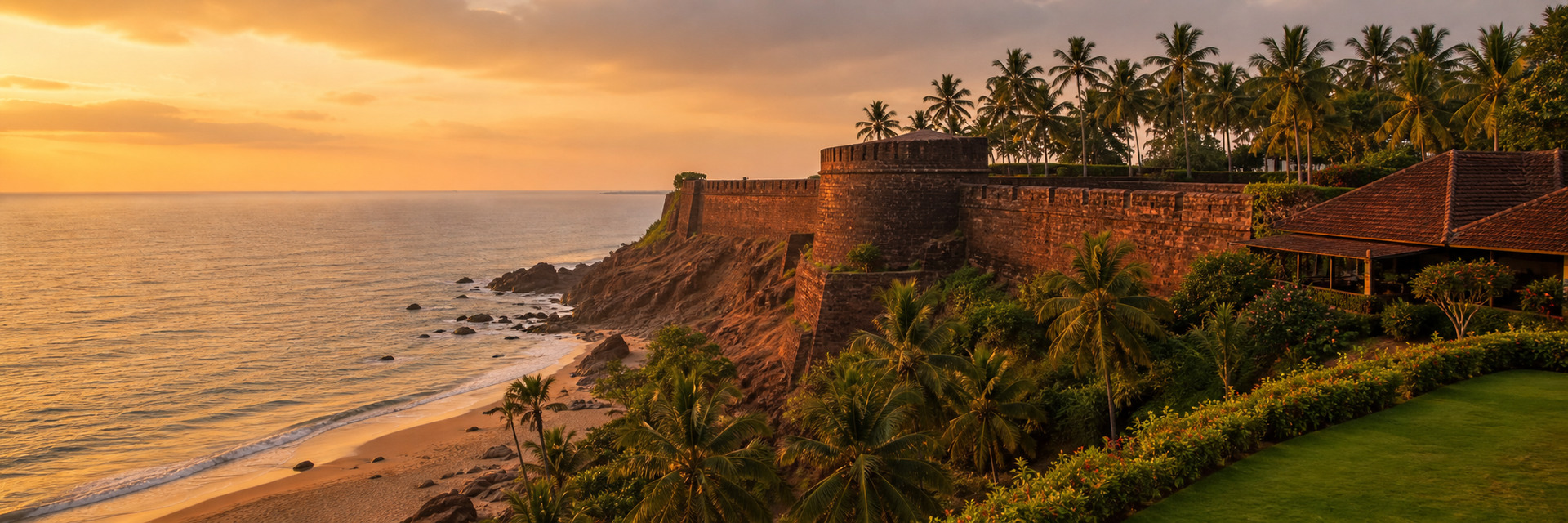
South Kerala taught the world that a European will fly in for a month of physician-led Panchakarma. Bekal and the North Malabar coast offer that same authentic Kerala Ayurveda on a quieter, emptier, more exclusive shore — the largest fort in the state, long unbuilt beaches, the Valiyaparamba backwaters and theyyam ritual country, now opened up by Kannur International Airport. We help owners plant genuinely clinical, unmistakably Keralan luxury-wellness resorts on this emerging coast — and run them from concept through the state's own Ayurveda classification, build and hiring to a stabilised opening.
First mover
Luxury-Ayurveda whitespace on an emerging coast
Kannur 2018
New international airport opening the North Malabar frontier
Green Leaf
Kerala's own Ayurveda-centre classification
Karkidaka peak
Monsoon Jun–Sep sold as the Ayurveda season
At a glance
Positioning
Authentic physician-led Kerala Ayurveda on a quieter, more exclusive coast than the crowded south
Peak season
Oct–Mar international winter escape; Jun–Sep monsoon 'Karkidaka' as the Ayurveda peak
Signature modalities
Ayurveda & Panchakarma (lead), naturopathy & mud therapy, yoga & meditation
Guest profile
European long-stay Panchakarma guests, repeat patients, domestic HNI, Gulf NRI
Typical asset
25–50 key wellness resort — beach-Ayurveda house or Valiyaparamba backwater retreat
Access & classification
Kannur International Airport (2018); Green Leaf / Olive Leaf, AYUSH, NABH, Clinical Establishment Act
The opportunity
The North Malabar coast has always had the same Ayurveda as the south — the same physicians, the same lineages, the same monsoon logic — but almost none of the destination-resort supply. For decades that was a function of access: the airport was hours away and the coast stayed a domestic secret. Kannur International Airport, open since 2018, closed that gap. For the first time a European Panchakarma guest can land within an hour or two of Bekal, Nileshwar and the Valiyaparamba backwaters, and the coast that had authenticity but no reach suddenly has both.
What that unlocks is a genuinely rare thing in Kerala wellness: whitespace. The south-Kerala Ayurveda coast around Kovalam and the backwaters is proven but increasingly crowded — the model works, and everyone is now on it. Bekal offers the identical proposition on an emptier shore: Kerala's largest fort standing over long, unbuilt beaches, backwater lagoons behind them, and a folk-ritual culture — the theyyam — that no southern resort can claim. A serious luxury property here does not have to out-shout an established cluster; it can define the category on a coast that has never had one.
The gap to fill is the one Kerala always presents, just with less competition. There is credible-but-basic clinical Ayurveda at one end, spa-Ayurveda hotels badging the word at the other, and very little that is authentically physician-led and genuinely luxurious at once. On this coast that combination — southern-grade Panchakarma rigour delivered with real comfort, clinical governance and a shore no one else has built on — is not just open, it is unclaimed.
The south invented destination-Ayurveda and is now crowded with it. Bekal has the same medicine, an emptier coast and a new airport — the model has arrived, and the luxury version has not yet been built.
The North Malabar coast as a wellness address
Bekal is not a single beach but a stretch of North Malabar wellness geography, and the concept forks by where on it the plot sits. The three registers — the fort-and-beach coast of Bekal and Kasaragod, the Nileshwar and Valiyaparamba backwater belt, and the theyyam-and-heritage hinterland toward Kannur — share one Ayurveda heritage but sell three subtly different stays, and an owner should choose deliberately.
The Bekal beach register is the classical one: long open sands under the fort, the sea and the season, and the closest analogue to the proven southern beach-Ayurveda model, only quieter. The Valiyaparamba backwater register is the serenity play — palm-fringed lagoons, houseboat calm and near-total seclusion, a setting that reads as restorative before treatment begins and suits longer stays. The Kannur-side hinterland adds cultural depth: theyyam ritual, weaving and toddy-tapping Malabar life that turns a wellness stay into a place, not just a programme.
| Register | Wellness premise | Guest & stay |
|---|---|---|
| Bekal beach & fort | Open sands, the sea, the season, heritage backdrop | European long-stay Panchakarma; the proven southern model, quieter |
| Valiyaparamba backwaters | Lagoon serenity, seclusion, near-total quiet | Longer restorative stays; repeat patients seeking privacy |
| Kannur cultural hinterland | Theyyam ritual, Malabar craft and heritage depth | Culturally curious HNI; shorter stays feeding longer courses |
Indicative contrast; refined against the specific plot and concept during the market study.
The guest & demand — authentic Ayurveda without the crowd
The North Malabar wellness guest is the same archetype that built south Kerala's market, sought on a coast that offers them something the south increasingly cannot: space. The core is a European — British, German, French, Nordic — who comes for a serious Panchakarma course, stays two to four weeks and returns. That base is longer-staying, higher-yielding and far stickier than domestic weekend traffic, and it rests on a claim the guest can verify: this is real Kerala Ayurveda, the same lineages as the south, not a spa word. The privacy and emptiness of Bekal are not a compromise for that guest — they are the upgrade. Domestic HNI and Gulf-NRI demand rounds it out, drawn by proximity to Kannur and Mangaluru and by a shorter naturopathy-and-yoga stay that converts newcomers into Ayurveda.
The distinctive Kerala move applies here in full: selling the monsoon. Ayurvedic tradition holds the cool, humid rains to be the ideal window for Panchakarma, when the body absorbs oils and treatment best. Karkidaka-month therapy (roughly June to September) turns the off-season into a genuine peak with its own rate line and European following — and on an uncrowded coast the monsoon serenity is more, not less, appealing. A serious property here designs for two demand shapes at once, the October–March winter escape and the monsoon-Ayurveda season, so the calendar is fuller than any dry-season resort can manage.
- European long-stay Panchakarma base — the south's proven engine, sought on a quieter coast
- Privacy and emptiness as the upgrade, not the compromise, for the long-stay wellness guest
- Karkidaka monsoon (Jun–Sep) sold as the Ayurveda peak, not a closure
- Domestic HNI and Gulf NRI via Kannur and Mangaluru: shorter nature-wellness and detox stays
Pricing & commercial model
The economics are programme-led, not nightly-rate-led. A Bekal Ayurveda resort earns most of its revenue and nearly all its margin from multi-week all-inclusive Panchakarma journeys, where the room is bundled into a physician-supervised programme rather than sold à-la-carte. We model length-of-stay, repeat-guest value and treatment-revenue dominance first, and scale clinical capacity — consultation rooms, Panchakarma theatres, therapist rosters — to the programme plan rather than to key count.
The first-mover position is itself a commercial lever. On an emerging coast with no established luxury-Ayurveda comparable, a genuinely credible property sets the reference rate rather than discounting into an existing one — and the scarcity of the shore, the seclusion of the backwaters and the heritage of the fort all support a premium the crowded south can no longer command as easily. Across the year the monsoon carries its own Karkidaka rate line, so the model is built to earn across three windows — winter escape, shoulder and monsoon-Ayurveda — instead of one.
| Revenue line | Model | Planning note |
|---|---|---|
| Panchakarma programmes | 14–28 night all-inclusive, physician-led | Primary revenue & margin; design theatres to it |
| Nature & detox stays | 5–10 night naturopathy/yoga intros | Feeder to longer classical courses; converts newcomers |
| Monsoon Karkidaka season | Dedicated Jun–Sep rate line | Turns off-season into a third earning window |
| First-mover premium | Reference-rate setting on an unbuilt coast | Scarcity and seclusion support price, not discount |
Indicative structure; modelled to the specific asset, site and brand.
Classification & regulatory realities
Kerala is the one state that classifies Ayurveda centres itself, and credibility in this market runs through that classification just as firmly on the North Malabar coast as in the south. Kerala Tourism operates the 'Green Leaf' and 'Olive Leaf' certification for Ayurveda centres — Green Leaf the premium tier, Olive Leaf the standard one — grading facilities, physician and therapist qualifications, hygiene and treatment standards. For the European guest choosing a Panchakarma property on an unfamiliar coast, the Green Leaf is the recognised signal of authenticity that substitutes for an established local reputation, and we design the facility and staffing to earn it from the outset rather than retrofit toward it.
The clinical layer sits on top: Ministry of AYUSH standards for Ayurveda practice and pharmacy, NABH wellness / AYUSH accreditation for a hospital-grade treatment operation, and registration under the Clinical Establishment Act for the medical dimension of the centre. These are not optional polish on a serious property — they are what separate a licensed, physician-led operation from a spa menu, and what let a resort hold a long-stay clinical guest on a coast where no one has done it before.
The site regime is where Bekal differs from the southern coast. The Coastal Regulation Zone governs everything near the water — a No Development Zone and setbacks from the High Tide Line, cleared through the Kerala Coastal Zone Management Authority (Kerala CZMA) — and on this coast the CRZ line is complicated by the Valiyaparamba backwaters and estuarine mouths, which bring their own tidal-influence classification. Move a plot inland and a second regime takes over: the Kerala Conservation of Paddy Land and Wetland Act, which restricts the conversion of paddy and wetland to built use and can decide whether a backwater-edge site is developable at all. Salt-laden air and high monsoon humidity round out the physical reality. We resolve which regime — or which combination — a plot sits under before capital is committed.
- Kerala Tourism 'Green Leaf' / 'Olive Leaf' Ayurveda-centre classification — designed for from day one
- Ministry of AYUSH standards for practice, physicians, therapists and pharmacy
- NABH wellness / AYUSH accreditation for a hospital-grade treatment operation
- Clinical Establishment Act registration for the medical dimension of the centre
- Coastal Regulation Zone, High Tide Line setback and Kerala CZMA clearance on the beach and backwater edge
- Kerala Conservation of Paddy Land & Wetland Act on inland and backwater-fringe plots
The Green Leaf is not marketing in Kerala — on an unbuilt coast it is the authenticity the international guest reads in place of a local reputation, and it is designed into the facility, not applied for afterward.
Facility, design & procurement
The treatment wing is the building here, not an amenity bolted to the side. A credible property needs Ayurveda-hospital-grade clinical space — physician consultation rooms, dedicated Panchakarma theatres, and the wet, humid, drainage-heavy therapy areas that classical treatment demands, laid out to Green Leaf and NABH logic. The signature apparatus is unmistakable and has to be planned for from the drawing stage: the Droni (the carved wooden treatment table for oil therapies), Shirodhara rigs, steam and swedana chambers, and the on-site medicinal-oil pharmacy that keeps a long-stay programme supplied.
The architecture should be as Malabar as the medicine. The nalukettu courtyard house handled with restraint, sloping Mangalore-tiled roofs pitched for the rain, laterite — the region's own warm stone — reclaimed timber and deep verandahs read as authentic to a guest who has come precisely for the place. On the Bekal beach the vernacular meets open sand and the fort's laterite mass; on the Valiyaparamba backwaters it meets water, stilted decks and jetties, with the lagoon and the palms doing as much as the building. Theyyam colour and Malabar craft — weaving, brass, coir — give the interiors a specificity the south does not have.
Procurement is a humidity-and-water exercise. The coast's brackish, salt-laden air and the backwaters' estuarine damp force corrosion-rated ironmongery, mould- and damp-resistant finishes, generous drainage and moisture-controlled treatment rooms; the Karkidaka monsoon that fills the beds also governs the build calendar. We run the full programme — Panchakarma apparatus, the medicinal-oil pharmacy and consumables supply chain, hydro and wet areas, the sattvic and Ayurvedic kitchens, FF&E and OS&E — specified for salt, water and monsoon, and for backwater-edge logistics where jetty and boat access replace the road, leaning on North Malabar's genuine strength in laterite, timber, coir and handloom.
Talent & hiring map
Kerala's real moat is its people, and the North Malabar physician and therapist tradition is as deep as the south's — the same vaidya lineages, the same training, the same clinical seriousness, historically exported to the southern resorts and to the Gulf rather than employed at home. Planting a serious property here can draw that talent back to its own coast. The clinical pool is genuinely available; the harder hire is the one Kerala always presents — luxury-hospitality leadership that respects clinical primacy and runs a premium P&L around a Chief Ayurvedic Physician rather than overriding them.
We build the team around that seam: a General Manager and Wellness Director fluent in a long-stay, programme-led operation, paired with the Chief Ayurvedic Physician, the vaidyas, and a therapist team with same-gender therapy built in as standard. The retention task is specific to the state and sharper on this coast — North Malabar's best physicians and therapists are pulled hard by Gulf and out-of-state migration, and the region's very proximity to Gulf recruitment makes it acute — so the hiring plan is designed to attract, train and hold that talent through the first winter and monsoon seasons the model is built to win. The emerging-coast location adds a relocation, housing and rotation layer an established cluster does not.
Gladwin's edge in North Kerala
Bekal turns on the same rare hire the rest of Kerala does, on a coast where nobody has assembled it yet: luxury-hospitality leadership that defers to clinical authority instead of overriding it, sitting over a deep but heavily-poached North Malabar pool of Ayurvedic physicians and therapists. That is precisely the seam Gladwin works. As an India-headquartered executive-search firm, we draw on both our Healthcare & Life Sciences and Hospitality & Travel practices to assemble a team where a Chief Ayurvedic Physician sets the clinical standard and a luxury GM runs the P&L around it — then plan the retention that holds North Malabar's best people against the Gulf and out-of-state pull that constantly drains them, a pull that is stronger here than almost anywhere in the state.
We also build the classification and accreditation pathway in from the start, because on an unbuilt coast the authenticity claim is the entire brand and it has to be defensible: the Green Leaf, AYUSH, NABH and Clinical Establishment standards designed into the facility, and the CRZ-and-paddy-wetland fork on this beach-and-backwater shore resolved before capital moves. One accountable partner, from a fort-side beach or Valiyaparamba backwater plot to a stabilised first Karkidaka season — and the conviction to be the first serious luxury-Ayurveda name a new coast is known by.
- Recruit luxury leadership that respects, not overrides, the Ayurvedic clinical lead
- Draw North Malabar's poached vaidya and therapist talent back to its own coast — and hold it
- Design in the Green Leaf / Olive Leaf, AYUSH, NABH and Clinical Establishment pathway
- Resolve the CRZ / HTL and Paddy Land & Wetland Act fork on a beach-and-backwater shore
Planning a resort here?
We take single accountability from concept to a stabilised opening — market and pricing strategy, design, procurement, and the full leadership and expert team hired.
Speak with a partnerBekal & North Kerala — frequently asked questions
Because the coast finally has both authenticity and access. North Malabar has always had the same Kerala Ayurveda as the crowded south — the same physician lineages and monsoon logic — but almost no destination-resort supply, largely because the airport was hours away. Kannur International Airport, open since 2018, closed that gap and put a European Panchakarma guest within an hour or two of Bekal, Nileshwar and the Valiyaparamba backwaters. It is the same proven model on an emptier, more exclusive shore, with the whitespace to define the category.
The medicine is the same; the market is not. The south around Kovalam and the backwaters is proven but increasingly crowded, with everyone now on the model. Bekal offers the identical physician-led Panchakarma proposition on a quieter coast — Kerala's largest fort over long unbuilt beaches, the Valiyaparamba backwaters and a theyyam ritual culture no southern resort can claim. A serious property here defines a category rather than out-shouting an established cluster, and the privacy is the upgrade the long-stay guest is looking for.
Kerala Tourism operates its own certification for Ayurveda centres — 'Green Leaf' (premium) and 'Olive Leaf' (standard) — grading facilities, physician and therapist qualifications, hygiene and treatment standards. On an unfamiliar, newly-built coast it matters even more than in the south: it is the recognised authenticity signal that substitutes for an established local reputation. We design the facility and staffing to earn the Green Leaf from the outset, alongside AYUSH, NABH and Clinical Establishment Act standards.
Two regimes, sometimes together. The Coastal Regulation Zone governs everything near the water — a No Development Zone and High Tide Line setbacks cleared through the Kerala CZMA — and on this shore the CRZ line is complicated by the Valiyaparamba backwaters and estuarine mouths. Move inland and the Kerala Conservation of Paddy Land & Wetland Act takes over, restricting conversion of paddy and wetland and sometimes deciding whether a backwater-edge site is developable at all. Salt air and monsoon humidity round it out. We resolve which regime a plot sits under before capital is committed.
Yes — the North Malabar physician and therapist tradition is as deep as the south's, with the same vaidya lineages, historically exported to southern resorts and the Gulf rather than employed at home. Planting a serious property here can draw that talent back to its own coast. The clinical pool is genuinely available; the harder task is luxury-hospitality leadership that respects clinical primacy, and retaining the best people against a Gulf pull that is especially strong here. We recruit and pair both sides and design the retention plan to hold the team through the first seasons.
Yes — as one accountable partner. We run positioning and the market study, the Green Leaf / AYUSH / NABH and Clinical Establishment pathway, the CRZ and Paddy Land & Wetland site work, place-rooted design of the treatment wing and Panchakarma theatres, procurement of apparatus, the medicinal-oil pharmacy and monsoon-and-salt-spec fit-out, and the full leadership and clinical team hired and trained through a stabilised first Karkidaka season on an emerging coast.
Related
Explore the rest of the cluster
Wellness modality · Traditional Eastern
Ayurveda & Panchakarma
India's most valuable wellness asset — if it is authentic, and run as one.
Wellness modality · Traditional Eastern
Naturopathy & Mud Therapy
Drugless, nature-cure healing — accessible, programme-friendly and uniquely Indian.
Wellness modality · Traditional Eastern
Yoga & Meditation
India's birthright modality — and the easiest to do badly.
Destination · Backwaters & coast
Kerala
The global home of authentic Ayurveda — and a premium that authenticity commands.
Destination · Karnataka · Kanara coast
Gokarna & the Karnataka Coast
The sacred alternative to Goa: a temple town, unspoilt beaches, and yoga taken upmarket.