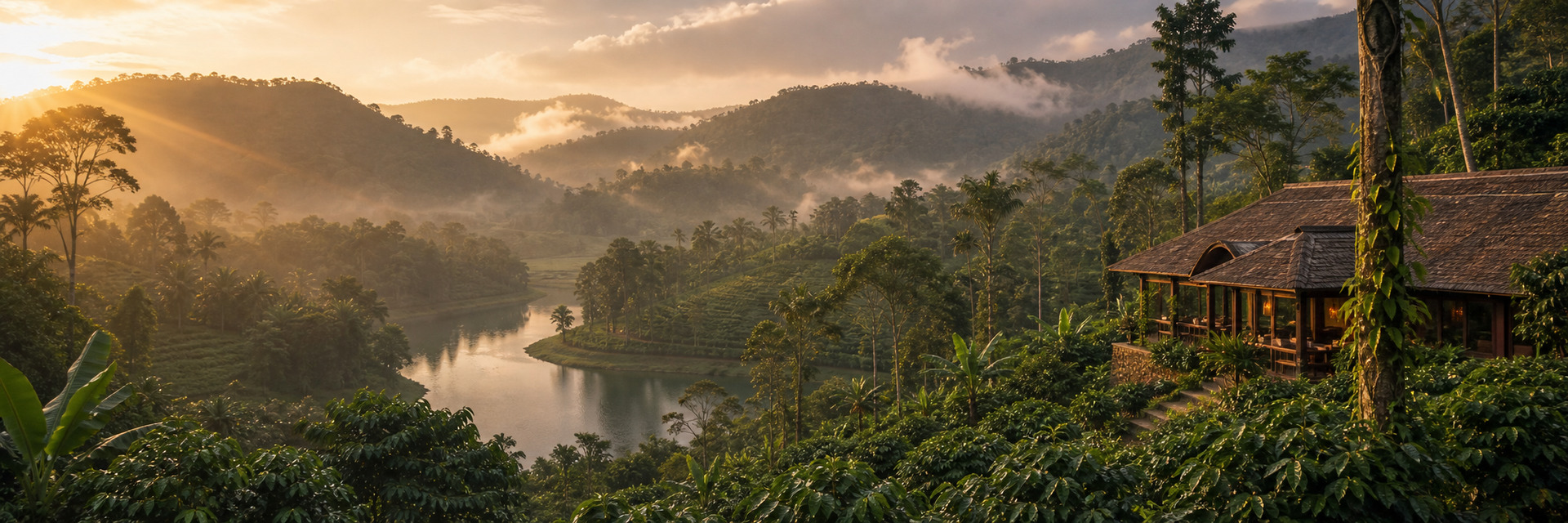
Destination - Kerala - Highland forests
Setting Up a Luxury Resort in Wayanad
Wayanad's mist, plantations and wildlife are highly investable, but ESZ scrutiny and the 2024 landslides make slope stability the first feasibility question.
Wayanad brings together Kerala's highland forests, coffee, tea and spice plantations, Edakkal Caves, Chembra Peak, Wayanad Wildlife Sanctuary and strong Bengaluru-Kerala leisure demand. But it is also one of the Western Ghats' most scrutinised districts, with forest buffers, plantation conversion, Gadgil-Kasturirangan debates and post-2024 landslide caution sharpening every approval and engineering decision. We help owners decide what land is safe, legal and premium enough before the resort promise is made.
ESZ-sensitive
Western Ghats scrutiny leads feasibility
Landslide-aware
Slope stability is now a board-level risk
Plantation + wildlife
Coffee, spice and sanctuary demand combine
Kerala service
A strong hospitality base supports premium operations
At a glance
Best-fit micro-markets
Vythiri, Kalpetta, Meppadi, Sultan Bathery edges, plantation belts and sites outside wildlife buffers and unstable slopes.
Peak season
October-March for cool highland leisure; monsoon-green demand exists but requires serious rain and landslide planning.
Positioning
Plantation-eco luxury, forest-edge wellness, spice and coffee experiences, wildlife access and monsoon-green retreats.
Critical approval
ESZ and forest/wildlife-buffer checks, land-use or plantation conversion, local sanction, Kerala pollution-control, fire and tourism registration.
Access
Kozhikode (Calicut) and Kannur airports, Bengaluru/Mysuru drive access and ghat roads into Wayanad.
Build watch-out
Slope stability, monsoon drainage, 2024 landslide sensitivity, forest adjacency, plantation tenure and ghat-road logistics.
A highland market under sharper scrutiny
Wayanad has long had the ingredients of a premium Kerala highland resort: mist, forests, coffee, tea, spices, tribal culture, caves, peaks and wildlife. It also has strong demand from Bengaluru, Mysuru, Kozhikode, Kochi and Kerala's domestic market, with travellers seeking a cooler and greener alternative to the coast and backwaters.
The district's risk profile changed in the public imagination after the 2024 Wayanad landslides. Slope, drainage, geology and settlement pattern are no longer technical notes; they are central to investment, approvals, insurance, brand and guest safety. A Wayanad resort must now prove it belongs on its hill.
In Wayanad, beauty is not enough. The first luxury is knowing the slope, water and forest context are safe enough to host guests responsibly.
Plantations, wildlife and monsoon-green demand
Wayanad's demand is more layered than a single hill-station season. Plantation stays, wildlife drives around the sanctuary, Edakkal Caves, Chembra Peak, waterfalls, spice trails, Ayurveda and monsoon-green leisure all contribute to stay decisions. Bengaluru and Kerala families are the dependable base, with wellness and nature-led travellers adding premium depth.
The resort should not overpromise safari-style wildlife if the site is not appropriately positioned. The stronger product is often forest-edge calm, plantation immersion, wellness and guided nature experiences, with wildlife access handled through responsible partnerships and clear guest expectations.
- Bengaluru, Mysuru and Kerala domestic demand as the core
- Coffee, tea, spice and plantation stays as differentiators
- Wayanad Wildlife Sanctuary and Nilgiri Biosphere context as a careful demand layer
- Monsoon-green leisure as brand strength when safety and access are planned
ESZ, sanctuary buffers and landslide memory
The regulatory and physical overlays are inseparable. Western Ghats ESZ scrutiny, forest and wildlife-sanctuary buffers, plantation conversion, slope stability, drainage, road access and water all need to be checked before the land is priced as resort land. The Gadgil-Kasturirangan debate has made Wayanad a visible district in the national conversation about Ghats development.
Post-landslide diligence should include contour, soil, historical slips, drainage lines, retaining requirements, safe setbacks, emergency evacuation and whether the site places guests or staff in a vulnerable valley or slope position. This is not only engineering; it is reputation and duty of care.
| Risk layer | What to establish |
|---|---|
| Slope and drainage | Whether the site can be safely built and evacuated in heavy rain |
| Forest / wildlife buffer | Whether construction and operations are permissible |
| Plantation tenure | Whether land conversion or resort use is legally clean |
| Ghat access | Whether guests, staff and materials can move reliably in monsoon |
Wayanad site diligence after the 2024 landslides.
Kerala approvals on fragile slopes
The approvals path may include local panchayat or planning sanction, land-use or plantation conversion, forest and wildlife-buffer confirmations, environmental clearance where thresholds apply, Kerala State Pollution Control Board consent, fire NOC, FSSAI, tourism registration and water/waste permissions. Any site near sanctuary influence or steep slopes needs specialist environmental and geotechnical inputs.
Kerala's hospitality standards are strong, but Wayanad's terrain demands that approvals and engineering move together. A design that cannot drain, evacuate, treat sewage or survive monsoon maintenance is not approval-ready in any meaningful sense.
A resort that behaves like forest edge
The design should be low-impact and highland-specific: steep roofs, deep overhangs, raised decks where needed, local stone, timber restraint, careful lighting, native planting, water-sensitive paths and quiet interiors. It should avoid heavy cuts into slopes or resort clutter that fights the forest edge.
The experience can draw from Kerala highland life: spice gardens, coffee and tea, tribal craft handled respectfully, Ayurveda, forest walks, birding, monsoon listening rooms, local cuisine and guided visits to Edakkal and Chembra where appropriate. The product should feel damp, green and calm by design, not by accident.
Rain, roads and Kerala service depth
Construction has to be sequenced around heavy rain and ghat logistics. Drainage, retaining, damp-proofing, roof details, road surfaces, staff housing and utilities need monsoon-first specifications. Premium materials can come from Kerala, Bengaluru and Coimbatore supply chains, but last-mile access into hill parcels must be planned.
Hiring is an advantage if organised early. Kerala has deep hospitality and wellness talent, and Bengaluru can support leadership, sales and specialist roles. We train the team around safety, monsoon communication, forest-edge guest behaviour and a service style that feels warm without crowding the landscape.
Gladwin's edge in Wayanad
We lead with hard site diligence: ESZ, forest and sanctuary buffers, plantation tenure, slope stability, drainage, road access, water and post-landslide risk. Only land that passes those gates deserves a luxury resort concept.
Then we manage the full programme as Owner's Representative: Kerala highland design, approvals, monsoon-ready procurement, wellness and plantation programming, hiring and launch. The operating team is trained for safety, rain, forest etiquette and premium service in a sensitive district.
Planning a resort in Wayanad?
We take single accountability from raw land to a stabilised opening — siting and approvals, market and pricing, design, procurement, and the full team — from General Manager to line level — recruited through our executive search practice and trained for opening.
Speak with a partnerSetting up a resort in Wayanad — FAQs
Yes. Slope stability, drainage, evacuation, geology and valley positioning now need much sharper diligence. A site that might once have been sold on view alone must now prove it is safe and responsible.
Sometimes, but tenure, conversion, local sanction and environmental overlays must be checked. Plantation land near forest or wildlife buffers can be especially sensitive.
Strict enough to shape the project from day one. Wayanad is central to the Gadgil-Kasturirangan debate, so ESZ, forest and wildlife-buffer status should be mapped before acquisition.
Yes, monsoon-green leisure is part of the appeal, but only if roads, slopes, drainage, damp control, guest communication and emergency protocols are designed properly.
Plantation-eco luxury, forest-edge wellness and spice/coffee experiences are more credible than a generic hill resort. Wildlife can be an extension, but it should be handled responsibly.
Kerala has strong hospitality and wellness talent, supported by Bengaluru leadership and sales depth. The team needs training in monsoon safety, forest-edge operations and low-impact guest behaviour.
Explore the cluster
Luxury resorts across India’s destinations
South · Backwaters & coast
Kerala
The one Indian destination that sells the monsoon and the one where the water is the product. Kerala rewards a resort built on Ayurveda and place — but the land beneath it is wetland and CRZ before it is buildable.
South · Western Ghats plantations
Coorg
The plantation-luxury market India actually created — inside one of the country's most protected landscapes. Coorg is an Eco-Sensitive Zone, land-conversion and slope problem long before it is a design one.
South - Malnad coffee highlands
Chikmagalur & Sakleshpur
Chikmagalur and Sakleshpur offer the un-crowded Coorg thesis, but plantation conversion, Western Ghats ESZ and monsoon slopes decide what can really be built.
Also explore our executive search practice for the General Manager and leadership team, and the wider end-to-end hospitality practice — hotels, residences, clubs and heritage properties.