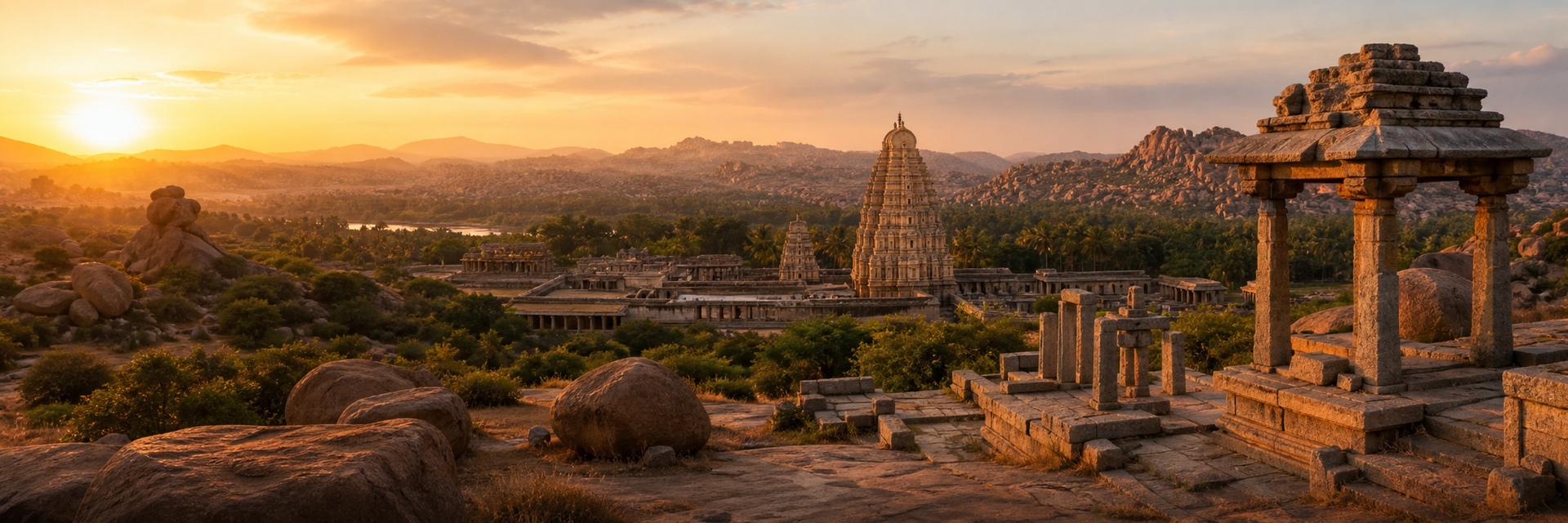
Destination - Karnataka - UNESCO heritage
Setting Up a Luxury Resort in Hampi
Hampi's ruins are the reason to invest and the reason you cannot build near them; luxury must sit outside the protected core and still feel inseparable from the landscape.
The Vijayanagara ruins, Tungabhadra river and boulder-strewn plains give Hampi one of India's most dramatic cultural landscapes. But UNESCO, ASI and the Hampi World Heritage Area Management Authority make the central constraint explicit: construction is barred or tightly controlled near the monuments, so credible luxury sits around Kamalapura, Hospet, Toranagallu or carefully selected land across the river. We help owners turn that constraint into a site strategy, not a late-stage refusal.
UNESCO-led
The heritage boundary decides the project
Outside core
Luxury must sit beyond protected monument zones
Cultural
Heritage, international and boulder-adventure demand
Semi-arid
Heat, stone and logistics shape design and build
At a glance
Best-fit micro-markets
Kamalapura, Hospet side, Toranagallu gateway, select cross-river sites and land with controlled access to the ruins without entering protected zones.
Season
October-March is strongest for weather and cultural travel; summer heat is severe and monsoon changes river and boulder access.
Positioning
Vijayanagara-inspired heritage resort, low-rise stone landscape, cultural guides, wellness and upmarket boulder/adventure extensions.
Critical approval
HWHAMA, ASI/protected-zone compliance, land-use conversion, local building sanction, tourism registration, fire and environmental permissions.
Access
Hospet and Toranagallu are the practical gateways; Hubli airport supports broader access, with Bengaluru and Hyderabad drive/rail demand.
Build watch-out
Protected-zone setbacks, semi-arid heat, boulder terrain, water, stone sourcing, Hospet logistics and specialist heritage guides.
The ruins are the draw and the red line
Hampi is valuable because the Vijayanagara landscape is irreplaceable: temples, bazaars, royal enclosures, boulder hills and the Tungabhadra setting create a destination with international cultural depth. Evolve Back Kamalapura Palace showed that guests will pay for a high-end product that interprets the empire from outside the monument core.
That phrase - outside the core - is the whole development thesis. A resort that tries to sit too close to the monuments will collide with UNESCO, ASI and HWHAMA controls. The project must instead make distance feel curated: strong guides, views, arrival, materials and programming that connect the guest to Hampi without violating the heritage landscape.
In Hampi the best site is not the closest site. It is the closest lawful, buildable and operationally calm site outside the heritage pressure zone.
Cultural demand beyond backpacker Hampi
Hampi's old demand was backpacker, boulder and budget heritage travel. The next layer is more valuable: domestic cultural luxury, international history travellers, Bengaluru and Hyderabad weekends, photography, architecture groups, soft adventure and wellness around a landscape that feels ancient and elemental.
The resort must be able to explain the place. Guides, archaeologists, curated routes, sunrise and sunset viewpoints, Tungabhadra experiences, boulder walks and temple interpretation are not optional extras; they are the difference between a room near Hampi and a Hampi resort.
- International and domestic cultural travellers as the premium base
- Bengaluru, Hyderabad and South India drive markets as dependable support
- Boulder, cycling, walking and river experiences as controlled adventure layers
- Expert guiding and interpretation as a luxury service line
Outside the protected zone
HWHAMA controls development across the heritage area, while ASI-protected monuments and buffer zones restrict new construction near the ruins. Kamalapura and Hospet-side locations are practical because they can offer resort land, road access, utilities and proximity without pretending the monument core is a development canvas. Cross-river sites can be powerful but need access, ferry/bridge, flood and village-impact diligence.
The physical site should be assessed for boulder stability, heat exposure, water, road access, views, night-sky impact and whether the route to the monuments is elegant. A site that is technically outside the protected zone can still fail if the guest journey feels like a commute to the reason they came.
| Siting route | Advantage | Constraint |
|---|---|---|
| Kamalapura side | Closest proven luxury logic and strong monument access | Heritage controls and limited premium land |
| Hospet / Toranagallu side | Better logistics, rail/airport access and larger parcels | Needs stronger landscape and programming to feel like Hampi |
| Across the river | Quieter boulder landscape and adventure identity | Access, flood, village impact and permissions are harder |
Hampi siting is a heritage-boundary exercise first, then a resort exercise.
HWHAMA, ASI and site permission
A Hampi project requires a clear map of protected monuments, regulated zones, HWHAMA development controls, land use, local-body sanction, environmental clearance where thresholds apply, fire NOC, tourism registration, FSSAI, water and pollution-control permissions. The heritage overlay must lead the sequence because it can decide whether the concept exists at all.
We coordinate architects, heritage consultants, lawyers and local authorities so the owner sees the approval path before design moves too far. In Hampi, a beautiful concept inside the wrong boundary is not a risk; it is a non-starter.
A Vijayanagara resort in a boulder landscape
Design should be literate in Vijayanagara and Dravidian forms without copying monuments. Stone, shaded courts, water bodies, colonnades, low-rise massing, earth tones and boulder-framed views can create a property that belongs to the landscape while staying deferential to the real ruins.
The experience should slow the guest down: dawn temple routes, guided archaeology, local food, craft, cycling, river viewpoints, astronomy and quiet pools that make sense after a hot day among stones. Hampi does not need spectacle added to it; it needs restraint and interpretation.
Heat, stone and Hospet logistics
The build is shaped by semi-arid heat, stone, dust and distance from mature luxury supply chains. Hospet and Toranagallu provide practical logistics, but premium FF&E, kitchens, landscape and specialist consultants may draw from Bengaluru, Hyderabad or Goa. Water strategy, shade, passive cooling and heat-resistant materials are commercial decisions, not sustainability slogans.
Hiring should blend Bengaluru/Hospet hospitality talent with trained local guides and heritage interpreters. The service standard must be calm, knowledgeable and outdoor-capable: guests will judge the resort as much by the quality of its Hampi experience as by the suite.
Gladwin's edge in Hampi
We begin by drawing the real heritage map: UNESCO, ASI, HWHAMA, protected zones, access and utilities. Then we compare Kamalapura, Hospet, Toranagallu and cross-river options against the guest journey and approval risk before capital is committed.
From there we run the owner's programme end to end: heritage-sensitive design, approvals, procurement, guide partnerships, hiring and launch. The team we build combines luxury operators with local interpretation capability, because in Hampi the story is part of the service.
Planning a resort in Hampi?
We take single accountability from raw land to a stabilised opening — siting and approvals, market and pricing, design, procurement, and the full team — from General Manager to line level — recruited through our executive search practice and trained for opening.
Speak with a partnerSetting up a resort in Hampi — FAQs
Construction near protected monuments is heavily restricted or barred. HWHAMA and ASI controls mean credible luxury usually needs to sit outside the protected core, commonly around Kamalapura, Hospet, Toranagallu or carefully selected cross-river land.
The Hampi World Heritage Area Management Authority controls development in the heritage area. Its rules, along with ASI and UNESCO sensitivities, must be mapped before land acquisition or concept design.
No. The cultural and landscape draw is strong enough for premium demand, especially from Bengaluru, Hyderabad and international heritage travellers. The product must solve access, guiding, heat and comfort rather than behave like a city hotel.
Kamalapura gives closest proven luxury positioning, Hospet/Toranagallu gives logistics and land, and cross-river sites give quiet landscape. The right answer depends on protected-zone status, access, views, water and guest journey.
Protected-zone refusal, semi-arid heat, water, boulder terrain, stone and dust, and reliance on Bengaluru or Hyderabad for premium suppliers. These need to be built into the programme early.
Leadership can be drawn from Bengaluru, Hyderabad and established resort markets, with local associates, guides and interpreters trained into the luxury standard. Heritage interpretation is a core operating skill in Hampi.
Explore the cluster
Luxury resorts across India’s destinations
South - Malnad coffee highlands
Chikmagalur & Sakleshpur
Chikmagalur and Sakleshpur offer the un-crowded Coorg thesis, but plantation conversion, Western Ghats ESZ and monsoon slopes decide what can really be built.
South · Western Ghats plantations
Coorg
The plantation-luxury market India actually created — inside one of the country's most protected landscapes. Coorg is an Eco-Sensitive Zone, land-conversion and slope problem long before it is a design one.
South - Coromandel coast (French quarter)
Pondicherry
Pondicherry's edge is intimate heritage and a Union Territory F&B regime; the constraint is fitting luxury into protected quarters, CRZ coast and Auroville-adjacent expectations.
Also explore our executive search practice for the General Manager and leadership team, and the wider end-to-end hospitality practice — hotels, residences, clubs and heritage properties.