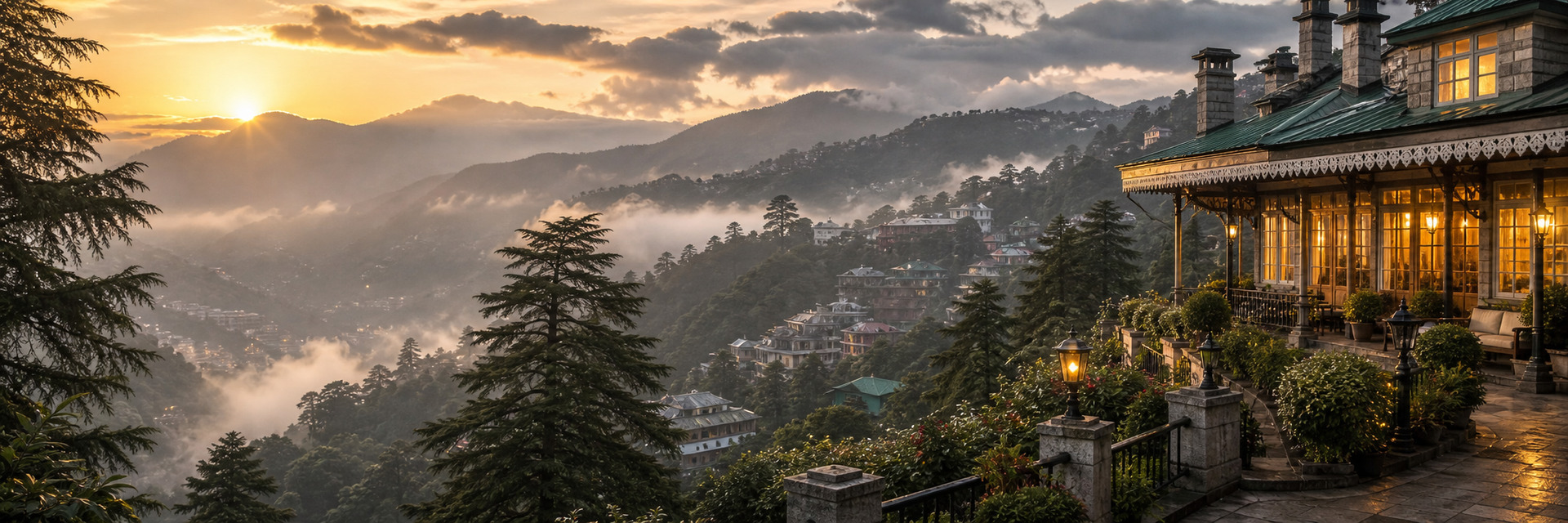
Branded & Luxury Residences · North India · Doon hills
Setting Up Branded & Luxury Residences in Mussoorie
Mussoorie is Delhi's hill retreat with a heritage soul — but a residence here is a business that must sell on scarcity and then be serviced like a boutique hotel, not simply built on a slope.
The Delhi and Doon money that buys above Dehradun is buying air, view, a Landour address and a cottage that runs itself when the owner is away — not a plot on a hillside. Getting it right means a brand and price calibrated to a scarce, protected market, a managed short-let and estate programme that turns an empty second home into yield, and land, ceiling and slope diligence that most developers underestimate in the Uttarakhand hills. Gladwin International runs the whole journey as one accountable programme — from a restorable cottage or a buildable ridge to a sold, serviced and stabilised community.
Sell + service
Hill real estate that runs like hospitality
Delhi + Doon HNI
Retirees · writers · CXOs · NRI roots
Managed short-let
The yield that fills an empty cottage
Turnkey
Restorable cottage to a serviced estate
At a glance
Best-fit micro-markets
Landour heritage belt (Sisters Bazaar, Char Dukan, the upper ridges) for exclusivity; Barlowganj and the Dehradun–Mussoorie road for buildable villa plots; central Mussoorie for restoration stock.
The buyer
Delhi and NCR HNI, Doon-valley families, retirees, writers and creatives, and CXOs — a heritage address, clean air, view, and a serviced second home that can earn.
The revenue lines
Villa / restored-cottage sales absorption + a managed short-let and hospitality programme + estate-management fees.
Critical approvals
Uttarakhand land-purchase permission for non-agriculturist / outside buyers, UK Town & Country Planning building and height sanction, forest and green-cover clearance, and UK RERA registration for sales.
Land watch-out
Uttarakhand's tightened hill land-ceiling rules, steep-slope stability, Zone IV seismicity and landslide caution decide what is really acquirable and buildable.
The access catalyst
The Delhi–Dehradun Expressway and Jolly Grant airport (~1.5 hrs to Mussoorie) are compressing the drive and widening the Delhi catchment.
The opportunity
Mussoorie has been Delhi's hill escape since the Raj, and the Queen of the Hills has never lost its pull on the capital's professional class. What has changed is access and appetite: the Delhi–Dehradun Expressway is collapsing a day's journey into a comfortable drive, Jolly Grant airport puts the ridge roughly ninety minutes away, and a post-pandemic generation of Delhi HNI, retirees, writers and CXOs now wants a hill home that is a base, not a once-a-year outing. Above the town, Landour — Ruskin Bond country, the exclusive literary and heritage belt of deodar and colonial cottages — carries a scarcity and cachet that no new township can manufacture.
The opportunity here is not a plotted layout stamped onto a hillside. It is the careful restoration of heritage cottages and a small number of design-led boutique villas — a handful to a few dozen units — that sell on address, view and provenance, and that convert Mussoorie's deep, sentimental Delhi demand into premium absorption rather than a slow, discounted sell-down.
In the Mussoorie hills a residence lives or dies on two things a bare plot can't offer: a Landour-grade address the buyer covets, and a managed programme that fills the cottage when the owner is in Delhi.
Sell and then service — why a hill cottage is hospitality, not just real estate
A Mussoorie residence has two businesses inside it. First it has to SELL — which needs a brand or a restoration signature, a pricing and absorption strategy calibrated to a scarce, protected, sentiment-driven market, and a sales approach that closes discerning Delhi and Doon buyers without slipping into the discounting that thin hill markets punish. Then it has to be SERVICED — a managed short-let and hospitality programme (housekeeping, caretaking, concierge, log-fire-and-provisions readiness, bookings) that turns an owner's empty months into a real yield, and an estate-management structure that keeps a cluster of cottages heated, watered, weather-proofed and secure through a Himalayan winter.
This is the trap developers fall into in the hills: they sell a romantic idea of a cottage, then hand the owner a house that leaks in the monsoon, freezes in January and sits dark and unearning for ten months. We design the sales engine and the estate/short-let operation together, so the yield story is honest and the residence is genuinely serviceable from the day the keys change hands.
- Brand / restoration signature + pricing and absorption strategy for the Delhi & Doon HNI buyer
- A sales approach built for a scarce, sentiment-led hill market — not volume discounting
- A managed short-let / hospitality programme with a defensible owner yield
- Estate management that survives a Himalayan winter and monsoon — the operation, not just the building
Land, ceiling & UK RERA — the Uttarakhand hill diligence reality
Uttarakhand has been tightening the rules on hill land, and this is the single biggest thing outside developers and buyers underestimate. Land-purchase limits and ceiling provisions restrict how much, and on what basis, a non-agriculturist or out-of-state buyer can acquire in the hills, and permission pathways have narrowed rather than widened. On top of that sit UK Town & Country Planning building and height controls that cap what can rise on a ridge, forest and green-cover rules that protect the deodar cover the market is buying into, and steep-slope, seismic (Zone IV) and landslide constraints that decide whether a plot is buildable at all. And any sale of units runs through UK RERA registration, with the escrow and disclosure discipline that brings.
We resolve the land-eligibility and ceiling position, the TCP building and height envelope, the forest and slope-stability picture, and stand up the UK RERA-compliant structure, before capital is committed — because in the Uttarakhand hills the land and regulatory work is precisely where projects lose seasons, or the whole scheme.
| Consideration | What it decides |
|---|---|
| Uttarakhand land-purchase / ceiling rules | Whether, and how much, an outside or non-agriculturist buyer can acquire |
| TCP building & height sanction | What can be built and how tall on the ridge |
| Forest & green-cover clearance | Whether the deodar-clad plot can be developed at all |
| Slope, seismic (Zone IV) & landslide | Whether the land is safely buildable, and at what engineering cost |
| UK RERA registration | Sales compliance, escrow and buyer protection |
Indicative diligence map — always subject to the specific land's classification, slope, ownership basis and the prevailing Uttarakhand land-purchase rules.
Product & experience — what a Mussoorie residence must be
The Mussoorie and Landour buyer pays a premium for restraint and provenance, not spectacle. The idiom is colonial-hill: pitched roofs built to shed snow and monsoon, load-bearing stone and dressed masonry, deodar and local timber, deep verandahs and bay windows that frame the Doon valley and the snow line, log fires and reading nooks that answer the literary romance of the place. A restored heritage cottage is worth more than a brand-new villa if the restoration is done with a conservationist's discipline — original stone, sympathetic joinery, modern warmth and waterproofing hidden inside a period skin.
But the service layer is what turns a beautiful cottage into a sale and a yield: a caretaking-and-concierge offer, a warmed, provisioned house on arrival, all-weather access and heating, and — where scale allows — a small shared amenity or clubhouse. We brief the restoration or product signature, the winter-readiness engineering and the short-let-programme requirements together, so the cottage, its comfort systems and its service model are designed as one saleable, serviceable proposition.
Procurement & the short summer build window
Building in the Mussoorie hills is governed by weather and access in a way that flatland developers rarely price in. The productive build window is short — a monsoon that runs roughly June to September brings landslip risk, saturated slopes and stalled logistics, and the winter closes in behind it — which leaves a compressed summer season to do the heavy work. Material has to be carried up narrow, switchback hill roads, slope and seismic engineering dictates specification, and the whole programme has to be sequenced around the weather rather than a flat-ground calendar. A residence cluster also carries a hill-estate infrastructure layer: retaining and drainage engineering, water sourcing and storage, sewage treatment, snow-and-monsoon-rated services, back-up power and security — plus the show cottage and sales setting that anchor the launch.
We run the full procurement programme — restoration works and joinery, interiors and FF&E, heating and comfort systems, slope and retaining engineering, estate infrastructure, and the operating supplies for the short-let programme — with independent vendor intelligence and a schedule mapped realistically to the build window, the sales launch and owner handovers.
The talent to sell it and run it
A Mussoorie residence needs two kinds of people, and they rarely come in one hire. On the front end it needs sales and relationship talent based in Delhi and Dehradun who understand the sentiment and the scarcity of this market and can close discerning buyers without discounting. On the back end it needs an estate and hospitality team who can actually run a cluster of hill cottages — caretakers, a short-let and concierge operation, and an estate manager who keeps the community warm, dry, secure and earning through winter and monsoon.
Through our executive search practice we build both sides — a Delhi/Doon-facing sales leadership and an on-the-ground estate and hospitality team — so the residence sells to the right standard and then runs to a standard owners will renew, long after the last cottage is sold.
Gladwin's edge in Mussoorie
We treat a Mussoorie residence as the sell-and-service business it actually is, in one of India's most protected and weather-governed hill markets. Before capital is committed we resolve the Uttarakhand land-eligibility and ceiling position, the TCP building and height envelope, the forest and slope-stability picture, and the UK RERA structure — and we design the brand or restoration signature, the sales approach and the short-let/estate operation as one system, so the yield story that closes the sale is honest and the cottage is serviceable from handover. Then we run restoration and design, procurement inside the short build window, the sales launch and the estate operation, as one accountable partner and your Owner's Representative.
The distinctive edge here is reading Mussoorie for what it is: the Landour heritage exclusivity that no new township can replicate, the Delhi–Dehradun Expressway catalyst that is widening the buyer pool, and the tightened Uttarakhand hill land rules that decide whether a scheme is even acquirable — and building around all three.
Planning a branded residence or villa estate in Mussoorie?
We take single accountability from raw land to a stabilised, sold-and-serviced community — brand and rental-pool strategy, the sales engine, design, procurement, PMO and estate operations. The team is recruited through our executive search practice and trained for opening.
Speak with a partnerSetting up a branded residence or villa estate in Mussoorie — FAQs
Because the Delhi and Doon buyer is buying an address, a view and a serviced retreat that can earn when they are away — not a plot on a slope. The asset has to sell (a Landour-grade address, a restoration or brand signature, pricing for a scarce market) and then be serviced (a managed short-let programme and estate management that survive a Himalayan winter). We design the sales engine and the service model together so the yield that closes the sale is real.
Uttarakhand has tightened its hill land-purchase and ceiling rules, which restrict how much and on what basis a non-agriculturist or out-of-state buyer can acquire, and the permission pathways have narrowed. On top of that sit TCP building and height controls, forest and green-cover clearance, and slope, seismic and landslide constraints. We resolve the land-eligibility and ceiling position, the building envelope and the slope picture before any capital is committed.
Often, yes — especially in Landour, where provenance and a genuine heritage address command a premium that a new build cannot manufacture. But it only works if the restoration is done with conservationist discipline: original stone and sympathetic joinery on the outside, modern warmth, waterproofing and comfort systems hidden within. We brief and run restoration to that standard, and where a ridge suits new work, a design-led boutique villa in the colonial-hill idiom.
By designing the estate and short-let operation up front — caretaking, housekeeping, concierge, an arrival-ready warmed house, all-weather access and bookings — and modelling realistic seasonal occupancy rather than promising a yield and leaving the owner with a cottage that sits dark for ten months. In a weather-governed market, an honest, operable yield is what converts a viewing into a sale.
Materially. The monsoon (roughly June–September) and the winter that follows compress the productive season, and material has to be carried up narrow hill roads, so the schedule has to be sequenced around the weather, not a flatland calendar. We plan procurement and the build realistically against that window, and against slope, seismic (Zone IV) and landslide engineering — the constraints that most flatland developers under-price.
Yes — it is core. Through our executive search practice we build both sides: a Delhi/Dehradun-facing sales leadership who understand the scarcity and sentiment of this market, and an on-the-ground estate and hospitality team who can run a cluster of hill cottages — and the short-let operation — to a standard owners will renew through winter and monsoon.
Explore the cluster
Branded & luxury residences across India
North · Kumaon lakes
Nainital
Nainital is Delhi-NCR’s hill retreat — but the money-making residence is a stone-and-slate villa in the quieter Kumaon belt around it, sold on a view and serviced like a lodge.
North · Himachal hills
Kasauli
Kasauli is Chandigarh and Delhi’s quiet-luxury second home — but a villa estate here is settled or stalled at one point: whether a non-agriculturist buyer can lawfully hold the land at all.
North · NCR branded
Gurugram
Gurugram is the Millennium City of corporate India — and its defining luxury product is not a villa but the hotel-branded residence, a tower that sells on a brand’s name and is then serviced to its standard.
Also explore our executive search practice for the leadership team, and the wider end-to-end hospitality practice.