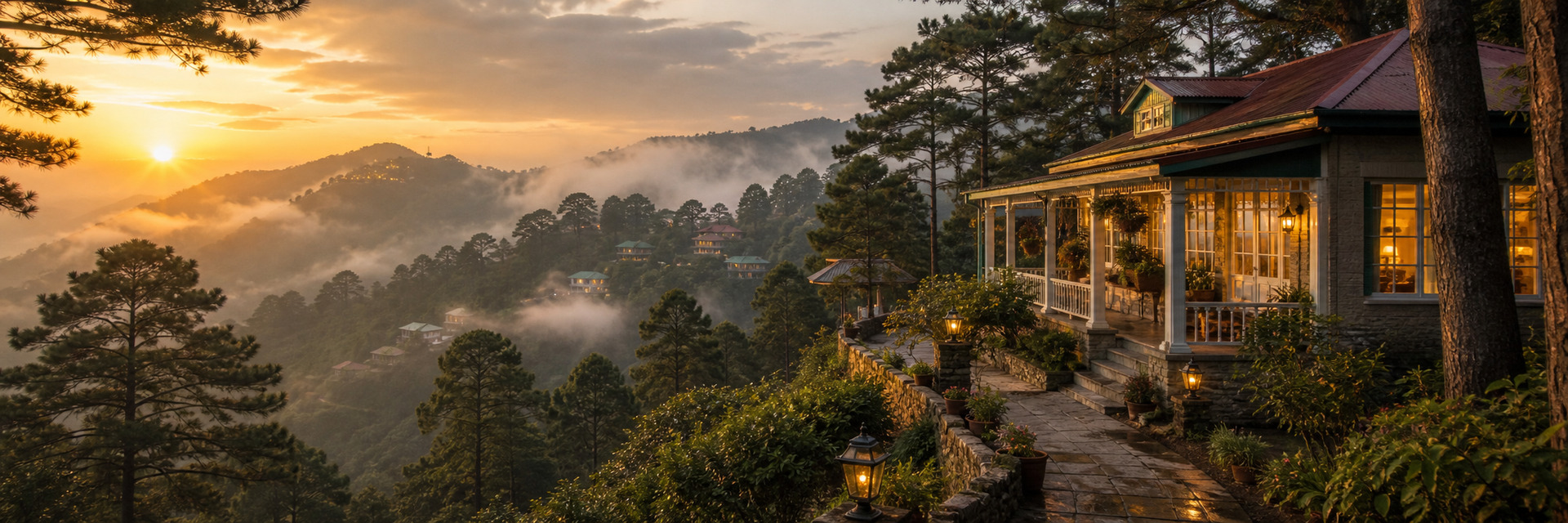
Branded & Luxury Residences · North India · Himachal hills
Setting Up Branded & Luxury Residences in Kasauli
Kasauli is Chandigarh and Delhi’s quiet-luxury second home — but a villa estate here is settled or stalled at one point: whether a non-agriculturist buyer can lawfully hold the land at all.
The Chandigarh, Punjab and Delhi money that buys in Kasauli is buying pine air, altitude, a slower weekend and a discreet address — not a mass layout. Getting it right means a Section 118 land and ownership structure that actually clears, a brand and price calibrated to a low-density, exclusivity-led buyer, and a retreat rental and estate operation that keeps a distant second home cared for and quietly earning. Gladwin International runs the whole journey as one accountable programme — from a lawful landholding to a sold, serviced and stabilised hillside community.
Section 118
The land bar that decides the whole scheme
Chandigarh 1.5h
Chandigarh & Punjab HNI · Delhi in ~5 hours
Low density
Boutique villas, not a mass hill layout
Sell + service
Villa sales, retreat rental and estate care
At a glance
Best-fit micro-markets
Kasauli town and the cantonment fringe, Dharampur, Garkhal, the Sanawar ridge, and the Kasauli–Parwanoo belt down toward the plains.
The buyer
Chandigarh, Punjab and Delhi HNI — retirees, CXOs and business families buying a weekend home, a retreat and a long-hold investment.
The revenue lines
Boutique villa sales + a managed retreat/rental programme + recurring estate-management fees on absentee homes.
The defining constraint
HP Section 118 (Tenancy & Land Reforms Act) — non-agriculturists generally cannot buy agricultural land in Himachal without state permission.
Critical approvals
Section 118 permission or a compliant structure, HP TCP building/height sanction, forest & green-felling clearance, HP RERA for sales.
What makes it sell
A lawful, clean title story, a boutique brand or design signature, and a retreat/estate service that looks after an absentee owner.
The opportunity
Kasauli has stayed deliberately small. A colonial cantonment on a pine-and-deodar ridge in Solan district, it never industrialised into a hill-station bazaar the way Shimla or Manali did — which is exactly why Chandigarh, Punjab and Delhi buyers now prize it. It is close enough to matter (Chandigarh is around ninety minutes, Delhi roughly five hours) and quiet enough to be worth the drive: low traffic, low density, clean air and a discretion that reads as luxury to a buyer who already owns the loud things.
The opportunity here is not a hill-slope apartment block or a plotted colony. It is a small number of design-led, serviced villas — a boutique estate of perhaps a dozen to forty homes — that sell on exclusivity, view and a lawful, cared-for landholding, and that convert Kasauli’s scarcity into a premium rather than into a slow, undifferentiated sell-down.
In Kasauli scarcity is the product. The moment a scheme reads as high-density or as a plot with a title question, the premium the whole market is built on evaporates.
Section 118 — the constraint that decides everything
Every Kasauli scheme begins and, if mishandled, ends with one statute: Section 118 of the HP Tenancy & Land Reforms Act. In Himachal, a non-agriculturist — which most outside individuals and virtually all corporate buyers are — generally cannot purchase agricultural land without the prior permission of the State Government. This is not a formality bolted on at the end; it is the gate the entire land-acquisition and ownership structure has to be designed around, and it is precisely where most projects stall, quietly, for years.
We treat Section 118 as the first question, not the last. Before capital is committed we test the specific land’s classification and route — whether permission is realistically obtainable, whether an already-converted or non-agricultural parcel exists, and what ownership and sale structure lets a Chandigarh or Delhi buyer hold a home here lawfully and marketably. A villa a buyer cannot cleanly own is not an asset; it is a liability with a view.
- Land-status diligence: agricultural vs non-agricultural classification for the exact parcel
- The Section 118 route — permission feasibility, or a compliant already-converted landholding
- An ownership and sale structure that gives the outside HNI buyer clean, marketable title
- A title and consent trail deep enough to survive due diligence years after handover
The single most valuable thing we do in Kasauli is answer, before anyone spends, whether the land can lawfully be held by the buyer we intend to sell it to.
Sell and then service — why this runs like hospitality
A Kasauli villa estate contains two businesses. First it has to SELL — which needs a boutique brand or design signature, a pricing and absorption plan tuned to a low-density, exclusivity-led buyer, and a sales approach that closes a small run of homes without discounting into the very mass-market perception that would kill the address. Then it has to be SERVICED — because the buyer lives in Chandigarh or Delhi and the house sits empty most of the month. That means a managed retreat/rental programme (housekeeping, caretaking, a concierge, bookings) that keeps the home warm and lightly earning, and an estate-management structure that maintains slate roofs, timber, gardens and access through hard Himachal winters.
The trap is familiar: a developer sells the plots, hands over, and leaves absentee owners with damp houses, a caretaker no one manages and a rental promise that never materialised. We design the sales engine and the retreat/estate operation as one system, so the service that reassures the buyer at the point of sale is real and running from the day keys change hands.
- Boutique brand / design signature + absorption and pricing for the exclusivity-led buyer
- A sales engine sized to a small, high-value run of homes — not volume discounting
- A managed retreat / rental programme that keeps an absentee owner’s home cared-for and earning
- Estate management built for the mountain: winter maintenance, security, timber and slate upkeep
Land, planning & environment — the Himachal diligence reality
Beyond Section 118, a Kasauli site carries a stack of Himachal-specific controls. HP Town & Country Planning sets building, coverage and height limits that are deliberately tight in a ridge town, and steep slopes push far more of the cost below ground than a plains developer expects. The hillsides are forested — deodar and pine — so felling and any diversion of forest land runs through green-felling and forest-clearance rules that can reshape a masterplan. Kasauli sits in seismic Zone IV, which drives structural specification and foundations on slope. And any sale of units needs HP RERA registration, with its escrow and disclosure discipline.
We resolve the planning envelope, the slope and geotechnical reality, the forest and felling position and the RERA structure before the scheme is fixed — because in Himachal the land, environment and regulatory work is where a hill project loses seasons, or its whole footprint.
| Consideration | What it decides |
|---|---|
| Section 118 status & route | Whether an outside/corporate buyer can lawfully hold the land at all |
| HP TCP sanction | Coverage, height and what density the ridge will actually permit |
| Forest & green-felling rules | How trees, forest land and the natural cover constrain the masterplan |
| Slope & seismic (Zone IV) | Foundation, structure and how much build cost goes below grade |
| HP RERA registration | Sales compliance, escrow and absentee-owner protection |
Indicative diligence map — always subject to the classification, planning zone and site survey for the specific land.
Product & experience — what a Kasauli villa must be
Kasauli buyers pay for a specific feeling of the hills, handled with restraint: colonial-Himachali architecture, pitched slate roofs, deodar and local stone, deep verandahs framing a valley view, and interiors built to be cosy through a cold, misty winter rather than merely photogenic in summer. The luxury is quiet — a home that belongs to the ridge, not one that shouts over it. Amenity is intimate too: a small clubhouse, a spa or wellness room, warm gathering spaces and walking trails, rather than the resort-scale offer that would break the low-density promise.
We brief the product mix, the intimate amenity strategy and the retreat-programme requirements together, so the villas, the shared spaces and the service model are designed as one saleable, serviceable proposition — a home that a Chandigarh family is proud to own and comfortable to leave empty for weeks.
Procurement & build realities
Building on a Kasauli ridge is governed by a short season and hard access. The workable build window is narrow — a wet monsoon and a genuine mountain winter bracket the year — so the programme has to hit its slope, structure and weather-tight milestones inside a compressed calendar or lose a full season. Material moves up steep, narrow hill roads, so logistics, staging and craft labour (slate, deodar joinery, stone) are planned, not assumed. A hill estate also carries a heavy infrastructure layer: retaining and slope stabilisation, access roads, water sourcing and storage, STP and power resilience, and the show-villa that anchors a small, high-trust sales launch.
We run the full procurement programme — villa interiors and FF&E, joinery and stone, the clubhouse and wellness fit-out, landscape, and the estate and slope infrastructure — with independent vendor intelligence and a schedule mapped to the build season, the sales launch and owner handovers.
Gladwin’s edge in Kasauli
We treat a Kasauli villa estate as the sell-and-service business it actually is, and we start where it actually starts — at Section 118. Before capital is committed we test the land’s status and the ownership route that lets an outside HNI buyer hold a home here lawfully and marketably, and we resolve the TCP envelope, the slope and forest reality and the HP RERA structure alongside it. Then we design the boutique brand, the sales engine and the retreat/estate operation as one system, and run design, procurement, the sales launch and the estate operation as one accountable partner and your Owner’s Representative.
The team we build spans both businesses: a sales leadership that can reach the Chandigarh, Punjab and Delhi buyer through the right, discreet channels, and an estate/hospitality team — recruited through our executive search practice — able to run a retreat programme and maintain absentee homes through Himachal winters to a standard owners will renew.
Planning a branded residence or villa estate in Kasauli?
We take single accountability from raw land to a stabilised, sold-and-serviced community — brand and rental-pool strategy, the sales engine, design, procurement, PMO and estate operations. The team is recruited through our executive search practice and trained for opening.
Speak with a partnerSetting up a branded residence or villa estate in Kasauli — FAQs
Because under Section 118 of the HP Tenancy & Land Reforms Act, a non-agriculturist — which most outside individuals and virtually all corporate buyers are — generally cannot buy agricultural land in Himachal without prior State Government permission. It dictates the entire land-acquisition and ownership structure, and it is where most projects stall. We test the land’s status and a compliant route before any capital is committed, because a villa a buyer cannot lawfully own is not a saleable asset.
Because the buyer lives in Chandigarh or Delhi and the home sits empty most of the month. The asset has to sell (a boutique brand, exclusivity-led pricing, a sales engine for a small high-value run) and then be serviced (a retreat/rental programme and an estate-management structure that maintains an absentee home through hard winters). We design the sales engine and the service model together so the reassurance that closes the sale is real from handover.
Chandigarh, Punjab and Delhi HNI — retirees, CXOs and business families — buying a mix of weekend home, retreat and long-hold investment. Chandigarh is around ninety minutes away and Delhi roughly five hours, so the catchment is real but the buyer is exclusivity-led: they want low density, clean air and discretion, not a mass hill layout.
HP TCP building, coverage and height limits that are tight in a ridge town; forest and green-felling rules governing deodar and pine; steep-slope and seismic Zone IV constraints that drive foundations and cost below grade; and HP RERA registration for unit sales. We resolve the planning envelope, the slope and forest position and the RERA structure before the scheme is fixed.
By standing up the retreat/estate operation up front — caretaking, housekeeping, security, winter maintenance of slate and timber, plus an optional managed rental/retreat programme with concierge and bookings — rather than handing over and leaving owners with a damp house and an unmanaged caretaker. A working service model is what reassures a buyer who lives hours away.
Typically a small run — roughly a dozen to forty homes — enough to justify a boutique brand, an intimate clubhouse and a serviced estate operation, while protecting the low-density exclusivity the whole address depends on. We size the scheme to the micro-market and to the service economics, and deliberately not to the maximum the land could be pushed to carry.
Explore the cluster
Branded & luxury residences across India
North · Doon hills
Mussoorie
Mussoorie is Delhi's hill retreat with a heritage soul — but a residence here is a business that must sell on scarcity and then be serviced like a boutique hotel, not simply built on a slope.
North · NCR branded
Gurugram
Gurugram is the Millennium City of corporate India — and its defining luxury product is not a villa but the hotel-branded residence, a tower that sells on a brand’s name and is then serviced to its standard.
North · Kumaon lakes
Nainital
Nainital is Delhi-NCR’s hill retreat — but the money-making residence is a stone-and-slate villa in the quieter Kumaon belt around it, sold on a view and serviced like a lodge.
Also explore our executive search practice for the leadership team, and the wider end-to-end hospitality practice.