Higher Education & Universities · Karnataka · University Town
Setting Up a University or Higher-Education Institution in Manipal
Manipal is the proof that a university need not sit inside a city — it can build its own town. Establishing one here is a township problem before it is a campus one.
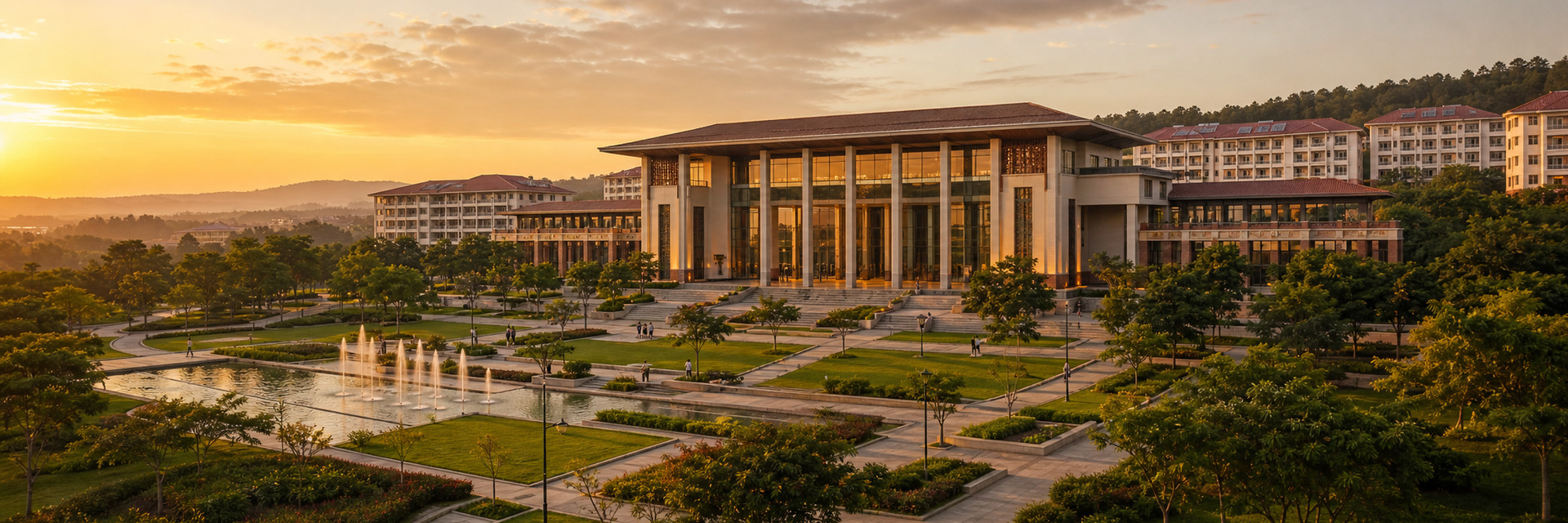
Manipal is India’s most complete demonstration of the residential university-township: a self-contained ecosystem of colleges, hostels, a teaching hospital and a town economy that a single institution grew around it, on a laterite plateau above the coast rather than in a metro. Building one turns on a decision most sponsors under-think — the legal instrument you establish under, a deemed-to-be-university under Section 3 of the UGC Act (the model that made this town), a private university under the Karnataka State Private Universities Act, or a professional college affiliated to Rajiv Gandhi University of Health Sciences or Visvesvaraya Technological University. Gladwin International runs the whole journey as one accountable programme — the sponsoring not-for-profit, the establishment route, UGC, AICTE and the statutory health councils, NAAC/NBA/NIRF accreditation, township-scale land, the campus, hostels and hospital, faculty, research, technology and a first admissions cycle built for a large international intake.
A town, not a campus
The residential-township model we build to
Deemed or private-Act
The two university routes we model first
Health + technology
The disciplinary spine that anchors the town
Turnkey
Sponsor and land to an accredited, admitting institution
At a glance
Establishment routes
Deemed-to-be-university (UGC Section 3) — the instrument behind Manipal itself; a private university under the Karnataka State Private Universities Act; or an affiliated college under RGUHS / VTU.
The affiliators
Rajiv Gandhi University of Health Sciences (RGUHS) affiliates Karnataka’s medical, dental and nursing colleges; Visvesvaraya Technological University (VTU) the engineering base.
Sponsoring body
A not-for-profit trust, society or Section 8 company — mandatory; no for-profit entity can sponsor a university or college. Manipal was built by an educational trust.
Land & siting
The Udupi-district laterite plateau above coastal Karnataka — contiguous, township-scale land, a healthier climate than the coast, and Mangaluru International Airport roughly an hour south.
Approvals stack
UGC establishment + 2(f) & 12(B), AICTE, and the health councils — NMC (medical), DCI (dental), INC (nursing), PCI (pharmacy) — plus NAAC/NBA/NIRF.
Catchment
Karnataka, Kerala and the wider South, a strong Gulf-NRI feeder, and a very large international student intake — the draw that a recognised university town creates.
Why Manipal
Manipal is not a place a university was added to — it is a place a university created. On a laterite plateau in Udupi district, above the humidity of the coast, an educational trust built one of independent India’s earliest private medical colleges and then grew an entire town around it: colleges, hostels, a teaching hospital, staff housing, and the shops, transport and services that a resident academic population demands. That is the market context here, and it matters because it names the ambition a sponsor comes to this location with — not a single professional campus, but a self-contained residential ecosystem that becomes its own town.
Coastal Karnataka — the Tulu Nadu belt around Udupi and Mangaluru — carries a deep, distinctive health-education pedigree; it exports doctors, nurses and technologists across India and the Gulf, and the region reads a well-run institution as a natural fit rather than an intrusion. A township-scale university here is not competing for a slice of a crowded metro’s attention; it is anchoring a local economy, drawing students who come precisely because the campus is the town, and plugging into a diaspora and international feeder that treats coastal Karnataka as an education destination.
In Manipal the ambition is not a campus inside a city — it is a residential university township that becomes its own town. That changes the land, the build and the operating model from the first day.
The establishment route — the decision that defines everything
The first and most consequential decision is the legal instrument, and here the choice is sharpened by history. The model that built Manipal is the deemed-to-be-university — conferred by the Ministry of Education on the recommendation of the UGC under Section 3 of the UGC Act. It grants its own degrees, carries real academic autonomy, and suits an institution building deep, health-and-technology-led standing across a residential township; it is also the most demanding on academic track-record, corpus and infrastructure. It is the route a self-contained university town is naturally built under.
The alternative for a new promoter is a private university under the Karnataka State Private Universities Act — established by the state legislature, degree-granting from inception, and generally a faster path to a university than the deemed route’s track-record threshold, but bound by the Act’s land, corpus and governance conditions. The lightest entry is a professional college affiliated to a state university: Rajiv Gandhi University of Health Sciences (RGUHS) for a medical, dental or nursing college, or Visvesvaraya Technological University (VTU) for engineering — the affiliator sets the curriculum and awards the degree while you run the college and can grow toward university status later. Each route fixes your degree-granting power, your regulator, your governance and your timeline for years, so it must be chosen against the township ambition and the disciplinary spine, not defaulted into. We model the three against your capital, horizon and health-versus-technology mix before any land is committed.
| Route | Best for |
|---|---|
| Deemed-to-be-university (UGC Sec. 3) | A residential, health-and-technology-led township with degree-granting autonomy and academic depth |
| Private university (Karnataka Act) | A degree-granting university from inception on a faster legislative path |
| Affiliated college (RGUHS / VTU) | A focused professional college — medical, dental, nursing or engineering — with the fastest entry |
Indicative route logic — subject to the current UGC and Karnataka norms and the specific disciplinary mix.
The sponsoring not-for-profit and governance
No route permits a for-profit promoter. The sponsor of a university or college must be a not-for-profit body — a public charitable trust, a registered society, or a Section 8 company — and its constitution, object clauses and asset-lock have to satisfy the regulator before an application is entertained. Manipal itself was built and is held by an educational trust, and that is the pattern every route follows: the sponsoring body is the applicant of record for every subsequent approval, so getting the vehicle wrong is a common and expensive cause of delay.
We structure the sponsoring body and the governance architecture the regulators expect — the Board of Management or Governing Council, the Academic Council, the Boards of Studies, the Finance Committee — and separate the sponsor’s stewardship from the institution’s academic autonomy. Both the UGC deemed-university regulations and the Karnataka Act scrutinise governance and the mandatory corpus or endowment; a township-scale institution, carrying a hospital and a resident population, additionally needs the sponsor’s balance sheet and long-horizon commitment evidenced. We build all of it to survive scrutiny rather than retro-fit it under a deadline.
- Sponsoring trust / society / Section 8 company — constituted and asset-locked to regulator norms
- Governance stack — Board of Management, Academic Council, Boards of Studies, Finance Committee
- Mandatory corpus / endowment fund structured and evidenced for a township-scale build
- Sponsor stewardship separated from academic and financial autonomy
Approvals & recognition — the regulatory stack
Establishment is only the first gate. UGC recognition under Section 2(f) brings the institution within the UGC’s ambit, and 12(B) status — the eligibility to receive central grants — is the marker of legitimacy that students, parents and faculty read. A health-and-technology township then attracts a dense council layer, and because the disciplinary spine here is medicine and allied health, that layer is heavier than for a general institution: each council runs its own inspection, intake sanction and standards, and they proceed in parallel rather than in sequence, which is where an unmanaged programme portfolio loses a year.
Licensed filings and inspections are conducted through the sponsoring body and its appointed experts; we coordinate and govern the whole stack to a recognised, admitting institution — mapping every council to the programme portfolio, and, critically for a medical township, sequencing the teaching hospital and bed strength that the medical council requires before an MBBS intake can be sanctioned.
- UGC Section 3 deemed status, or a Karnataka Act private university, or affiliation to RGUHS / VTU
- UGC recognition — Section 2(f), and 12(B) eligibility for central grants
- AICTE approval for engineering, technology and management programmes
- Health councils by discipline — NMC (medical), DCI (dental), INC (nursing), PCI (pharmacy)
- Statutory clearances — Karnataka planning and land-conversion, building, fire, environment, water and sewage for a township footprint
Accreditation, rankings & academic credibility
For a university that means to draw a large international intake, accreditation is not a compliance afterthought — it is the passport. NAAC grades the institution, NBA accredits individual professional programmes, and NIRF ranks against national peers; together they shape domestic admissions, fee-approval standing and the recognition that lets a foreign student’s degree travel home. An overseas family choosing a coastal-Karnataka university reads these grades — and the recognitions of the relevant health councils — as the assurance that the qualification will be accepted abroad.
We build the academic and quality architecture to earn them from the first cohort — the Internal Quality Assurance Cell (IQAC), outcome-based education and programme outcomes, the documentation trail, and the research, publication and consultancy metrics NIRF weighs — so accreditation is a designed outcome of how the institution runs, not a scramble before an inspection. In a location whose whole reputation rests on graduates whose credentials are trusted, that architecture is the institution’s market signal.
Land assembly, the residential township and the first cohort
This is where a Manipal institution diverges most sharply from a single campus, and where the build is won or lost. A residential university township needs contiguous, township-scale land assembled and secured on clean title — not the compact plot a professional college needs — with a master-plan that carries academic blocks and specialised laboratories, a compliant teaching hospital and bed strength for the health programmes, hostels and staff housing at the scale of a resident population, and the water, sewage, power, roads and services of a small town. The Udupi-district laterite plateau offers the terrain, the drainage and a healthier climate than the coast for exactly this; we resolve title, land-conversion, Karnataka planning consents and access — including the connection to Mangaluru International Airport that an international intake depends on — before capital is committed.
The institution is ultimately made by its faculty, its international recruitment and its first admissions cycle. Manipal’s enduring lesson is that a self-contained town, once recognised, becomes a draw in its own right — pulling students from Karnataka and Kerala, a strong Gulf-NRI feeder, and a very large international body who come precisely because the campus is the town. We recruit the Vice-Chancellor and founding faculty through our executive-search practice, drawing on coastal Karnataka’s deep health-and-technology talent base and its returning diaspora academics; brief the programmes, research agenda and global partnerships that make the institution recruit internationally; specify the campus ERP, learning-management and hospital-information systems a township runs on; and build the admissions engine — domestic and international, with the student-visa, hostel and pastoral infrastructure a resident foreign intake requires — so the institution opens recognised, staffed, housed and enrolled.
- Contiguous, township-scale land on the Udupi plateau — title, conversion and planning resolved before capital is committed
- Master-plan for academic blocks, specialised laboratories, a compliant teaching hospital, hostels and staff housing
- Town-scale infrastructure — water, sewage, power, roads, transport and services for a resident population
- Vice-Chancellor and founding faculty via executive search, from the coastal-Karnataka and diaspora talent base
- International recruitment, global partnerships and a domestic-plus-overseas admissions engine with visa, hostel and pastoral infrastructure
Gladwin’s edge in Manipal
We treat a Manipal institution as the township problem it actually is, not a campus problem dressed up larger. Before land is committed we choose the instrument — UGC deemed, a Karnataka Act private university, or an affiliated college — against your capital, horizon and health-versus-technology mix; constitute the sponsoring not-for-profit and its governance to survive regulatory scrutiny; assemble contiguous, township-scale land on clean title on the Udupi plateau; and map every UGC, AICTE and health-council approval — NMC, DCI, INC, PCI — to the programme portfolio, sequencing the teaching hospital the medical council needs so nothing surfaces late. Then we run the campus, hostels and hospital, faculty and leadership search, accreditation, technology and the first admissions cycle as one accountable partner.
The differentiator is that we build for the model this town invented — a residential ecosystem that becomes its own economy and recruits the world. We wire in the coastal-Karnataka health-and-technology talent base and returning diaspora academics for the founding faculty, design the global partnerships and admissions engine that a large international intake depends on, and build the hostel, visa and pastoral infrastructure a resident foreign student body requires — so the institution opens credible to students, parents and the councils, at home and abroad.
Planning a university or higher-education institution in Manipal?
We take single accountability from a sponsoring trust and a plot of land to a running, accredited institution — the university-establishment pathway, UGC/AICTE and council approvals, NAAC/NBA/NIRF accreditation, academic programme and research development, campus and labs, procurement, PMO, leadership and faculty search, governance, SOPs, technology and admissions. The team is recruited through our executive search practice and trained for opening.
Speak with a partnerSetting up a university or higher-education institution in Manipal — FAQs
Manipal is India’s clearest demonstration of the residential university-township: an educational trust grew an entire town — colleges, hostels, a teaching hospital and a town economy — around a single institution on a laterite plateau above the coast. The ambition here is not a campus inside a city but a self-contained ecosystem that becomes its own town, which changes the land assembly, the build and the operating model from day one. We plan for that township scale, not for a compact professional campus.
There are three. A deemed-to-be-university under Section 3 of the UGC Act is the model that built Manipal — degree-granting, autonomous, and best for a health-and-technology-led township, but the most demanding on track-record and corpus. A private university under the Karnataka State Private Universities Act is degree-granting from inception on a faster legislative path. An affiliated college under RGUHS (health) or VTU (engineering) is the lightest, fastest entry. We model the three against your capital, horizon and disciplinary mix before any land is committed.
Yes — it is mandatory on every route. The sponsor must be a not-for-profit body: a public charitable trust, a registered society, or a Section 8 company, with the right object clauses, asset-lock and corpus. Manipal itself was built by an educational trust. Because the sponsor is the applicant of record for every approval, we structure it and the governance stack first, before any application is filed — and evidence the balance sheet a township-scale, hospital-carrying build requires.
Medicine and allied health carry their own councils — NMC for medical, DCI for dental, INC for nursing, PCI for pharmacy — each with its own inspection, intake sanction and standards, running in parallel with UGC and AICTE rather than in sequence. The medical council in particular requires a compliant teaching hospital and bed strength before an MBBS intake can be sanctioned, so we sequence the hospital into the build and map every council to the programme portfolio so nothing is discovered late.
It is designed in from the start, because a recognised university town is precisely what draws it. We build the accreditation and council recognitions that let a foreign degree travel home, design the global partnerships and international admissions engine, and put in place the student-visa, hostel and pastoral infrastructure a resident overseas intake requires — alongside the Karnataka, Kerala and Gulf-NRI feeder — with Mangaluru International Airport connectivity factored into the master-plan.
Both, as one programme. We assemble contiguous, township-scale land on clean title on the Udupi plateau; resolve conversion, Karnataka planning consents and access; and master-plan the academic blocks, laboratories, teaching hospital, hostels, staff housing and town-scale services. Then we run procurement, technology, leadership and faculty search, accreditation and the first admissions cycle — so you go from a sponsoring trust and a plot to a running, accredited, enrolled institution.
Explore the cluster
Universities & higher-education institutions across South India
Karnataka · Coastal
Mangaluru
Mangaluru is coastal Karnataka’s education powerhouse — a nationally significant health-sciences destination whose medical, dental and nursing campuses draw students from across India and the Gulf.
Karnataka · Metro
Bengaluru
Bengaluru is India's deep-tech and research capital — the one Indian city where a new university can be built around live industry, not away from it.
Karnataka · Heritage
Mysuru
Mysuru has been a university city for more than a century — and it is now the most affordable, liveable place in Karnataka to build a residential university that draws Bengaluru's overflow demand.
Also explore our executive search practice for the leadership team, and the wider end-to-end education practice.