Higher Education & Universities · Karnataka · Heritage City
Setting Up a University or Higher-Education Institution in Mysuru
Mysuru has been a university city for more than a century — and it is now the most affordable, liveable place in Karnataka to build a residential university that draws Bengaluru's overflow demand.
The University of Mysore, established in 1916, made this one of India's first great university towns, and the academic culture that grew around it never left. What the city offers a founder today is rarer than heritage: buildable land at a fraction of Bengaluru's cost, a calm residential setting a formal two hours down the expressway from the country's largest talent and employer market, and a faculty tradition to recruit into. Gladwin International runs the whole journey as one accountable programme — choosing the establishment route, securing the approvals and accreditation, and taking you from a sponsoring trust and a plot of land to an admitting, accredited institution.
Est. 1916
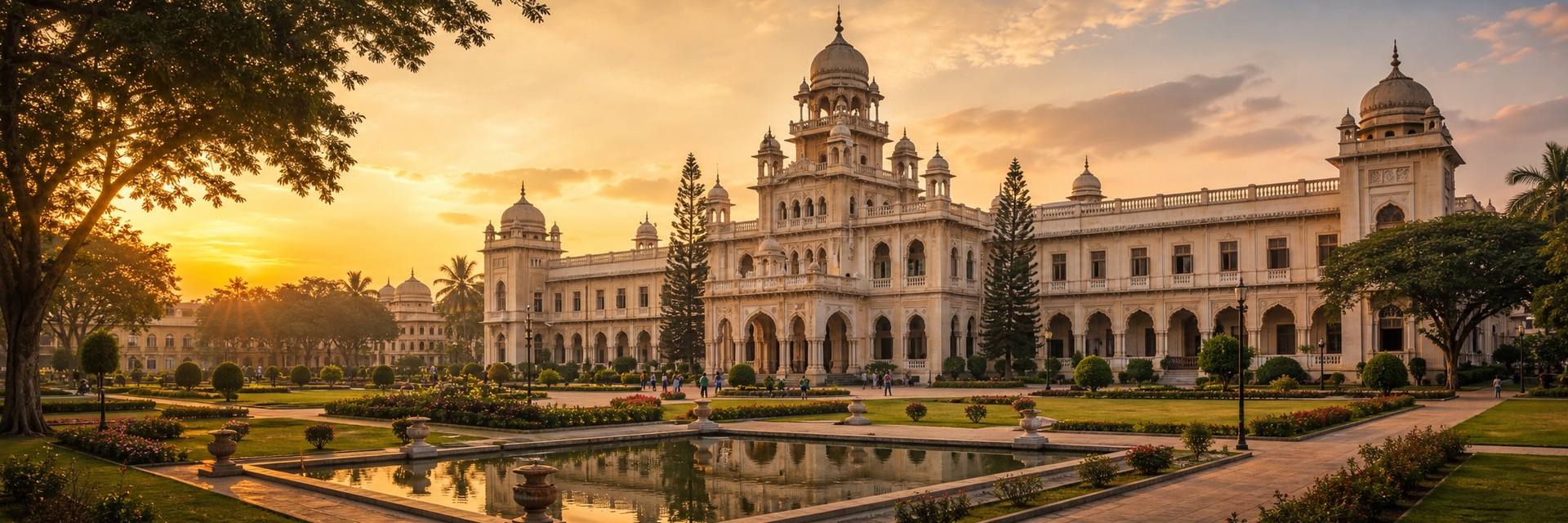
University of Mysore — a century-old academic city
~2 hours
To Bengaluru on the new expressway
Trust or Section 8
The not-for-profit sponsor we build with you first
Turnkey
Sponsor and land to an accredited, admitting institution
At a glance
Establishment routes
Karnataka private-university enabling Act (own degrees); UGC Section 3 deemed-to-be-university; or an affiliated college/institute under the University of Mysore, VTU or RGUHS.
The mandatory sponsor
A not-for-profit — a public trust, a Section 8 company or a registered society — must own and sponsor the institution; no institution can run for profit.
Recognition to secure
UGC 2(f) to be recognised as a university and 12(B) to become eligible for central grants; council approval (AICTE, and the relevant statutory council) per programme.
Accreditation targets
NAAC (institutional grade), NBA (programme accreditation), and an NIRF ranking strategy from the outset.
Why Mysuru
A century of academic pedigree, a low cost base, a growing IT/ITeS presence (the large Infosys Mysore campus), tourism and heritage, and expressway proximity to Bengaluru demand.
Land base
The extended campus a modern residential university needs is available and affordable here in a way the Bengaluru metro can no longer offer.
The opportunity
Mysuru is one of the very few Indian cities that can offer a university founder both academic credibility and cheap, buildable land in the same place. The University of Mysore, established in 1916, was among the first universities in the country, and the professional and postgraduate ecosystem that formed around it — a large body of teaching talent, established schooling, a settled middle class that values education — is exactly the environment a new institution wants to be born into. That pedigree is context, not a competitor: it is what makes recruiting faculty and being taken seriously by regulators and parents materially easier here than in a greenfield location with no academic history.
The commercial logic is the second half of the story. Land inside and around Bengaluru has priced most new residential campuses out; a modern multidisciplinary university needs 25 to 50-plus acres for academic blocks, laboratories, a library, hostels, sports and future phases, and that acreage is available near Mysuru at a fraction of metro cost. With the Bengaluru–Mysuru expressway compressing the journey to roughly two hours, a Mysuru campus can credibly draw students and parents from the Bengaluru catchment — offering a calmer, safer, more affordable residential experience while sitting within reach of the country's deepest graduate employer market.
Mysuru lets a founder buy academic credibility and affordable, buildable campus land in one place — then sell a calm residential experience two hours from India's largest employer market.
Choosing the establishment route — the decision that shapes everything
How you are constituted determines what you may call yourself, what you may award, and how much autonomy you hold — and it must be settled before land, brand or admissions. There is no route by which a private promoter simply 'opens a university'; the pathways are specific and each has a different cost, timeline and control profile.
The first route is a state private university, established by an enabling Act of the Karnataka legislature. This gives you your own degree-granting powers and the freedom to design your own programmes and academic calendar, within the state's regulatory frame and the UGC's norms — the strongest autonomy, but the highest bar of land, corpus, infrastructure and governance to clear before notification. The second is deemed-to-be-university status under Section 3 of the UGC Act, granted by the central government to an institution with a proven academic record — typically a route an established college earns over time rather than a day-one option. The third is to begin as an affiliated college or institute under an existing university — the University of Mysore for arts, science, commerce and management; VTU for engineering and technology; RGUHS for health-sciences programmes — awarding that parent's degrees while you build the track record. We model these against your ambition, capital and time horizon and commit to the pathway before anything downstream is designed.
| Route | Best for |
|---|---|
| Karnataka private university (state Act) | Founders wanting own degree-granting powers and programme freedom, able to meet the land, corpus and infrastructure bar |
| Deemed-to-be-university (UGC Section 3) | An established institution with a strong record seeking university status and autonomy |
| Affiliated college / institute (Mysore / VTU / RGUHS) | A faster, lower-threshold start that awards a parent university's degrees while a record is built |
Indicative route logic — the specific requirements follow the Karnataka enabling framework, the UGC regulations and the affiliating university's statutes in force.
The sponsoring not-for-profit and governance
Every recognised higher-education institution in India must sit under a not-for-profit sponsor — a public charitable trust, a Section 8 company or a registered society — which owns the assets and holds the institution; surpluses must be reinvested, not distributed. The choice between a trust, a society and a Section 8 company is not cosmetic: it drives who controls the board, how succession works, how the corpus is held and how the founding family's intent is protected over decades.
We structure and register the sponsoring body, draft the governing documents and the board architecture, and design the governance the regulators will scrutinise — a Board of Management or Governing Council, an Academic Council, Boards of Studies and a Finance Committee — so the institution is credible to the UGC and the state on the day the application is filed, and durable long after opening.
- Sponsor selection and registration — trust, society or Section 8 company — matched to control and succession intent
- Memorandum, rules and the endowment/corpus structure the route requires
- Statutory governance bodies — Board of Management, Academic Council, Boards of Studies, Finance Committee
- Founder-intent safeguards built into the constitution to survive leadership transition
Recognition, approvals & accreditation — the stack
Recognition is sequenced and each layer unlocks the next. UGC recognition under Section 2(f) establishes you as a university for UGC purposes; 12(B) eligibility, which follows a satisfactory review, opens access to central grants. Professional programmes carry their own gate — AICTE for engineering, management and allied technical programmes, and the relevant statutory council for any regulated field — and these must be secured programme by programme, not once for the institution. We build the whole stack into the programme from day one; the formal filings are made by the sponsor and its appointed experts, and we coordinate and govern them to a recognised, admitting institution.
- UGC 2(f) recognition and, in course, 12(B) eligibility for central funding
- State notification (private-university route) or affiliation grant (college route) with the University of Mysore, VTU or RGUHS
- AICTE approval and the relevant statutory-council approval per professional programme
- NAAC institutional accreditation and NBA programme accreditation planned from the first cohort
- An NIRF ranking strategy — data systems and outcomes tracking built in from year one, not retrofitted
- Anti-Ragging, IQAC, grievance-redressal and mandatory-committee compliance ready before admissions
Academic programme, research and faculty
The academic plan has to answer a specific question in Mysuru: what does a residential university here offer that Bengaluru does not, at a price the market will pay? We distinguish a broad multidisciplinary residential university — a mixed portfolio of sciences, humanities, commerce, design, computing and professional schools, drawing students who want a fuller campus life at a lower cost — from a focused professional institution built around one or two high-demand fields. The two imply different land, laboratory, faculty and accreditation footprints, and the choice must be made deliberately rather than drifted into.
We design the programme portfolio and the credit and curriculum architecture to the NEP 2020 frame — multidisciplinary pathways, multiple entry and exit, the Academic Bank of Credits — and set a research agenda that plays to local strengths: linkages with Mysuru's IT/ITeS base, including the large Infosys campus, and with the heritage, tourism, life-sciences and manufacturing economy of the region. Faculty is where Mysuru's academic tradition pays off, and we run the recruitment of the Vice-Chancellor or Director, the deans and the founding professoriate through our search practice, building a plan that draws on the city's own teaching depth alongside national and returning talent.
- Multidisciplinary residential university versus focused professional institution — chosen against demand and cost
- NEP 2020-aligned curriculum, credit framework and Academic Bank of Credits from launch
- A research and industry-linkage agenda tied to Mysuru's IT/ITeS, heritage and manufacturing base
- Vice-Chancellor, deans and founding faculty recruited through our executive-search practice
Campus, laboratories, technology & admissions
The physical university is where Mysuru's cost advantage becomes real. We brief and govern a phased master plan across academic blocks, laboratories, a library, hostels and sports on land that would be unaffordable at metro prices — designed for the UGC's built-up-area and facility norms, for the discipline mix, and for a growth curve that does not strand capital in unused blocks. Laboratory and specialist infrastructure is specified to the accreditation standard of each programme, so NBA and council reviews are cleared on the first attempt rather than remediated later.
We run the full procurement programme — laboratory and workshop equipment, library, IT and campus network, the academic ERP and learning-management systems, and the outcomes and analytics platform an NIRF strategy depends on — with independent vendor intelligence. And we stand up the admissions and student-recruitment engine deliberately built to capture the Bengaluru-adjacent catchment the expressway now brings within reach, so the first cohorts arrive at the standard and scale the financial model assumes.
Gladwin's edge in Mysuru
We treat establishing a university as the constitutional, regulatory and academic programme it actually is — not a construction project with a nameplate. Before land is committed we settle the establishment route, structure the sponsoring not-for-profit, and map the UGC, state, AICTE and council pathway against your ambition and capital. Then we run the sponsor set-up, the recognition and accreditation stack, the academic and research design, the campus and laboratories, procurement, the PMO, and the leadership and faculty search as one accountable partner, all the way to an admitting, accredited institution.
We also read Mysuru precisely: the affordable, buildable land base, the century-old faculty tradition to recruit into, the IT/ITeS and heritage economy to link research and employability to, and the two-hour expressway that lets a Mysuru campus credibly compete for Bengaluru demand. The academic leadership and founding professoriate we hire are recruited to hold that promise from the first cohort.
Planning a university or higher-education institution in Mysuru?
We take single accountability from a sponsoring trust and a plot of land to a running, accredited institution — the university-establishment pathway, UGC/AICTE and council approvals, NAAC/NBA/NIRF accreditation, academic programme and research development, campus and labs, procurement, PMO, leadership and faculty search, governance, SOPs, technology and admissions. The team is recruited through our executive search practice and trained for opening.
Speak with a partnerSetting up a university or higher-education institution in Mysuru — FAQs
Three, with very different profiles. A Karnataka private university is established by a state enabling Act and gives you your own degree-granting powers, subject to meeting the land, corpus, infrastructure and governance bar. Deemed-to-be-university status under Section 3 of the UGC Act is granted centrally to an institution with a proven record — usually earned over time, not a day-one option. Or you can begin as an affiliated college or institute under the University of Mysore, VTU or RGUHS, awarding that parent's degrees while you build a track record. We model the three against your ambition, capital and timeline and commit before anything downstream is designed.
Yes. Every recognised institution must sit under a not-for-profit sponsor — a public trust, a Section 8 company or a registered society — which owns the assets, and surpluses must be reinvested rather than distributed. The choice between the three affects board control, succession and how the corpus is held, so we structure and register the sponsor and draft the governance before the application is filed.
Section 2(f) recognises you as a university for UGC purposes, and 12(B) eligibility — which follows a satisfactory review — opens access to central grants. NAAC is institutional accreditation (a grade for the whole institution), NBA is programme-level accreditation for professional courses, and NIRF is the national ranking framework. We plan all of these from the first cohort, including the outcomes and data systems an NIRF strategy needs, rather than retrofitting them later.
Cost, land and liveability, without giving up demand. Mysuru offers the 25–50-plus acres a modern residential university needs at a fraction of Bengaluru prices, a century-old academic tradition and faculty pool to recruit into, and a calm, safe residential setting — while the Bengaluru–Mysuru expressway keeps you roughly two hours from India's largest student and employer market. A Mysuru campus can credibly draw Bengaluru-adjacent demand at a buildable cost the metro can no longer offer.
They are different businesses. A broad multidisciplinary residential university spans sciences, humanities, commerce, design, computing and professional schools and sells campus life at a lower cost than the metro; a focused professional institution concentrates on one or two high-demand fields with a tighter land, laboratory and accreditation footprint. We choose deliberately against the demand you are targeting and the capital you can commit, because the two imply very different campuses, faculty and approvals.
Yes — it is core. We recruit the Vice-Chancellor or Director, the deans and the founding professoriate through our executive-search practice, building a plan that draws on Mysuru's own deep teaching tradition alongside national and returning talent, so academic leadership is in seat and the standard is set before the first cohort arrives.
Explore the cluster
Universities & higher-education institutions across South India
Karnataka · Metro
Bengaluru
Bengaluru is India's deep-tech and research capital — the one Indian city where a new university can be built around live industry, not away from it.
Karnataka · Coastal
Mangaluru
Mangaluru is coastal Karnataka’s education powerhouse — a nationally significant health-sciences destination whose medical, dental and nursing campuses draw students from across India and the Gulf.
Karnataka · University Town
Manipal
Manipal is the proof that a university need not sit inside a city — it can build its own town. Establishing one here is a township problem before it is a campus one.
Also explore our executive search practice for the leadership team, and the wider end-to-end education practice.