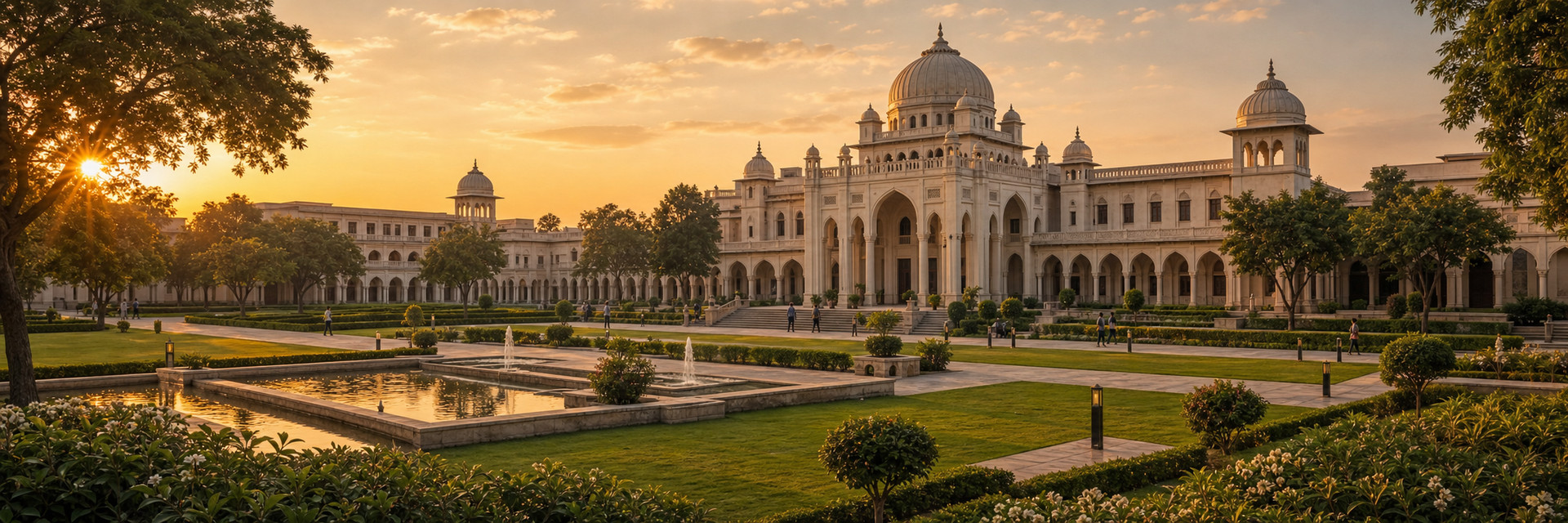
Higher Education & Universities · Uttar Pradesh · Capital
Setting Up a University or Higher-Education Institution in Lucknow
Lucknow is the capital of India's largest state — the rare Indian city where a serious new university faces an enormous, education-hungry catchment and remarkably little competition for it.
Uttar Pradesh sends more school-leavers into higher education each year than any state in the country, and far too few of them are met by an institution worth crossing the state for. That is the founder's opening in Lucknow: not a saturated metro to fight into, but a vast, under-served market anchored by a governance, health-sciences, IT and defence-corridor economy — with the University of Lucknow, KGMU, SGPGIMS and IIM Lucknow setting the reference points. The work is to choose the right vehicle to hold the institution (a charter under the Uttar Pradesh Private Universities Act, UGC deemed status, or an affiliated college under AKTU or the University of Lucknow), clear the UGC, AICTE and professional-council gates, and secure developable land on the outer ring where a real campus is still affordable. Gladwin International runs the whole journey as one accountable programme — from a sponsoring society and a shortlist of sites to a recognised, accredited institution taking its first admissions.
Three routes
UP Private Universities Act, UGC deemed, or affiliated college
2(f) & 12(B)
The UGC recognition that confers legitimacy and grant eligibility
Largest catchment
India's most populous state, an under-served first-mover market
Turnkey
Sponsoring society to first cohort admitted
At a glance
Establishment routes
A charter under the Uttar Pradesh Private Universities Act; UGC Section 3 deemed-to-be-university status; or a college affiliated to AKTU (Dr A.P.J. Abdul Kalam Technical University, for engineering and technology), the University of Lucknow (arts, science, commerce) or the relevant state health-sciences university.
Core regulators
UGC (recognition, norms), AICTE (technical), plus the relevant professional council — PCI, COA, BCI, NMC/DCI/INC, VCI or NCTE — by discipline, alongside the UP higher-education department.
Accreditation & ranking
NAAC (institutional grade), NBA (programme-level, professional streams), and NIRF as the national reputational benchmark.
Sponsoring body
A not-for-profit — a registered Society, a Public Charitable Trust, or a Section 8 company — must own the assets and run the institution.
Where campuses land
The Sultanpur Road and Shaheed Path outer-ring belt, the Sitapur Road and Kanpur Road corridors, and the Amethi–Raebareli axis — where 25–50-acre footprints remain affordable and title can be cleaned.
The Lucknow edge
A capital-city economy — state governance, health sciences, an emerging IT city and the UP Defence Industrial Corridor — feeding an enormous, first-mover student catchment across Awadh and eastern UP.
The opportunity — why Lucknow, and for whom
Lucknow is the seat of government of the most populous state in India, and everything about its higher-education prospects follows from that scale. Uttar Pradesh produces the country's single largest cohort of school-leavers, and the supply of credible, well-run institutions has never come close to matching it. Where Bengaluru or Pune is a market a founder must fight into, Awadh and eastern UP are a market a founder can genuinely open — the demand is present, the alternatives are thin, and a serious institution built here does not need to displace an incumbent to fill its seats. The capital already carries real academic weight: the University of Lucknow among the oldest in the country, KGMU and SGPGIMS setting the standard in medicine and health sciences, and IIM Lucknow anchoring management education. But these are reference points, not a crowd.
The catchment is regional and deep rather than national and thin: students from across Awadh, Rohilkhand, Bundelkhand and the eastern districts look to the capital for the degree and the job market that a capital city implies. That shapes the entry decision. The winning move is not to build a boutique institution for a metro elite, but a scaled, employability-first institution that serves a large under-met demand credibly. The first question is still the defining one — a multidisciplinary or health-sciences university, or a focused technology and professional institution — because that single choice drives the legal vehicle, the land, the faculty and the capital plan, and a health-sciences university and a technology institution are two very different undertakings in this city.
Lucknow's advantage is not prestige-density — it is a vast, under-served catchment. The differentiator here is reach and outcome: an institution that serves the scale of UP's demand credibly, not one that merely looks the part.
Choose the vehicle — UP Private Universities Act, UGC deemed, or affiliated college
Every downstream decision — degree-granting power, autonomy, capital, timeline and land — flows from which of three legal vehicles you adopt, and this is the first thing we resolve with you. A private university in Uttar Pradesh is established under the Uttar Pradesh Private Universities Act, the State's standing enabling framework: rather than a fresh Act for each institution, a sponsor is chartered under the existing law once it meets the Act's land, corpus-fund, infrastructure and sponsoring-body conditions, and the university then grants degrees in its own name from inception. A deemed-to-be-university is conferred by the Central Government under Section 3 of the UGC Act on the advice of UGC, but it is granted to an institution of proven standing — a maturation path rather than a standing start.
The third route is an affiliated college: you establish a college that grants degrees under an existing affiliating university — AKTU (Dr A.P.J. Abdul Kalam Technical University) at Lucknow for engineering, technology, management, pharmacy and architecture, the University of Lucknow for arts, science and commerce, or the relevant state health-sciences university for medical, dental, nursing and allied-health streams. It is the fastest and lightest-capital way in, and the natural starting point for a focused professional institution, but you inherit the affiliating body's syllabus, examinations and autonomy limits. We model the three against your ambition, capital and horizon — and, where the plan is a college now and a university later, we structure the society and the campus so an affiliated college can graduate into deemed or private-university status without being rebuilt.
| Route | Degree-granting | Best for |
|---|---|---|
| UP Private Universities Act charter | In its own name, from inception | A well-capitalised multidisciplinary or health-sciences university with autonomy from day one |
| UGC Section 3 deemed status | In its own name, once conferred | A maturing institution of standing seeking autonomy and research depth |
| Affiliated college (AKTU / University of Lucknow) | Under the affiliating university | A focused technology or professional institution — fastest, lightest-capital entry |
The three establishment routes — indicative; the right vehicle depends on your capital, horizon and degree-granting ambition.
The recognition, approval and accreditation stack
Whichever vehicle you choose, recognition is what makes the institution real. UGC recognition under Section 2(f) brings the institution within the University Grants Commission's ambit; inclusion under Section 12(B) confers eligibility for central grants and is, in practice, the reputational threshold serious partners and students look for. Professional programmes then carry a second layer of statutory approval that must be secured before intake: AICTE for engineering, management, pharmacy and architecture programmes, and the discipline's council — the Pharmacy Council of India, the Council of Architecture, the Bar Council of India for law, the National Medical, Dental or Nursing Councils for health sciences, the Veterinary Council, or NCTE for teacher education. In UP the higher-education department is an active gatekeeper at each stage, and its conditions are best met by design rather than by remedy.
Accreditation is where the market forms its judgement. NAAC grades the institution, NBA accredits individual professional programmes, and NIRF has become the national scoreboard — the benchmark against which a Lucknow institution earns the right to draw students from beyond its immediate districts. In an under-served market a credible, sequenced accreditation path is exactly what separates a scaled institution from an assembled one, and it is what lets a new name pull applicants from across the state. We build the approval calendar backwards from your target first-intake, so the AICTE and council sanctions, the charter or affiliation, and the accreditation readiness are all standing when admissions open — and we govern each licensed filing to that date.
- UGC recognition — Section 2(f) inclusion and the Section 12(B) grant-eligibility threshold
- AICTE approval for technical programmes; the relevant council (PCI, COA, BCI, NMC/DCI/INC, VCI, NCTE) by discipline
- A charter under the UP Private Universities Act, the deemed-status process, or affiliation with AKTU / University of Lucknow
- NAAC (institutional), NBA (programme-level) and a deliberate NIRF-readiness trajectory
- Uttar Pradesh higher-education-department clearances, land use and building approvals for the campus
The sponsoring society, the land and the campus
Indian higher education is not-for-profit by law, so the institution must sit under a not-for-profit sponsoring body — a Society registered under the Societies Registration Act, a Public Charitable Trust, or a Section 8 company — which owns the land and assets and carries the governance. The UP Private Universities Act is specific about the sponsoring body's standing, its corpus and reserve-fund commitments, and its infrastructure obligations, and UGC and AICTE scrutinise the same structure. Getting the object clauses and the governing-council composition right at the outset matters, because it is expensive to restructure later. We establish or reshape the sponsoring society, the corpus and endowment arrangements, and the governance framework to withstand that scrutiny.
Land in Lucknow is a real constraint but, unlike a saturated metro, still a workable one. A university needs a substantial contiguous holding to meet the State's and UGC's norms, and while land close to the historic core prices steeply, the outer ring does not. The serious new campuses have moved to the Sultanpur Road and Shaheed Path belt, the Sitapur Road and Kanpur Road corridors, and the Amethi–Raebareli axis — where a 25-to-50-acre footprint is affordable and still within reach of the catchment and the airport. We resolve title, land-conversion (from agricultural use where required) and zoning against the UP framework, and master-plan the campus, laboratories, hospital or teaching facilities, libraries and residences in phases matched to enrolment, so capital is not sunk into empty buildings ahead of demand.
Academic programme, research and faculty
The academic plan is where a Lucknow institution earns the reach to draw students from across the state rather than only its own districts. We design the programme architecture — the schools, the degrees, the specialisations and the research centres — to serve the capital's economy and its catchment's aspirations: health sciences and allied health where the city already leads through KGMU and SGPGIMS, computer science, data and IT for an emerging IT-city economy, engineering and manufacturing aligned to the UP Defence Industrial Corridor, and management, law, agriculture, education and the applied sciences that a large regional population most needs and most under-consumes. NEP 2020's push toward multidisciplinary, credit-mobile, research-embedded institutions gives a well-designed new university room to differentiate on breadth and outcome from its first year.
None of it works without faculty, and this is the practical test in a capital city rather than a metro academic hub. UGC norms govern cadre ratios, qualification and NET/PhD requirements, student-faculty ratios and the professor-associate-assistant structure. Lucknow's own academic and clinical base — around the University of Lucknow, KGMU, SGPGIMS and the IIM — provides an anchor, and part of our work is drawing talent back to a capital that many left for lack of institutions worth staying for. We build the faculty plan to UGC norms, run the leadership and senior-faculty search through our executive-search practice, and set up the research infrastructure, funding pathways, industry-and-hospital-linked chairs and foreign-university academic collaborations — twinning, joint and dual-degree partnerships under the UGC framework — that a credible institution needs to be taken seriously.
- Programme and school architecture designed for health sciences, IT, defence-corridor engineering and a large regional catchment
- Faculty plan built to UGC cadre, qualification and student-faculty-ratio norms
- Leadership, dean and senior-faculty search through our executive-search practice
- Research centres, sponsored chairs and foreign-university joint / dual / twinning partnerships
- Laboratory, teaching-hospital, library and technology specification matched to programme accreditation standards
Industry linkage, employability and admissions
In an under-served market, the outcome is the whole argument: families in UP will back a new institution that visibly turns a degree into a livelihood. Lucknow gives a founder credible ground to build that on — a large state-government and public-sector employer base, a health and hospital ecosystem hungry for clinical and allied-health talent, an emerging IT city, and the UP Defence Industrial Corridor drawing manufacturing and engineering investment into the region. We structure the industry-linkage framework — advisory boards, co-designed and apprenticeship-embedded curricula, hospital and corporate placement tie-ups, sponsored research and chairs, and an incubation and entrepreneurship pathway — so that employability is an engineered outcome rather than a promise, and the institution's reputation compounds from its first graduating cohorts.
Finally, admissions. The opportunity in Lucknow is scale, and a new institution must convert an enormous but discerning regional demand into a strong, well-matched first cohort. That is a reach, trust and go-to-market problem across the districts as much as an academic one. We build the admissions strategy, the counselling and outreach engine tuned to the Awadh and eastern-UP catchment, the scholarship and financial-aid architecture that matters in a price-sensitive market, the digital enrolment technology, and the student-information and learning-management systems — and we align fee positioning to the regulated fee structures and the value families will actually pay, so the institution opens with a full, well-matched first cohort rather than an empty prospectus.
Gladwin's edge in Lucknow
We treat a Lucknow institution as the vehicle, land and recognition problem it actually is — and as a first-mover play in the country's largest under-served market. Before capital is committed we settle the fork — a UP Private Universities Act charter, deemed status, or an AKTU / University of Lucknow affiliated college — structure the not-for-profit sponsoring society and governance to the Act's standards, and secure land on the Sultanpur Road, Sitapur Road and outer-ring corridors where a real campus is affordable and title is clean. Then we sequence the UGC 2(f)/12(B) recognition, the AICTE and council approvals, and the NAAC / NBA / NIRF accreditation path backwards from your target first-intake, and govern every licensed filing to that date as one accountable partner.
Our differentiator is fit to the market. We build the academic programme, the research centres and the placement engine around what UP actually needs and rewards — health sciences, IT, defence-corridor engineering, management and the applied disciplines — and hire the founding leadership and faculty to UGC norms through our executive-search practice, so the institution opens recognised, accredited-ready, staffed and connected to a catchment that has been waiting for it, not merely built.
Planning a university or higher-education institution in Lucknow?
We take single accountability from a sponsoring trust and a plot of land to a running, accredited institution — the university-establishment pathway, UGC/AICTE and council approvals, NAAC/NBA/NIRF accreditation, academic programme and research development, campus and labs, procurement, PMO, leadership and faculty search, governance, SOPs, technology and admissions. The team is recruited through our executive search practice and trained for opening.
Speak with a partnerSetting up a university or higher-education institution in Lucknow — FAQs
It depends on your capital, horizon and degree-granting ambition. A private university in UP is chartered under the standing Uttar Pradesh Private Universities Act once you meet its land, corpus and sponsoring-body conditions, and grants degrees in its own name from inception. UGC Section 3 deemed status is conferred on an institution of proven standing, so it is a maturation path rather than a standing start. An affiliated college under AKTU or the University of Lucknow is the fastest, lightest-capital entry — ideal for a technology or professional institution — but you work within the affiliating body's syllabus and autonomy. We model all three against your plan, and can structure a college now to graduate into university status later.
The opposite. Lucknow is the capital of Uttar Pradesh, which produces the largest cohort of school-leavers of any Indian state, and the supply of credible institutions has never matched it. Where a metro is a market you fight into, Awadh and eastern UP are a market you can open — the demand is present and the alternatives are thin. The advantage here is reach and scale, so the entire plan, from programme mix to fee positioning, is built to serve a large, under-met regional demand credibly rather than to court a metro elite.
Section 2(f) brings the institution within the University Grants Commission's recognition, and Section 12(B) confers eligibility for central grants. In practice, 12(B) status is the reputational threshold serious students and partners look for. The path to each depends on your vehicle and maturity, and we build it into the establishment programme from the outset rather than treating it as an afterthought.
On the outer ring, where land is affordable and holdings large enough to meet State and UGC norms are still available. The serious footprints — 25 to 50 acres — sit along the Sultanpur Road and Shaheed Path belt, the Sitapur Road and Kanpur Road corridors, and the Amethi–Raebareli axis, all within reach of the catchment and the airport. We resolve title, agricultural-land conversion and zoning against the UP framework, and master-plan the campus in phases matched to enrolment.
Beyond UGC recognition and your charter or affiliation, technical programmes need AICTE approval, and each discipline needs its statutory council's sanction — engineering flows through AICTE and AKTU affiliation, health sciences through the relevant medical, dental or nursing council and the state health-sciences university, pharmacy through PCI, architecture through COA, and law through the Bar Council of India. We sequence every sanction backwards from your target first-intake so they are all standing when admissions open.
Yes — both are core. We build the faculty plan to UGC cadre, qualification and student-faculty-ratio norms and run the Vice-Chancellor, Registrar, dean and senior-faculty search through our executive-search practice, drawing talent back to the capital. On the front end, we build the admissions strategy, the outreach and counselling engine tuned to the Awadh and eastern-UP catchment, the scholarship architecture, the enrolment technology and student-information systems, so the institution opens fully staffed and with a strong, well-matched first cohort.
Explore the cluster
Universities & higher-education institutions across South India
Uttar Pradesh · Ganga Plain
Kanpur
Kanpur is central Uttar Pradesh's industrial and engineering-education heavyweight — a city where a serious institution can be built with room to grow and a manufacturing base to plug into.
NCR · Uttar Pradesh
Greater Noida
Greater Noida was master-planned as the NCR's Education City — the one place in India where the land was set aside for universities before the universities arrived.
Bihar · Ganga Plain
Patna
Patna sits on India's largest under-served student catchment — the one major state capital where a serious institution is still a first-mover, not a late arrival.
Also explore our executive search practice for the leadership team, and the wider end-to-end education practice.