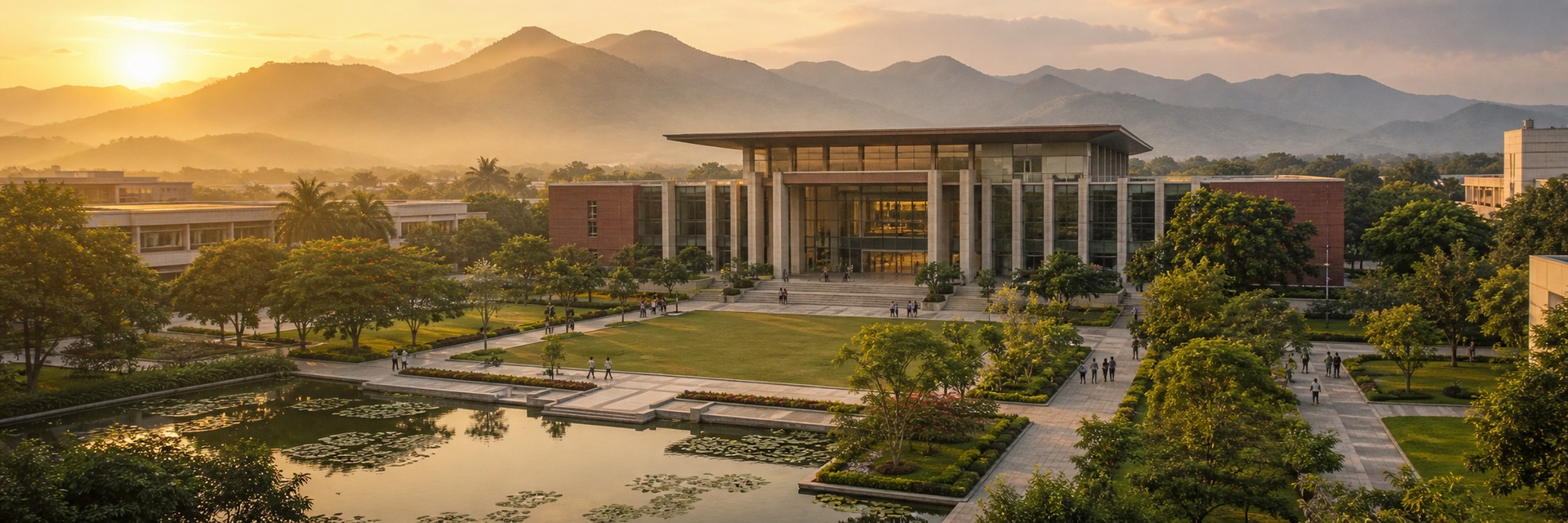
Higher Education & Universities · Tamil Nadu · Industrial
Setting Up a University or Higher-Education Institution in Coimbatore
Coimbatore is where an Indian technology institution can still be built on real industry — the Kongu belt gives you the placements, the founders and the land that Chennai no longer does.
The Manchester of South India educates its engineers next to the pump foundries, knitwear mills and precision-machining shops that will hire them — a rare closeness of classroom and factory. But an institution here is won or lost long before the first prospectus: on choosing the right legal vehicle (a Tamil Nadu private university, a UGC-declared deemed university, or an affiliated college under Anna or Bharathiar), on standing up a credible sponsoring not-for-profit, and on clearing the UGC, AICTE and professional-council stack in sequence. Gladwin International runs the whole journey as one accountable programme — from a sponsoring trust and a plot of Kongu land to a recognised, accredited, admitting institution.
University or college
The vehicle we choose with you first
Industry-linked
Textiles, pumps and precision engineering next door
Land that prices
Ample campus land at a fraction of Chennai
Trust to admissions
Single accountability, end to end
At a glance
The establishment routes
State private university (Tamil Nadu Private Universities Act, 2019); UGC deemed-to-be under Section 3 of the UGC Act; or an affiliated college.
The affiliating universities
Engineering and technology under Anna University; arts, science and most other disciplines under Bharathiar University (Coimbatore's territorial university).
The market context
PSG, Kumaraguru (Anna-affiliated, autonomous) and the deemed universities Amrita Vishwa Vidyapeetham and Karunya set the local benchmark.
Recognition & grants
UGC 2(f) brings the institution under UGC purview; 12(B) opens eligibility for central grants; NAAC, NBA and NIRF carry the reputation.
Why the Kongu belt
A large western-Tamil-Nadu and Kerala-border catchment, a deep philanthropic education-trust tradition, cooler foothill climate and genuine employability.
Professional councils
AICTE for technical programmes; PCI, COA, BCI, NMC, INC, NCTE and others by discipline; Tamil Nadu essentiality / NOC for professional courses.
Why Coimbatore
Coimbatore is one of the few Indian cities where higher education and industry genuinely feed one another. The Kongu belt runs on manufacturing — India's pump and motor capital, the wet-grinder and foundry cluster, textile mills stretching to the Tiruppur knitwear economy, and a dense mesh of precision-engineering and automotive-component MSMEs. That base gives a technology institution what a metro campus struggles to buy: real internships, near-campus placements, industry-funded projects, and a founder culture that turns graduates into employers. Employability here is not a placement-cell slogan; it is the ecosystem next door.
The catchment is large and loyal. Coimbatore draws students from across western Tamil Nadu — Tiruppur, Erode, Salem, Namakkal, Dindigul and the Nilgiris — and across the porous Kerala border from Palakkad and Thrissur, a belt with a strong appetite for professional education and a tradition of studying close to home. The city sits at the foothills of the Western Ghats, so the climate is cooler and the setting greener than the plains, which residential campuses and parents both value. And unlike Chennai, land is still available at scale and at a price that lets a campus master-plan for decades rather than squeeze a tower onto a plot.
In Coimbatore the argument for a technology institution is not aspiration — it is the pump shop, the mill and the machining cluster within a lorry-ride of the campus gate.
Choosing the vehicle — university or college
The single most consequential decision is the legal form of the institution, because it fixes your degree-granting rights, your regulator, your autonomy and your timeline for the next twenty years. Three routes are open, and they are not interchangeable. A state private university is established by, and named in, an Act under the Tamil Nadu Private Universities Act, 2019 — it can grant its own degrees from day one but must be sponsored by an eligible not-for-profit, meet the state's land, corpus and infrastructure norms, and clear the legislative process. A deemed-to-be-university is declared by the Ministry of Education on the University Grants Commission's recommendation under Section 3 of the UGC Act, 1956 — the path that Amrita Vishwa Vidyapeetham (whose flagship campus is in Coimbatore) and Karunya took — and typically expects an established, high-quality institutional track record before it is granted.
The third route is an affiliated college: you run degree programmes under the umbrella and ordinances of a parent university, with degrees awarded in that university's name. In Coimbatore the affiliating map matters — engineering and technology affiliate to Anna University, while arts, science, commerce and most other disciplines affiliate to Bharathiar University, the city's territorial university. Strong colleges (PSG College of Technology, Kumaraguru among them) later earn autonomous status under their affiliating university, which restores much of the academic freedom of a university without the full establishment burden. We size all three against your ambition, capital and time horizon before a rupee is committed to buildings.
| Route | Best when you want |
|---|---|
| State private university (TN Act, 2019) | Own degree-granting power and a multidisciplinary campus, built de novo |
| Deemed-to-be-university (UGC Sec. 3) | University status grown from a proven, high-quality existing institution |
| Affiliated college (Anna / Bharathiar) | A faster, lower-threshold start in a defined discipline, autonomy later |
The three establishment routes — the choice sets your regulator, autonomy and timeline. Indicative; each is subject to the prevailing UGC and Tamil Nadu norms.
The sponsoring not-for-profit and UGC recognition
Every legitimate route runs through a not-for-profit sponsoring body — a public charitable trust, a Society, or a Section 8 company — and Coimbatore has one of India's deepest traditions of exactly this: the industrialist-philanthropist education trust, where a manufacturing family or community endows an institution and governs it for the long term. We structure the sponsoring vehicle so that objects, governance, board composition, related-party rules and the financial firewall between promoter and institution satisfy both the regulator and your own succession intentions.
Recognition is a distinct layer from establishment. UGC recognition under Section 2(f) formally brings an institution within the Commission's purview, and 12(B) status opens eligibility to receive grants from central agencies — both carry weight with faculty, funders and ranking bodies. Reputation then rests on the accreditation triad: NAAC institutional accreditation (the grade parents read), NBA programme accreditation (essential for engineering credibility and for graduate mobility), and an NIRF ranking that a technology institution in this city will be measured against from its earliest cohorts. We build the data systems, the IQAC and the evidence trail for these from the founding year, not retrofitted before a peer-team visit.
- Sponsoring trust / Society / Section 8 structuring, governance and financial firewall
- UGC 2(f) and 12(B) recognition pathways sequenced against the chosen route
- NAAC, NBA and NIRF readiness — IQAC, data architecture and evidence from year one
- Promoter-succession and long-term board continuity designed in, Kongu-trust style
Approvals & the regulatory stack
A higher-education institution carries a sequenced approvals stack, and the order is unforgiving — miss a step and an admitting deadline slips a full academic year. Technical programmes (engineering, management, pharmacy, architecture, applied computing) require AICTE approval; discipline-specific councils govern their own — the Pharmacy Council of India, the Council of Architecture, the Bar Council of India, the National Medical Commission, the Indian Nursing Council, the NCTE for teacher education, and the AYUSH councils each with their own norms. Professional courses in Tamil Nadu also need state clearance — an essentiality certificate and a No-Objection Certificate from the Government of Tamil Nadu — before the central council and the affiliating university will proceed.
We map this into a single critical path aligned to the admissions calendar and, for Tamil Nadu professional courses, to the state's centralised counselling (TNEA for engineering) that most of your seats will fill through. Statutory filings are made by your appointed architects, lawyers and chartered engineers; we coordinate, govern and expedite them to a recognised, admitting institution.
- AICTE approval for technical programmes; council approvals (PCI, COA, BCI, NMC, INC, NCTE, AYUSH) by discipline
- Affiliation / inspection with Anna University or Bharathiar University for the college route
- Tamil Nadu essentiality certificate and government NOC for professional courses
- Land use, CMDA/DTCP planning, building, fire and pollution-control consents for the campus
- Admissions integration — including TNEA state counselling for engineering seats
Programmes, faculty & research — the academic engine
The academic identity has to be decided deliberately, because Coimbatore rewards focus. An engineering-and-technology institution plays to the city's core strength and its industry mesh; a multidisciplinary university broadens into management, sciences, design, law and liberal arts; a health-sciences institution is a wholly different regulatory and capital animal governed by the NMC or its allied councils and paired with a teaching hospital. We frame the programme portfolio around real regional demand and differentiation — not a generic catalogue — and build in the applied, industry-facing strands (advanced manufacturing, textile and materials technology, mechatronics, applied AI and data, agri- and food technology) where the Kongu economy gives you an unfair advantage.
Faculty is the hardest resource and the one we start earliest. We build the recruitment plan against AICTE and UGC cadre and qualification norms — the professor-to-student ratios, the doctoral-qualified share, the department leadership — and run the searches through our executive-search practice, drawing on the strong existing academic base in the city and returning talent from the metros and abroad. Research and industry linkage are designed as one: MoUs and sponsored projects with the pump, textile and precision-manufacturing clusters, incubation and an entrepreneurship cell that fits a city that already mints founders, and consultancy that funds laboratories and keeps faculty current.
Decide the institution's DNA up front — a technology institute, a broad university, or a health-sciences campus. Each carries a different regulator, capital profile and faculty market; conflating them is the most expensive early mistake.
Campus, laboratories, technology & admissions
Land is Coimbatore's quiet advantage, and we use it to plan properly. Rather than a vertical squeeze, a Kongu campus can be master-planned in phases — academic blocks, laboratories and workshops, a library, residential hostels, sports and staff housing — sited on the periphery where DTCP-approved parcels remain affordable and expansion room is real. We resolve title, land-use conversion, planning and the environmental and fire consents before construction, and phase the build so the institution can open and grow without stranding capital.
Laboratories and technology are where a credible technology institution is made or exposed. We specify and procure the engineering workshops, materials and testing labs, computing and design studios, and the specialist facilities your programmes and the councils require — through independent vendor intelligence, not a supplier's catalogue. In parallel we stand up the digital spine that a modern institution runs on: the ERP and academic-management system, the learning-management platform, the library and research systems, the campus network and security, and the admissions engine. Then we design and run the first admissions cycle end to end — brand and positioning against a city of established names, the counselling and TNEA integration, and the recruitment funnel — so the founding cohort arrives at the standard the institution intends to keep.
- Phased campus master-plan on affordable, expandable peripheral Kongu land
- Engineering workshops, testing and computing labs specified and independently procured
- ERP, LMS, library, network, security and admissions technology stack stood up
- Founding-cycle admissions, branding and TNEA/counselling integration run end to end
Gladwin's edge in Coimbatore
We treat a Coimbatore institution as the establishment, recognition and industry-linkage problem it actually is. Before ground is broken we choose the right vehicle — Tamil Nadu private university, UGC deemed status, or an Anna- or Bharathiar-affiliated college — structure the sponsoring not-for-profit in the city's own long-endowment tradition, and sequence the UGC 2(f)/12(B), AICTE and council stack against the admissions calendar. Then we run the campus, the laboratories, the technology, the faculty and leadership search, the governance and SOPs, and the founding admissions cycle as one accountable partner.
Our advantage here is that we design for employability from the outset, because the city lets us. We wire the institution into the pump, textile and precision-manufacturing clusters that surround it — internships, sponsored research, an incubation and entrepreneurship cell, and a placements strategy anchored in genuine local demand — so the institution's first graduates land in an economy that was built to hire them.
Planning a university or higher-education institution in Coimbatore?
We take single accountability from a sponsoring trust and a plot of land to a running, accredited institution — the university-establishment pathway, UGC/AICTE and council approvals, NAAC/NBA/NIRF accreditation, academic programme and research development, campus and labs, procurement, PMO, leadership and faculty search, governance, SOPs, technology and admissions. The team is recruited through our executive search practice and trained for opening.
Speak with a partnerSetting up a university or higher-education institution in Coimbatore — FAQs
It depends on your capital, ambition and time horizon. A Tamil Nadu private university (under the 2019 Act) or a UGC deemed-to-be-university grants its own degrees but carries higher land, corpus and process thresholds; an affiliated college under Anna University (engineering/technology) or Bharathiar University (arts, science and others) is a faster, lower-threshold start in a defined discipline, with autonomous status earnable later. We model all three against your plan before you commit to buildings.
A deemed-to-be-university is declared by the Ministry of Education on the UGC's recommendation under Section 3 of the UGC Act, and generally expects a proven, high-quality existing institution — the route Amrita and Karunya took in this city. A state private university is created by an Act under the Tamil Nadu Private Universities Act, 2019, can be built de novo, and is regulated by the state within UGC norms. They differ in regulator, threshold and how much track record you need first.
Section 2(f) recognition formally brings an institution within the UGC's purview, and 12(B) status makes it eligible to receive grants from central agencies. They are distinct from the establishment/affiliation step and carry real weight with faculty, funders and ranking bodies. We sequence both against your chosen route so they are secured rather than chased later.
Technical programmes need AICTE approval; the college route also needs affiliation and inspection by Anna University; professional courses need a Tamil Nadu essentiality certificate and government NOC; and specialist disciplines add their own councils (PCI, COA, NMC, INC, NCTE, AYUSH). Campus approvals cover land use, DTCP/planning, building, fire and pollution control. We map the whole stack to the admissions calendar and the TNEA counselling cycle.
Three reasons. Industry linkage: the pump, textile and precision-manufacturing clusters give genuine internships, placements and sponsored research on the doorstep. Land: campus-scale, expandable parcels remain available at a fraction of Chennai prices, so you can master-plan for decades. And catchment: a large, loyal western-Tamil-Nadu and Kerala-border student belt, in a cooler foothill setting that residential campuses and parents value.
Yes, both are core. We build the faculty plan against AICTE and UGC cadre and qualification norms and run leadership and faculty search through our executive-search practice, drawing on the city's strong academic base and returning metro and overseas talent. We then design and run the founding admissions cycle end to end — positioning against a city of established names, the recruitment funnel, and integration with state counselling such as TNEA for engineering seats.
Explore the cluster
Universities & higher-education institutions across South India
Tamil Nadu · South
Madurai
Madurai anchors an under-served southern Tamil Nadu that still sends its brightest students north — the clearest first-mover case in the state for a serious regional university.
Tamil Nadu · Central
Tiruchirappalli
Tiruchirappalli is central Tamil Nadu’s education engine — an engineering-and-management city with a deep faculty pool, a delta-wide catchment and land economics a metro can’t match.
Tamil Nadu · Metro
Chennai
Chennai is one of India’s deepest higher-education economies — an engineering, medical and technology city that now lets private universities in alongside its historic affiliated-college model.
Also explore our executive search practice for the leadership team, and the wider end-to-end education practice.