Destination · Karnataka · Nilgiri biosphere
Luxury Wellness Resorts in Kabini & BR Hills
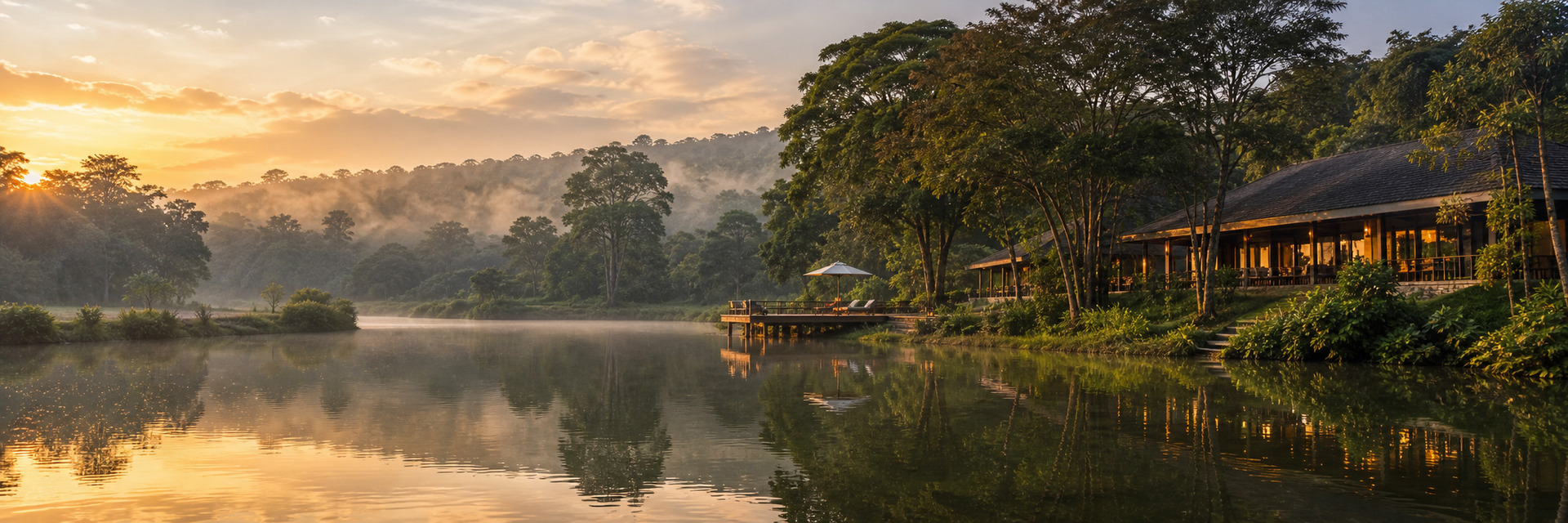
Forest-and-wildlife wellness where the Ghats meet: the Kabini river and the Soliga hills of BRT.
Kabini is India's most established jungle-luxury address — a river and backwater edge to Nagarhole where the wildlife lodge was proven, and where wellness has barely been built. BR Hills is the quieter, higher counterpart: a Tiger Reserve and UNESCO-recognised biosphere at the junction of the Western and Eastern Ghats, and the home of the Soliga and their healing knowledge. We help owners build low-density, forest-edge wellness resorts here — nature-immersion, Ayurveda, naturopathy and genuine digital detox — and run them from concept through the tiger-reserve regulation, build and hiring to a stabilised opening.
Nagarhole edge
Kabini river & backwaters at India's proven jungle-lodge address
Biosphere
BR Hills where the Western and Eastern Ghats meet
Soliga home
Indigenous ethnobotanical and forest-healing knowledge
Low-density
Buffer-zone build — few keys, deep forest, dark skies
At a glance
Positioning
Forest-and-wildlife wellness — nature immersion, jungle Ayurveda and naturopathy, real digital detox
Peak season
Oct–May dry-season wildlife window; monsoon and seasonal park closure shape the calendar
Signature modalities
Forest bathing & nature immersion (lead), Ayurveda and naturopathy, yoga & meditation
Guest profile
Bengaluru and metro HNI, safari-and-wellness couples, digital-detox seekers, inbound wildlife travellers
Typical asset
18–40 key low-density forest-edge lodge — Kabini riverfront or BR Hills ridge, on the reserve fringe
Regulation
Ministry of AYUSH, NABH, Clinical Establishment Act; plus NTCA, forest and Eco-Sensitive-Zone rules on the reserve buffer
The opportunity
Kabini is the address that made jungle luxury a category in India. The lodges that opened this river edge — the estate at the water that became the Kabini benchmark, and the safari camps around it — proved that a guest will pay resort rates to sit on the fringe of Nagarhole for the game drive, the boat safari and the elephant congregation the backwaters are famous for. What almost none of that supply does is wellness. The demand that already travels here for the forest is the exact demand a serious wellness resort wants — affluent, time-rich, nature-seeking — and it is being sold a safari, not a stay that restores.
BR Hills is the whitespace above it. The Biligiri Rangana Hills are a Tiger Reserve and a UNESCO-recognised biosphere at the rare seam where the Western and Eastern Ghats meet, higher and cooler than Kabini, quieter, and carrying something no other South Indian wildlife destination can claim: the Soliga, an indigenous forest community whose ethnobotanical and healing knowledge is living, documented and rooted in these exact hills. A wellness resort that engages that knowledge respectfully — not as decoration, but as a genuine, credited strand of the programme — has a story no manufactured retreat can copy.
Across both, the gap is identical to the one the whole jungle-luxury segment leaves open: superb wildlife access and lodge comfort, but no clinical wellness depth, no Ayurveda or naturopathy operation of substance, and no structured digital detox despite the forest being the perfect place to sell one. That combination — Kabini's proven pull or BR Hills' biosphere and Soliga distinctiveness, delivered with real wellness governance at genuinely low density — is the space to own.
Kabini proved that guests pay to sit on the forest's edge, and never sold them wellness. BR Hills adds a biosphere and a living healing tradition almost no one has built around.
Two forests, one nature-wellness promise
Kabini and BR Hills are not interchangeable jungle backdrops — they are two different wellness products sharing one biosphere. The concept, the altitude, the guest and the build all fork by site, and an owner should choose the register deliberately rather than average across them.
Kabini is the river-and-backwater register: water frontage, the established safari funnel, boat and jeep access into Nagarhole, and a guest who already understands a two-to-three-night wildlife booking that a wellness overlay can lengthen. BR Hills is the ridge register: higher, cooler, more remote, temple-and-tribal in character, with the Soliga knowledge and the biosphere quiet as the premise, suited to a longer, slower, deeper nature-immersion and detox stay.
| Dimension | Kabini (river edge) | BR Hills (biosphere ridge) |
|---|---|---|
| Wellness premise | River, backwaters, elephant country, jungle-lodge comfort | Ghats junction, biosphere quiet, Soliga forest knowledge |
| Lead modality | Forest bathing and safari-wellness, Ayurveda, naturopathy | Deep nature immersion, naturopathy, ethnobotanical strand |
| Guest & stay | Bengaluru HNI + inbound; 2–4 night safari-plus-wellness | Slower, longer detox and restorative stays |
| Defining constraint | Nagarhole buffer, riverfront, backwater level, tiger-reserve rules | BRT Tiger Reserve, biosphere, remoteness, ridge access |
Indicative contrast; refined against the specific plot and concept during the market study.
The guest & demand — the forest, the safari and the switch-off
This is a drive-market wellness proposition before it is an inbound one. Kabini sits within a few hours of Bengaluru and close to Mysuru, and its core guest is the metro professional and family who already treat the forest as the premium weekend — the same affluent, time-poor, nature-hungry cohort that fills the existing lodges. Layer credible wellness onto that and a two-night safari becomes a four-night restorative stay; the willingness to pay is already proven, only the reason to stay longer is missing. BR Hills draws a quieter, more deliberate version of the same guest, plus the wellness traveller who specifically wants remoteness.
The distinctive move here is selling the switch-off. A forest on the edge of a tiger reserve, with genuinely dark skies and thin connectivity, is the most honest digital-detox setting in South India — you are not asked to surrender your phone in a spa, the place simply removes the pull. Married to forest bathing, guided nature immersion and the Soliga's reading of the forest, that becomes a wellness proposition no urban retreat can fake. The calendar is governed by the wildlife season and the park: the dry months (roughly October to May) are the safari and sighting peak, the monsoon is greener and quieter, and the seasonal reserve closures shape when the safari layer is available — so the wellness programme is built to carry demand even when the game drives pause.
- Bengaluru and Mysuru drive-market HNI — the proven engine that already pays for the forest
- Safari-and-wellness couples and families: a two-night game booking extended into a restorative stay
- Digital detox sold honestly — dark skies and thin signal, not a phone-surrender gimmick
- Inbound wildlife travellers already routed to Kabini, plus the deliberate remoteness-seeker at BR Hills
Pricing & commercial model
The economics here are low-density by design, not by accident. Buffer-zone and eco-sensitive building rules cap what can be built, and the proposition depends on the forest staying private — so the model earns from a small key count at a high rate and a long stay, not from volume. We model length-of-stay, wellness attachment and the safari-to-programme conversion first, and size the treatment and naturopathy capacity to the stay plan rather than to a headline room number.
Kabini carries the safari as a revenue layer the wellness stay sits on top of — game drives, boat safaris and naturalist-led experiences bundled into a nature-wellness journey — while BR Hills leans further into the longer detox and immersion programme where the forest itself is the product. Across both, the wildlife season sets the rate calendar and the park closures shape it, so the model is built to hold rate through the wellness layer when the safari layer is seasonally constrained, rather than collapsing into an off-season.
| Revenue line | Model | Planning note |
|---|---|---|
| Nature-wellness stays | 3–7 night forest-immersion and detox programmes | Core across both sites; wellness carries the calendar |
| Safari layer | Bundled game and boat drives, naturalist experiences | Kabini's proven pull; extends the stay, not the whole yield |
| Low-density premium | Few keys, deep privacy, dark-sky exclusivity | Rate over volume — the build rules make this the model |
| Wellness treatment revenue | Ayurveda, naturopathy, forest-therapy programmes | Sized to length-of-stay, not to key count |
Indicative structure; modelled to the specific asset, site and brand.
Classification & regulatory realities
The wellness layer runs the standard national pathway. Ministry of AYUSH standards govern the Ayurveda practice, physicians, therapists and pharmacy; NABH wellness / AYUSH accreditation lifts the treatment operation to hospital-grade credibility; and registration under the Clinical Establishment Act covers the medical dimension of the centre. On a forest resort these are what separate a genuine naturopathy-and-Ayurveda operation from a spa menu, and we design the facility and staffing to earn them from the outset rather than retrofit toward them.
The location layer is where Kabini and BR Hills are unusual, and it is unforgiving. Both sit against protected tiger habitat governed by the National Tiger Conservation Authority: there is no construction in the core zones, and building is confined to the buffer and the surrounding Eco-Sensitive Zone, where floor area, height, footprint, effluent, lighting and even landscaping are constrained. BR Hills carries the BRT Tiger Reserve and its biosphere status on top; Kabini sits against Nagarhole and its backwaters. Forest Department land status, right-of-way, and the seasonal reserve closures all bear on what you can build and operate — and the Soliga community's rights and presence in the BRT landscape are a genuine consideration, not a footnote.
The practical consequence is that the whole project must be conceived as a low-density, fringe build with a light footprint from the first sketch. We establish exactly which zone a plot sits in — core, buffer, Eco-Sensitive Zone, or genuinely private revenue land on the fringe — and what that permits, before any capital is committed. Getting this wrong is not a delay; on a tiger-reserve boundary it can be terminal.
- Ministry of AYUSH standards for practice, physicians, therapists and pharmacy
- NABH wellness / AYUSH accreditation for a hospital-grade treatment operation
- Clinical Establishment Act registration for the medical dimension of the centre
- NTCA rules: no core-zone construction; building confined to buffer and Eco-Sensitive Zone
- Nagarhole (Kabini) and BRT (BR Hills) reserve boundaries, forest-land status and seasonal closures
- Biosphere sensitivity and Soliga community rights and presence in the BRT landscape
On a tiger-reserve fringe the zone a plot sits in decides the project. We resolve core-versus-buffer-versus-private status before capital moves, because here that answer is the difference between a resort and a refusal.
Facility, design & procurement
The forest sets the design brief before the wellness does. This is a low-density, low-slung build — dispersed cottages and a light-touch central pavilion that read as part of the tree line rather than an imposition on it, with the treatment wing woven into the landscape rather than blocked over it. Ayurveda consultation rooms, naturopathy and hydrotherapy spaces, and open-sided forest-therapy and yoga decks are designed to AYUSH and NABH logic while opening onto the canopy; a small on-site pharmacy keeps the Ayurveda and naturopathy programmes supplied where the nearest town is a drive away.
The architecture should belong to the biosphere. Local stone and reclaimed and sustainable timber, deep shaded verandahs, rammed earth and lime where they suit the climate, and materials that weather into the forest rather than fighting it — the vernacular of a Ghats-junction landscape, not a coastal or a hill-station borrow. Dark-sky lighting is a design discipline here, not an afterthought: low, warm, shielded fixtures that protect both the wildlife and the astronomy the setting can genuinely offer, and that the eco-sensitive-zone rules will in any case demand.
Procurement is a remoteness-and-ecology exercise. Off-grid-capable services — solar, water harvesting and recycling, on-site sewage treatment to the standard a reserve buffer requires — matter more than in any urban build, because the site is expected to tread lightly and may sit beyond reliable infrastructure. We run the full programme — the Ayurveda and naturopathy apparatus and pharmacy, hydrotherapy and wet areas, the sattvic and forest-to-table kitchens, FF&E and OS&E — specified for damp forest conditions, humane wildlife-boundary detailing, and single-road hill logistics into a location where every delivery is planned, not assumed. Where the programme draws on Soliga knowledge, sourcing and craft are engaged fairly and by consent, as a credited strand rather than an extracted motif.
Talent & hiring map
This resort is run by two kinds of expert who rarely sit in one team. The first is the naturalist and forest guide — the reason a jungle lodge earns its rate — who reads the reserve, leads the safari and the forest immersion, and whom Kabini and BR Hills can genuinely supply from an established wildlife-tourism talent base. The second is the clinical wellness side: Ayurvedic physicians, naturopaths and therapists, drawn from Karnataka's real strength in the systems, with Mysuru's Ayurveda heritage and Bengaluru's naturopathy and yoga institutions within recruiting reach. Building a resort where a Wellness Director and a Chief Naturalist operate as peers, neither subordinated to the other, is the defining hiring task.
We build the team around that seam: a General Manager and Wellness Director fluent in a low-density, programme-led forest operation, paired with a Chief Ayurvedic Physician and naturopathy lead, a therapist team with same-gender therapy built in as standard, and a naturalist and field team who know these two reserves specifically. The harder, place-specific layer is engagement with the Soliga — bringing indigenous forest and ethnobotanical knowledge into the programme through fair, consented, credited partnership rather than appropriation, which is both the right way and the only credible way to carry that strand. Remoteness then sets the retention agenda: staff housing, rotation, family logistics and training pipelines that hold a skilled team on a forest fringe hours from the nearest city.
Gladwin's edge in Kabini & BR Hills
Kabini and BR Hills turn on a hire almost no one gets right: a wellness leadership team and a wildlife-and-naturalist team operating as equals on a tiger-reserve fringe, over Karnataka's Ayurveda and naturopathy pool and an established jungle-lodge talent base. That is precisely the seam Gladwin works. As an India-headquartered executive-search firm, we draw on both our Hospitality & Travel and our Healthcare & Life Sciences practices to assemble a team where a Chief Ayurvedic Physician and naturopathy lead set the clinical standard, a Chief Naturalist owns the forest, and a luxury GM runs a low-density P&L across both — then plan the retention that holds skilled people on a remote forest edge.
We also build the regulatory and community pathway in from the start, because on this boundary getting it wrong is terminal. AYUSH, NABH and Clinical Establishment standards designed into the facility; the NTCA core-versus-buffer, Eco-Sensitive-Zone, biosphere and forest-land status resolved before capital moves; dark-sky and light-footprint design treated as discipline, not decoration; and the Soliga knowledge engaged by fair, consented, credited partnership. One accountable partner, from a river or ridge plot on the reserve fringe to a stabilised first wildlife season.
- Recruit a wellness team and a naturalist team that operate as equals, not one over the other
- Deep access to Karnataka's Ayurveda and naturopathy pool via Mysuru and Bengaluru — and a plan to retain it on a forest fringe
- Design in the AYUSH, NABH and Clinical Establishment pathway alongside dark-sky, light-footprint standards
- Resolve NTCA buffer / Eco-Sensitive-Zone, biosphere, forest-land and Soliga-community realities before capital moves
Planning a resort here?
We take single accountability from concept to a stabilised opening — market and pricing strategy, design, procurement, and the full leadership and expert team hired.
Speak with a partnerKabini & BR Hills — frequently asked questions
They are Karnataka's two strongest forest-wellness registers on one biosphere. Kabini is India's most proven jungle-luxury address — a river and backwater edge to Nagarhole that already draws affluent, nature-seeking guests but sells them a safari, not wellness. BR Hills is the higher, quieter counterpart: a Tiger Reserve and UNESCO-recognised biosphere at the junction of the Western and Eastern Ghats, home to the Soliga and their living forest-healing knowledge. An owner picks the register deliberately; both are open to an authentic, low-density wellness build.
Only on the right land, and only low-density. There is no construction in the core zones under National Tiger Conservation Authority rules; building is confined to the buffer, the surrounding Eco-Sensitive Zone, or genuinely private revenue land on the fringe, where footprint, height, effluent and lighting are all constrained. BR Hills adds the BRT Tiger Reserve and biosphere status, Kabini sits against Nagarhole. We establish exactly which zone a plot sits in and what it permits before any capital is committed — on this boundary that answer decides the project.
As a credited, consented strand — not decoration. The Soliga are an indigenous community whose ethnobotanical and forest-healing knowledge is living and rooted in the BRT hills, and their rights and presence in the landscape are a genuine consideration, not a footnote. Where a programme draws on that knowledge, we design the engagement as fair, consented partnership with sourcing and craft credited to the community, which is both the right way and the only credible way to carry a story no manufactured retreat can copy.
The wellness programme carries it. The wildlife season — roughly October to May for dry-season sightings — sets the safari calendar, and the reserve has seasonal closures when game drives pause. We build the commercial model so rate holds through the nature-immersion, forest-bathing, Ayurveda and naturopathy layers even when the safari layer is seasonally constrained, so the property is not exposed to a collapsing off-season the way a safari-only lodge is.
Both pools are genuinely reachable. Karnataka has real strength in Ayurveda and naturopathy, with Mysuru's Ayurveda heritage and Bengaluru's naturopathy and yoga institutions within recruiting range, and Kabini and BR Hills sit on an established wildlife-tourism talent base for naturalists and field staff. The harder tasks are building a team where the wellness and naturalist leads operate as equals, and holding skilled people on a remote forest fringe — so we design staff housing, rotation and retention around the remoteness from the outset.
Yes — as one accountable partner. We run positioning and the market study, the AYUSH / NABH / Clinical Establishment pathway, the NTCA buffer, Eco-Sensitive-Zone, biosphere and forest-land site work, place-rooted low-density and dark-sky design of the treatment wing and forest-therapy spaces, procurement of Ayurveda and naturopathy apparatus, pharmacy and off-grid-capable services, fair engagement of the Soliga strand, and the full leadership, clinical and naturalist team hired and trained through a stabilised first wildlife season.
Related
Explore the rest of the cluster
Wellness modality · Traditional Eastern
Naturopathy & Mud Therapy
Drugless, nature-cure healing — accessible, programme-friendly and uniquely Indian.
Wellness modality · Traditional Eastern
Yoga & Meditation
India's birthright modality — and the easiest to do badly.
Wellness modality · Traditional Eastern
Ayurveda & Panchakarma
India's most valuable wellness asset — if it is authentic, and run as one.
Destination · Plantation hills
Coorg & Western Ghats
Coffee-country calm within reach of South India's biggest source markets.
Destination · Kerala highland forests
Wayanad
Plantation-and-forest wellness in the high Western Ghats, delivered with real Kerala Ayurveda — and built to survive an eco-sensitive slope.