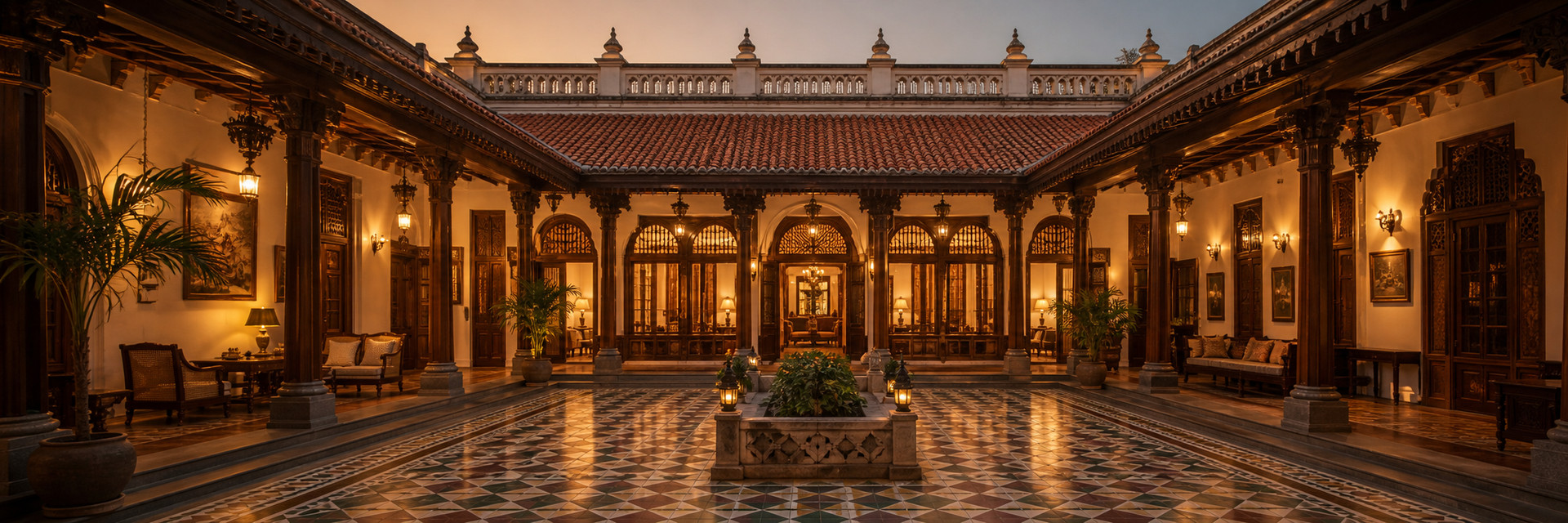
Destination · Tamil Nadu · Heritage mansion country
Luxury Wellness Resorts in Chettinad
Heritage-mansion wellness: the Chettiar palaces of Karaikudi restored into slow-luxury Siddha and Ayurveda retreats.
Nowhere else in India offers what Chettinad does — a landscape of palatial merchant mansions, built with Burma teak and Belgian glass and floored in handmade Athangudi tile, standing half-shuttered across a UNESCO tentative-list cultural landscape. The wellness opportunity here is adaptive reuse: taking a grand Nattukottai Chettiar house and turning its courtyards, thinnais and craft into a Siddha-and-Ayurveda retreat that no purpose-built resort can imitate. We help owners conceive, restore, staff and launch culturally rooted wellness properties in the mansion country — from a conservation-grade concept through AYUSH, heritage and Tamil Nadu approvals to a stabilised opening.
Mansion country
Palatial Chettiar houses across ~70 villages
Siddha home
Tamil Nadu's own indigenous medical system
Tentative list
UNESCO World Heritage tentative cultural landscape
Adaptive reuse
Restoration, not new build — the whole proposition
At a glance
Positioning
Heritage-mansion wellness — Siddha & Ayurveda inside a restored Chettiar palace
The distinctive angle
Adaptive reuse of the mansions: slow-luxury, culture-and-craft wellness unique in India
Signature modalities
Siddha (Tamil Nadu's own) & Ayurveda (lead), sound & mantra therapy, heritage-craft wellness
Guest profile
Culture-led HNI, heritage and design travellers, diaspora Chettiars, slow-travel Europeans
Gateways
Madurai (~90 min) and Tiruchirappalli (Trichy) airports; Karaikudi the market town
Regulation
AYUSH, NABH, Clinical Establishment Act — plus heritage conservation and Tamil Nadu approvals
The opportunity
Chettinad is a wellness site unlike any other in India, and the reason is architectural. Across Karaikudi, Kanadukathan and the cluster of villages the Nattukottai Chettiar banking families built, stand thousands of mansions raised at the height of a nineteenth- and early-twentieth-century trading fortune — houses with sequences of pillared courtyards, Burma teak columns, Belgian mirror glass, Italian and Spanish marble, and floors of the handmade Athangudi tile made in the village of the same name. Many are shuttered, occupied a few weeks a year for weddings, or slowly decaying for want of a use. That is the raw material of a wellness proposition no competitor can manufacture.
The move is adaptive reuse, not new build. A restored Chettiar mansion arrives already carrying the two things a purpose-built resort spends years and fortunes trying to buy: genuine place and genuine craft. Its courtyards are made for stillness, its thinnai verandahs for the slow rhythm a wellness stay wants, and its scale and materials read as authentic before a single therapy is offered. Pair that fabric with Siddha and Ayurveda — the treatment traditions of the Tamil south — and the result is a slow-luxury, culturally rooted retreat that the market has almost nowhere else to find.
The reference points are instructive. A handful of Chettinad houses — Bangala at Karaikudi, the Visalam property, boutique heritage stays around Kanadukathan — have proven that discerning travellers will come for the mansions and the celebrated Chettinad table. None of them, though, runs a serious clinical wellness operation. The whitespace is exact: heritage that is already visited, a wellness layer that has never been built on it properly, and a treatment tradition indigenous to the state sitting ready to fill it.
The Chettiar mansions are the rarest asset in Indian wellness — genuine heritage and genuine craft you cannot build new. The opportunity is to give them a wellness use worthy of the fabric.
The wellness proposition — slow luxury in the mansion country
Chettinad does not compete on beach, backwater or hill. Its proposition is heritage, craft and calm — a slow-luxury register in which the setting is the primary therapy and the treatment tradition completes it. That is a deliberately different guest promise from a coastal Ayurveda house or a mountain retreat, and it should be built as such rather than borrowed from either.
The architecture is the whole differentiator. The courtyard-and-thinnai plan of a Chettiar house gives a wellness operation its natural anatomy: sequential courtyards for arrival, quiet and treatment; deep colonnaded verandahs for rest and consultation; cool, high-ceilinged, thick-walled rooms that hold the heat of the Sivaganga plain at bay without machinery. A retreat here sells the experience of living slowly inside a restored palace as much as it sells any protocol — and reinterprets Chettinad's famously robust cuisine into a lighter, sattvic wellness table that keeps the region's flavour without its heaviness.
- Setting-as-therapy: the courtyard, the thinnai and the craft carry the wellness experience
- Siddha and Ayurveda as the clinical spine — indigenous, credible, place-appropriate
- Heritage-craft and sound/mantra wellness woven through the programme
- Chettinad cuisine reinterpreted as a lighter wellness table, not abandoned
Modality fit — Siddha, Ayurveda and the craft of calm
The lead modality that makes Chettinad coherent is Siddha — Tamil Nadu's own indigenous system of medicine, with its materia medica of herbs, minerals and the varmam pressure-point tradition. Building a Siddha-led retreat in the Tamil heartland is an origin claim, not an import: the system belongs here, its practitioners are trained in the state, and it gives a Chettinad property a genuinely distinct clinical identity in a market crowded with Ayurveda. Ayurveda sits alongside it as the recognised, guest-legible partner — the pairing lets a property speak to newcomers in a language they already trust while offering something they cannot get elsewhere.
Around the clinical core, the modality mix should draw on what the place already holds. Sound and mantra work suit the acoustic calm of stone courtyards; the meditative craft of the region — the making of Athangudi tile, the woodwork and stucco of the houses — can be programmed as heritage-craft wellness, a slow, hands-on antidote to a screen-lived life. Yoga and meditation complete the offer. The design principle is consistency: every modality should feel native to a Chettiar mansion in the Tamil south, not lifted from a generic international spa menu.
| Modality | Fit to Chettinad | Role |
|---|---|---|
| Siddha | Tamil Nadu's own system — an origin claim in the Tamil heartland | Distinctive clinical lead |
| Ayurveda | Guest-legible, trusted partner tradition | Recognised clinical anchor |
| Sound & mantra therapy | Stone-courtyard acoustics and stillness | Signature restorative layer |
| Heritage-craft wellness | Tile, wood and stucco craft of the region | Unique cultural programming |
| Yoga & meditation | Courtyards and thinnais as practice space | Universal daily spine |
Indicative modality fit; sequenced to the specific house, concept and clinical lead.
The wellness guest & demand
Chettinad's wellness guest is culture-led before they are treatment-led — and that is the point of difference. The core is the traveller who comes for heritage, architecture, craft and cuisine, and who will pay a premium to sleep inside a restored palace and slow down there; the wellness programme deepens the stay and lengthens it rather than being the sole reason for the trip. That profile skews toward design-literate domestic HNI, heritage and slow-travel Europeans, and the global Chettiar and Tamil diaspora with an ancestral pull to the mansion country. It is a different, and in many ways stickier, guest than the pure destination-Ayurveda patient.
Demand is drivable but has to be built deliberately, because Chettinad is inland and gatewayed rather than a walk-up beach market. Madurai — a major temple-tourism draw roughly ninety minutes away — and Trichy are the airports, and a serious property positions itself as the restorative, culturally rich counterpoint to a Madurai or Tamil-heritage circuit: the slow days after the temple towns. The calendar favours the cooler October-to-March window for the inland Sivaganga heat, with the diaspora wedding season and festival travel adding their own peaks a property can programme around.
- Culture-led HNI and design travellers — heritage first, wellness as the deepening layer
- Global Chettiar and Tamil diaspora with an ancestral draw to the mansions
- Slow-travel and heritage Europeans on a South India cultural circuit
- Madurai / Trichy gateway play — the restorative counterpoint to the temple towns
Heritage conservation, AYUSH & regulatory realities
Chettinad carries a regulatory layer no beach or hill resort does: heritage conservation. The mansion landscape sits on UNESCO's World Heritage tentative list as a cultural landscape, and a restoration here is a conservation project before it is a hospitality one. That means INTACH-grade conservation practice — retaining and repairing the Athangudi tile, the Burma teak, the lime-plaster and stucco and the Belgian glass rather than stripping and replacing them — sympathetic intervention that reads as restoration not renovation, and a build governed by Tamil Nadu heritage and local-body approvals. Get this wrong and the very asset that made the project worth doing is destroyed; get it right and it becomes unrepeatable.
The clinical layer is the standard wellness stack, calibrated to a Siddha-and-Ayurveda operation. Ministry of AYUSH standards govern Siddha and Ayurveda practice, practitioners and pharmacy; NABH wellness / AYUSH accreditation lifts the treatment operation to hospital-grade credibility; and registration under the Clinical Establishment Act covers the medical dimension of the centre. For a property whose distinctiveness rests on an authentic indigenous-medicine claim, these are what make that claim defensible rather than decorative.
The two layers have to be reconciled, and that is the specialist work. Inserting hospital-grade Siddha and Ayurveda treatment space — wet therapy rooms, drainage, consultation suites, an oil-and-herb pharmacy — into a protected heritage fabric without violating conservation principle is the central design problem of a Chettinad wellness build. We resolve the heritage status, the conservation brief and the AYUSH and clinical pathway together, before capital is committed, so the mansion, the medicine and the approvals are one plan rather than three conflicting ones.
- UNESCO tentative-list cultural-landscape status — a conservation project first
- INTACH-grade restoration of tile, teak, stucco, lime plaster and glass
- Tamil Nadu heritage, land-use and local-body approvals for the mansion works
- Ministry of AYUSH standards for Siddha and Ayurveda practice and pharmacy
- NABH wellness / AYUSH accreditation for a hospital-grade treatment operation
- Clinical Establishment Act registration for the medical dimension of the centre
A Chettinad wellness build is two projects in one — a heritage restoration and a clinical fit-out — and the whole skill is making them a single, non-destructive plan.
Facility, spa design & procurement
The design task in Chettinad is restraint, not expression: the mansion is already the architecture, and the wellness intervention must sit inside it deferentially. Therapy halls belong in the existing courtyards and colonnaded rooms, floored in restored or faithfully matched Athangudi tile, with the thick walls and high timber ceilings kept as the natural climate control they were built to be. The treatment programme — Siddha and Ayurveda consultation rooms, wet therapy areas, Droni oil-therapy tables, steam and swedana provision, and the on-site herbal-and-oil pharmacy — has to be threaded into that fabric with new services concealed, drainage solved without cutting into protected floors, and every intervention reversible in spirit.
Procurement is a craft-and-conservation exercise as much as a hospitality one, and it is where Chettinad's own trades become the supply chain. Athangudi tile is still handmade in the region; teak joinery, lime plaster, stucco and the decorative arts of the mansions are living crafts here. A serious restoration sources and commissions locally — tilemakers, carpenters, plaster and stucco artisans — both to keep the work authentic and to hold the craft economy that makes the place what it is. Modern wellness FF&E and OS&E, clinical equipment and the pharmacy consumables are then specified to sit quietly against that heritage backdrop rather than fight it.
The build reality is inland and material-sensitive. The Sivaganga heat argues for the passive cooling the houses already provide and against clumsy mechanical retrofits; sourcing conservation-grade materials and the artisans who can work them is the long-lead item, not the imported spa kit. We run the full programme — conservation works, therapy-hall and pharmacy fit-out, wet areas, the wellness kitchen reinterpreting Chettinad cuisine, and FF&E — as a single procurement plan built around the heritage fabric and the local trades.
Practitioner & talent pool
Chettinad's talent story has two strands, and both are genuine local strengths. The first is clinical: Tamil Nadu trains and holds a real pool of Siddha and Ayurveda practitioners — the state is the home of Siddha, with its own colleges and registered vaidyas and Siddha physicians — so a retreat here can staff its clinical spine from within the tradition it claims, not import it. That is the credibility a Siddha-led property lives on, and it is available in a way it simply is not anywhere outside the Tamil south.
The second strand is the artisan pool that the restoration and the craft-wellness programme both depend on — the Athangudi tilemakers, the teak carpenters, the lime-plaster and stucco workers whose skills built the mansions and can now maintain and interpret them for guests. The harder hire, as ever in credible wellness, is the leadership seam: a luxury General Manager and Wellness Director who can run a slow-luxury heritage property while deferring to a Chief Siddha or Ayurvedic Physician on clinical primacy. We build the team around that pairing, add same-gender therapy as standard, and design the recruitment and retention plan around an inland location — where relocation, training and rotation need real attention to hold talent through the first seasons.
Gladwin's edge in Chettinad
Chettinad rewards a partner who can hold three disciplines at once — heritage conservation, indigenous-medicine clinical governance, and luxury hospitality — and refuse to let any one override the others. That is precisely the coordination Gladwin exists to run. As an India-headquartered firm working across our Healthcare & Life Sciences and Hospitality & Travel practices, we assemble the team a mansion retreat needs: a Chief Siddha or Ayurvedic Physician setting the clinical standard, a luxury GM running a slow-luxury P&L around it, and conservation-literate restoration leadership that treats the Athangudi tile and Burma teak as the asset rather than an obstacle.
We also make the mansion, the medicine and the approvals one plan instead of three. The UNESCO tentative-list status and INTACH-grade conservation brief, the AYUSH, NABH and Clinical Establishment pathway, the Tamil Nadu heritage and local-body approvals, and the local artisan supply chain are resolved together and up front — so the restoration protects what makes the house worth restoring, and the clinical fit-out earns its authenticity claim. One accountable partner, from a shuttered Chettiar palace to a stabilised first season.
- Recruit a Siddha / Ayurvedic clinical lead the luxury leadership defers to, not overrides
- Tap Tamil Nadu's genuine Siddha and Ayurveda practitioner pool and Chettinad's artisan trades
- Design in the AYUSH, NABH and Clinical Establishment pathway from day one
- Reconcile UNESCO tentative-list heritage, INTACH conservation and Tamil Nadu approvals before capital moves
Planning a resort here?
We take single accountability from concept to a stabilised opening — market and pricing strategy, design, procurement, and the full leadership and expert team hired.
Speak with a partnerChettinad — frequently asked questions
Its architecture. Chettinad is a landscape of palatial Nattukottai Chettiar mansions — Athangudi handmade tile, Burma teak, Belgian glass, Italian marble — many shuttered and awaiting a use. The proposition is adaptive reuse: restoring a mansion into a Siddha-and-Ayurveda retreat that carries genuine heritage and craft no purpose-built resort can manufacture. It is a slow-luxury, culturally rooted wellness product unique in India.
Because Siddha is Tamil Nadu's own indigenous system of medicine, and building a Siddha-led retreat in the Tamil heartland is an origin claim rather than an import — the practitioners are trained in the state and the tradition belongs here. We pair it with Ayurveda, the guest-legible partner, so a property speaks to newcomers in a language they already trust while offering something distinctive they cannot find elsewhere.
Fundamentally. The mansion landscape is on UNESCO's World Heritage tentative list as a cultural landscape, so a restoration is a conservation project before a hospitality one. It calls for INTACH-grade practice — retaining and repairing the Athangudi tile, teak, stucco and glass rather than replacing them — sympathetic intervention, and Tamil Nadu heritage and local-body approvals. The central design problem is inserting clinical treatment space without violating that fabric.
Culture-led before treatment-led. The core is the design-literate HNI, heritage and slow-travel European, and the global Chettiar and Tamil diaspora, who come for the mansions, craft and cuisine and stay longer for the wellness. It is a stickier, more culturally engaged guest than the pure destination-Ayurveda patient — and a property positions itself as the restorative counterpoint to a Madurai or Tamil-heritage circuit.
Yes, on two fronts genuinely local to the region. Tamil Nadu holds a real pool of Siddha and Ayurveda practitioners — the state is Siddha's home — so the clinical spine can be staffed from within the tradition. And Chettinad's own artisan trades — tilemakers, carpenters, plaster and stucco workers — supply both the restoration and the craft-wellness programme. The harder hire is luxury leadership that respects clinical primacy, which we recruit and pair deliberately.
Yes — as one accountable partner. We run positioning and the market study, the UNESCO tentative-list heritage and INTACH conservation brief, the AYUSH / NABH / Clinical Establishment pathway, Tamil Nadu heritage and land-use approvals, conservation-led design of the therapy halls and pharmacy inside the mansion fabric, procurement through local artisan trades, and the full leadership and clinical team hired and trained through a stabilised first season.
Related
Explore the rest of the cluster
Wellness modality · Traditional Eastern
Ayurveda & Panchakarma
India's most valuable wellness asset — if it is authentic, and run as one.
Wellness modality · Traditional Eastern
Sound & Vibrational Therapy
A low-capex, high-experience signature — when the acoustics are designed, not improvised.
Wellness modality · Traditional Eastern
Yoga & Meditation
India's birthright modality — and the easiest to do badly.
Destination · Tamil Nadu · East coast
Coromandel Coast (ECR)
Where the Chennai clinical belt meets the sea: coastal Ayurveda and Siddha with a longevity edge on the East Coast Road.
Destination · Tamil Nadu · Palani hills
Kodaikanal
The Princess of Hill Stations, made for silence: shola-forest retreat wellness in the Palani hills.