Bhishma Pitamaha
भीष्म पितामह
The Grandfather Who Gave the World Its Code of Righteous Law
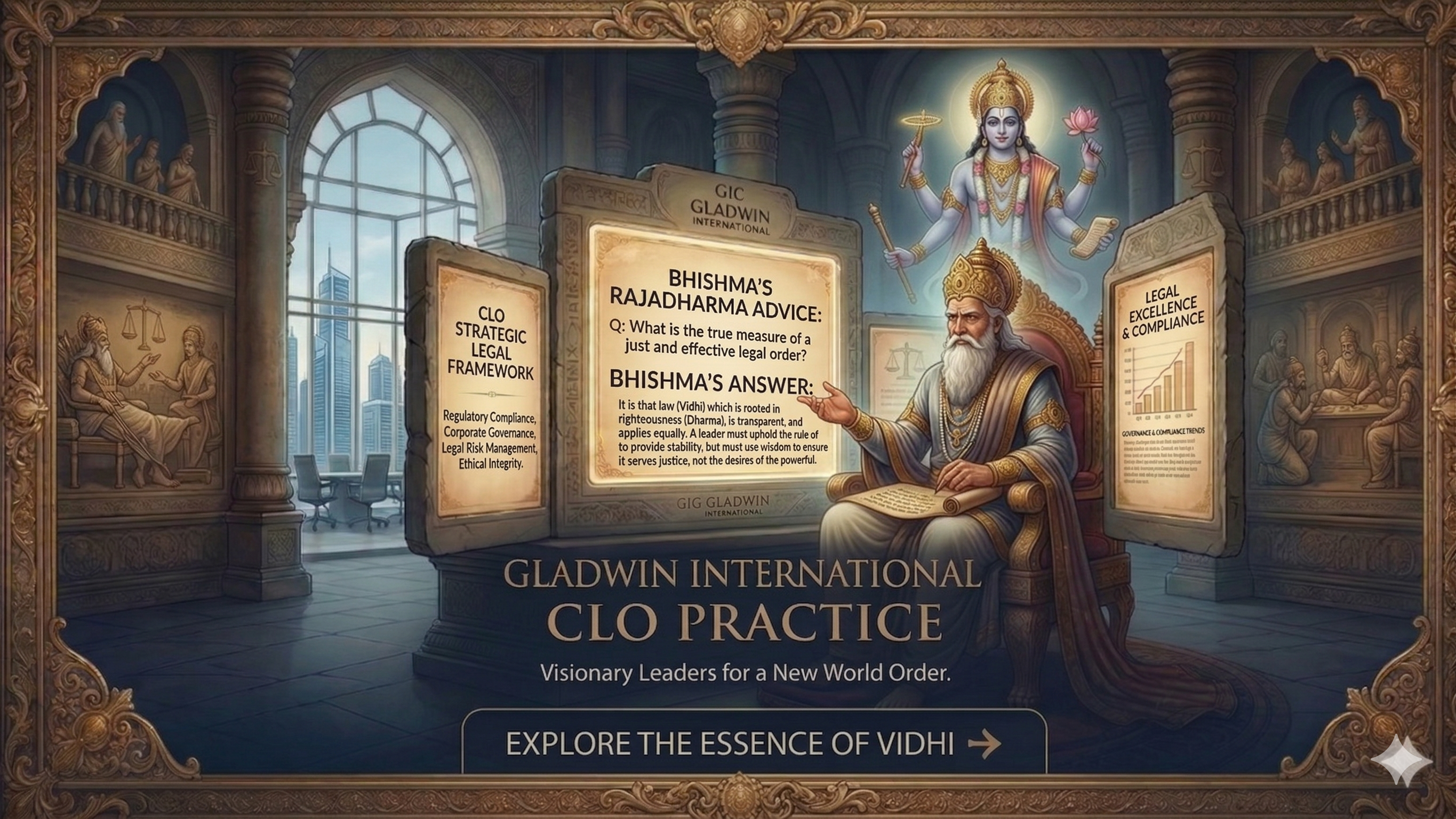
The Artwork — Bhishma Pitamaha studies the CLO Strategic Legal Framework as Dharma himself presides above — the scales of righteous justice balanced in the divine hand. The Rajadharma scrolls are arrayed before him: Regulatory Compliance, Corporate Governance, Legal Risk Management, Ethical Integrity. He is the one figure in the Mahabharata who mastered law completely and chose principle over every personal interest. The great CLO does not ask what the law permits. They ask what justice requires.
Bhishma chose to lie on a bed of arrows for fifty-eight days rather than die before he had transmitted the complete code of law and justice — the Rajadharma — to the king who would govern after him. He was mortally wounded. He was in extraordinary pain. And he spent those fifty-eight days delivering four hundred chapters of jurisprudence, governance philosophy, and the ethics of righteous rule. The great Chief Legal Officer is Bhishma: the one who holds the organisation's complete legal and ethical architecture, who transmits it faithfully, and who considers the law not a constraint on ambition but the foundation on which all durable ambition must rest.
Bhishma's most famous act is also his most misunderstood. The Bhishma Pratigya — his oath of eternal celibacy — is remembered as a sacrifice. It was, in fact, the first and greatest act of legal reasoning in the Mahabharata. His father Shantanu wished to marry Satyavati, whose father demanded that her sons, not Bhishma, inherit the throne. Bhishma saw the problem clearly: his own claim to succession was creating a legal obstacle to his father's happiness and the kingdom's continuity. He resolved it with precision — renouncing succession and taking the oath — creating a legal resolution that was clean, permanent, and beyond dispute. He did not protest. He did not bargain. He saw the legal architecture of the problem and built the solution in a single irrevocable act. That is Bhishma's CLO quality: the ability to see the legal structure of a situation with absolute clarity, and to act on that clarity with equal decisiveness.
The Shanti Parva and Anushasana Parva — the two parvas of the Mahabharata in which Bhishma delivers the Rajadharma — are the most comprehensive treatises on governance, law, and justice in all of ancient Indian literature. Over four hundred chapters, Bhishma addresses every dimension of righteous rule: the accountability of the king to dharma, the protection of those who cannot protect themselves, the legal frameworks for commerce, dispute resolution, property, and succession, the relationship between law and ethics, and the conditions under which a law that is technically valid may nonetheless be unjust. This is not legal theory. This is the world's first comprehensive legal operating system for an enterprise — and Bhishma delivered it while dying, because he understood that the transmission of this knowledge was more important than the comfort of his final hours.
Bhishma's great tragedy — his silence at Draupadi's humiliation in the Kaurava court — is the most important legal failure in the Mahabharata. He knew the act was illegal. He knew it violated every code of dharma. He remained silent because of a vow of loyalty to the throne. His legal knowledge was complete. His legal courage, in that moment, failed. The consequence was a war. Bhishma himself, from his bed of arrows, acknowledged this failure to Yudhishthira: that the CLO who knows the law and remains silent in the moment of injustice has abandoned the only function that makes legal knowledge valuable. The law without the courage to speak it is not law — it is complicity.
The scene of Bhishma delivering the Rajadharma while lying on his bed of arrows is one of the most extraordinary images in world literature — the greatest legal mind of his age, in his final hours, choosing to use those hours to ensure that the code of righteous governance was perfectly transmitted to the next generation. He understood something that the modern CLO must also understand: the organisation's legal and ethical architecture is not self-perpetuating. It requires a custodian who treats its transmission as a personal obligation — who builds the legal culture, trains the next generation, and ensures that the organisation's commitment to righteous conduct survives beyond any individual leader's tenure.
धर्म एव हतो हन्ति धर्मो रक्षति रक्षितः । तस्माद् धर्मो न हन्तव्यो मा नो धर्मो हतोऽवधीत् ॥
Dharma eva hato hanti dharmo rakshati rakshitah, tasmad dharmo na hantavyo ma no dharmo hato'vadhit.
“Dharma, if destroyed, destroys. Dharma, if protected, protects. Therefore, let Dharma not be destroyed, lest the destroyed Dharma destroy us.”
— Manusmriti 8.15 — The Law of Reciprocal Protection, cited in the Shanti Parva
The Four Pillars That Define the Great Chief Legal Officer / GC
The Rajadharma: Law as the Foundation of All Enterprise
Bhishma's Rajadharma does not begin with a list of rules. It begins with a philosophy: that the king is not above the law — the king is the law's first servant. The monarch who places himself above the code of righteous conduct does not thereby gain power. He loses the only power that is durable: the consent of the governed, the trust of the institution, and the protection of the very dharma that makes governance possible.
The great CLO builds legal architecture on this foundation: the organisation is not above the law and does not govern by exception. The CEO's enthusiasm for a transaction does not change the legal analysis. The board's preference for a particular outcome does not alter the regulatory reality. The CLO who treats legal compliance as a ceiling to be avoided rather than a floor to be built upon has already compromised the organisation's most valuable long-term asset — its reputation for operating within righteous bounds. Bhishma's Rajadharma for the modern enterprise is simple: build the legal architecture that protects the organisation not from the consequences of illegality, but from the temptation of it.
The Courage of Legal Clarity in a Political Court
Bhishma knew that Draupadi's humiliation was illegal. The Kaurava court knew it. Everyone in the assembly knew it. Bhishma remained silent because the politics of the moment felt more powerful than the law. He spent the rest of his life — including his final fifty-eight days on the arrows — reckoning with that silence. His advice to Yudhishthira in the Shanti Parva is shaped by this failure: the legal adviser who is silent when the law is violated has committed the greatest act of legal betrayal, regardless of the political pressures that produced the silence.
The great CLO has said no in the boardroom, on the record, to a transaction that the CEO wanted and the board had already endorsed. Not suggested caution. Not raised concerns in a side conversation. Said no, clearly, with the legal analysis behind it, in the room where the decision was being made. This is the Bhishma test. Every CLO who has not been tested in this way has not yet demonstrated the quality that makes the role valuable. When Gladwin International assesses CLO candidates, we spend more time on the decisions they stopped than the transactions they closed.
Governance Architecture: The Rajadharma for the Modern Enterprise
The four hundred chapters of Bhishma's Rajadharma are not a moral lecture. They are a governance operating system: how decisions must be structured, how power must be distributed, how accountability must be assigned, how disputes must be resolved, how the rights of every participant in the enterprise must be protected. Bhishma was not building a religion. He was building institutions. The CLO who reads the Shanti Parva does not find theology. They find the world's oldest comprehensive corporate governance framework.
The great CLO is a governance architect. They design the board charter, the delegation of authority matrix, the conflict of interest policy, the whistleblower mechanism, the regulatory engagement protocol, the M&A legal governance framework, and the twenty other documents that constitute the organisation's legal and governance operating system. These are not compliance documents. They are the constitutional architecture of the enterprise — the Rajadharma of the modern corporation. An organisation that has this architecture, built by a CLO who understands its purpose, is significantly harder to destroy than one whose legal governance is a collection of templates downloaded from the internet and never reviewed since.
The Transmission of Legal Culture
Bhishma's final act — fifty-eight days of jurisprudence delivered from a bed of arrows — was an act of institutional transmission. He was not simply answering Yudhishthira's questions. He was ensuring that the complete code of righteous governance would survive him, would be understood by the next generation of rulers, and would shape the legal culture of the kingdom for generations after his death. He treated the transmission of legal knowledge as more important than his own comfort. That is the Bhishma standard for every CLO.
The great CLO builds a legal culture that does not depend on their personal presence. They train the next generation of legal counsel. They ensure that every business leader in the organisation understands the legal principles that govern their decisions. They build the legal operating system so that when they eventually move on, the organisation's legal culture is stronger, not weaker, than when they arrived. The CLO who has been at an organisation for ten years and whose departure would cause a governance crisis has not done the CLO's job. They have done a lawyer's job. The Bhishma CLO leaves behind the Rajadharma — the enduring code — not a dependency.
How We Search for Your Chief Legal Officer / GC
Gladwin International's CLO practice is built on Bhishma's central insight: legal excellence and legal courage are not the same thing, and organisations usually need the second more than the first. We have spoken with hundreds of CLO candidates across India's most sophisticated organisations, and the technical legal knowledge is rarely the differentiating factor. What differentiates the great CLO from the competent one is whether they have ever stood in a room with the CEO and the board and said the thing that no one wanted to hear — and whether the organisation was better for it. We build CLO profiles that start from this question: what is the most consequential legal or governance decision this organisation will face in the next five years, and do we have a CLO candidate who has the technical depth, the board presence, and the personal courage to navigate it? We are looking for the Bhishma — the one who would rather deliver the Rajadharma from a bed of arrows than leave the organisation without a code of righteous governance.
Every organisation has a moment when it faces the choice that Bhishma faced at Draupadi's humiliation — a moment when the legal answer is clear, the ethical answer is clear, and the political pressure to remain silent is immense. The organisations that prevail in that moment are the ones whose CLO has the institutional standing, the personal courage, and the legal architecture already in place to speak clearly and be heard. That is the Chief Legal Officer Gladwin International will find for you: not the one who keeps the organisation out of court by avoiding difficult decisions, but the one who keeps the organisation out of court by building the Rajadharma — the code of righteous governance — that makes the difficult decision obvious and the courageous choice the only viable one.
Begin Your Chief Legal Officer / GC Search
Every great Chief Legal Officer / GC search starts with a conversation. Speak with our practice lead — confidentially, without obligation.