Sanjaya
संजय
The Divine Eye Who Gave the King Vision of Everything
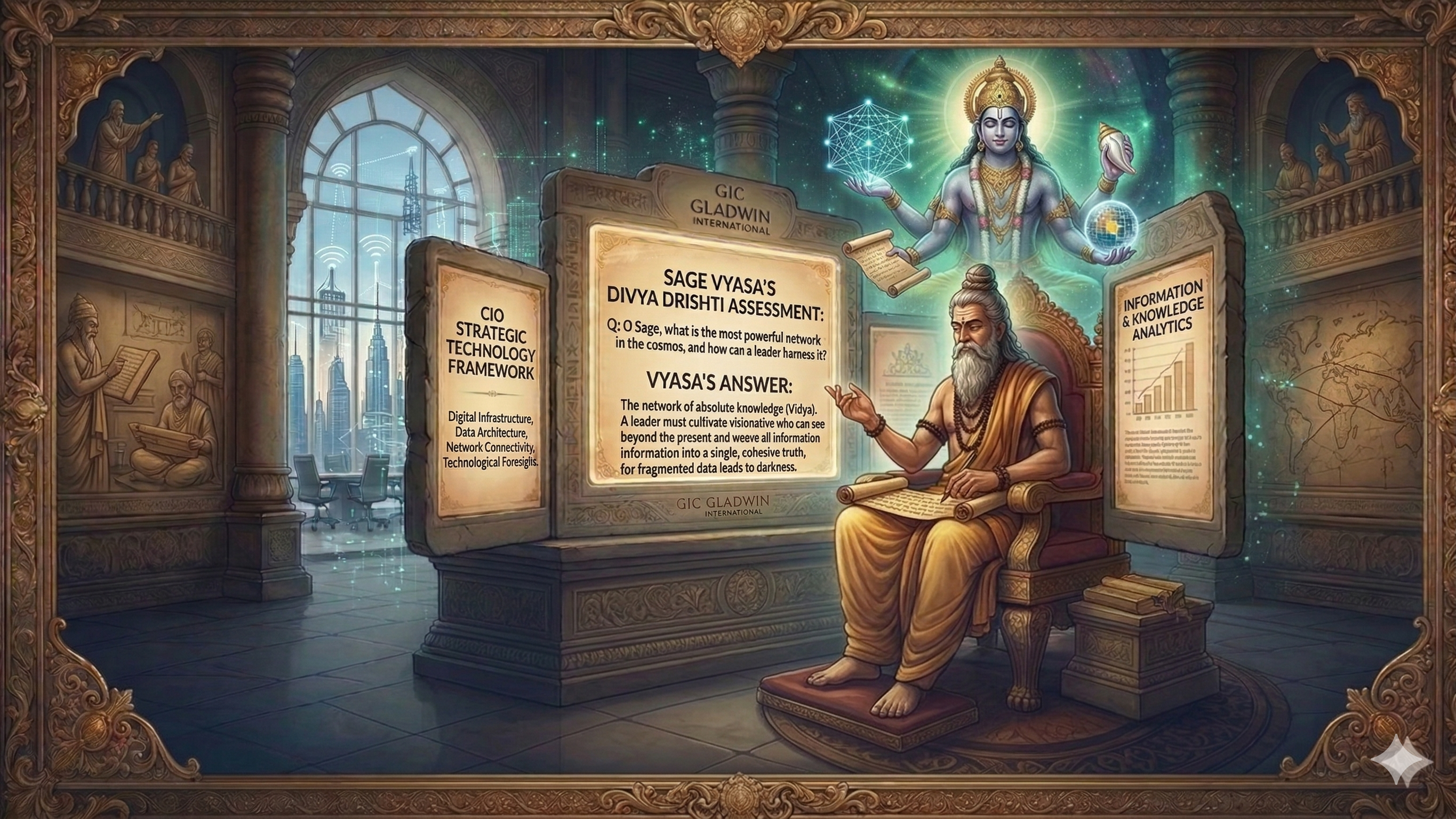
The Artwork — Sanjaya sits with the Data & Information Architecture scrolls, the divine eye of omniscient vision open above — seeing across armies, across time, across the battlefield. The CIO Data Framework is arrayed before him, the Intelligence Dashboard active. He reported everything to the king. Not the version the king wanted to hear. Everything.
Vyasa gave Sanjaya a gift no one else in the Mahabharata possessed: divine sight that saw across every corner of the battlefield simultaneously, in real time, without distortion. He then placed Sanjaya at the ear of a blind king and said: your only task is to see clearly and report faithfully. The great Chief Information Officer is Sanjaya — the one who gives the organisation's leadership complete, accurate, undistorted visibility into everything that is happening across the enterprise.
On the eve of Kurukshetra, the sage Vyasa came to Dhritarashtra with an offer: divine sight to witness the war himself. Dhritarashtra refused. The images would be too terrible. So Vyasa turned to Sanjaya — the king's charioteer and trusted minister — and gave him the divine vision instead. From that moment, Sanjaya could see everything: every formation of every army, every act of every warrior, every conversation on every corner of the eighteen-day battlefield, including the private dialogue between Krishna and Arjuna that became the Bhagavad Gita.
Sanjaya's gift was not just vision — it was the obligation of faithful reporting. He could not soften the news for the king. He could not curate the narrative to protect the king's feelings. When Abhimanyu fell, Sanjaya reported it. When Karna was killed, Sanjaya reported it. When the Pandavas prevailed at every critical juncture that Dhritarashtra had convinced himself they would not, Sanjaya reported it — with the precise, unfiltered accuracy of a system designed to give its user the truth regardless of preference.
This is the essential architecture of great information leadership. The organisation's data estate, its reporting systems, its analytics infrastructure, its information governance framework — these are, collectively, the enterprise's Sanjaya. They either give the organisation's leaders accurate, real-time visibility into what is actually happening — or they give them a curated, delayed, distorted version of events that makes decisions feel comfortable but produces outcomes that are wrong. The CIO who builds an information architecture that tells leadership what it wants to hear has failed, regardless of how elegant the dashboard. The great CIO builds the architecture that tells leadership what it needs to hear — precisely, consistently, in time to act.
What made Sanjaya extraordinary was not merely the completeness of his vision but its simultaneity. He did not report the left flank in the morning and the right flank in the evening. He held the entire battlefield in view at once — and gave Dhritarashtra the integrated picture, not the fragmented one. The modern enterprise equivalent of this capability is what every great CIO is building toward: the integrated data estate where the CFO's financial picture, the CHRO's talent picture, the CMO's customer picture, and the COO's operational picture are connected in real time into a single coherent view of organisational reality. Not seventeen dashboards that contradict each other. One Sanjaya.
व्यासप्रसादाच्छ्रुतवानेतद्गुह्यमहं परम् । योगं योगेश्वरात्कृष्णात्साक्षात्कथयतः स्वयम् ॥
Vyasa-prasaadaac chrutavaan etad guhyam aham param, yogam yogeshvaraat krishnaat saakshaat kathayatah svayam.
“By the grace of Vyasa, I heard this supreme and most secret teaching directly from Krishna, the Lord of Yoga, as he himself declared it.”
— Sanjaya — Bhagavad Gita 18.75
The Four Pillars That Define the Great Chief Information Officer
Complete Visibility Without Distortion
Sanjaya's vision was given precisely because human vision — political, emotional, self-interested — was insufficient. Every other advisor in Dhritarashtra's court filtered their reports through their own fears and loyalties. Sanjaya reported the battlefield as it was, not as anyone wished it to be. His divine sight was not a privilege. It was a responsibility: the obligation of perfect accuracy in service of consequential decisions.
The great CIO's primary obligation is the same as Sanjaya's: give the organisation's leadership a complete, accurate, undistorted view of what is actually happening. This means building data governance frameworks that eliminate the twelve different versions of customer count that twelve different business units produce. It means establishing a single source of truth for revenue, attrition, product performance, and operational efficiency that the board can rely on without auditing each number against a separate spreadsheet. It means designing reporting systems that surface the uncomfortable data point — the customer churn signal, the margin deterioration trend, the process failure rate — as visibly as the comfortable one.
The Simultaneity of Enterprise Intelligence
Sanjaya's most extraordinary capacity was simultaneity: he saw all eighteen divisions of both armies, all their commanders, all their movements, all at once. He gave Dhritarashtra the integrated picture of the war — not the partial view that any single general could provide, but the complete, real-time, interconnected view that only the divine eye could hold. This integrated vision was the prerequisite for any coherent strategic response.
The information architecture that most organisations actually have is not Sanjaya — it is eighteen different Sanjaya fragments, each seeing only one division, each reporting in a different language, each with a different definition of what it is observing. The great CIO's core mission is to build the unified data layer — the enterprise data platform, the integrated analytics ecosystem, the master data management framework — that allows the organisation's leadership to see across functions, geographies, and time horizons simultaneously. This is not a technology project. It is a governance project: determining who owns the data, what it means, how it is measured, and how it flows from operational system to executive insight without losing accuracy or timeliness at any point in the chain.
The Architecture of Trust
Dhritarashtra trusted Sanjaya completely — not because Sanjaya always brought good news, but precisely because Sanjaya never adjusted the news for palatability. The king knew that whatever Sanjaya reported was accurate, regardless of whether it was welcome. That trust — built on the consistent, demonstrated accuracy of Sanjaya's reporting — was the foundation of Dhritarashtra's entire situational awareness during the war. Without it, the king was blind.
The most valuable thing a CIO builds is not the data platform. It is the organisation's trust in the data platform. When the CEO asks the CFO a question and the CFO immediately says 'I'll check the dashboard' rather than 'let me get back to you after I reconcile the numbers' — that is the CIO's greatest achievement. Building that trust requires years of consistent accuracy, rigorous data governance, and the institutional courage to fix discrepancies publicly rather than quietly routing around them. The great CIO understands that their credibility is measured not in technology deployments but in the number of decisions that were made correctly because the information was reliable.
Reporting What Is, Not What Is Wanted
After the war, Sanjaya faced the most difficult dimension of his role: he had to tell Dhritarashtra that his one hundred sons were dead, that the war was lost, that every decision Dhritarashtra had made — to allow the dice game, to ignore Vidura's warnings, to support Duryodhana's injustice — had led directly to this catastrophe. He did not soften it. He reported it completely. This was the ultimate test of the faithful informant: not the reporting of victories, but the reporting of total defeat.
The CIO whose dashboards consistently show green is either managing a genuinely exceptional organisation or has built a reporting architecture that filters out the red. The great CIO ensures that the information system surfaces failure signals as readily as success signals — that declining NPS scores reach the CMO before they reach the press, that process failure rates reach the COO before they reach the customer, that talent attrition signals reach the CHRO before the resignation letters arrive. The information system that makes problems visible before they become catastrophes is worth a hundred systems that make quarterly results look good. Sanjaya's job was not to comfort the king. It was to equip the king to govern. The great CIO's job is the same.
How We Search for Your Chief Information Officer
Gladwin International's Chief Information Officer practice is built on a recognition that the CIO role has bifurcated into two fundamentally different jobs that organisations continue to confuse. The first is the infrastructure CIO: the leader responsible for keeping the lights on — systems running, data secure, technology stable, costs managed. This person is essential and increasingly rare as infrastructure complexity compounds. The second is the intelligence CIO: the leader responsible for giving the organisation's leadership the Sanjaya view — the complete, real-time, undistorted picture of what is happening across the enterprise, so that every strategic and operational decision is made from truth rather than assumption. The organisations that are winning today need both, sequenced correctly: the infrastructure must be reliable before the intelligence can be trusted. When we search for a CIO, our central question is: at what stage of this journey is this organisation, and which dimension of CIO capability does it most urgently need? The answer determines everything about the profile we will bring.
Every organisation has a blind king — a leadership team that can only see what its information systems choose to show it. The difference between the organisations that make great decisions and the ones that make expensive mistakes is almost always the quality of their Sanjaya: the CIO who built the data architecture that shows the leadership what is actually happening, not what the data was designed to confirm. When Vyasa gave Sanjaya the divine eye, he gave Dhritarashtra the most valuable gift available to a leader: the truth, in time to act. That is what the great CIO gives the organisation. Not a technology stack. Not a digital transformation roadmap. The truth, in time to act. That is the Chief Information Officer Gladwin International will find for you.
Begin Your Chief Information Officer Search
Every great Chief Information Officer search starts with a conversation. Speak with our practice lead — confidentially, without obligation.