Chanakya & Kubera
चाणक्य & कुबेर
The Strategist of Artha and the Divine Treasurer
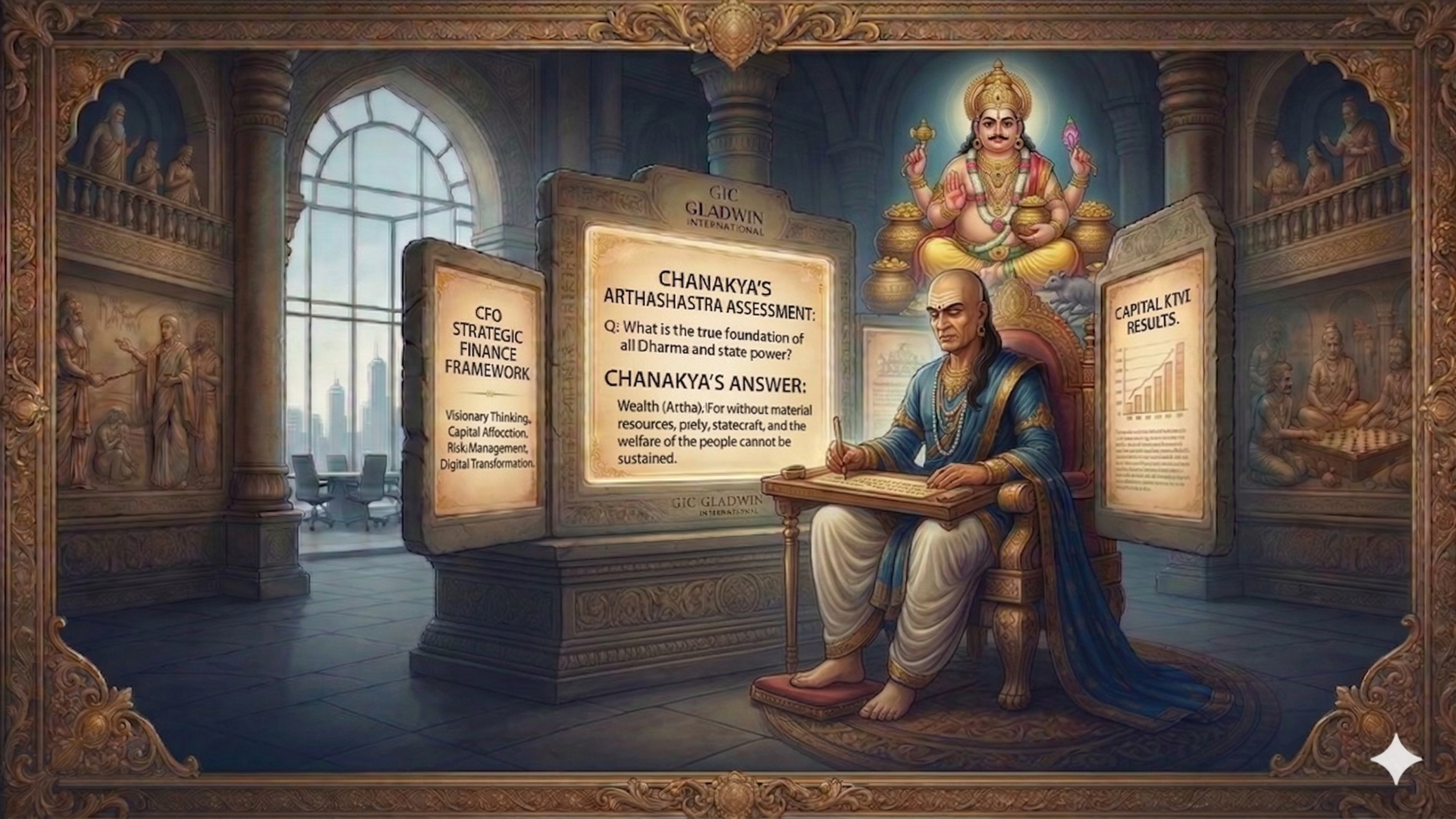
The Artwork — Chanakya writes the Arthashastra — the world's first CFO manual — as Kubera, the divine treasurer of the cosmos, watches from above. The CFO Strategic Finance Framework unfolds on the scrolls before them.
The world's first CFO wrote his manual in 350 BCE. We have been reading it ever since — and we have never found a better definition of what a great Chief Financial Officer must be.
Around 350 BCE, in the court of the Nanda Empire, a young scholar named Vishnugupta — later known to history as Chanakya, or Kautilya — was humiliated at the royal court and expelled. He left with nothing but his intellect and a vow. He would build an empire that would make the Nandas obsolete. He found a young boy named Chandragupta Maurya playing king in a village, and he saw in him what no one else could see. He trained him, strategised for him, and crowned him the first Emperor of the greatest empire India had ever known.
But before he was a kingmaker, Chanakya was a financial architect. His Arthashastra — fifteen books, 6,000 verses, written without a single computer, without a single spreadsheet — covered state revenue, fiscal policy, treasury management, anti-corruption protocols, accounting practices, wage benchmarking, trade regulation, and economic intelligence. It is the world's first comprehensive treatise on finance and economics. Adam Smith's Wealth of Nations was written 2,100 years later. Chanakya got there first.
His central axiom was radical for its age and remains radical today: 'Sukhasya mulam dharma, dharmasya mulam artha.' The root of happiness is dharma, but the root of dharma is artha — wealth, resources, economic strength. Without financial foundation, even the most ethical kingdom cannot sustain its goodness. The CFO is not the counter of coins. The CFO is the guardian of the organisation's capacity to be good. Remove the Chanakya, and the dharma collapses.
Above Chanakya in the divine hierarchy stands Kubera — the treasurer of the cosmos, the lord of Yakshas, the keeper of the earth's wealth. Kubera does not merely count treasure. He stewards it across generations, across worlds, across the full arc of cosmic time. He is the archetype of custodianship: the understanding that the wealth one manages is not one's own — it belongs to the organisation, its people, its future. The great CFO holds both truths simultaneously: Chanakya's strategic ferocity and Kubera's eternal stewardship.
सुखस्य मूलं धर्मः । धर्मस्य मूलं अर्थः । अर्थस्य मूलं राज्यम् ।
Sukhasya mulam dharma, dharmasya mulam artha, arthasya mulam rajyam.
“The root of happiness is dharma. The root of dharma is artha. The root of artha is the kingdom.”
— Chanakya — Arthashastra (1.7.3)
The Four Pillars That Define the Great Chief Financial Officer
Artha as Moral Responsibility
Chanakya taught that a king who ignores the treasury ignores his people. Revenue is not greed — it is the oxygen of governance. Without artha, dharma has no vehicle.
The CFO who sees their role as only 'financial control' has misread their mandate. Capital allocation, cash management, and investor strategy are not accounting functions — they are the moral infrastructure that allows the organisation to fulfil its purpose.
The Intelligence of Risk
The Arthashastra devotes entire chapters to economic intelligence — understanding the financial movements of rivals, the fiscal vulnerabilities of allies, and the early signals of economic collapse. Chanakya was the world's first CFO who also ran intelligence operations.
The modern CFO must be a risk intelligence officer: scenario planning not just for known risks but for the edges of the map — regulatory shifts, currency crises, supply chain fractures, the first signs of a credit contraction. The CFO who is surprised is the CFO who was not watching.
Kubera's Custodianship
Kubera does not own the earth's wealth. He guards it. His palaces and treasures are cosmic responsibilities, not personal possessions. He is the keeper for a cycle of time far longer than any individual life.
The CFO holds assets, cash, and capital that belong to shareholders, employees, and stakeholders who may not yet exist. The great CFO thinks in decades, not quarters — and makes decisions with the humility of a steward, not the aggression of an owner.
Counsel Before Conquest
Chanakya's most important role was not treasurer — it was counsellor. He sat beside the king not to say yes, but to say the things no one else dared to say. He was the institutionalised voice of uncomfortable financial truth.
The CFO who only reports numbers is an accountant. The CFO who challenges the CEO's growth projections, who refuses to sign off on an acquisition without evidence, who brings the board an alternative scenario when consensus has formed too quickly — that is the Chanakya. That is the one we search for.
How We Search for Your Chief Financial Officer
Gladwin International's CFO practice was built on one insight: most CFO searches in India are run backwards. Organisations define the role by what the previous CFO did, and recruit someone who looks the same but costs less. We define the CFO role by what the organisation needs to survive the next five years — and then we find the leader who has both the technical architecture and the strategic spine to deliver it. We look for the Chanakya mind behind the Kubera custodianship. We ask our candidates not just about their financial track record, but about the hardest conversation they ever had with a CEO and whether they were right. The answer to that question tells us everything.
Every organisation reaches a reckoning with artha. A moment when the cash position is not what the board was told, when the currency has moved against the model, when the acquisition that looked brilliant in the deck has become a liability in the market. In that moment, the question is not 'who built the spreadsheet?' The question is: do we have a Chanakya? Do we have someone who saw this coming, who built the scenario plan three years ago, who can now stand in the boardroom and say — with calm, with evidence, with courage — 'Here is what we do next'? That is the CFO Gladwin International will find for you. The Arthashastra mind for your age of uncertainty.
Begin Your Chief Financial Officer Search
Every great Chief Financial Officer search starts with a conversation. Speak with our practice lead — confidentially, without obligation.