Yudhishthira
युधिष्ठिर
The King Who Chose Dharma Over Victory
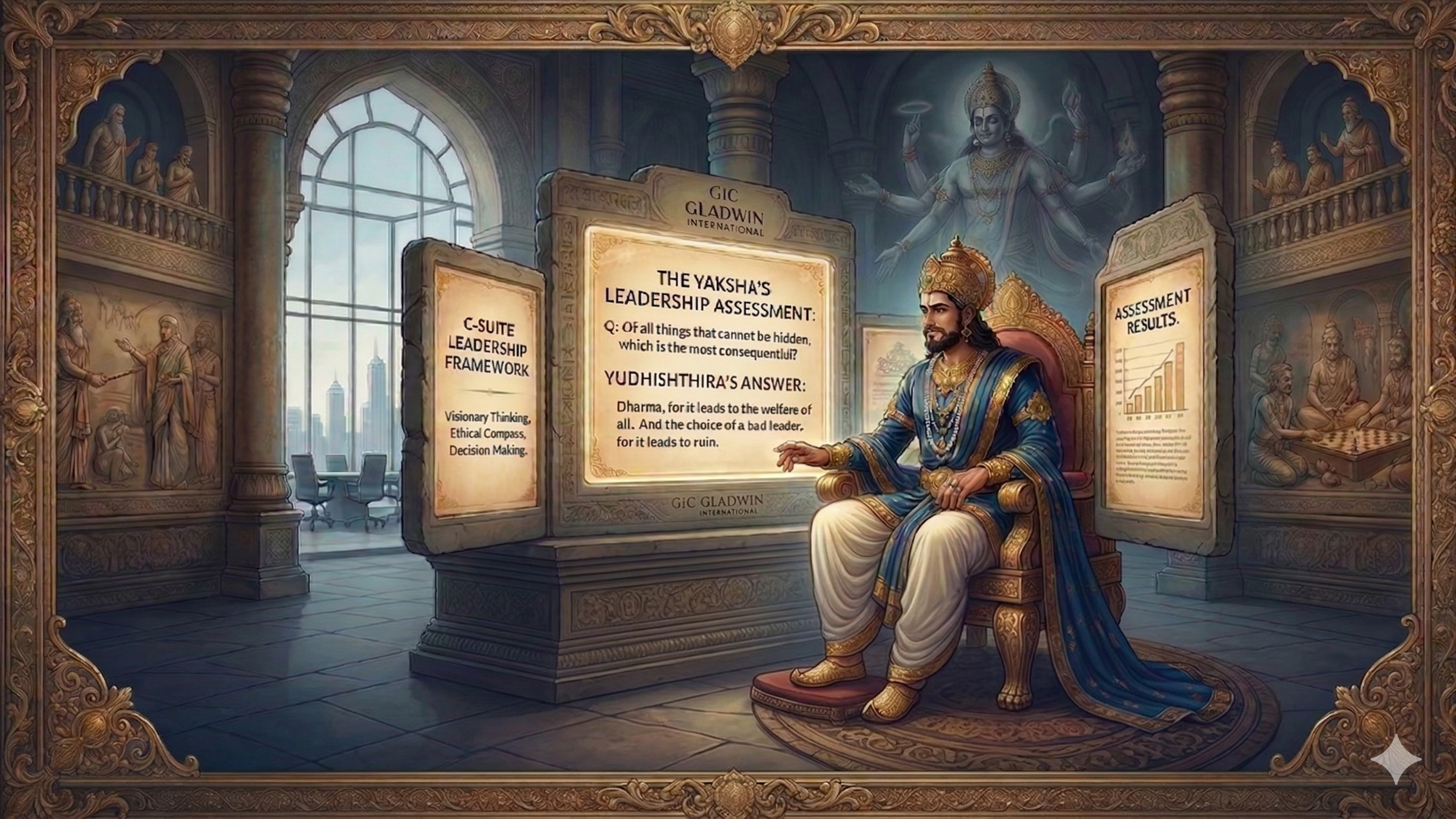
The Artwork — Yudhishthira faces the Yaksha's assessment in a chamber of eternal questions — the C-Suite Leadership Framework, the Yaksha Prashna, and the divine counsel of Vishnu above.
Every CEO search is a Yaksha Prashna — and the only leader who will endure is the one who answers not with strategy, but with dharma.
The Pandavas had been wandering in exile for twelve years. Exhausted and thirsty, they came upon a lake in the forest of Dvaita. One by one, Yudhishthira's brothers — Bhima the mighty, Arjuna the supreme archer, Nakula, and Sahadeva — approached the lake to drink. And one by one, a voice from the water warned them: 'Do not drink. Answer my questions first.' They ignored the voice. They fell.
When Yudhishthira arrived and found all four brothers lying still at the water's edge, he did not panic. He did not rage. He sat at the bank and waited for the voice. The Yaksha — a divine spirit who had enchanted the lake — posed eighteen questions. Not questions of warfare or statecraft or tactical genius. Questions of ultimate truth. 'What is heavier than the earth? What is faster than wind? What is the greatest wonder of the world? What is the true path?'
Yudhishthira's final answer became the most quoted passage in the Mahabharata: 'Ahany ahani bhutani gacchanteeha yamalayam, sheshas sthavaram icchanti — kim ashcharyam atah param.' Every day, beings are carried away to Yama's realm. Yet those who remain desire permanence. This — this — is the greatest wonder. The Yaksha, revealed as Dharma himself — Yudhishthira's divine father — restored all four brothers to life. Yudhishthira had not won through force. He had won through clarity.
This is the archetype of the true CEO. Not the warrior who conquers markets. Not the genius who disrupts industries. The CEO who endures is the one who, when all around them have fallen — when the board is uncertain, the P&L is bleeding, the market has turned — sits at the water's edge, waits for the right question, and answers from dharma. The one whose authority is not derived from title or charisma, but from an unshakeable internal compass. Yudhishthira did not drink. He listened. Then he led.
अहन्य अहनि भूतानि गच्छन्तीह यमालयम् । शेषाः स्थावरमिच्छन्ति किमाश्चर्यमतः परम् ॥
Ahany ahani bhutani gacchanteeha yamalayam, sheshas sthavaram icchanti — kim ashcharyam atah param.
“Every day, beings depart to Yama's realm. Yet those who remain desire permanence. What greater wonder is there than this?”
— Mahabharata — Vana Parva, Yaksha Prashna (3.297.78)
The Four Pillars That Define the Great Chief Executive Officer / MD
Dharmic Accountability
Yudhishthira never acted for personal gain, not even in the greatest war in history. He bore the burden of kingship as a sacred duty — even when it broke him.
The exceptional CEO treats accountability not as a corporate obligation but as a moral one. They answer to the board, the employees, the communities, and the future — before they answer to the P&L.
Composure Under Dissolution
When Yudhishthira found four mighty brothers collapsed at the lake's edge, he did not raise his bow. He sat. He breathed. He listened. The Yaksha rewarded stillness over strength.
Every CEO faces a moment when the instruments fail — the CFO resigns, the quarter collapses, the press turns hostile. The leader who survives is the one who can be still when everything demands panic.
Wisdom Over Intellect
The Yaksha's questions could not be answered by knowledge alone. Arjuna knew the Gita. Bhima knew strength. But wisdom — the integration of experience, ethics, and consequence — lived only in Yudhishthira.
The modern CEO is surrounded by brilliant specialists. Their irreplaceable function is wisdom: the ability to synthesise contradictory inputs from finance, operations, culture, and markets into one coherent direction.
The Burden of Being Last
Yudhishthira's brothers fell one by one because they acted without pausing. Yudhishthira was last — not because he was slowest, but because he was the one who would still be standing when the others were not.
The CEO is always the last one standing in the room when the crisis is real. They cannot fall. They are the answer to the question that no one else can answer. This is why the search for a CEO is unlike any other search.
How We Search for Your Chief Executive Officer / MD
At Gladwin International, we have placed CEOs and Managing Directors across India's most demanding leadership environments — from Series A founders to Fortune 500 subsidiaries to billion-dollar family office transitions. What we have learned across 500+ senior placements and 16 years is this: the right CEO is not always the most decorated candidate. It is the one who, when we pose them our version of the Yaksha Prashna — questions about failure, ethics, legacy, and accountability — answers without hesitation, without performance, and without deflection. We are not looking for the warrior. We are looking for the Dharma King. And we will know them the moment we find them.
Every organisation reaches a moment at the water's edge — when the old strategies have fallen, when the market has turned stranger than anyone predicted, when the board needs a leader who can hold the room without flinching. In that moment, the question is never 'who is the most impressive?' The question is Yudhishthira's question: who is the one who stayed? Who listened? Who answered from something deeper than ambition? That is the CEO Gladwin International will find for you. The Dharma King for your era.
Begin Your Chief Executive Officer / MD Search
Every great Chief Executive Officer / MD search starts with a conversation. Speak with our practice lead — confidentially, without obligation.