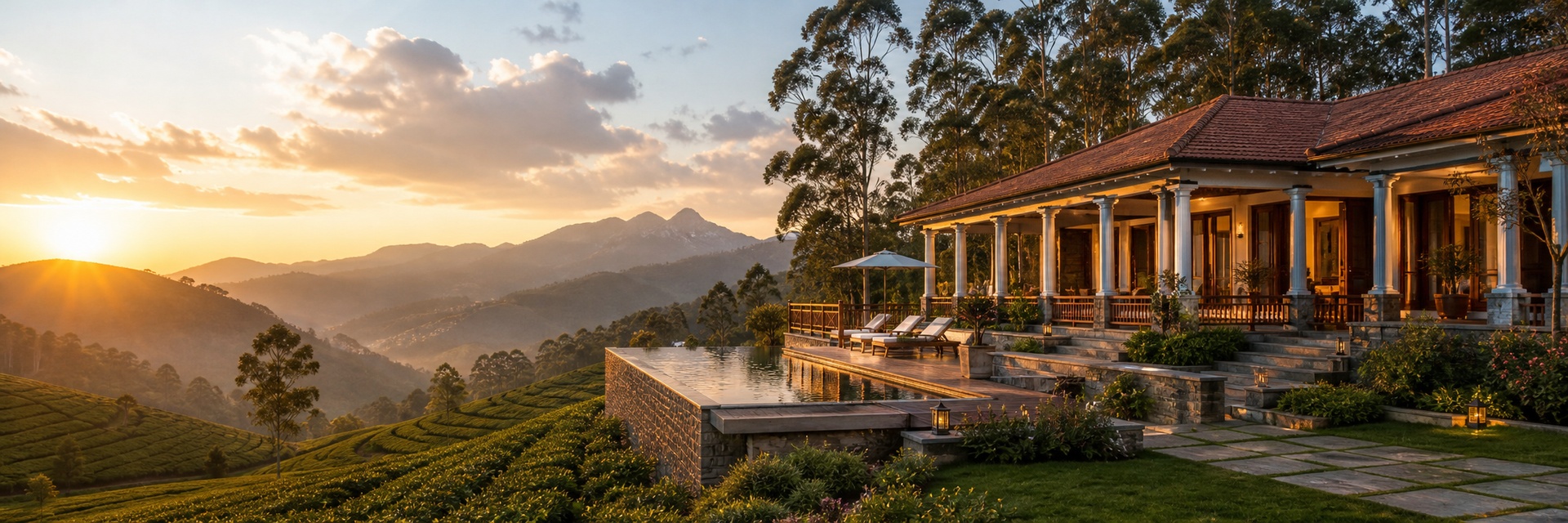
Wellness Clinics & Longevity · Tamil Nadu · Nilgiris Retreat
Setting Up a Longevity Retreat & Wellness Clinic in Ooty
Ooty spent a century as India's convalescence station — the Nilgiris were where people came to recover. A governed longevity retreat is that heritage rebuilt to a clinical standard.
Long before 'wellness' was a category, the British came up the ghat to Udhagamandalam for the air — the Nilgiris were dotted with sanatoria and health resorts because a cool, dry, high-altitude climate was itself considered a treatment. That inheritance is the real asset here, and it points to a specific business: not a spa hotel with a treatment menu, but a residential longevity and medical-wellness centre where a guest checks in for a supervised multi-day programme — detox, metabolic reset, recovery, climate and altitude therapy, integrative medicine — under continuous clinical governance. The distinction is the whole venture. A residential programme that administers diagnostics, IV therapy, prescribed protocols and supervised fasting is a licensed clinical establishment under Tamil Nadu's regime, answerable to the TN Medical Council and, where it integrates AYUSH, to that board too, with NABH the mark that separates a credible medical retreat from a rebranded resort. Gladwin International builds the whole thing as one accountable programme — from the medical model and the licence stack to a governed retreat taking its first residents.
Residential
Multi-day supervised programmes, not a day-spa menu
Climate heritage
A Nilgiris convalescence tradition rebuilt clinically
TN CEA + AYUSH
Clinical Establishments registration, integrative governance
NABH-ready
Accreditation as the credibility and pricing threshold
At a glance
Core registration
Registration as a clinical establishment under the Tamil Nadu Clinical Establishments (Regulation) framework, administered through the district health authority — the licence a residential programme that delivers medical services cannot operate without.
Medical governance
A registered medical practitioner as the accountable resident medical head; doctors registered with the Tamil Nadu Medical Council; and, for the integrative arm, practitioners registered with the relevant AYUSH board, each working to a defined scope of practice.
Accreditation
NABH — the clinic / small-healthcare-organisation standard for the medical core, or the wellness-centre / AYUSH accreditation for the integrative programme — as the mark insurers, referrers and discerning residents read.
Statutory overlays
Drug licence for the in-house pharmacy and injectables / IV store, biomedical-waste authorisation under the BMW Rules, AERB registration for any X-ray or DEXA, and a resident kitchen operating to therapeutic-diet and FSSAI standards.
The land constraint
The Nilgiris sit inside an eco-sensitive zone with tight building, tree-felling and land-use controls, so a low-density estate campus — restored heritage bungalow, tea-estate parcel or a governed greenfield holding — must be assembled and permitted with care.
The Ooty edge
A cool, high-altitude climate marketed as therapy in its own right, a recognised health-retreat heritage, and a residential catchment drawing from Coimbatore, Chennai, Bengaluru and Kerala within a day's reach.
The opportunity — why Ooty, and which retreat
Ooty is the only destination on this cluster whose value proposition is written into its history. The Nilgiris were developed as a health station: colonial-era sanatoria, convalescent homes and 'hill resorts' existed here precisely because a cool, dry, temperate climate at altitude was prescribed for recovery from the heat and illness of the plains. That is not marketing folklore — it is a genuine, defensible positioning for a longevity and medical-wellness retreat, because the climate is part of the therapy rather than a backdrop to it. A residential programme that combines altitude and climate exposure, clean air, low-stimulus surroundings and clinical supervision can make a claim in Ooty that the same programme cannot credibly make on a city high street.
But 'wellness retreat' spans a wide range, and the first thing we settle is where on it you intend to sit, because the answer decides the licence, the clinical staffing and the capital plan. At one end is a lifestyle spa hotel with treatments — a hospitality business, lightly regulated, competing on views and finish. At the other is a governed residential medical-wellness centre — supervised detox and fasting, metabolic and cardiometabolic reset, post-illness and post-surgical recovery, integrative and functional medicine, longevity diagnostics and prescribed protocols — which is a clinical establishment in law. Gladwin builds the second. The Nilgiris are full of the first, and the whole commercial thesis of a longevity retreat is that it is not one of them.
The Nilgiris have no shortage of hill-station spa hotels. The opening is the opposite: a residential centre governed as a medical institution, where the climate heritage is backed by clinical rigour rather than borrowed by a brochure.
The residential model — programmes, not treatments
A longevity retreat lives or dies on the programme, not the treatment list, and this is what most fundamentally separates it from a spa. A guest does not book a massage; a resident is admitted for a structured, medically-supervised stay — typically several days to several weeks — that opens with diagnostics and a clinical assessment, follows a physician-designed pathway across metabolic, nutritional, movement, recovery and mind domains, and closes with a re-assessment and a continuation plan. That residential arc is the product. It also changes the whole operating model: overnight duty-of-care, resident medical cover, a therapeutic kitchen, emergency escalation from a remote hill location, and length-of-stay economics rather than footfall economics.
We define the programme architecture with you before anything is built, because it drives everything downstream. A detox-and-reset programme, a metabolic and weight programme, a recovery and rehabilitation programme, a stress, sleep and climate-therapy programme, and a longevity and preventive-diagnostics programme each carry a different clinical intensity, a different scope of licensed practice, a different equipment list and a different staffing ratio. Getting the portfolio and its clinical governance right at the model stage is what lets the retreat register cleanly, price by outcome, and scale its calendar — rather than improvising a medical layer on top of a hospitality shell that was never designed to carry it.
- Physician-led admission, mid-stay and discharge assessments framing every residential programme
- A portfolio of governed multi-day programmes — detox, metabolic, recovery, sleep / climate-therapy, longevity diagnostics
- Resident overnight clinical cover, emergency escalation and duty-of-care protocols for a remote setting
- A therapeutic kitchen and prescribed-nutrition operation run to clinical and FSSAI standards
- Length-of-stay and programme-outcome economics, not day-spa footfall
The licensing pathway — registering a clinical establishment in Tamil Nadu
The moment a residential programme administers diagnostics, prescribes protocols, supervises fasting or delivers IV, injectable, hormonal or regenerative therapy, it is a healthcare facility in law, and the gate is registration as a clinical establishment. In Tamil Nadu this runs through the Clinical Establishments (Regulation) framework administered by the district health machinery, and it turns on the accountable medical head, the qualifications and council registration of the clinical staff, the declared scope of services, and the physical, safety and record-keeping standards of the premises. Because the model is residential, the standard also reaches the overnight care, the emergency pathway and the length-of-stay documentation — which is why the medical model and the building must be designed to the standard rather than retrofitted to it.
Governance sits on the practitioners as much as the premises, and Ooty adds a specific wrinkle: integrative medicine. If the programme blends modern medicine with AYUSH systems — as most credible longevity retreats in India do — then the modern-medicine practitioners must hold current registration with the Tamil Nadu Medical Council and the AYUSH practitioners with their respective board, and each must work strictly within their own defensible scope; the two cannot be blurred. We map the entire programme portfolio against who is licensed to deliver each element, structure the resident-medical-director and consultant roles accordingly, and assemble the registration dossier so the establishment clears inspection cleanly and opens on a sound legal footing rather than a hopeful one.
- Clinical-establishment registration under the Tamil Nadu Clinical Establishments (Regulation) framework (district health authority)
- Tamil Nadu Medical Council registration for the resident medical head and doctors; AYUSH-board registration for the integrative arm
- A defined, separated scope of practice across modern-medicine and AYUSH modalities — never blurred
- Fire, building, occupancy and residential duty-of-care standards designed to the registration standard
- Professional indemnity, consent architecture and medico-legal records built for overnight, multi-day care
The statutory overlays — drugs, waste, radiation and the therapeutic kitchen
Beyond the core registration sit the overlays that separate a governed retreat from an exposed one, and each attaches to a specific capability rather than to the centre as a whole. A residential programme that dispenses medicines, or stocks the injectables, peptides and IV formulations a longevity practice runs on, needs a drug licence for that pharmacy or store under the Drugs and Cosmetics regime. Any facility generating sharps, biological and pharmaceutical waste must hold biomedical-waste authorisation under the Bio-Medical Waste Management Rules and contract a treatment facility — logistically more demanding in a remote hill location, and a routine inspection item that is disproportionately damaging to fail.
Two overlays are sharper here than in a city clinic. First, diagnostics: any X-ray or DEXA scanner — the latter common in body-composition and bone-density work — requires AERB registration and quality assurance through the eLORA system before it is switched on, and remote servicing must be planned for. Second, food: a residential retreat runs a large therapeutic kitchen at the centre of the programme, so it operates under FSSAI licensing with prescribed, medically-supervised diets, allergen control and clinical-nutrition governance — not a hotel restaurant with a spa menu. We scope every overlay against the equipment and programme list at design stage, so the clinical menu, the procurement, the kitchen and the licences are consistent and nothing is discovered after the fit-out is poured.
| Trigger capability | Regime / regulator | Applies when |
|---|---|---|
| Pharmacy / injectables & IV store | Drug licence (Drugs & Cosmetics) | The retreat dispenses or stocks medicines and formulations |
| Sharps & clinical waste | Biomedical-waste authorisation (BMW Rules) | Any clinical facility generating regulated waste |
| X-ray / DEXA / imaging | AERB registration (eLORA) | Any radiation-emitting diagnostic device is installed |
| Therapeutic / prescribed-diet kitchen | FSSAI licence + clinical-nutrition governance | A residential kitchen serves medically-supervised diets at scale |
Statutory overlays by capability — indicative; each attaches to a specific service, device or operation, not to the retreat in general.
Clinical governance, SOPs and longevity & climate-therapy protocols
Credibility in a residential medical-wellness centre is manufactured in the governance layer, and it is also what NABH accreditation examines. We build the clinical governance framework the retreat will be run and inspected on: standard operating procedures for admission, assessment, the residential programme itself and discharge; consent and documentation protocols; infection-prevention and injection-safety standards; an emergency and adverse-event pathway built for a remote setting with a planned escalation and transfer arrangement to a base hospital down the ghat; a drug-and-formulary policy; calibration and equipment logs; and a clinical audit and incident-review cadence. In a residential model, where a resident is in the centre's care overnight and for days at a time, this governance is not paperwork — it is the duty of care itself.
On top of that sits the medicine, and here Ooty's climate heritage has to be turned from a claim into a protocol. We help codify the diagnostic and treatment pathways — the biological-age and biomarker panels, cardiometabolic, metabolic and hormonal work-ups, the supervised detox and fasting algorithms, the recovery and rehabilitation pathways, and the specific climate-and-altitude therapy protocols that justify a Nilgiris location — into evidence-graded, physician-signed programmes with clear indications, contraindications, monitoring and follow-up. Supervised fasting and detox in particular demand real clinical guardrails and resident monitoring; done well, they are the retreat's signature, and done casually they are its biggest liability. That protocolisation is what lets the programme scale across a residential calendar without drifting into the unregulated fringe.
- SOP suite spanning admission, the residential programme, overnight care, discharge and continuation
- A remote-setting emergency and adverse-event pathway with a defined base-hospital escalation and transfer arrangement
- NABH-oriented quality system — clinical audit, incident review, calibration and formulary control
- Physician-signed, evidence-graded longevity, detox and supervised-fasting protocols with monitoring and contraindications
- Climate- and altitude-therapy protocols that convert the Nilgiris setting from marketing into medicine
Medical-grade & hospitality design, procurement and technology
A longevity retreat has to reconcile three languages at once — the calm and finish of a luxury residential estate, the warmth of hospitality across a multi-day stay, and the compliance of a healthcare facility — and in the Nilgiris a fourth constraint sits over all of them: the land. The hills fall inside an eco-sensitive zone with tight building, height, tree-felling and land-use controls, so the estate has to be master-planned at low density, ideally around a restored heritage bungalow or a tea-estate parcel, with the clinical spine woven discreetly into a residential setting rather than announcing itself. We plan the campus so residential suites, a clinical and diagnostics block, treatment and IV rooms, a therapeutic kitchen and dining, movement and hydrotherapy spaces, and the back-of-house all meet their respective standards — clinical zoning, infection-control finishes, medical-gas and waste holding on the clinical side; comfort, light and quiet on the residential side — and so that permitting, registration, NABH and AERB do not become expensive retrofits.
Procurement is a clinical decision, not a shopping list, and remoteness sharpens it. We specify and source the diagnostic, therapy and hydrotherapy platforms — body-composition and imaging, laboratory or partner-lab pathology, IV and regenerative equipment, and the integrative and physiotherapy kit — against the intended programmes, the regulatory trigger each device pulls, and a realistic utilisation model, with serviceability and spares planned for a location a servicing engineer cannot reach in an hour. Underneath it we implement the technology the business actually runs on: an EMR built for a clinic, a residential programme-management and scheduling system that treats a resident's stay as a governed longitudinal episode, membership and CRM for repeat and continuation care, and a data and consent architecture fit for sensitive health information.
Resident staffing, land, catchment and the launch
The hardest operational truth about a Nilgiris retreat is talent. Senior clinical staff — a resident medical director, longevity and functional-medicine physicians, integrative and AYUSH practitioners, and the nursing and therapy cadre a residential centre needs on duty around the clock — are harder to attract to a remote hill town than to a metro, and the retreat cannot run its overnight duty of care on visiting consultants alone. We build the staffing model around this reality: a genuinely resident core team, relocation and rotation packages that make Ooty liveable for clinicians and their families, and partnerships with the medical talent base down in Coimbatore for cover and referral. The senior clinical and executive appointments — resident medical director, clinical leads, the general manager — we run through our executive-search practice, because in a residential clinical business the wrong medical leadership is a governance failure, not a staffing gap.
Land, catchment and calendar then decide the commercials. We assemble and permit the estate within the eco-sensitive-zone rules, resolve title and land-use, and master-plan in phases. The catchment is genuinely favourable — Coimbatore is a short drive down the ghat, and Chennai, Bengaluru and Kerala all sit within a comfortable day's reach, giving the retreat a large residential drive-and-fly market rather than depending on inbound tourism. Against that we build the launch: a programme and membership architecture priced by outcome and length of stay, a strategy to counter the Nilgiris' pronounced tourist seasonality by anchoring demand on year-round health programmes and corporate and executive-longevity contracts, medical-tourism and NRI positioning where relevant, and a go-to-market that opens the retreat with a founding cohort of residents rather than an empty calendar in the off-season.
- A genuinely resident clinical core — medical director, physicians, integrative practitioners, round-the-clock nursing and therapy
- Relocation, rotation and Coimbatore-partnership arrangements to solve remote clinical-talent supply
- Resident-medical-director, clinical-lead and general-manager search through our executive-search practice
- Eco-sensitive-zone-compliant estate assembly, permitting and phased master-planning
- Outcome-and-length-of-stay pricing, plus a strategy to beat Nilgiris seasonality with year-round and corporate demand
Gladwin's edge in Ooty
We treat an Ooty longevity retreat as the residential clinical-establishment problem it actually is, not a hill-station spa with better testing. Before capital is committed we settle the model — a governed multi-day residential medical-wellness centre, not a lifestyle resort — and design the programme portfolio and its clinical intensity to it. Then we run the licence stack as one programme: Tamil Nadu clinical-establishment registration, TN Medical Council and AYUSH governance for the integrative arm, the drug, biomedical-waste, AERB and therapeutic-kitchen overlays scoped capability-by-capability, and an NABH-oriented quality system, all sequenced backwards from your target opening and governed to that date.
Our differentiator is that we build the clinical credibility and the destination commercial engine together — and we know the two constraints that break Nilgiris projects. We codify the longevity, detox and climate-therapy protocols and the remote-setting emergency pathway, master-plan a medical-and-hospitality estate that clears the eco-sensitive-zone rules, solve resident clinical staffing for a hill town, implement the EMR and programme technology, and build a launch that beats seasonality with year-round programme demand from the Coimbatore, Chennai, Bengaluru and Kerala catchment — so the retreat opens governed, accredited-ready, staffed and full, not merely fitted out.
Planning a wellness clinic or longevity centre in Ooty?
We take single accountability from a clinical concept and a licence strategy to a governed, revenue-live centre — the medical model and regulatory pathway (Clinical Establishments Act, state medical council, NABH), longevity and diagnostic protocols, design, medical-grade procurement, PMO, medical and para-medical search, SOPs, technology and the membership launch. The team is recruited through our executive search practice and trained for opening.
Speak with a partnerSetting up a wellness clinic or longevity centre in Ooty — FAQs
It is a different business in law and in economics. A spa hotel is a lightly-regulated hospitality operation selling treatments; a longevity retreat is a residential medical-wellness centre where a resident is admitted for a supervised multi-day programme — diagnostics, prescribed protocols, supervised detox, IV or integrative therapy — which makes it a clinical establishment governed by the Tamil Nadu Clinical Establishments regime, the TN Medical Council and, for the integrative arm, the AYUSH board. We build the governed medical retreat, because that clinical rigour, backed by Ooty's genuine climate heritage, is the entire competitive thesis.
It is a genuine, historically grounded advantage. The Nilgiris were developed as a health station: sanatoria and convalescent homes existed here precisely because a cool, dry, high-altitude climate was prescribed for recovery. That heritage lets a residential retreat make a defensible climate-and-altitude-therapy claim it could not make on a city high street — provided the claim is codified into physician-signed protocols rather than left as brochure language, which is exactly the work we do. The catchment helps too: Coimbatore, Chennai, Bengaluru and Kerala are all within a day's reach.
The core gate is clinical-establishment registration under Tamil Nadu's Clinical Establishments framework, with an accountable resident medical head and council-registered clinicians. Integrative medicine does add a layer: modern-medicine doctors must be registered with the TN Medical Council and AYUSH practitioners with their board, each working within a separate, defensible scope that is never blurred. On top sit capability-specific overlays — a drug licence for the pharmacy and IV store, biomedical-waste authorisation, AERB registration for any X-ray or DEXA, and FSSAI plus clinical-nutrition governance for the therapeutic kitchen. We scope and sequence all of it before the fit-out.
The hills fall inside an eco-sensitive zone with tight building, height, tree-felling and land-use controls, so the estate must be assembled and permitted deliberately and built at low density — often around a restored heritage bungalow or a tea-estate parcel. We resolve title and land-use, master-plan a low-density medical-and-hospitality campus that respects the controls, weave the clinical spine discreetly into a residential setting, and phase the build so capital is not sunk ahead of demand or permitting.
Both are real risks we plan for explicitly. On talent, we build a genuinely resident clinical core rather than relying on visiting consultants, with relocation and rotation packages that make Ooty liveable for clinicians and their families, plus partnerships with the medical base down in Coimbatore, and we run the senior appointments through our executive-search practice. On safety, we design a remote-setting emergency and adverse-event pathway with a defined escalation and transfer arrangement to a base hospital, because a residential centre carries an overnight duty of care that a day clinic does not.
By not being a tourism business. A longevity retreat sells outcome-driven, length-of-stay health programmes and memberships to a residential drive-and-fly catchment, and we anchor demand on year-round preventive, recovery and metabolic programmes, corporate and executive-longevity contracts, and medical-tourism or NRI positioning — so occupancy is driven by health need and programme calendar rather than by the peak-season tourist curve. We build that commercial and go-to-market plan alongside the clinical one so the retreat opens with a founding cohort of residents rather than an empty off-season.
Explore the cluster
Wellness clinics & longevity centres across South India
Tamil Nadu · Kongu
Coimbatore
Coimbatore is western Tamil Nadu's healthcare capital — a health-conscious, entrepreneur-wealthy city that will underwrite a clinically serious longevity centre, not a spa with a stethoscope.
Karnataka · Western Ghats
Coorg
Coorg is where South India goes to slow down — a coffee-country retreat market ready to be converted from luxury leisure into medically supervised longevity.
Kerala · Highlands
Wayanad
Kerala already sells the world its Ayurveda. Wayanad is where you can put a clinical spine inside it — a residential longevity retreat that is medically governed, not merely marketed.
Also explore our executive search practice for the leadership team, and the wider end-to-end lifestyle & wellness practice.