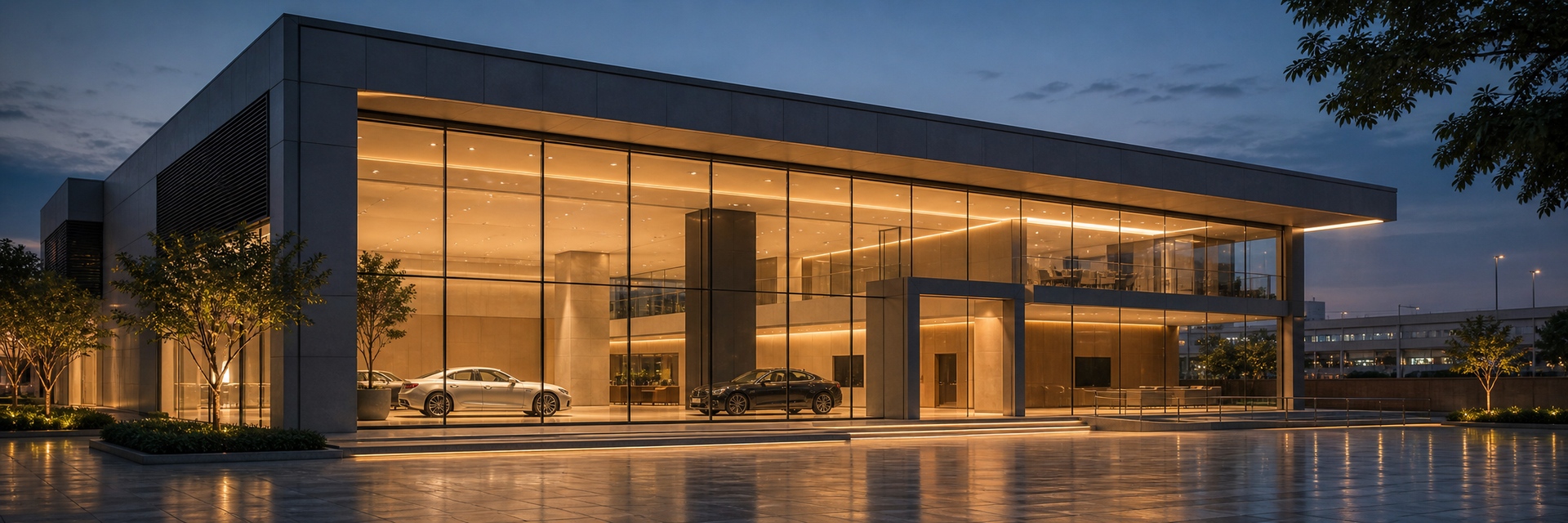
Multi-Brand Auto Retail Groups · Tamil Nadu · Metro
Building a Multi-Brand Auto Retail Group in Chennai
Chennai is the Detroit of India — the one city where you can build a dealer group next to the factories, the talent and the components that make cars in the first place.
No Indian metro sits closer to the metal. Hyundai at Sriperumbudur, the Renault-Nissan alliance at Oragadam, Ford's legacy plant at Maraimalai Nagar, Ashok Leyland and the two-wheeler and components base built around TVS give Chennai an automotive ecosystem — OEMs, tier-one suppliers, service talent and logistics — that no other city can match. That is the raw material for a dealer group, not a single showroom. But a metro group is not a state volume network: it is a portfolio decision, a format decision and a governance decision. Which OEM franchises to hold, how to make one 3S template repeatable across sites, how to run procurement, DMS, hiring and floor-plan financing centrally, and how to roll the format out across Tamil Nadu — that is the hard part, and the part Gladwin International runs as one accountable programme, from a group thesis to a scaled, multi-brand network.
Detroit of India
The country's largest automobile-manufacturing cluster
Portfolio, not one brand
OEM and territory strategy across mass, premium and CV
One 3S template
A repeatable Sales-Service-Spares format, replicated site by site
Group to network
Central shared services, then a Tamil Nadu rollout
At a glance
Why Chennai as a base
India's largest auto-manufacturing cluster — Hyundai, Renault-Nissan, Ford legacy, Ashok Leyland, TVS and a dense tier-one component belt — giving unrivalled OEM proximity, service talent and supply-chain depth.
OEM landscape
A full spread to build a portfolio from — mass-market and mid-market passenger cars, premium and luxury marques, EV entrants, two-wheelers, and commercial vehicles — plus manufacturer regional offices on the doorstep.
3S land corridors
Large-format Sales-Service-Spares plots along GST Road (NH-45), OMR (the IT corridor), and the Sriperumbudur–Oragadam industrial belt, with used-car and workshop yards on the peripheral bypasses.
Central shared services
One procurement, DMS/CRM, finance, HR, marketing and PMO layer serving every rooftop — the operating leverage that separates a group from a collection of standalone dealerships.
Governance & funding
Group SPV structure, OEM dealer agreements, floor-plan (inventory) financing lines, and a controls-and-audit framework built to survive scale and multiple manufacturer audits.
Regional cluster
Chennai as the metro anchor, then the Tamil Nadu volume corridor — Coimbatore, Madurai, Trichy, Salem, Vellore and the tier-two towns — reached through a documented rollout playbook.
The opportunity — why Chennai, and what kind of group
Chennai is the natural home for a serious dealer group because it is where the industry itself lives. The Sriperumbudur–Oragadam corridor is one of the densest automotive-manufacturing zones in the country: Hyundai's plant, the Renault-Nissan alliance, Ford's legacy facility, Ashok Leyland's commercial-vehicle base, and the two-wheeler and components ecosystem anchored by TVS and a deep tier-one supplier belt. That proximity is not a slogan — it means OEM regional offices are local, aftersales and workshop talent is trained and available, parts logistics are short, and the city's relationship with the automobile is cultural. A founder building here is building inside the ecosystem, not next to it.
But the first decision is not where — it is what. A metro multi-brand group and a state-wide volume network are different businesses. A metro group concentrates a portfolio of complementary OEM franchises in one high-value catchment, wins on customer experience, aftersales throughput and premium mix, and runs lean shared services across a handful of large rooftops. A state network chases volume and coverage across tier-two and tier-three towns with a lighter, replicable format. Most durable groups are both in sequence — anchor the metro, prove the operating model, then roll it out — and the mistake is to blur the two. We resolve the thesis first: which segments, which brands, which catchments, and in what order, so every subsequent decision on land, capital and people serves one strategy rather than several.
In Chennai the advantage is not the showroom — it is proximity to the OEMs, the aftersales talent and the components that surround the city. Build a group that exploits that ecosystem, and you have something a dealer in any other metro cannot replicate.
OEM portfolio and territory strategy
A group's economics are set by its portfolio. Franchises are awarded by manufacturers against defined territories, facility standards and investment norms, so which OEMs you hold — and how they complement one another — is the single most important commercial decision. We build the portfolio deliberately: a mass-market volume brand for throughput and aftersales density, a mid-market or premium marque for margin and brand, an EV entrant to hold the segment as it shifts, and — where the group's ambition runs to it — a commercial-vehicle or two-wheeler franchise that Chennai's manufacturing base makes natural. The aim is a balanced book that is resilient to any one manufacturer's cycle, not a scramble for whatever franchise is going.
Territory is the other half. OEM dealer agreements define a market area, sales and service obligations, and facility-and-signage standards, and manufacturers actively manage dealer density within a city and across a state. We map the Chennai catchment and the Tamil Nadu corridor against each OEM's existing dealer footprint, identify where genuine white space exists, and sequence franchise applications so the group builds a coherent territory rather than a patchwork. Where the plan is metro-first, we structure the portfolio so the group can extend the same brands into Coimbatore, Madurai and Trichy under one manufacturer relationship as it scales.
| Portfolio role | Segment | What it contributes |
|---|---|---|
| Volume anchor | Mass-market passenger cars | Throughput, aftersales density and workshop utilisation |
| Margin & brand | Premium / luxury marque | Higher unit margin, a flagship 3S facility and group prestige |
| Segment hold | EV entrant | Position in the fastest-shifting part of the market |
| Ecosystem play | Commercial vehicles / two-wheelers | Volume and parts depth that Chennai's manufacturing base supports |
Building a balanced OEM portfolio — indicative; the right mix depends on the group's capital, catchment and ambition.
The repeatable 3S format and the land
Scale comes from repeatability. A group that hand-builds each dealership never gets operating leverage; a group with one disciplined 3S template — Sales, Service and Spares under a defined footprint, layout, equipment schedule, bay count, brand-standard fit-out and manpower model — can replicate a site in months and hold consistent economics across the network. We codify that template to each OEM's corporate-identity and facility standards, then value-engineer it so a premium marque and a volume brand share the same construction, technology and process backbone even where the customer experience differs. The used-car sales and workshop yards are designed into the same system, not treated as an afterthought.
In Chennai the template meets a real land question. Large-format 3S plots need frontage, depth for the workshop and a service-bay count that inner-city sites cannot offer, which is why the serious facilities line the arterial corridors: GST Road (NH-45) toward the airport and Maraimalai Nagar, the OMR IT corridor for the affluent southern catchment, and the Sriperumbudur–Oragadam belt close to the plants. We also design for the city's monsoon reality — Chennai floods, and a workshop that goes underwater loses inventory, equipment and weeks of revenue — so drainage, plinth levels, flood-resilient bay layout and stock-protection are built into site selection and design rather than discovered later. We resolve title, land use and approvals, and phase the build so capital tracks the rollout.
- One codified 3S template — footprint, layout, bay count, equipment and manpower — replicated site by site
- Value-engineered to each OEM's facility and corporate-identity standards
- Large-format plots on GST Road, OMR and the Sriperumbudur–Oragadam belt
- Flood-resilient workshop design — plinth, drainage and stock protection — for Chennai's monsoon
- Used-car and service yards designed into the same system, not bolted on
The hiring academy and Chennai's talent pool
A dealer group is a people business, and its constraint at scale is trained manpower — sales consultants, service advisors, workshop technicians, spare-parts and warranty staff, and the site management to run a rooftop to OEM standard. Chennai's advantage here is real: the same manufacturing ecosystem that makes the cars produces a deep, trained pool of automotive service and technical talent, supported by the city's ITIs, polytechnics and engineering base. But drawing on a pool is not the same as building a bench, and a group rolling out multiple sites cannot recruit ad hoc for each one.
So we build a central hiring-and-training academy: one recruitment engine feeding the whole group, standardised role profiles and competency frameworks, an induction and technical-training curriculum aligned to each OEM's certification programmes, and a career-pathway structure that retains talent as the network grows. It becomes the group's manpower factory — supplying trained, brand-certified staff to each new rooftop on the rollout schedule — and it is what makes opening the fourth or fifth dealership as controlled as the first. Founding leadership and functional-head hiring runs through our executive-search practice alongside it.
Group governance, floor-plan financing and the used-car vertical
Scaling a dealer group is a governance and capital problem before it is anything else. We structure the group holding and the special-purpose vehicles that hold each franchise, negotiate and align the OEM dealer agreements, and build a controls, audit and compliance framework that survives multiple manufacturer audits and the group's own growth. The capital engine is floor-plan (inventory) financing — the working-capital lines against which vehicle stock is held — and getting those facilities, their terms and their controls right is what lets the group carry the inventory that volume demands without choking cash. We set up the banking relationships, the floor-plan lines and the treasury discipline that a multi-rooftop group needs.
The used-car vertical is the profit pool most groups under-build. A metro group anchored on Chennai's new-car franchises has a natural feed of exchange and trade-in inventory, and a structured pre-owned operation — sourcing, reconditioning, warranty, certification and its own retail format — turns that feed into a high-margin, counter-cyclical business that also drives new-car exchange volume. We design the used-car vertical as a deliberate part of the group from the outset: its reconditioning workshop, its digital retail channel, its certification standard and its integration with the DMS, so it is a genuine second engine rather than a lot of traded-in cars parked behind the showroom.
- Group holding and per-franchise SPV structure, with aligned OEM dealer agreements
- Floor-plan / inventory financing lines, banking relationships and treasury discipline
- A controls, audit and compliance framework built to survive OEM audits at scale
- A structured used-car vertical — sourcing, reconditioning, certification and digital retail
- The pre-owned engine wired into the DMS and the new-car exchange flow
The Tamil Nadu rollout playbook
Chennai is the anchor; Tamil Nadu is the growth. Once the metro group proves the format and the shared-services model, the same template extends into the state's volume corridor — Coimbatore's affluent industrial market, Madurai's southern hub, Trichy at the centre, and Salem, Vellore, Erode and the tier-two towns that together carry a large share of the state's vehicle demand. The value of having built the group properly is that this expansion is a rollout, not a series of fresh starts: the 3S template, the DMS, the procurement function and the academy are already built, so each new town is a site-selection, franchise-extension and staffing exercise against a proven playbook.
We write that playbook and run it. It sequences the towns by market potential and OEM white space, standardises the site-selection and land criteria, replicates the format and the shared-services onboarding, and phases the capital so the network grows at a pace the group can fund and manage. The result is a group that starts as a metro portfolio in the Detroit of India and becomes a Tamil Nadu network — built on one operating model, one data spine and one bench of trained people, under a single accountable programme from thesis to scaled network.
- Chennai metro anchor, then a sequenced rollout across the Tamil Nadu corridor
- Coimbatore, Madurai, Trichy, Salem, Vellore and the tier-two towns prioritised by potential and OEM white space
- Standardised site-selection, franchise-extension and staffing against a proven template
- Shared services and the academy extended to each new town rather than rebuilt
- Capital phased to a fundable, manageable growth pace
Gladwin's edge in Chennai
We treat a Chennai auto group as the portfolio, format and governance problem it actually is — and we take single accountability across all three. Before capital is committed we settle the thesis: which OEM franchises to hold and in what balance, which catchments to anchor, and whether the ambition is a metro portfolio, a Tamil Nadu network, or the metro-first sequence that becomes both. Then we secure the large-format 3S land on the GST Road, OMR and Sriperumbudur corridors — designed for Chennai's flood reality — codify one repeatable format to each OEM's standards, and stand up the central procurement, DMS/CRM, finance and shared-services layer that turns a set of rooftops into a group.
Our differentiator is that we build the scaling engine, not just the first dealership. The hiring-and-training academy, the floor-plan-financed governance framework, the used-car vertical and the Tamil Nadu rollout playbook are designed from the outset, and the founding leadership is hired through our executive-search practice — so the group opens its first rooftop already built to open its tenth. We exploit the one thing Chennai offers that no other metro can: proximity to the OEMs, the aftersales talent and the components that make the industry, wired into the group from day one.
Planning a multi-brand auto retail group in Chennai?
We take single accountability from a group thesis to a scaled, multi-brand network — OEM portfolio and territory strategy, a repeatable 3S format, central procurement and hiring, DMS and shared services, PMO and a city-by-city rollout playbook. The team is recruited through our executive search practice and trained for opening.
Speak with a partnerSetting up a multi-brand auto retail group in Chennai — FAQs
Because it is India's largest automobile-manufacturing cluster — the Detroit of India. Hyundai at Sriperumbudur, the Renault-Nissan alliance at Oragadam, Ford's legacy plant, Ashok Leyland and the TVS-anchored two-wheeler and components base put the OEM regional offices, the trained aftersales talent, the parts logistics and the supply chain on the group's doorstep. No other Indian metro lets you build a dealer group inside the automotive ecosystem rather than next to it, and that proximity feeds portfolio access, hiring and service quality directly.
They are different businesses. A metro group concentrates a portfolio of complementary OEM franchises in one high-value catchment and wins on customer experience, aftersales throughput and premium mix across a few large rooftops. A state network chases coverage and volume across tier-two and tier-three towns with a lighter, replicable format. The durable path is usually metro-first — anchor Chennai, prove the operating model and shared services, then roll the template out across Tamil Nadu — and we resolve which you are building before any land or capital is committed.
We build the portfolio deliberately against the group's capital, catchment and ambition: a mass-market volume brand for throughput and aftersales density, a mid-market or premium marque for margin and prestige, an EV entrant to hold that segment, and — where it fits — a commercial-vehicle or two-wheeler franchise that Chennai's manufacturing base makes natural. The aim is a balanced book resilient to any one manufacturer's cycle. We then map each OEM's existing dealer footprint across Chennai and Tamil Nadu to find real white space and sequence the franchise applications into a coherent territory.
3S is Sales, Service and Spares under one facility. A repeatable format is a single codified template — footprint, layout, service-bay count, equipment schedule, brand-standard fit-out and manpower model — that can be replicated site by site with consistent economics. It is what gives a group operating leverage: instead of hand-building each dealership, you deploy a proven template value-engineered to each OEM's facility standards, with the used-car and workshop yards designed into the same system. In Chennai we also build flood-resilience into that template, because a workshop that floods loses inventory, equipment and weeks of revenue.
Floor-plan, or inventory, financing is the working-capital line against which vehicle stock is held — it is the capital engine of a dealer group. Volume demands inventory, and inventory demands funding, so getting the floor-plan facilities, their terms and their controls right is what lets the group carry stock across multiple rooftops without choking cash. We structure the group holding and per-franchise SPVs, align the OEM dealer agreements, set up the banking relationships and floor-plan lines, and build the treasury and controls discipline that a multi-rooftop group needs to scale safely.
Yes — both are core to the programme. We build a central hiring-and-training academy: one recruitment engine for the whole group, standardised role and competency frameworks, an induction and technical curriculum aligned to each OEM's certification, and career pathways that retain talent as the network grows, so each new rooftop is staffed to schedule. Founding leadership is hired through our executive-search practice. And we write and run the Tamil Nadu rollout playbook — sequencing Coimbatore, Madurai, Trichy and the tier-two towns by potential and OEM white space, and extending the format, shared services and academy to each rather than starting fresh.
Explore the cluster
Multi-brand auto retail groups across South India
Karnataka · Metro
Bengaluru
Bengaluru is one of India's deepest, fastest-growing and most EV-forward vehicle markets — the natural base from which to build not a dealership, but a multi-brand retail group.
Tamil Nadu · Kongu
Coimbatore
Coimbatore is western Tamil Nadu's industrial capital — the one base from which a single owner can consolidate a fragmented, cash-rich Kongu vehicle market into a governed multi-brand group.
Tamil Nadu · South
Madurai
Madurai is the commercial capital of southern Tamil Nadu — the natural headquarters from which to consolidate a large, fragmented, under-served automotive catchment into one multi-brand group.
Also explore our executive search practice for the leadership team, and the wider end-to-end automotive & retail practice.